Cabinet extends one-time special DAP package beyond NBS from 01.01.2025
Why in News?
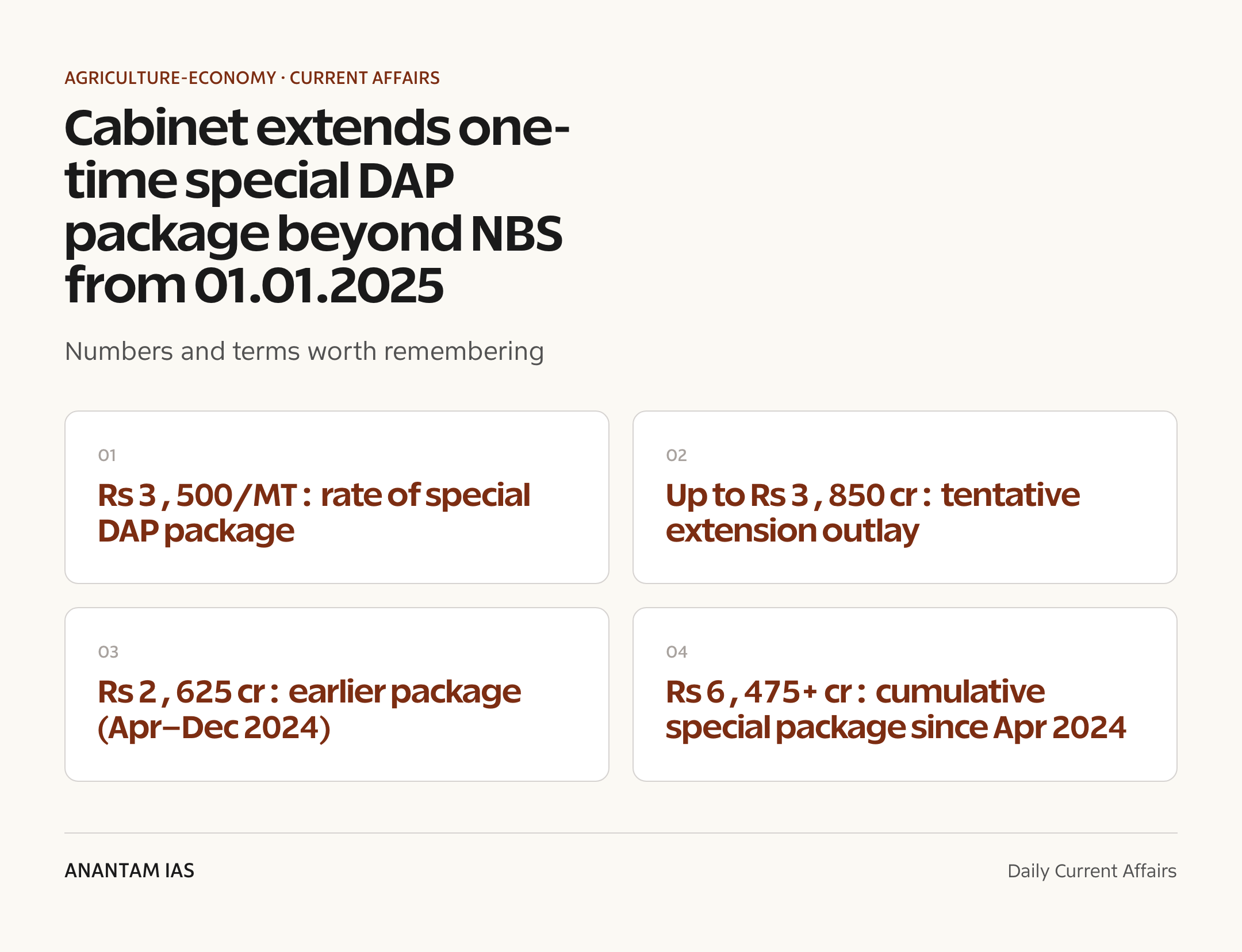
The Union Cabinet approved an extension of the One-time Special Package for Di-Ammonium Phosphate (DAP) beyond the Nutrient Based Subsidy (NBS) regime at Rs 3,500 per metric tonne, effective from 01.01.2025 until further orders. The decision aims to secure availability of DAP at affordable prices for farmers during the ongoing cropping cycles and to stabilise the fertiliser market against global supply and price shocks.
The extension carries a tentative additional budgetary requirement of up to Rs 3,850 crore. This builds on an earlier one-time special package that covered 01.04.2024–31.12.2024 and raises the cumulative special support on DAP since April 2024 to more than Rs 6,475 crore. The move has immediate implications for agricultural input costs, procurement and distribution logistics ahead of Kharif and Rabi seasons, and for short-run fiscal planning.
- Policy decision: Extension of the special DAP package to continue over and above NBS subsidy from 01.01.2025.
- Fiscal element: Tentative additional budgetary requirement up to Rs 3,850 crore for the extended period.
- Farmer impact: Keeps retail DAP prices stable and predictable across sowing windows, reducing input cost stress.
- Market signal: Government intervention to manage import-linked price shocks and ensure uninterrupted supply.
- Aggregate relief: Total special package for DAP since April 2024 now exceeds Rs 6,475 crore, reflecting recurring short-term support.
The development matters in the context of:
- NBS framework: Nutrient Based Subsidy (NBS) has been the primary mechanism for P&K fertiliser subsidies since 01.04.2010 and specifies nutrient-wise subsidy rates paid to manufacturers and importers.
- Earlier special package: Cabinet had approved a one-time special DAP package at Rs 3,500/MT for 01.04.2024–31.12.2024 with an estimated outlay of Rs 2,625 crore to mitigate 2024 price volatilities.
- Supply risk: Global geopolitical tensions and volatility in commodity markets in 2024 raised import prices and threatened domestic availability of DAP, prompting emergency fiscal support.
- Coverage: Under NBS, 28 grades of P&K fertilisers are covered and supplied to farmers through manufacturers and importers; the special package targets DAP specifically.
- Implementation: The special support is paid over and above NBS rates to manufacturers/importers so that retail prices remain unchanged for farmers until further orders.
UPSC Relevance
Prelims Relevance
- Nutrient Based Subsidy (NBS) scheme details and its start date (01.04.2010).
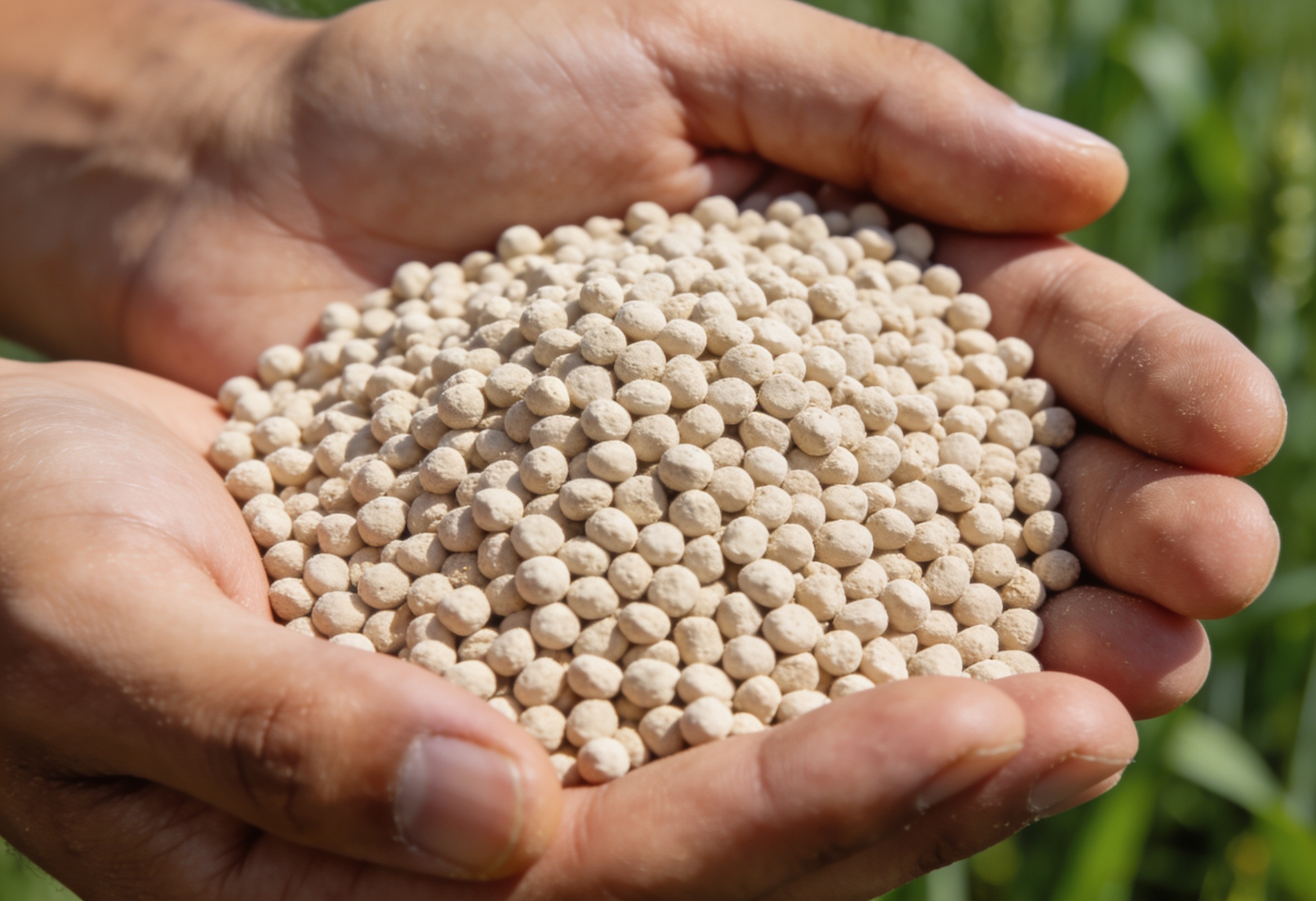
- Role and nutrient profile of DAP (Di-Ammonium Phosphate) as a phosphate and nitrogenous fertiliser used widely in Indian cropping systems.
- Specifics of the Cabinet decision: special support of Rs 3,500 per MT and tentative outlay up to Rs 3,850 crore for the extension period.
Mains Relevance
GS3 Economy
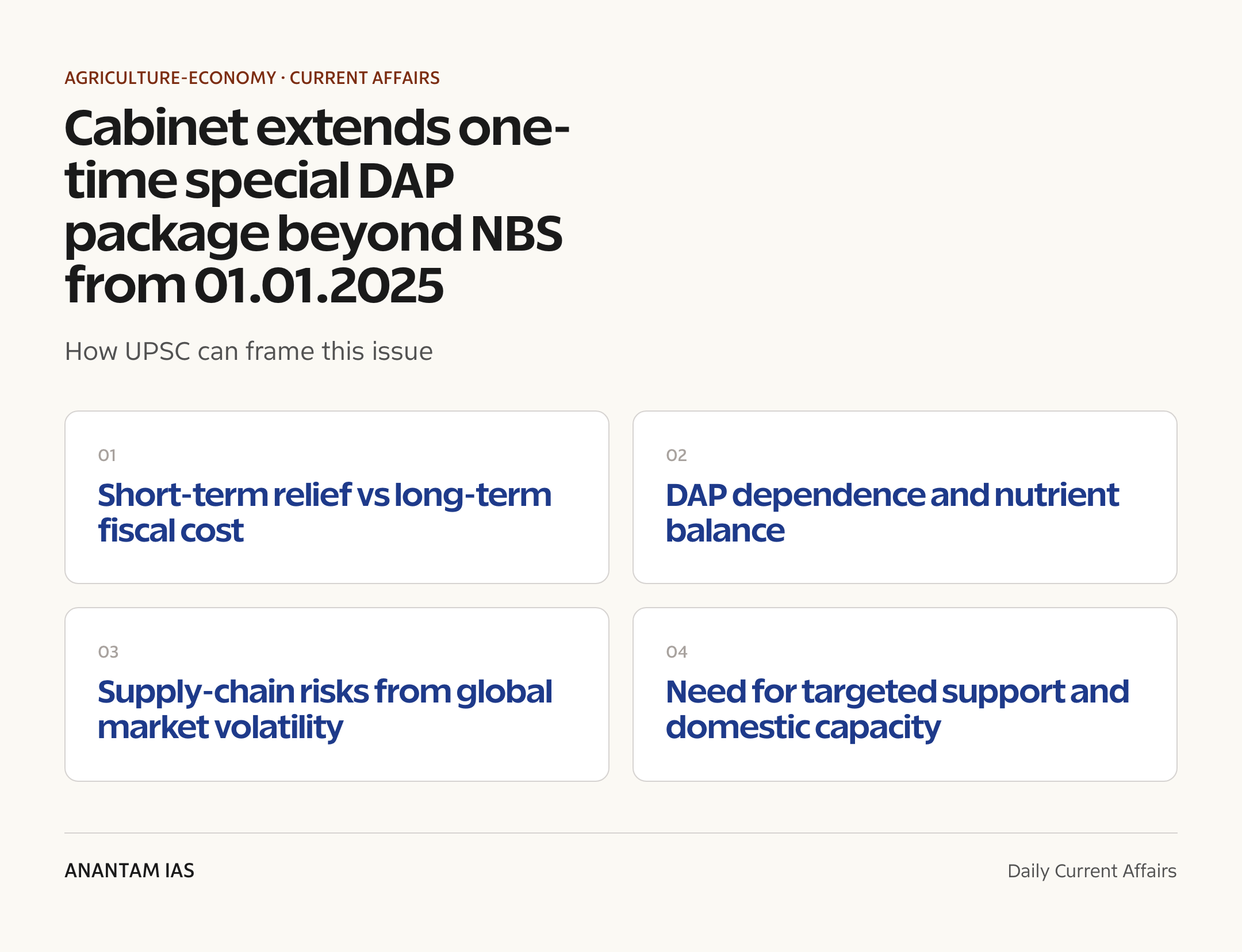
- Assess implications of input subsidies on agricultural productivity, resource use efficiency and fiscal balance.
- Analyse pros and cons of episodic fiscal interventions versus structural reforms in fertiliser policy and supply chains.
- Discuss policy options for ensuring affordable, efficient and sustainable fertiliser supplies, including targeting, domestic capacity enhancement and nutrient management.
Essay
- Can be used as empirical evidence in essays on state support to agriculture, public finance trade-offs, market interventions during crises and long-term institutional reforms.
- Useful when discussing food security linkages, agricultural price policies and the transition from universal subsidies to targeted welfare mechanisms.
Background and Context
NBS scheme basics
Structure, intent and operational mechanics of the Nutrient Based Subsidy regime.
- Launch date: NBS has been in operation since 01.04.2010 as a replacement for earlier concession-based subsidy systems.
- Mechanism: The scheme prescribes fixed subsidy rates per kg for major nutrients (N, P, K), paid to fertiliser manufacturers/importers to keep retail prices steady.
- Objective: Encourage rationalisation of subsidies across fertiliser grades and enable differentiated pricing by nutrient content.
- Administration: Ministry of Chemicals & Fertilizers sets NBS rates periodically based on input costs, with payments routed to producers/importers.
DAP in Indian agriculture
Why Di-Ammonium Phosphate is critical to cropping and how demand patterns shape policy choices.
- Nutrient profile: DAP provides phosphorus and a portion of nitrogen; phosphorus is essential for root development and early crop growth.
- Crop usage: Widely used across cereals, oilseeds and horticulture; demand peaks before sowing in Kharif and Rabi seasons.
- Supply pattern: Domestic capacity exists but India imports significant quantities of phosphoric raw materials and finished DAP depending on global prices.
- Price sensitivity: Domestic retail prices link to international phosphoric acid and rock phosphate markets; supply disruptions can quickly affect farmer access.
Reasons for the one-time special package
Immediate drivers that led the government to offer additional support beyond NBS.
- Global price shocks in 2024 raised input costs for DAP manufacturers and importers, threatening retail price increases.
- Short-term policy gap: NBS rates may not have fully shielded farmers from sudden international market moves during the cropping season.
- Food security risk: Elevated fertiliser prices risked lower application rates and potential yield loss if left unchecked.
- Political economy: Protecting farmer incomes and sowing decisions ahead of key seasons is a high priority for governments during stress periods.
Fiscal implications and scale
How episodic support affects government budgets and planning.
- Estimated cost: The January 2025 extension carries a tentative additional requirement up to Rs 3,850 crore.
- Cumulative outflow: Combined with earlier measures since April 2024, total special support on DAP exceeds Rs 6,475 crore.
- Budget trade-offs: Recurring emergency measures compress fiscal space for other programmes if not offset by savings or revenue measures.
- Contingent planning: Repeated extensions necessitate clearer contingency provisions in budgetary frameworks for commodity-linked subsidies.
Supply chain and implementation dynamics
Operational aspects of keeping fertiliser available at farm gates.
- Channel payments: Subsidy payments are routed to manufacturers/importers to bridge gap between landed costs and retail price caps.
- Distribution timing: Stocks and logistics must be aligned with sowing windows to prevent local shortages even when national supplies are adequate.
- Monitoring needs: Timely data on allocations, offtake and retail availability is necessary to prevent diversion and hoarding.
- Quality controls: Ensuring genuine, standard-grade DAP reaches farmers requires inspection and grievance redress mechanisms.
Alternatives and long-term considerations
Policy pathways to reduce recurring fiscal dependence while securing farmer access.
- Targeting: Direct Benefit Transfer (DBT) mechanisms to channel support only to eligible farmers can save resources.
- Balanced nutrition: Promote soil testing and balanced fertilisation to reduce over-reliance on single fertiliser grades like DAP.
- Domestic investments: Encourage capacity building in phosphate rock processing, phosphoric acid production and recycling of nutrients.
- Market instruments: Use strategic buffer stocks and price-linked triggers for temporary support instead of open-ended subsidies.
Way Forward
Design clearer time-bound rules
Set explicit criteria and review timelines for any future extensions.
- Institute periodic market reviews linked to international price indices and domestic availability metrics to decide extensions.
- Announce sunset clauses and phased exit strategies to avoid open-ended fiscal commitments.
- Develop contingency protocols that tie emergency support to measurable supply disruptions or price thresholds.
Move towards better targeting
Reduce universal fiscal outgo by focusing support where it is most needed.
- Pilot DBT for fertiliser users in high-need regions to evaluate leakage reduction and administrative feasibility.
- Design differentiated support for smallholders and marginal farmers who are most price-sensitive.
- Leverage Aadhaar–land records–soil health card data to deliver targeted assistance while protecting legitimate entitlements.
Strengthen domestic supply and resilience
Reduce exposure to global shocks through capacity and market interventions.
- Provide incentives for phosphate rock exploration and processing to reduce import dependence over the medium term.
- Encourage public–private investment in DAP manufacturing and storage infrastructure to smooth seasonal bottlenecks.
- Promote nutrient recycling technologies and use of indigenous phosphate alternatives where agronomically viable.
Promote efficient nutrient management
Address demand-side factors to lower subsidy dependency sustainably.
- Scale up soil health cards, micro-nutrient advisories and farm-level soil testing to guide balanced fertiliser use.
- Support extension and precision farming tools that optimize dose and timing of fertiliser application.
- Link incentive programmes for balanced nutrient application with credit and crop insurance schemes to encourage adoption.
Conclusion
Immediate objective: The extension preserves DAP affordability and availability for farmers during critical cropping periods by providing an additional Rs 3,500/MT over NBS until further orders.
Trade-offs: While short-term relief reduces risks of input underuse and protects cropping decisions, recurrent extensions raise questions about fiscal sustainability, market distortions and long-term resilience of domestic supply chains.
Policy message: Emergency interventions should be paired with clearer exit rules, targeted delivery mechanisms and investments in domestic capacity and nutrient management to reduce the need for repeated fiscal support.
UPSC Practice Questions
Prelims MCQ 1
The Nutrient Based Subsidy (NBS) scheme for P&K fertilisers in India was introduced in which year?
(a) 2005 (b) 2010 (c) 2015 (d) 2020
Answer: (b) 2010
Explanation:
NBS for P&K fertilisers has been in effect since 01.04.2010. The scheme replaced earlier subsidy mechanisms and prescribes nutrient-wise subsidy rates paid to manufacturers and importers.
Prelims MCQ 2
The Cabinet approval on 01.01.2025 extended a one-time special package on DAP at what rate over and above NBS?
(a) Rs 1,500 per MT (b) Rs 2,500 per MT (c) Rs 3,500 per MT (d) Rs 4,500 per MT
Answer: (c) Rs 3,500 per MT
Explanation:
The extension continues the special DAP package at Rs 3,500 per metric tonne over and above the NBS subsidy, aimed at keeping retail prices stable for farmers.
UPSC Mains Questions
- {‘question’: ‘Examine the economic and fiscal implications of providing recurrent fertilizer subsidies such as the extended one-time DAP package. Suggest reforms to balance farmer support and fiscal sustainability.’, ‘model_answer_points’: [‘Economic effects: Subsidies reduce input prices and can boost short-term fertiliser use, agricultural output and farmer incomes; they also support planting decisions in stress periods.’, ‘Market distortions: Price support can bias nutrient choice, encourage inefficient use and retard adoption of integrated nutrient management practices.’, ‘Fiscal burden: Recurrent episodic support increases subsidy outgo, constrains budgetary space for other rural investments and complicates fiscal planning.’, ‘Leakage and targeting: Universal subsidies risk diversion to non-target users; targeted transfers and improved delivery systems can enhance efficiency.’, ‘Reforms: Transition to targeted DBT pilots, link temporary support to transparent triggers, incentivise balanced fertilisation and invest in domestic production capability.’, ‘Implementation: Strengthen monitoring with public disclosure of allocation and offtake data, set market-linked review mechanisms and prepare phased exit pathways.’]}
- {‘question’: ‘Discuss the role of central government interventions in stabilising agricultural input markets. Use the DAP special package extension as an example to illustrate short-term and long-term policy trade-offs.’, ‘model_answer_points’: [‘Stabilisation role: Central interventions can avert acute shortages, prevent price spikes and maintain cropping intensity, thereby safeguarding food production.’, ‘Short-term benefits: Immediate affordability and predictability of input prices reduce risk aversion among farmers and support yields in vulnerable seasons.’, ‘Long-term trade-offs: Prolonged state support can crowd out private investment, create dependency and impose recurring fiscal costs that may be unsustainable.’, ‘Case illustration: The DAP extension prevented price-driven cutbacks in fertiliser use in 2024–25, but repeated measures signal the need for structural steps such as capacity building and targeted delivery.’, ‘Policy synthesis: Combine emergency support with reforms—promote domestic supply, precision nutrient management, targeted transfers and transparent exit criteria to optimise outcomes.’]}
Sources: PIB, Cabinet Secretariat and PIB, Ministry of Chemicals & Fertilizers.
Frequently Asked Questions
q
a
q
a
q
a
q
a
q
a
q
a