Delhi Assembly election schedule announced for 2025
Why in News?
The Election Commission released the schedule and detailed operational instructions for the Delhi Assembly poll including final electoral rolls, polling station norms and voter facilitation measures. This sets the election management framework and Model Code of Conduct activation for the capital.
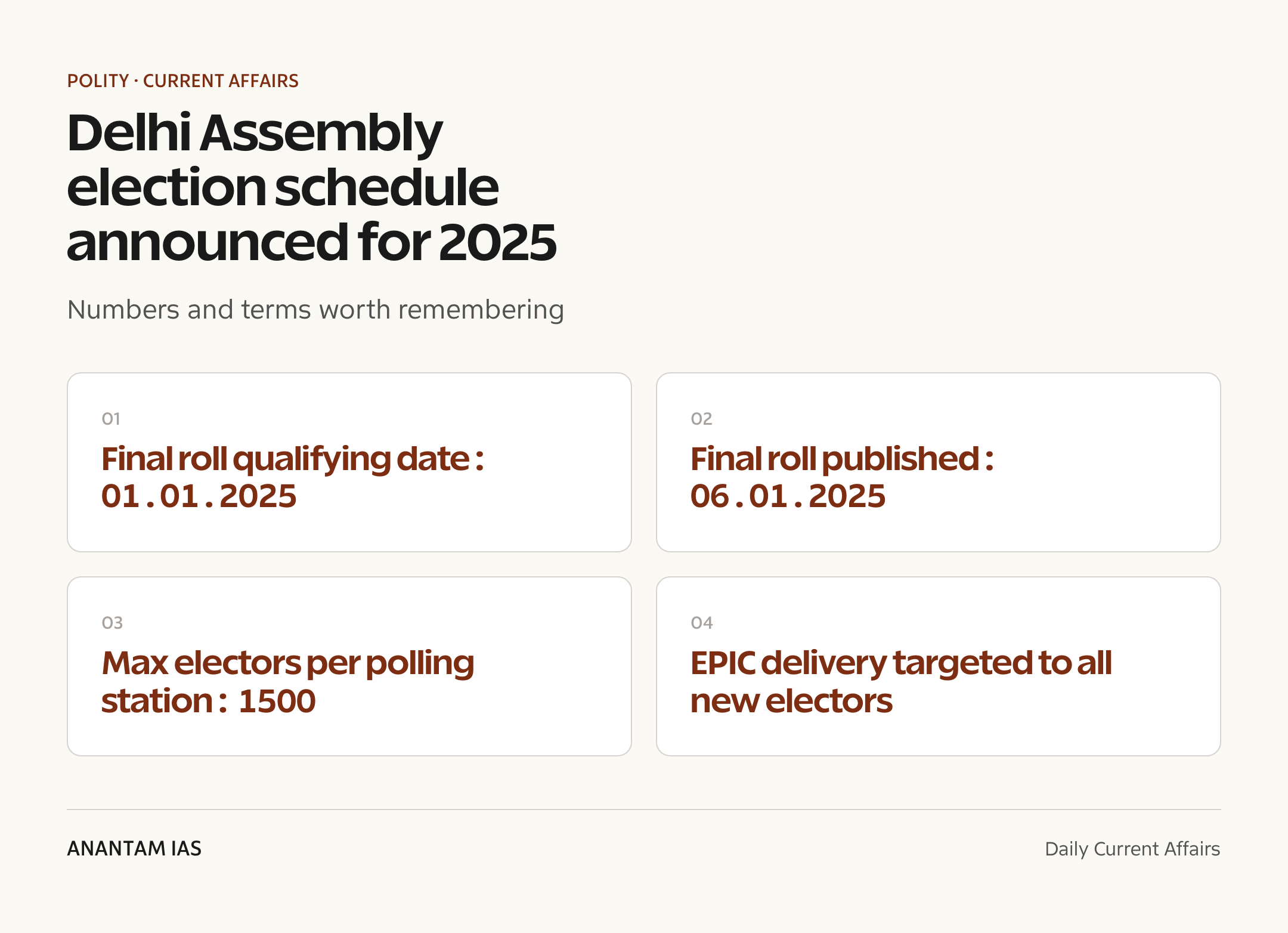
- Schedule and final roll published after Special Summary Revision with qualifying date 01.01.2025; final roll released on 06.01.2025.
- Electoral size disclosed for NCT of Delhi with total electors and categories such as service voters, PwD and senior citizens.
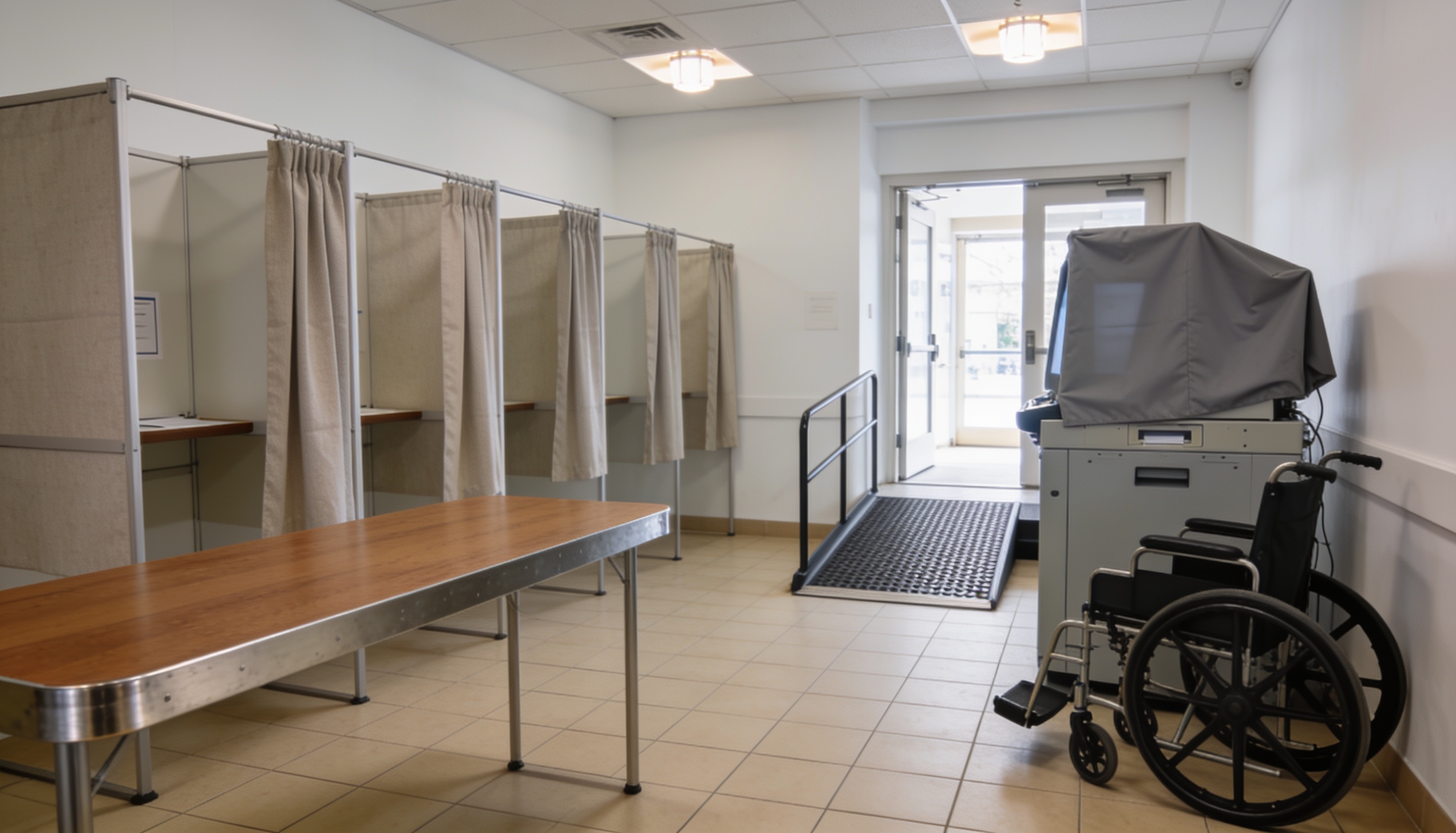
- Polling station norms mandated: ground-floor location, ramps, Assured Minimum Facilities and maximum 1500 electors per station.
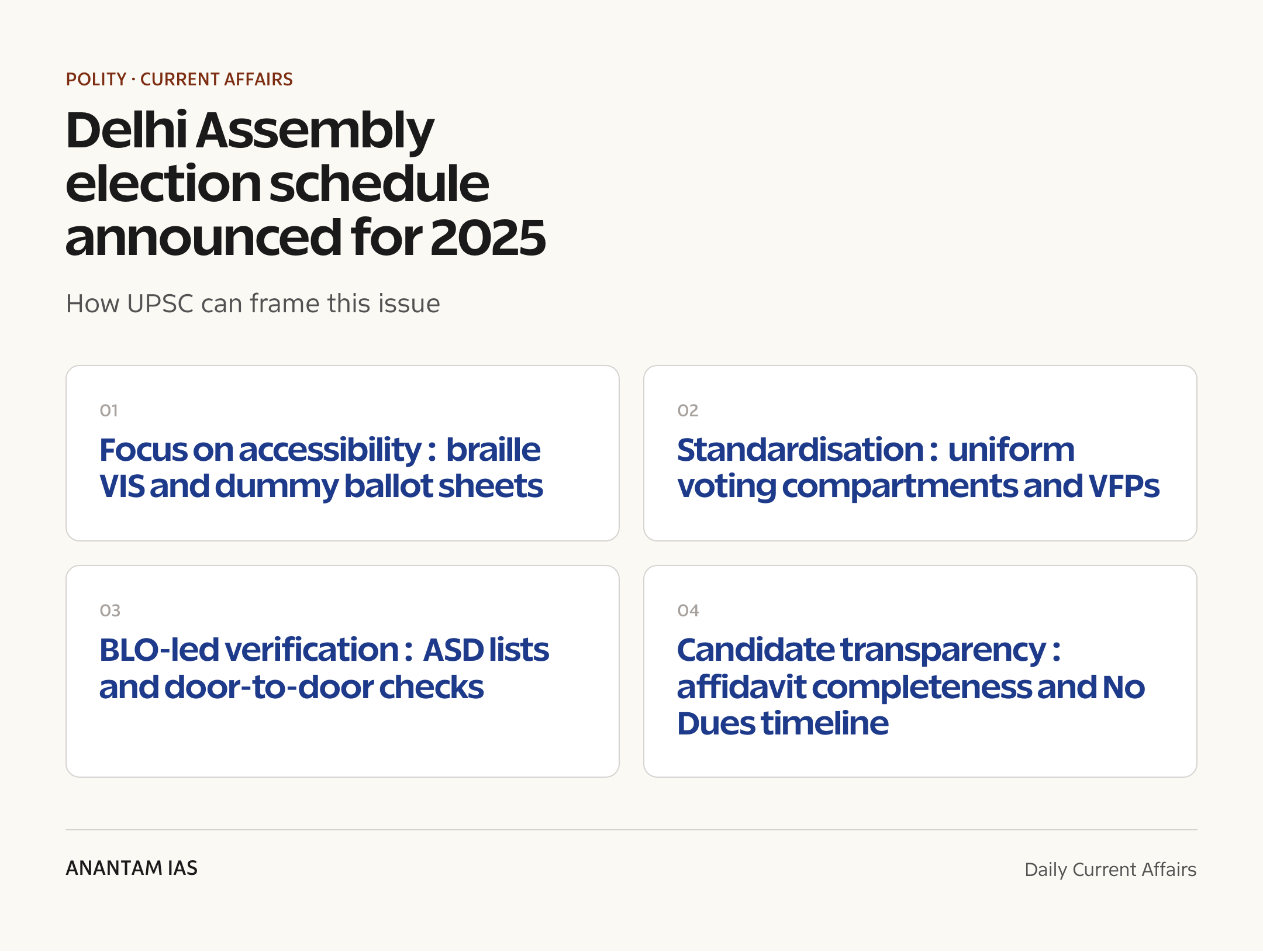
- Accessibility measures for Persons with Disabilities: braille voter slips, dummy braille ballot sheets, Saksham-ECI wheelchair facility, priority entry and transport.
- Voter facilitation measures: Voter Information Slips, Voter Guide brochures, Voter Assistance Booths and standardized Voter Facilitation Posters.
- Candidature rules tightened: affidavit must be complete at filing or face rejection after notice; nominees get ‘No Dues Certificate’ assistance.
The development matters in the context of:
- Constitutional mandate: Elections to Legislative Assemblies are held under Article 172 read with Article 324, placing responsibility on the Election Commission to ensure free and fair polls.
- Legal framework: Representation of the People Acts, 1950 and 1951, and Conduct of Elections Rules, 1961, govern electoral rolls, nomination, polling and postal ballots.
- Electoral roll reforms: After the Election Laws (Amendment) Act, 2021, the ECI uses quarterly qualifying dates; this Special Summary Revision used 01.01.2025.
- Urban electorate challenge: High population density and mobility in Delhi demand more polling stations, robust BLO outreach and ASD lists for accurate rolls.
- Accessibility push: ECI directives reflect a rights-based approach to enfranchisement of PwD, elderly voters and women participation in polling staff.
- Operational clarity: Standardized voting compartments, Voter Information Slips and Voter Assistance Booths aim to reduce procedural errors and booth-level confusion.
UPSC Relevance
Prelims Relevance
- High — facts on qualifying date for roll revision, final roll date, maximum electors per polling station, and special facilitation measures can be directly asked as static factual MCQs.
Mains Relevance
GS2 Polity and Elections
- Direct — issues of electoral administration, enfranchisement of PwD and senior citizens, role of ECI in ensuring free and fair elections, and legal-procedural aspects of candidacy and nominations are relevant for GS2 answers on electoral reforms and democratic processes.
Essay
- Moderate — material useful for essays on ‘Governance and Elections’, ‘Strengthening Democratic Institutions’, and ‘Inclusive Participation in Indian Democracy’. Use details on accessibility, roll quality and administrative measures as evidence.
Background and Context
Legal and constitutional basis
Framework that empowers the Election Commission and governs assembly elections.
- Article 324 vests the superintendence, direction and control of elections in the Election Commission of India; Article 172 fixes the term of state legislative assemblies.
- Representation of the People Act, 1951 regulates the conduct of elections, qualifications and disqualifications of members and electoral offences.
- Conduct of Elections Rules, 1961 specify procedural details such as voting compartments, postal ballots and appointment of polling personnel.
- Election Laws (Amendment) Act, 2021 amended Section 14 of RP Act, 1950 to allow multiple qualifying dates for roll revision, improving enrolment opportunities during the year.
- Statutory duties on Returning Officers include scrutiny of nomination papers and guidance from the Supreme Court ruling (Resurgence India case) to ensure affidavits are complete at filing.
Electoral rolls and Special Summary Revision
Why roll health matters and how the ECI updated Delhi’s rolls for 2025.
- Roll integrity is central to credible polls; errors cause proxy voting and disenfranchisement.
- Special Summary Revision was carried out with 01.01.2025 as qualifying date and final roll published on 06.01.2025.
- The Commission emphasised delivery of EPIC to newly registered electors before nomination closures to aid identification at booths.
- BLOs executed door-to-door surveys and compiled lists of Absent, Shifted or Dead (ASD) voters to be used at polls for verification.
- Electors marked as PwD, third gender and senior citizens (85+) are identified on rolls for targeted facilitation and assistance on poll day.
Polling station infrastructure and norms
Standards set to ensure accessibility, secrecy and convenience at booths.
- Maximum of 1500 electors per polling station to avoid crowding and long waits.
- Mandatory ground-floor or road entry level location with accessible approach and permanent ramp construction urged by ECI.
- Assured Minimum Facilities include drinking water, waiting shed, toilets with water, lighting and signage.
- Uniform voting compartments: steel-grey corrugated flex boards, 30-inch height for compartment and table, with adhesive stickers indicating poll details.
- Direction to create at least one women-managed and one PwD-managed polling station per Assembly Constituency where feasible.
Voter facilitation and information
Measures to inform and assist electors before and during polling.
- Voter Information Slips to be distributed at least 5 days before poll with QR code and booth details; not valid as ID.
- A household Voter Guide in Hindi/English/local language will be provided with polling details, BLO contacts and Do’s/Don’ts at booths.
- Voter Assistance Booths near polling premises will help electors locate their serial number and polling station using ERO-Net generated alphabetic locators.
- Four standardized Voter Facilitation Posters to be displayed at every polling station covering required statutory information.
- Specialised outreach for visually impaired electors: Accessible VIS with braille and dummy braille ballot sheets at polling stations.
Assistance to Persons with Disabilities and senior citizens
Specific operational steps to enable inclusive voting.
- Identified PwD and senior citizen electors are tagged to polling stations for targeted assistance and priority entry.
- Provision of Saksham-ECI app for wheelchair requests; transport facilities to be arranged at each polling station.
- Allowing companions for visually impaired voters under Rule 49N, while enabling independent voting using braille features on ballot units.
- Designated parking close to polling station entrance and volunteers trained to assist differently abled electors and those with hearing impairment.
- Instructions for presiding officers to double check identity of ASD-list voters to prevent impersonation.
Nomination and candidate compliance
Procedural safeguards for nomination filings and financial/administrative clearances.
- Affidavit filed with nomination paper must be complete; Returning Officer will issue notice if any column is left blank and can reject nomination on non-compliance.
- Latest nomination forms and affidavits are available on the ECI website for candidate reference.
- A ‘No Dues Certificate’ is to be provided by concerned agencies within 48 hours where applicable to expedite candidature certification.
- Guidelines emphasize thorough scrutiny at filing stage to reduce post-election litigation and enhance transparency.
- Postal ballot procedures remain in force for absentee voters in categories of senior citizens, PwDs and eligible health-affected persons.
Way Forward
Strengthen roll accuracy and accessibility
- Sustain periodic Special Summary Revisions and strengthen BLO capacity for door-to-door verification to reduce ASD discrepancies.
- Deploy targeted enrolment drives in high-mobility urban pockets and university residential areas to capture young electors.
- Accelerate EPIC delivery using local postal partnerships and digital acknowledgement to ensure ID availability on polling day.
- Integrate PwD tagging with municipal and health databases for proactive facilitation and transport planning on poll day.
Enhance polling station facilities and human resources
- Prioritise permanent ramp construction and AMF upgrades in identified polling stations ahead of future elections.
- Expand recruitment and training of women polling teams and youth-managed polling squads to foster trust and efficiency.
- Institutionalise Voter Assistance Booths with mobile-enabled ERO-Net kiosks for rapid query resolution on voting day.
- Set up district-level rapid response teams to resolve last-minute polling station infrastructure or staffing shortfalls.
Improve inclusion and voter experience
- Scale Saksham-ECI and similar assistive services with pre-poll registration to reduce on-the-spot requests.
- Standardise braille materials, dummy sheets and accessible VIS templates across states to ensure uniformity.
- Run targeted media literacy campaigns for PwD and elderly voters on their rights, facilities and postal ballot options.
- Encourage civil society and disabled persons organisations to monitor accessibility compliance at polling stations.
Strengthen transparency and dispute readiness
- Publish constituency-level roll health metrics and ASD statistics to enable public scrutiny and corrective action.
- Ensure Returning Officers have digital checklists and affidavit-completeness tools to reduce rejections at scrutiny.
- Create a 48-hour escalation mechanism for candidate ‘No Dues’ issues with designated nodal officers in agencies.
- Use geo-tagged photographs and audit trails for critical polling infrastructure deployment to aid post-poll review.
Conclusion
The ECI’s Delhi 2025 schedule and operational instructions reflect a focus on roll integrity, accessibility and standardised booth procedures. The measures aim to strengthen enfranchisement of PwD and senior citizens, reduce procedural variability at polling stations and streamline candidate nomination processes. Effective implementation will depend on BLO capacity, inter-agency cooperation and pre-poll infrastructure upgrades.
UPSC Practice Questions
Prelims MCQ 1
Which qualifying date was used for the Special Summary Revision of electoral rolls for the NCT of Delhi ahead of the 2025 Assembly election?
(a) 01.04.2024 (b) 01.01.2025 (c) 01.10.2024 (d) 01.01.2024
Answer: (b) 01.01.2025
Explanation:
The Election Commission conducted the Special Summary Revision with reference to the qualifying date 01.01.2025 and published the final roll on 06.01.2025.
Prelims MCQ 2
What is the maximum number of electors permitted per polling station as indicated by the ECI norms for the Delhi 2025 election?
(a) 1200 (b) 1500 (c) 2000 (d) 1000
Answer: (b) 1500
Explanation:
The Commission set a cap of a maximum of 1500 electors per polling station to reduce crowding and improve management on poll day.
UPSC Mains Questions
- {‘question’: ‘Analyse the measures taken by the Election Commission for ensuring accessibility of polling for Persons with Disabilities and elderly voters. What operational gaps remain and how should they be addressed?’, ‘model_answer_points’: [‘Summarise ECI measures: PwD tagging on rolls, Accessible Voter Information Slips with braille, dummy braille ballot sheets, Saksham-ECI wheelchair facility, priority entry and transport at polling stations.’, ‘Assess strengths: rights-based focus, procedural clarity, identification of beneficiaries and technological aids for requests.’, ‘Identify gaps: last-mile delivery of wheelchair/transport on poll day, variability in polling station infrastructure, need for consistent volunteer training and monitoring.’, ‘Recommend solutions: pre-registered mobility bookings, audit of permanent ramps before polls, mandatory accessibility training for polling personnel and civil society monitoring.’]}
- {‘question’: ‘Discuss the role of Blo (Booth Level Officer) outreach in maintaining electoral roll health in urban constituencies like Delhi. What changes can improve roll fidelity ahead of elections?’, ‘model_answer_points’: [‘Explain BLO functions: door-to-door verification, identification of absentee/shifted/dead voters, distribution of Voter Information Slips and EPIC follow-up.’, ‘Urban challenges: high mobility, rental populations and institutional voters complicate roll accuracy.’, ‘Propose improvements: strengthen BLO staffing, use GIS-enabled mobile apps for real-time updates, targeted enrolment drives in universities and rental localities, and public dashboards on roll corrections.’, ‘Emphasise institutional support: greater resources, strict timelines and coordination with municipal and civic agencies for address validation.’]}
Source: PIB, Election Commission of India.
Frequently Asked Questions
q
a
q
a
q
a
q
a
q
a
q
a