Delhi High Court: LLM Training Can Fall Under Fair Dealing
Why in News?
The Delhi High Court, in an interim order on 24 July 2026 in ANI v OpenAI, held that using copyrighted works to train large language models can fall within India’s fair dealing exception.
- News agency ANI sued OpenAI, alleging ChatGPT models were trained on ANI’s copyrighted works.
- The holding is interim and appealable. It is legal cover for training, not a blanket licence.
- Arul George Scaria of NLSIU Bengaluru, the Court’s amicus, framed the split between training and output.
- Training can be fair dealing. Output can still infringe if it is verbatim or substantially similar.
- Two US district courts last year held training can be fair use. The Delhi High Court refused to import that test.
- A contrary holding could have chilled indigenous model-building, including Indian developers such as Sarvam.
- Consumer AI agents raise a different problem: agency and control, not training copyright.
- News facts have thinner copyright than novels or music. Nobody owns a raw fact.
UPSC Relevance
Prelims Relevance
- Indian fair dealing sits in the Copyright Act, 1957, mainly Section 52(1)(a).
- The analysis is two-stage: a listed purpose first, then a fairness analysis.
- The Court read private use, research and learning dynamically to cover machine training.
- US fair use is an open-ended four-factor test. India refused to import it.
- Substantial similarity and verbatim output remain the output-side tests.
- Lawful access is not a general fair-dealing condition. Circumventing technological protection measures can still attract liability.
Mains Relevance
GS Paper 2
- How a High Court reads a listed copyright exception without rewriting the statute.
- Why an interim, appealable order is cover for developers, not a permanent licence.
GS Paper 3
- Why training data and model output are different regulatory events for generative AI.
- Where licensing still matters once retrieval-augmented generation reprints publisher text.
Essay
- An exception that lets a machine learn is not a licence that lets it reprint.
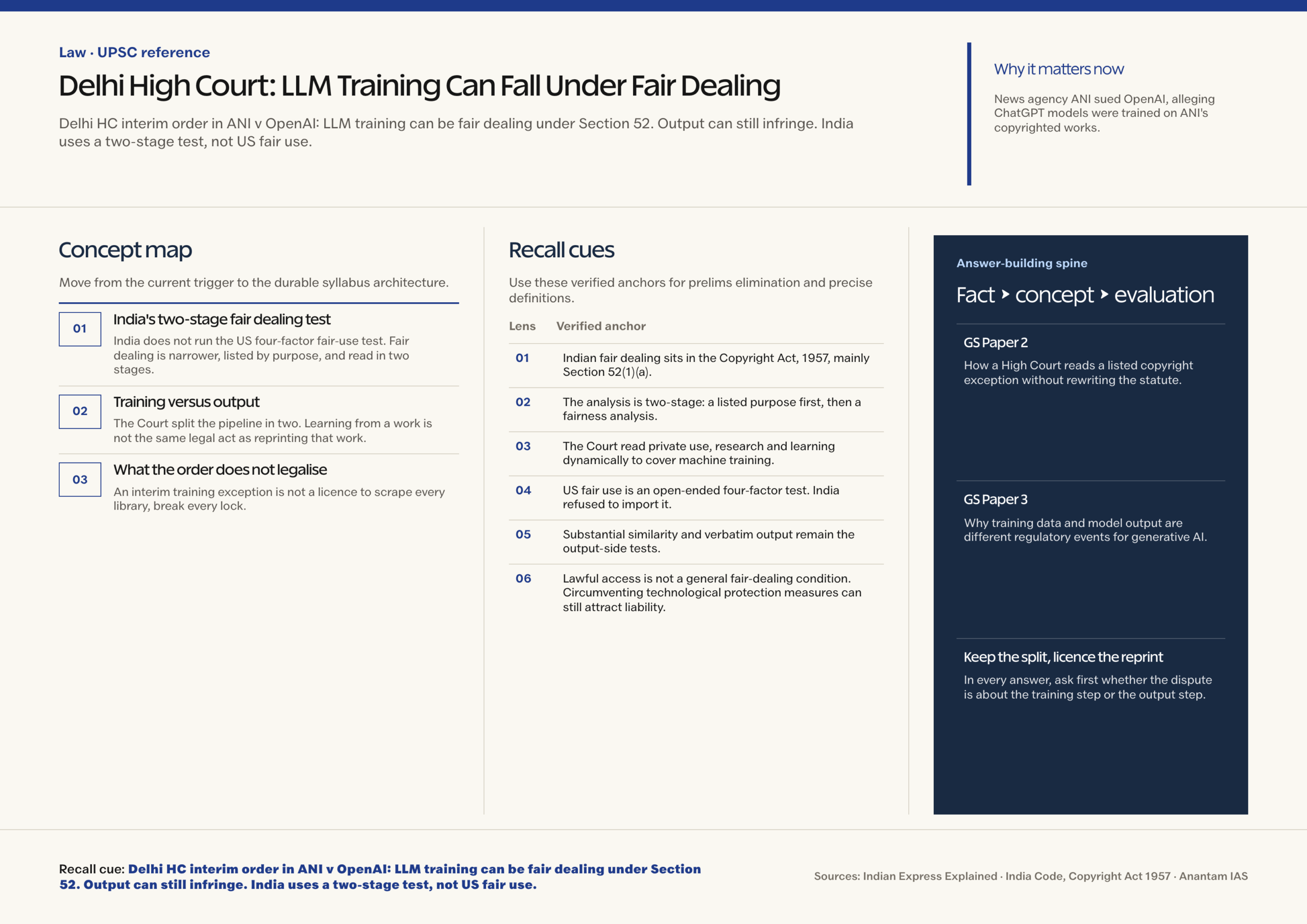
Background and Context
India's two-stage fair dealing test
India does not run the US four-factor fair-use test. Fair dealing is narrower, listed by purpose, and read in two stages.
- Fair dealing sits in Section 52 of the Copyright Act, 1957, mainly clause (1)(a). The Court treated it as a purpose-limited exception, not an open US-style fair-use clause that a judge can stretch at will.
- Stage one asks whether the use is for a listed purpose. The Court read private use, research and learning dynamically so machine training could enter that gate without waiting for a new statute.
- If that purpose gate fails, the fairness analysis never starts. That is why the dynamic reading of research and private use mattered more than any imported US four-factor test in this case.
- Stage two is a fairness analysis that balances rights holders and users. The Court laid down a three-factor test, including whether the use would cause market harm to the plaintiff on these facts.
- For ANI, market harm meant substitution of paid syndication by LLM answers. The Court found customers would not switch, and also weighed the public-interest value of large language models.
Training versus output
The Court split the pipeline in two. Learning from a work is not the same legal act as reprinting that work.
- Training can fall inside fair dealing. That finding is the interim cover now available to OpenAI and to Indian developers such as Sarvam. It is not a statutory licence to copy everything.
- Output is a separate facts case. Verbatim paragraphs or substantially similar answers can still be infringement even if the training step was fair. The rights holder can still sue on later facts.
- ANI’s cited ChatGPT examples carried dates after August 2024. The relevant training cut-offs were April 2022 for GPT-4 and April 2024 for GPT-4o, so those pieces were not in the trained set at all.
- Most outputs were also not substantially similar. The model produced different wording in response to user prompts, so the infringement threshold was not met on the examples cited by ANI.
- News has thinner copyright than a novel or a song. You can own expression. You cannot own the fact, and there are only so many ways to state one in a wire story.
What the order does not legalise
An interim training exception is not a licence to scrape every library, break every lock, or reprint every publisher story as an answer.
- The order is interim and subject to appeal. Indian law has not permanently legalised all AI training on every copyrighted work in every dataset, and a later bench can still narrow it.
- Lawful access is not a general fair-dealing condition. A shadow-library source is not automatically fatal if the use fits the exception. That is a legal point, not a defence of piracy.
- Circumventing technological protection measures, such as paywalls or crawler blocks, can still attract liability even when the later training use might otherwise be fair dealing. The lock and the learning are separate.
- Retrieval-augmented generation and verbatim reproduction stay on the output side. Licensing is the path publishers and model-makers already use for that risk. Different facts can still produce infringement.
- US district courts in the Anthropic and Meta cases last year treated training as fair use. That comparison is useful. Copying their four factors into an Indian answer is not. The statutes differ.
Way Forward
Keep the split, licence the reprint
- In every answer, ask first whether the dispute is about the training step or the output step.
- Use publisher licences where the product retrieves or reprints text, especially through retrieval-augmented generation.
- Do not treat an interim High Court order as a statute that legalises every crawl or every dataset.
- If Parliament wants more certainty, it can write a dedicated text-and-data-mining exception. Until then, the two-stage test is the working law.
Conclusion
- The news is a split, not a licence. Training on copyrighted works can be Indian fair dealing at the interim stage. Reprinting those works in an answer can still infringe on different facts.
- Write the two-stage test, the no-substitution finding on ANI syndication, and the interim tag. Do not import the US four-factor fair-use test into the Indian analysis in a Mains answer.
- If the product retrieves or reprints publisher text, especially through RAG, licensing remains the safe path. An appeal can still narrow the training cover without touching that output risk.
UPSC Practice Questions
Prelims MCQ 1
With reference to the Delhi High Court’s interim order in ANI v OpenAI, consider the following statements:
- Using copyrighted works to train a large language model can fall within India’s fair dealing exception.
- The Court applied the US four-factor fair use test as India’s fairness analysis.
- Verbatim or substantially similar model output can still amount to copyright infringement.
How many of the above statements are correct?
(a) Only one (b) Only two (c) All three (d) None
Answer: (b) Only two
Explanation:
Statements 1 and 3 are correct. Training can be fair dealing; output can still infringe. The Court refused to import the US four-factor test because Indian fair dealing is narrower and two-stage.
Prelims MCQ 2
In Indian copyright law, the first stage of the fair dealing analysis asks:
(a) whether the use is transformative under the US four-factor test (b) whether the use is for a purpose listed in the exception (c) whether the defendant had a licence from every publisher in the dataset (d) whether lawful access is proved in every case before fairness is examined
Answer: (b) whether the use is for a purpose listed in the exception
Explanation:
Indian fair dealing is two-stage. The court first asks whether the use is for a listed purpose such as private use or research. Only then does a fairness analysis begin. Lawful access is not a general first-stage requirement.
UPSC Mains Questions
- The Delhi High Court’s interim order in ANI v OpenAI splits training from output. Examine how India’s two-stage fair dealing analysis differs from US fair use, and why that split matters for AI policy. (250 words)
- An exception for machine learning is not a licence to reproduce. Discuss with reference to output-side copyright risk, retrieval-augmented generation and technological protection measures. (150 words)
Sources: Indian Express Explained and India Code, Copyright Act 1957.
Frequently Asked Questions
Did the Delhi High Court legalise all AI training in India?
No. The 24 July 2026 order is interim and appealable. Training can be fair dealing on these facts. It is not a permanent, across-the-board licence.
How is Indian fair dealing different from US fair use?
US fair use is an open-ended four-factor test. Indian fair dealing is two-stage: a listed purpose first, then a fairness analysis. The Court refused to import the US factors.
Can ChatGPT still infringe ANI’s copyright in its answers?
Yes. Training and output are separate. Verbatim or substantially similar answers can still infringe. Most of ANI’s cited examples failed on date and on similarity.
Does a shadow-library source automatically kill a fair dealing defence?
No. Lawful access is not a general requirement under fair dealing. If the use fits the exception, the source is not automatically fatal. Circumventing technical locks can still be liability.
Why do news agencies have a weaker copyright case than novelists?
Copyright protects expression, not facts. There are only so many ways to state a news fact. Novels and music carry more protected expression than a wire story.