Delhi High Court recognises the Right to be Forgotten
Why in News?
The Delhi High Court, in a landmark judgment, recognised the “Right to be Forgotten” (RTBF) as an integral part of the fundamental right to privacy under Article 21 of the Constitution.
The Court directed search engines and legal databases such as Google and Indian Kanoon to de-index certain judicial records from name-based searches, thereby protecting individuals from disproportionate reputational harm arising from permanent digital accessibility of past legal proceedings.
| UPSC Relevance: GS-2 Polity and Governance: Fundamental Rights, Digital Governance Prelims & Mains: Right to be Forgotten: Significance & Framework |
What is the Right to be Forgotten (RTBF)?
- The Right to be Forgotten refers to an individual’s right to seek the removal, restriction, or reduced accessibility of personal information available online when such information:
- Has become irrelevant or outdated.
- No longer serves a legitimate public interest.
- Causes disproportionate harm to an individual’s dignity, reputation, or privacy.
- It is based on the principle of informational self-determination, allowing individuals greater control over their personal data in the digital age.
Constitutional Basis of RTBF in India:
The Delhi High Court held that:
- RTBF flows from the Right to Privacy under Article 21.
- The absence of specific legislation does not prevent constitutional courts from protecting this right.
- Privacy protections must evolve to address the permanence of digital records and internet searchability.
Judicial Evolution:
- Justice K.S. Puttaswamy v. Union of India (2017): The Supreme Court declared privacy a fundamental right under Article 21. Recognised informational privacy as an essential component of human dignity.
- Delhi High Court Judgment (2026): The Court explicitly recognised RTBF and established an operational framework for its enforcement in India.
What is De-indexing?
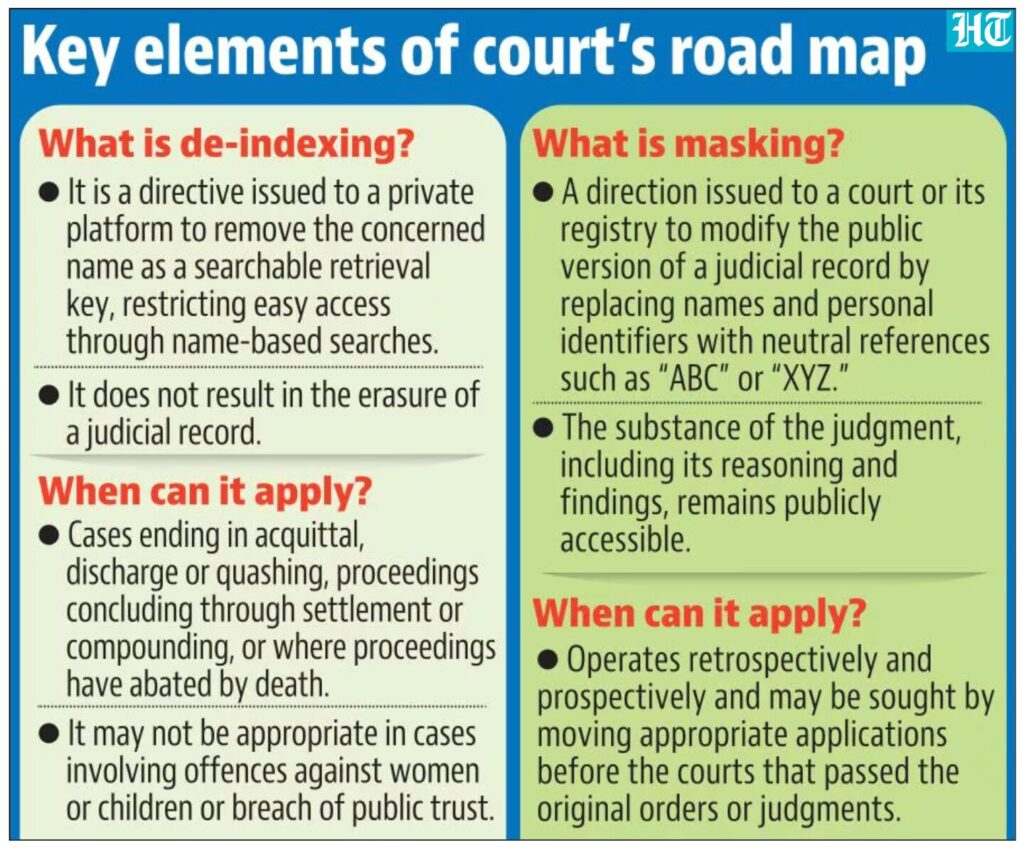
- De-indexing means removing a person’s name as a searchable keyword from search engines or legal databases.
- De-indexing does not delete or erase judicial records. The judgment, order, or legal document remains available through case number, citation, Court details, and date of judgment. Only name-based searches cease to retrieve the record.
Example: If an acquitted person’s name is searched on Google, the old criminal case should no longer automatically appear in search results. However, legal researchers can still access the judgment through citations or case references.
Masking: Under masking, names may be replaced with identifiers such as “ABC”, “XYZ”, etc.
Why did the Court recognise RTBF?
- The petitioners argued that the continued online accessibility of judicial records:
- Damaged their reputation.
- Reduced employment opportunities.
- Affected marriage prospects.
- Caused social stigma despite legal exoneration.
- The Court agreed that permanent digital searchability can create a disconnect between legal outcomes and public perception.
Categories of Individuals who sought Relief:
The petitions included:
- Persons acquitted in criminal cases.
- Individuals whose proceedings had been quashed.
- Parties involved in matrimonial disputes.
- Persons involved in settled civil disputes.
- Individuals whose names appeared incidentally in judicial records.
Framework laid down by the Delhi High Court:
The Court directed that while considering RTBF claims, authorities should assess:
1. Nature of Information: Whether the information is personal or public in character.
2. Outcome of Proceedings: Acquittal, Discharge, Quashing of proceedings, Settlement or compounding.
3. Public Role of the Individual: Whether the person is a public official, elected representative, or public figure.
4. Continuing Relevance: Whether the information still serves a legitimate public interest.
5. Proportionality Test: Whether privacy harm outweighs public interest in accessibility.
Cases where De-indexing may be Appropriate:
- Criminal Cases Ending in: Acquittal, Discharge, Quashing of proceedings. The Court observed that continued searchability undermines the presumption of innocence.
- Settled or Compounded Cases: Where parties have amicably resolved disputes.
- Civil and Matrimonial Matters: The Court held that family disputes and personal relationships are protected by privacy rights and often have little continuing public relevance.
- Demonstrably False Information: The Court stated that false information has no claim to protection under public interest principles.
Cases where De-indexing may not be Appropriate:
The Court suggested caution in granting relief in cases involving:
- Convictions for offences against women.
- Convictions involving children.
- Corruption and abuse of public office.
- Breach of public trust by public servants.
- Cases involving elected representatives and fiduciary responsibilities.
These cases involve strong public interest considerations.
Regarding the framework governing masking, the court clarified that such relief would be limited to concealing names and personal identifiers, while the substance of the judgment, including its reasoning, findings, legal conclusions and court details, would remain publicly accessible to preserve its institutional and precedential value.
The bench further held that masking directions would operate both retrospectively and prospectively, covering existing digital records as well as future uploads.
Significance of the Judgment:
- Strengthens Privacy Rights: Expands the practical scope of the Right to Privacy in the digital era.
- Balances Open Justice and Privacy: The judgment seeks to reconcile: Judicial transparency, Public access to records, Individual dignity and rehabilitation.
- Addresses Digital Permanence: Recognises that internet search engines can perpetuate reputational harm long after legal disputes have ended.
- Provides Judicial Framework: Offers India’s first detailed judicial roadmap for RTBF implementation.
Challenges and Concerns:
- Transparency Concerns: Critics argue that de-indexing could limit public access to judicial information.
- Absence of Statutory Framework: India still lacks a dedicated Right to be Forgotten (RTBF) law.
- Potential for Abuse: Public figures may seek privacy protections to suppress information that remains relevant to public accountability.
- Compliance Challenges: Implementation requires coordination among Search engines, Legal databases, Courts, and data intermediaries.
Data Protection Law and RTBF:
- The Digital Personal Data Protection Act 2023 provides rights relating to correction and erasure of personal data, but does not explicitly establish a comprehensive Right to be Forgotten.
- The Delhi High Court judgment, therefore, fills an important jurisprudential gap until Parliament enacts a detailed legal framework.
The Delhi High Court’s 2026 judgment marks a significant milestone in India’s evolving privacy jurisprudence. By recognising the Right to be Forgotten as a facet of Article 21 and establishing a framework for de-indexing judicial records, the Court has sought to protect individuals from perpetual digital stigma while preserving the principles of open justice.