Delhi Right to Services Bill: Accountability for Delayed Public Services
Why in News?
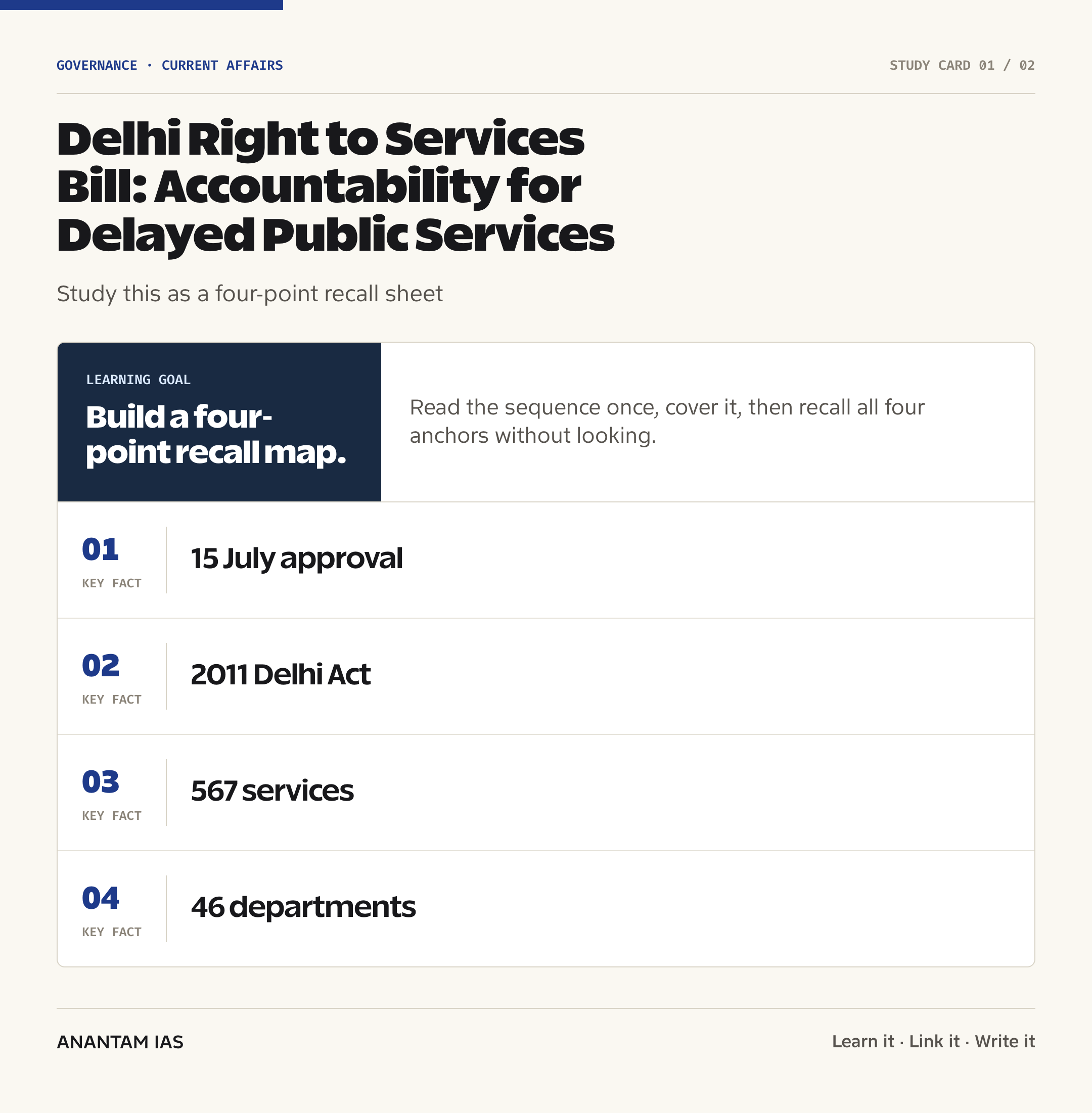
The Delhi Cabinet approved the proposed Delhi (Right of Citizen to Time Bound and Ease of Delivery of Services) Bill, 2026 on 15 July 2026. The Hindu reported that the proposal seeks to make officials personally accountable for unjustified delay in notified public services.
This is a Cabinet-approved Bill, not an enacted law. Cabinet approval authorises the government to take a legislative proposal forward, but the proposed duties, penalties and remedies can’t operate merely because the Cabinet cleared the draft. The applicable legislative and assent process must first be completed.
- The reported design links time-bound service delivery with responsibility for delay instead of treating every missed deadline as an anonymous departmental failure.
- The proposal reportedly covers notified public services, meaning the final legal obligation would depend on the services, time limits and authorities formally specified under the enacted framework.
- The Hindu reported a proposed financial penalty on the responsible official for unjustified delay, but the exact liability must be read from the Bill when its authoritative text becomes public and from the law if enacted.
- Delhi already has the Delhi (Right of Citizen to Time Bound Delivery of Services) Act, 2011. The 2026 proposal should be studied as a reported effort to replace or update that framework, not as Delhi’s first move toward time-bound services.
- The debate joins four governance ideas: citizen rights, administrative capacity, individual accountability and procedural fairness. A sound law has to make these ideas work together.
The development matters in the context of:
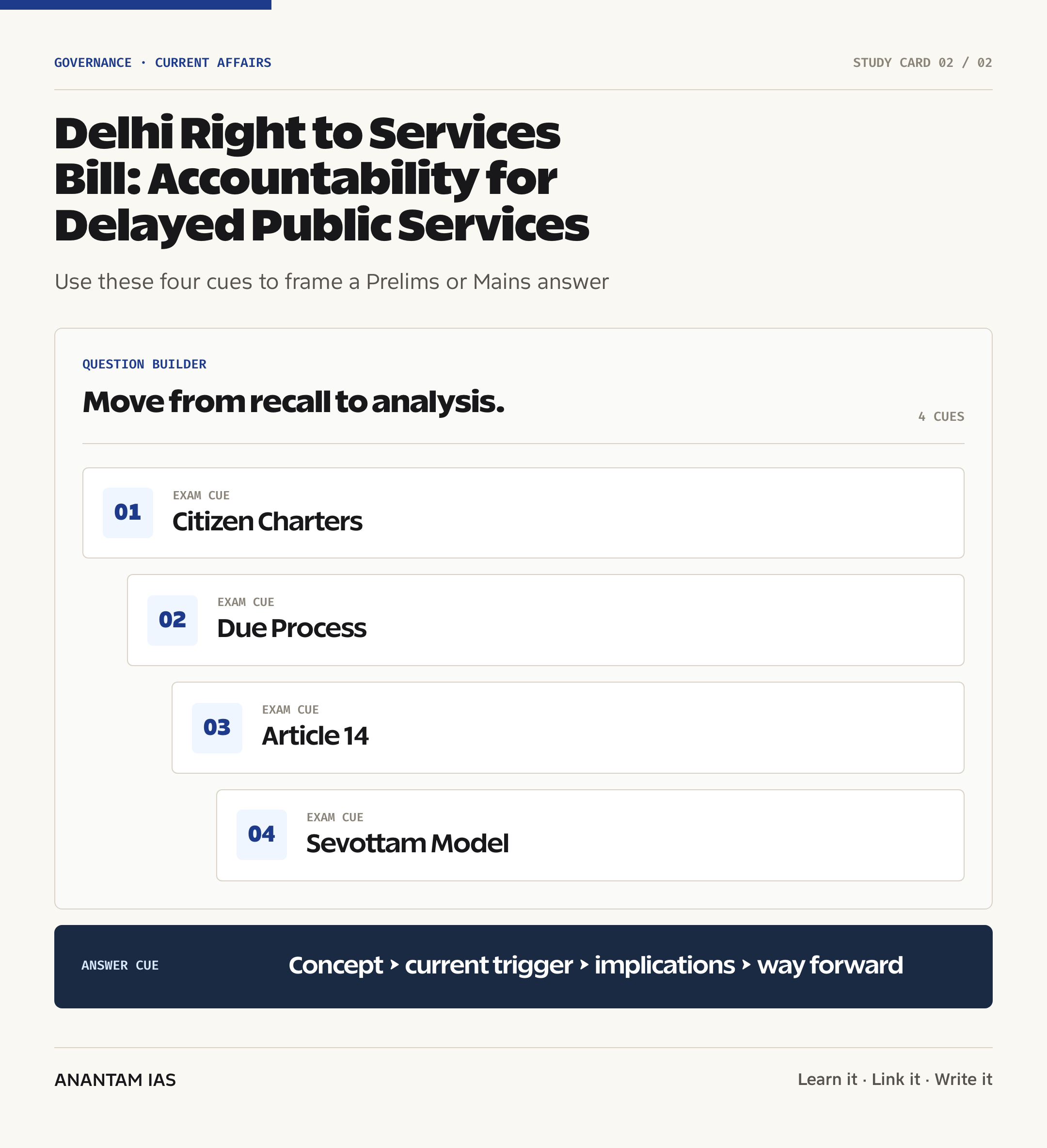
- For GS Paper 2, the proposal connects transparency, accountability, e-governance, citizen charters and institutional mechanisms for grievance redress.
- For administrative reform, the hard question is whether delay arose from individual neglect or from missing staff, inter-departmental dependence, poor records or a defective digital workflow.
- For citizens, a service guarantee matters when the system identifies the responsible authority and offers a usable remedy after default.
UPSC Relevance
Prelims Relevance
- A Bill is a legislative proposal; it becomes an Act only after passage and the constitutionally required assent and notification steps.
- The Delhi Act of 2011 is an existing enacted framework for time-bound delivery of notified citizen services in the National Capital Territory.
- Delhi’s official e-SLA monitoring system tracks applications, processing stages, responsible officers and compliance with prescribed service timelines.
- A Citizen’s Charter publicly states service standards and grievance channels, but a charter by itself doesn’t automatically create a statutory penalty or an enforceable legal remedy.
- The Sevottam framework of the Department of Administrative Reforms and Public Grievances combines Citizen’s Charter implementation, public grievance redress and service-delivery capability.
- Article 14 guards against arbitrary state action. It supports fair, non-discriminatory administration, but it shouldn’t be read as a standalone guarantee that every public service must be delivered within one uniform deadline.
- The Right to Information Act, 2005 gives access to information within its statutory framework; it isn’t a substitute for completing the underlying certificate, licence, benefit or approval.
- The rule of audi alteram partem, or hear the other side, requires a fair opportunity to answer an allegation before an adverse penalty is imposed.
Mains Relevance
GS Paper 2
- Government policies and interventions: converting service standards into enforceable obligations while retaining room for genuine exceptions.
- Transparency and accountability: using named responsibility, digital audit trails, escalation and reasoned decisions to reduce administrative delay.
- Citizen charters and e-governance: moving from promises on a website to measurable delivery, accessible appeals and public performance data.
GS Paper 4
- Probity in governance: fixing responsibility without using penalties as a substitute for leadership, staffing and process reform.
- Civil-service values: balancing responsiveness to citizens with fairness, reasoned discretion and protection against arbitrary punishment.
Essay
- Accountability without capacity can produce fear and defensive administration; capacity without accountability can normalise delay.
- A citizen-centric state is judged not only by the policies it announces but by whether an ordinary applicant receives a predictable, reasoned and timely decision.
Background and Context
What the Cabinet decision does and does not do
The first exam-safe distinction is between a political-executive approval and a binding statute.
- The Delhi Cabinet has approved a proposal, according to The Hindu. This settles the government’s intention to pursue the measure, not the final wording that the legislature may consider.
- A Cabinet note or approved draft doesn’t itself impose a recoverable fine, create an appeal or amend the 2011 Act. Those effects require valid legislation and commencement.
- The proposal must pass through the applicable Delhi Legislative Assembly process and the constitutional route governing Bills of the National Capital Territory.
- If the introduced text, amendments and enacted text differ, the enacted text controls. News reports help explain the trigger, but they can’t substitute for the Gazette.
- The safest current formulation is that the Bill seeks to strengthen personal accountability for unjustified delay. Any clause-level claim remains provisional until an authoritative Bill is available.
Delhi's existing 2011 right-to-service framework
Delhi already operates a statutory and digital architecture for time-bound citizen services.
- The Delhi (Right of Citizen to Time Bound Delivery of Services) Act, 2011 was brought into force from 15 September 2011 through official notification.
- Its operating design depends on notified services, prescribed time limits, competent officers and appellate authorities. This makes the Schedule and later notifications as important as the parent Act for day-to-day delivery.
- The official e-SLA Delhi platform monitors applications at different processing stages and allows a citizen to view status, the responsible officer and whether the service-level timeline has been invoked.
- The official e-SLA dashboard states that 567 services across 46 departments are integrated. It also reports more than 36 lakh applications in the monitored system.
- These figures show that Delhi’s challenge isn’t simply absence of a framework. The policy question is whether enforcement, coverage, data quality and responsibility are strong enough to change the citizen’s experience.
- If the 2026 Bill replaces the 2011 Act, transition provisions will matter for pending applications, existing notifications, designated officers and appeals. No transition detail should be assumed before the text is published.
Citizen's Charter and statutory right to service
A charter tells citizens what an office promises; a right-to-service law adds legal machinery behind that promise.
- A Citizen’s Charter normally identifies services, eligibility, documents, expected timelines, contact points and the route for complaints.
- A charter improves transparency and predictability, but its standards may remain administrative commitments unless a statute, rule or binding order supplies enforceability.
- A right-to-service statute can designate accountable officers, create appeals, authorise compensation or penalties and require reasons for delay or rejection.
- This distinction often trips aspirants: a charter and a law can use the same service timeline, but only the legal source decides whether breach produces a statutory remedy.
- The strongest design connects the two. The charter explains the service, while the statute and rules make responsibility, escalation and review operational.
Sevottam as the durable reform framework
Sevottam treats service quality as a system, not as a penalty imposed after the system has already failed.
- The Department of Administrative Reforms and Public Grievances developed Sevottam as a framework for excellence in public-service delivery.
- Its first component is Citizen’s Charter implementation: identify the client group, specify services and standards, communicate them and review performance.
- Its second component is public grievance redress: give citizens an accessible channel, acknowledge complaints, set disposal norms and analyse recurring causes.
- Its third component is service-delivery capability: align staff, infrastructure, processes, records and training with the promised standard.
- The framework explains why a fine alone can’t repair a broken workflow. If five offices must act in sequence, the system needs process ownership and traceable hand-offs, not a convenient last officer to blame.
- The Second Administrative Reforms Commission, in its citizen-centric administration work, also stressed measurable standards, grievance mechanisms and periodic review as parts of responsive governance.
Personal accountability and natural justice
Personal liability can sharpen responsibility, but fairness depends on proving who controlled the delay and why it occurred.
- A workable scheme must distinguish unjustified inaction from delay caused by missing documents, court orders, technical failure, disaster, another department or a legally required verification.
- The decision-maker should rely on a digital audit trail showing receipt, transfer, query, response and disposal. Without this trail, personal liability can rest on guesswork.
- Before imposing an adverse consequence, the official needs notice and an opportunity to respond. This is the practical meaning of audi alteram partem.
- A penalty order should record reasons, evidence and the basis for attribution. A review or appeal guards against factual error and inconsistent treatment.
- Accountability should follow actual control. A frontline officer shouldn’t bear the entire burden for a policy-level vacancy, server outage or upstream approval beyond that officer’s authority.
Delhi's special constitutional and administrative setting
Delhi’s service-delivery law operates within a Union Territory structure that differs from an ordinary State.
- Article 239AA creates a Legislative Assembly and Council of Ministers for the National Capital Territory while excluding public order, police and land from the Assembly’s ordinary legislative domain.
- The Government of National Capital Territory of Delhi Act, 1991 and later parliamentary amendments shape the institutional route through which Delhi’s elected government, Lieutenant Governor and administration function.
- This constitutional setting doesn’t erase citizen-service duties, but it can complicate ownership and coordination where a service crosses Delhi departments, local bodies or Union-controlled institutions.
- A good notification must identify the correct service provider and accountable authority. Citizens shouldn’t have to decode institutional boundaries before seeking a certificate, benefit or permission.
Likely gains and design risks
The proposal can improve responsiveness only if the incentives reward correct and timely decisions, not hurried disposal.
- Clear deadlines and named officers can reduce administrative opacity, repeated visits, rent-seeking opportunities and the citizen’s dependence on informal follow-up.
- Automatic escalation and application tracking can reveal bottleneck stages, helping managers fix recurring process failures instead of handling each complaint as an isolated event.
- But a narrow disposal target can produce premature rejection, superficial scrutiny or requests for unnecessary documents simply to stop the clock.
- Officials may adopt defensive administration if penalties are unpredictable, evidence is weak or exceptions aren’t defined with care. That can slow complex cases rather than speed them up.
- The best metric isn’t files closed. It is correct service delivered within time, with low reversal rates, clear reasons and an effective remedy when the state defaults.
Way Forward
Publish the legal design clearly
- Place the authoritative Bill, statement of objects and rules in the public domain and explain how the proposal relates to the 2011 Act.
- Notify each service, timeline, required documents, responsible officer and appellate route in language citizens can understand.
Build evidence-based accountability
- Create a tamper-evident application audit trail with timestamps for every transfer, query, response and decision.
- Attribute delay to the officer or unit that had legal control of the next action, while recording justified exclusions and inter-departmental dependencies.
Protect fairness and service quality
- Require notice, hearing, reasoned orders and review before personal financial liability is final.
- Track rejections, appeals, reversals and citizen satisfaction alongside timeliness so speed doesn’t reward poor decisions.
Fix the system behind repeated delays
- Use Sevottam-style process reviews to address vacancies, unclear forms, duplicate verification, weak interoperability and inaccessible grievance channels.
- Publish periodic department-wise performance data and corrective action while protecting personal data and preventing public naming before liability is determined.
Conclusion
The Delhi proposal puts a useful governance question back at the centre: when a citizen meets every requirement, who answers for an avoidable administrative delay? A legal deadline can make that responsibility visible, but Cabinet approval alone hasn’t created the new right or penalty.
The durable answer combines Citizen’s Charters, Sevottam, digital audit trails, natural justice and administrative capacity. Personal accountability should close the last mile of service delivery, while process reform prevents the same delay from recurring.
UPSC Practice Questions
Prelims MCQ 1
With reference to the Delhi right-to-services framework, consider the following statements:
- Approval of a Bill by the Cabinet makes its proposed penalties immediately enforceable.
- Delhi already has the Delhi (Right of Citizen to Time Bound Delivery of Services) Act, 2011.
- A Citizen’s Charter, by itself, always creates a statutory right to compensation for delay.
How many of the above statements are correct?
(a) Only one (b) Only two (c) All three (d) None
Answer: (a) Only one
Explanation:
Only Statement 2 is correct. Cabinet approval doesn’t enact a Bill, and a Citizen’s Charter doesn’t automatically create a statutory penalty or compensation remedy.
Prelims MCQ 2
Which one of the following best describes the three core components of the Sevottam framework?
(a) Legislative drafting, judicial review and social audit (b) Citizen’s Charter implementation, grievance redress and service-delivery capability (c) Fiscal devolution, district planning and outcome budgeting (d) Information disclosure, vigilance inquiry and departmental prosecution
Answer: (b) Citizen's Charter implementation, grievance redress and service-delivery capability
Explanation:
Sevottam, developed by DARPG, integrates published service standards, effective grievance handling and the organisational capacity needed to meet those standards.
UPSC Mains Questions
- A statutory deadline can strengthen citizen rights, but penalties alone may encourage defensive administration. In the context of the proposed Delhi right-to-services Bill, critically examine how personal accountability can be combined with natural justice, process reform and adequate administrative capacity. (15 marks, 250 words)
- Distinguish a Citizen’s Charter from an enforceable right-to-service law. Discuss how the Sevottam framework, digital audit trails, reasoned decisions and accessible appeals can convert public-service promises into measurable and equitable outcomes. (15 marks, 250 words)
Sources: Government of NCT of Delhi, Department of Information Technology and The Hindu.
Frequently Asked Questions
Is the 2026 Delhi proposal already a law?
No. The Delhi Cabinet approved a Bill proposal on 15 July 2026, as The Hindu reported. It must complete the applicable legislative and assent process before becoming law. Until then, no new penalty or remedy can be treated as enforceable solely on the strength of Cabinet approval.
What does personal accountability mean here?
It means identifying the official who controlled the delayed action and attaching a consequence to unjustified default. Fair attribution requires timestamps, defined duties, notice, a chance to explain and a reasoned order. It shouldn’t make one officer liable for a server failure, vacancy or approval controlled elsewhere.
How is a citizen charter different?
A Citizen’s Charter publishes services, standards, timelines and grievance contacts. It improves transparency, but it may remain an administrative promise. A right-to-service statute can add designated officers, appeals, compensation or penalties, making compliance legally reviewable within the limits set by the enacted law.
What is the Sevottam framework?
Sevottam is DARPG’s public-service excellence framework. It combines Citizen’s Charter implementation, grievance redress and service-delivery capability. The third part matters because offices need trained staff, workable processes, records and infrastructure to meet the standards they publish. Penalties can’t substitute for those foundations.
Why does due process matter?
A personal penalty is an adverse administrative consequence. Natural justice requires notice, access to the basis of the allegation, an opportunity to explain and a reasoned decision by a competent authority. Review or appeal also helps correct mistaken attribution and keeps similar cases from receiving inconsistent treatment.
What should UPSC aspirants remember?
Remember three distinctions: Cabinet approval isn’t enactment; a Citizen’s Charter isn’t automatically a statutory remedy; and individual accountability works only with institutional capacity. Link the topic to GS2 themes of transparency, accountability, e-governance, citizen charters, grievance redress and Delhi’s Article 239AA framework.