Slum Rehabilitation: Article 21 Requires More Than Relocation
Why in News?
On August 25, the Delhi High Court gave residents of three jhuggi clusters six weeks to relocate to Savda Ghevra while ordering safeguards for meaningful rehabilitation.
- The order covered residents of Bhai Ram Camp, Masjid Camp and DID Colony near Lok Kalyan Marg.
- A committee headed by a retired judicial officer was ordered to monitor the rehabilitation process.
- Authorities had to honor assurances covering schools, electricity, LPG connections, bus passes, dispensaries and other essential amenities.
- The Delhi Urban Shelter Improvement Board was directed to help transport residents’ household belongings to the allotted accommodation.
- The reported relocation involved 717 residents, but the court did not recognize a general right to rehabilitation at the original site.
- Relocation changes access to work, education, health care and social networks; a housing unit alone may not preserve a resident’s effective standard of living.
- The order illustrates how positive obligations under Article 21 can shape the implementation of an otherwise permitted administrative action.
- Court-supervised monitoring converts promises about services from a general assurance into duties whose performance can be reviewed.
UPSC Relevance
Prelims Relevance
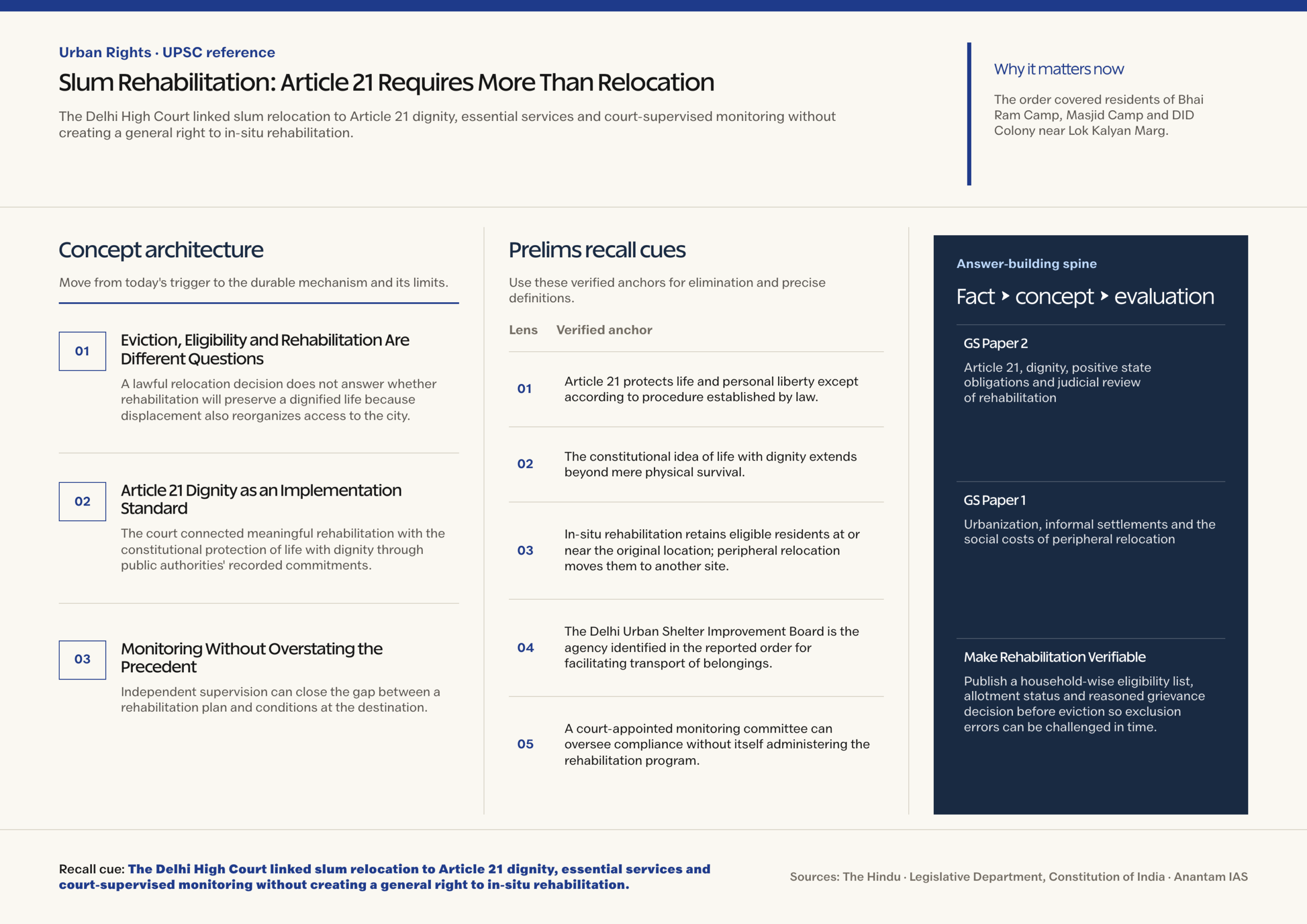
- Article 21 protects life and personal liberty except according to procedure established by law.
- The constitutional idea of life with dignity extends beyond mere physical survival.
- In-situ rehabilitation retains eligible residents at or near the original location; peripheral relocation moves them to another site.
- The Delhi Urban Shelter Improvement Board is the agency identified in the reported order for facilitating transport of belongings.
- A court-appointed monitoring committee can oversee compliance without itself administering the rehabilitation program.
Mains Relevance
GS Paper 2
- Article 21, dignity, positive state obligations and judicial review of rehabilitation
- Accountability tools for converting government assurances into measurable implementation
GS Paper 1
- Urbanization, informal settlements and the social costs of peripheral relocation
Essay
- Development becomes just when the State protects both physical shelter and the relationships that make urban life viable.
Background and Context
Eviction, Eligibility and Rehabilitation Are Different Questions
A lawful relocation decision does not answer whether rehabilitation will preserve a dignified life because displacement also reorganizes access to the city.
- Eviction concerns removal from occupied land; eligibility determines who qualifies under the applicable policy; rehabilitation concerns what support eligible households receive after displacement.
- The Division Bench rejected the residents’ challenge based on the Delhi Slum and JJ Rehabilitation and Relocation Policy, 2015 and allowed relocation to proceed.
- The reported order did not create an unconditional right to remain near Lok Kalyan Marg or a general constitutional entitlement to in-situ rehabilitation.
- In-situ rehabilitation can reduce disruption to jobs, schools and neighborhood networks, but land constraints or public-interest claims may make it contested or unavailable.
- Peripheral relocation may provide allotted housing while increasing travel time and household costs; rehabilitation quality must account for these functional consequences.
Article 21 Dignity as an Implementation Standard
The court connected meaningful rehabilitation with the constitutional protection of life with dignity through public authorities’ recorded commitments.
- Article 21 says no person shall be deprived of life or personal liberty except according to procedure established by law.
- Constitutional dignity asks whether State action leaves people able to live as rights-bearing persons, not merely whether a physical structure has been allotted.
- Schools, electricity, cooking fuel, transport and health facilities matter because they connect shelter with education, safety, mobility, nutrition and access to care.
- Transporting household belongings is a small but concrete safeguard against loss during displacement and lowers the immediate burden imposed on relocated families.
- The order’s force lies in linking stated service commitments to the relocation process; it does not make every promised amenity an independent fundamental right.
Monitoring Without Overstating the Precedent
Independent supervision can close the gap between a rehabilitation plan and conditions at the destination, supplying evidence for corrective orders.
- A committee led by a retired judicial officer creates an identifiable channel for checking whether agencies deliver what they assured the court.
- Monitoring should track readiness before movement, continuity during transition and access after occupation, rather than treating the allotment letter as completion.
- Useful indicators include functioning utilities, school access, public transport, primary health services, grievance resolution and safe movement of household possessions.
- The service and monitoring directions were case-specific implementation safeguards; they should not be converted into a final, universal merits doctrine on all slum evictions.
- For a Mains answer, separate the immediate holding, the authorities’ recorded assurances and the broader Article 21 principle; this prevents overstating judicial precedent.
Way Forward
Make Rehabilitation Verifiable
A rights-sensitive relocation process needs measurable duties before, during and after the move.
- Publish a household-wise eligibility list, allotment status and reasoned grievance decision before eviction so exclusion errors can be challenged in time.
- Verify utilities, schools, health care and transport at the destination before movement, with independent inspection records accessible to residents.
- Track livelihood and school disruption after relocation, and provide time-bound remedies when promised services are absent or unusable.
- Give the monitoring body clear reporting intervals, agency responsibility and an escalation route so recorded non-compliance leads to corrective action.
Conclusion
- The Delhi High Court order shows that meaningful rehabilitation is judged by whether relocation preserves the practical conditions of a dignified life, not by housing allotment alone.
- Use the case to argue for service guarantees and accountable monitoring, while noting that it did not establish a general right to in-situ rehabilitation.
- A balanced constitutional answer should test both sides: the State’s stated public-interest justification for relocation and its positive duty to prevent avoidable deprivation at the destination.
UPSC Practice Questions
Prelims MCQ 1
With reference to slum rehabilitation and the reported Delhi High Court order, consider the following statements:
- The Court recognized a general fundamental right to in-situ rehabilitation.
- A monitoring committee headed by a retired judicial officer was ordered to oversee rehabilitation.
- The Delhi Urban Shelter Improvement Board was directed to facilitate transport of household belongings.
How many of the above statements are correct?
(a) Only one (b) Only two (c) All three (d) None
Answer: (b) Only two
Explanation:
Statements 2 and 3 are correct. The Court allowed relocation with case-specific safeguards; it did not recognize a general fundamental right to rehabilitation at the original site.
Prelims MCQ 2
Which one of the following best explains the constitutional significance of essential-service assurances during relocation?
(a) They automatically transfer ownership of the original land to residents (b) They convert every welfare benefit into an absolute fundamental right (c) They connect physical shelter with the practical requirements of life with dignity (d) They remove the need to determine eligibility under a rehabilitation policy
Answer: (c) They connect physical shelter with the practical requirements of life with dignity
Explanation:
Education, electricity, cooking fuel, transport and health care affect whether relocated residents can sustain a dignified life. The assurances do not settle title or erase policy eligibility rules.
UPSC Mains Questions
- Slum rehabilitation must be assessed as a question of dignified urban citizenship, not merely physical relocation. Discuss with reference to Article 21.
- How can court-supervised monitoring make rehabilitation assurances enforceable without converting the judiciary into a day-to-day administrator?
Sources: The Hindu and Legislative Department, Constitution of India.
Frequently Asked Questions
What did the Delhi High Court direct in the slum relocation case?
It allowed six weeks for relocation to Savda Ghevra, ordered a monitoring committee and required authorities to honor assurances on essential services and transport of belongings.
Did the Court recognize a general right to in-situ rehabilitation?
No. The reported order rejected the residents’ relocation challenge and imposed case-specific safeguards; it should not be read as a universal right to remain at the original site.
Why is Article 21 relevant to rehabilitation?
Article 21 protects life and personal liberty. The Court treated dignity as requiring meaningful rehabilitation supported by services that make the allotted shelter practically habitable.
What is the role of the monitoring committee?
The committee provides independent oversight of whether rehabilitation commitments are carried out, helping the court review implementation without directly managing each service.
How should aspirants use this case in a Mains answer?
Use it to connect Article 21 dignity with service-linked rehabilitation and monitoring, while clearly stating that the directions were fact-specific and did not establish a universal in-situ right.