DengiAll: India’s First Dengue Vaccine in Phase 3
Why in News?
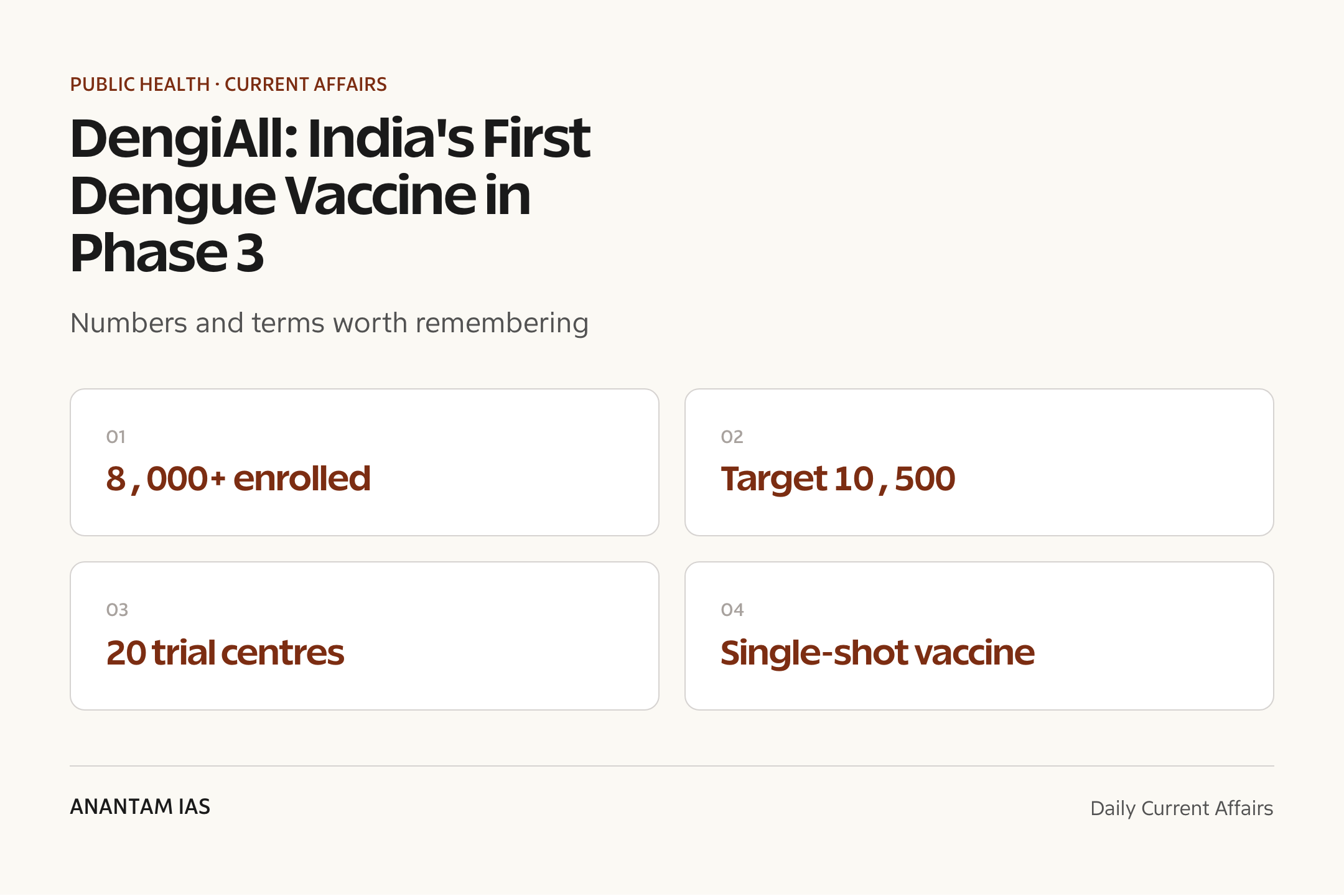
In mid-July 2025 the Indian Council of Medical Research (ICMR) reported that DengiAll — India’s first indigenous, single-shot, tetravalent dengue vaccine — had enrolled more than 8,000 of a planned 10,500 participants in its Phase-3 trial, as reported by Business Standard. Enrolment is expected to be completed by October 2025.
The candidate is being developed by Panacea Biotec in partnership with the ICMR, and the trial is co-led by ICMR institutes across 20 centres in the country. It targets an endemic vector-borne disease for which no dengue vaccine is currently licensed or available in India.
- Over 8,000 participants enrolled out of 10,500 planned, across 20 trial centres.
- Enrolment expected to finish by October 2025, with a two-year follow-up planned thereafter.
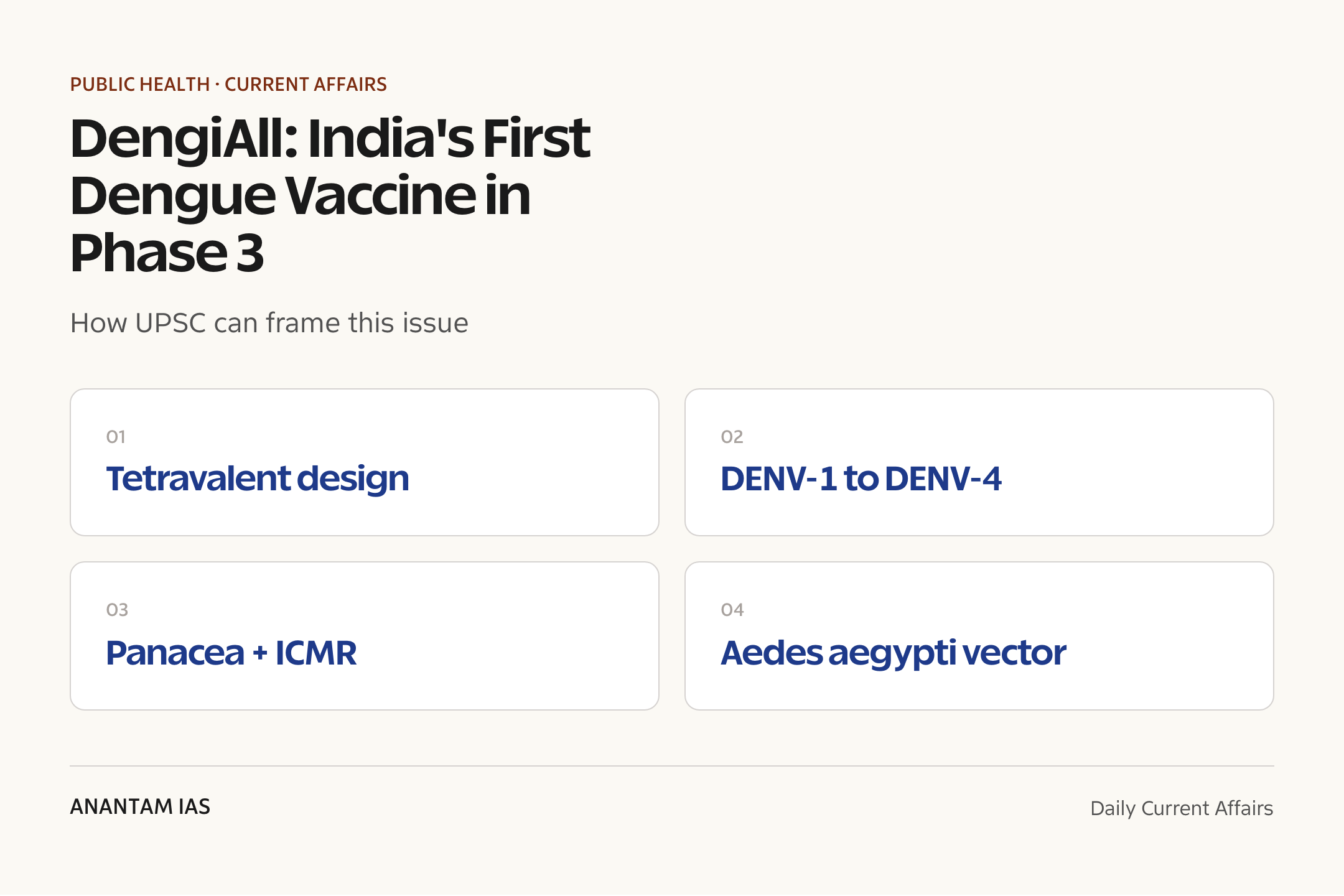
- DengiAll is a single-shot, tetravalent vaccine covering all four dengue serotypes (DENV-1 to DENV-4).
- Developed by Panacea Biotec with the ICMR; the Phase-3 trial began in August 2023, first dosed at PGIMS Rohtak.
- Design is a multi-centre, double-blind, randomised, placebo-controlled trial.
- ICMR institutes report no safety concerns in the Phase-1/2 results for the one-shot candidate.
The development matters in the context of:
- Matters because dengue is a fast-growing endemic vector-borne disease in India, spread by the Aedes aegypti mosquito, with no licensed vaccine in use here.
- Showcases India’s indigenous vaccine-development and clinical-trial ecosystem, building on the Atmanirbhar Bharat push in health-tech.

UPSC Relevance
Prelims Relevance
- DengiAll — India’s first indigenous single-shot tetravalent dengue vaccine candidate.
- Developer — Panacea Biotec, in collaboration with the ICMR.
- Phase-3 trial spans 20 centres; target enrolment 10,500 participants.
- Dengue is caused by four serotypes — DENV-1, DENV-2, DENV-3, DENV-4.
- Vector of dengue is the Aedes aegypti mosquito (also chikungunya, Zika).
- Trial is double-blind, randomised, placebo-controlled — the gold standard for efficacy.
- ICMR institutes involved include the National Institute of Epidemiology (NIE), Chennai and the National Institute of Virology (NIV), Pune.
- DengiAll is built on a strain technology originally developed by the US National Institutes of Health (NIH).
- No licensed dengue vaccine is currently available for use in India.
- ICMR is the apex body for biomedical research in India, under the Department of Health Research.
Mains Relevance
GS Paper 3
- Indigenisation of technology and developing new technology — the design and conduct of a domestic vaccine clinical trial.
- Achievements of Indians in science and technology; the role of bodies like ICMR in the public-health innovation ecosystem.
GS Paper 2
- Issues relating to development and management of the health sector; public-health interventions against endemic vector-borne diseases.
Essay
- Self-reliance in vaccines and the politics of public health.
- Science as a public good: from the lab bench to the clinic.
Background and Context
What DengiAll is
DengiAll is designed as a one-and-done shot against all four dengue viruses.
- A tetravalent vaccine — it carries components against all four serotypes, DENV-1 to DENV-4, in a single formulation.
- Delivered as a single shot, unlike multi-dose regimens, which can ease coverage in a large population.
- Developed by Panacea Biotec in collaboration with the ICMR.
- Built on a vaccine strain technology originally developed by the US National Institutes of Health (NIH) and licensed for Indian development.
- Billed as India’s first indigenous dengue vaccine candidate to reach late-stage trials.
Why a dengue vaccine is hard
Four serotypes and weak cross-immunity make dengue an unusually tough vaccine target.
- Dengue is caused by four distinct serotypes — DENV-1, DENV-2, DENV-3, DENV-4.
- Immunity against one serotype does not protect against the others, so a person can be infected up to four times.
- A partial vaccine can risk a more severe second infection in some cases, so a vaccine must work well against all four serotypes at once.
- All four serotypes circulate across Indian regions, raising the bar for a domestic vaccine.
- This is why a balanced, broadly protective tetravalent design is the goal.
Inside the Phase-3 trial
The study follows the standard late-stage design for proving efficacy and safety.
- It is a multi-centre, double-blind, randomised, placebo-controlled trial across 20 centres.
- Planned enrolment is 10,500 participants; over 8,000 had been dosed by mid-July 2025.
- Enrolment is expected to be completed by October 2025.
- The trial began in August 2023, with the first participant dosed at PGIMS Rohtak.
- A two-year follow-up of all participants is planned to assess efficacy and longer-term safety.
- ICMR institutes have flagged no safety concerns from the earlier Phase-1/2 results.
Who runs it — ICMR's role
The trial is co-led by ICMR’s specialist virology and epidemiology institutes.
- The ICMR is India’s apex body for the formulation, coordination and promotion of biomedical research, under the Department of Health Research.
- Partner institutes include the National Institute of Epidemiology (NIE), Chennai and the National Institute of Virology (NIV), Pune.
- ICMR’s National Institute of Translational Virology and AIDS Research in Pune is among the co-leading institutes.
- Panacea Biotec is the industry partner manufacturing and developing the candidate.
- Public-private collaboration mirrors India’s earlier vaccine pushes during COVID-19.
Why it matters for public health
Dengue is a rising, seasonal burden with no vaccine yet in routine Indian use.
- Dengue is an endemic vector-borne disease spread by the Aedes aegypti mosquito, which bites during the day.
- India sees large, recurring outbreaks in the monsoon and post-monsoon months.
- There is currently no licensed dengue vaccine in routine use in India, so control relies on vector management and supportive care.
- Vector control and clinical care alone struggle to cap outbreaks, raising the value of an effective vaccine.
- A domestically made vaccine, if it succeeds, could lower cost and improve supply security.
Significance for India's health-tech
DengiAll is a test case for India’s end-to-end vaccine and trial capability.
- Demonstrates indigenous capacity to take a vaccine from strain technology to a Phase-3 trial.
- Strengthens the case for India as a global vaccine manufacturing and trials hub.
- Aligns with Atmanirbhar Bharat goals of self-reliance in critical health products.
- Builds a regulatory and clinical-trial ecosystem that can be reused for other neglected diseases.
- Caveat — late-stage trials can still fail on efficacy; results were not yet available as of July 2025.
Way Forward
Finish the trial cleanly
- Complete enrolment and the planned two-year follow-up with rigorous, transparent reporting of efficacy and safety.
- Ensure adequate representation across age groups and dengue-endemic regions for a true read on protection.
Plan for delivery, not just approval
- Prepare cold-chain, pricing and vector-control integration so a successful vaccine is actually deployable at scale.
- Sequence any rollout with surveillance to monitor real-world effectiveness against all four serotypes.
Sustain the ecosystem
- Keep investing in ICMR-industry partnerships and trial infrastructure for other neglected and vector-borne diseases.
- Pair vaccine research with continued Aedes aegypti control — clean-up drives, larval-source reduction and public awareness.
Conclusion
DengiAll’s move into late-stage trials marks a significant step for Indian public health: a single-shot, tetravalent vaccine, built domestically, aimed at a disease that has long evaded an Indian vaccine. With over 8,000 of 10,500 participants enrolled by mid-2025 and no safety concerns flagged so far, the programme reflects a maturing vaccine and clinical-trial ecosystem.
The decisive evidence still lies ahead in the efficacy data and the two-year follow-up. Even a successful trial would have to be matched with affordable manufacturing, robust delivery and continued vector control before dengue’s seasonal toll begins to ease.
UPSC Practice Questions
Prelims MCQ 1
With reference to DengiAll, India’s indigenous dengue vaccine candidate, consider the following statements:
- It is a tetravalent vaccine intended to protect against all four dengue serotypes.
- It is being developed by Panacea Biotec in collaboration with the ICMR.
- A dengue vaccine was already licensed and in routine public use in India before DengiAll.
How many of the above statements are correct?
(a) Only one (b) Only two (c) All three (d) None
Answer: (b) Only two
Explanation:
Statements 1 and 2 are correct — DengiAll is a tetravalent, single-shot candidate from Panacea Biotec with the ICMR. Statement 3 is wrong; no dengue vaccine was in routine use in India.
Prelims MCQ 2
The mosquito species primarily responsible for transmitting dengue is:
(a) Anopheles stephensi (b) Culex quinquefasciatus (c) Aedes aegypti (d) Mansonia uniformis
Answer: (c) Aedes aegypti
Explanation:
Dengue is mainly transmitted by the Aedes aegypti mosquito, which also spreads chikungunya and Zika. Anopheles transmits malaria; Culex transmits filariasis and Japanese encephalitis.
UPSC Mains Questions
- Dengue remains an endemic vector-borne disease in India with no licensed vaccine in routine use. In this light, examine the significance of an indigenous, single-shot tetravalent vaccine candidate and the challenges in moving from a successful trial to population-level protection.
- “India’s vaccine story is as much about clinical-trial capacity as about manufacturing.” Discuss with reference to the public-private model and institutional ecosystem behind India’s late-stage dengue vaccine development.
Sources: Business Standard (ICMR) and Business Today.
Frequently Asked Questions
What is DengiAll?
DengiAll is India’s first indigenous dengue vaccine candidate, developed by Panacea Biotec in collaboration with the ICMR. It is a single-shot, tetravalent vaccine, meaning it is designed to protect against all four dengue serotypes at once, and it entered late-stage Phase-3 trials in India.
How many people are in the Phase-3 trial?
The Phase-3 trial plans to enrol 10,500 participants across 20 centres in India. As of mid-July 2025, the ICMR reported that more than 8,000 had been dosed, with enrolment expected to be completed by October 2025, followed by a two-year follow-up period.
Why is a dengue vaccine so difficult to develop?
Dengue is caused by four serotypes, DENV-1 to DENV-4, and immunity to one does not protect against the others. A vaccine must protect well against all four at once, since partial protection can in some cases raise the risk of a more severe later infection, making a balanced tetravalent design essential.
Who is developing DengiAll and which bodies are involved?
The vaccine is developed by Panacea Biotec in partnership with the Indian Council of Medical Research. The trial is co-led by ICMR institutes including the National Institute of Epidemiology in Chennai and the National Institute of Virology in Pune. The candidate uses a strain technology originally developed by the US NIH.
Is there already a dengue vaccine available in India?
As of July 2025 there was no dengue vaccine licensed for routine public use in India. Control of the disease relied on managing the Aedes aegypti mosquito vector and on supportive clinical care. DengiAll, if its trials succeed, could become an indigenous option.
What type of trial is the DengiAll Phase-3 study?
It is a multi-centre, double-blind, randomised, placebo-controlled trial, the standard design for proving a vaccine’s efficacy and safety. ICMR institutes have reported no safety concerns from the earlier Phase-1/2 stage, but final efficacy results depend on completing the trial and follow-up.