DGFT CoO Open API: Verifiable Origin Data for Exporters
Why in News?
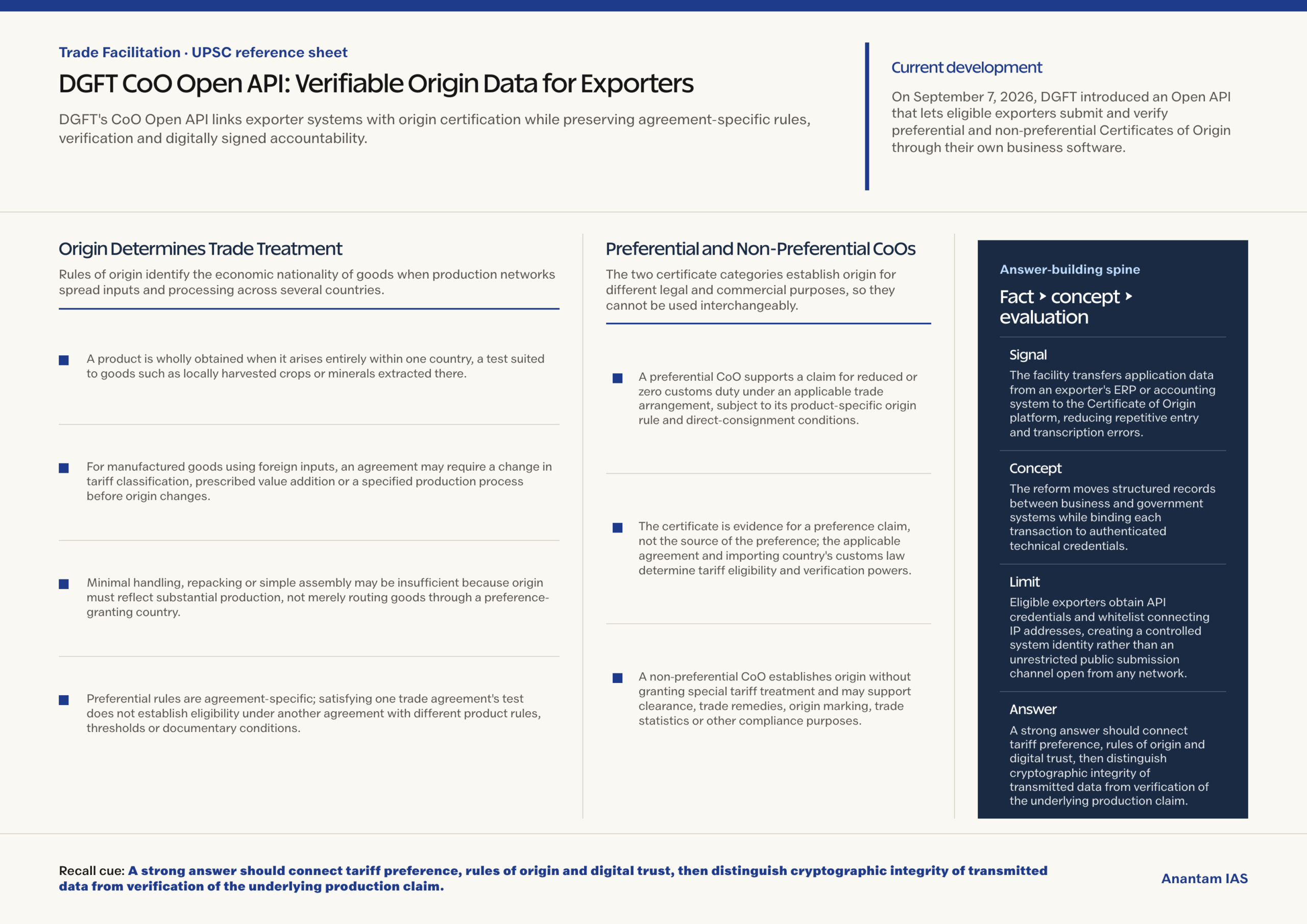
On September 7, 2026, DGFT introduced an Open API that lets eligible exporters submit and verify preferential and non-preferential Certificates of Origin through their own business software.
- The facility transfers application data from an exporter’s ERP or accounting system to the Certificate of Origin platform, reducing repetitive entry and transcription errors.
- Three interfaces cover authentication, application submission and certificate receipt, and verification of certificates already issued.
- Digitally signed requests and responses support data integrity, sender authentication and non-repudiation across system-to-system exchange.
- The system applies the relevant fields, origin criteria and validation rules according to the trade agreement or certification scheme selected.
- A Certificate of Origin is not merely a shipping document; it links a product’s claimed economic nationality to customs and trade-policy consequences.
- Digital exchange lowers compliance friction only when importing authorities can trust the identity, integrity and traceability of the transmitted record.
- The reform joins trade facilitation with compliance-by-design: structured data moves faster, while agreement-specific eligibility rules remain decisive.
UPSC Relevance
Prelims Relevance
- A Certificate of Origin provides evidence of the country in which goods originate.
- Preferential origin can support a tariff concession under an FTA, RTA, PTA or unilateral preference when prescribed conditions are met.
- A non-preferential CoO may serve customs clearance, origin marking, trade remedies or statistics, but does not itself confer a preferential tariff.
- Common origin tests include wholly obtained status, change in tariff classification, value addition and specified processing operations.
- DGFT operates under the Department of Commerce in the Ministry of Commerce and Industry.
- A digital signature can establish integrity and attribution; it does not prove that the underlying commercial declaration is factually correct.
Mains Relevance
GS Paper 3
- Rules of origin, tariff preferences and transaction costs in India’s external trade
- Digital public infrastructure for trusted cross-border documentation
GS Paper 2
- Authentication, auditability and accountability in system-to-system public services
Essay
- Trustworthy digitalisation makes compliance easier to perform and harder to deny.
Background and Context
Origin Determines Trade Treatment
Rules of origin identify the economic nationality of goods when production networks spread inputs and processing across several countries.
- A product is wholly obtained when it arises entirely within one country, a test suited to goods such as locally harvested crops or minerals extracted there.
- For manufactured goods using foreign inputs, an agreement may require a change in tariff classification, prescribed value addition or a specified production process before origin changes.
- Minimal handling, repacking or simple assembly may be insufficient because origin must reflect substantial production, not merely routing goods through a preference-granting country.
- Preferential rules are agreement-specific; satisfying one trade agreement’s test does not establish eligibility under another agreement with different product rules, thresholds or documentary conditions.
- The importing customs authority applies the relevant agreement and may deny a concession when origin conditions or documentary requirements are unmet, despite presentation of a formally issued certificate.
Preferential and Non-Preferential CoOs
The two certificate categories establish origin for different legal and commercial purposes, so they cannot be used interchangeably.
- A preferential CoO supports a claim for reduced or zero customs duty under an applicable trade arrangement, subject to its product-specific origin rule and direct-consignment conditions.
- The certificate is evidence for a preference claim, not the source of the preference; the applicable agreement and importing country’s customs law determine tariff eligibility and verification powers.
- A non-preferential CoO establishes origin without granting special tariff treatment and may support clearance, trade remedies, origin marking, trade statistics or other compliance purposes.
- DGFT’s Handbook requires Indian non-preferential origin to reflect manufacture beyond listed simple operations when imported inputs are used, preventing mere packing or labelling from conferring origin.
- Separating these categories prevents a non-preferential certificate from being mistaken for proof that goods qualify for an FTA concession, a distinction central to customs assessment.
How the Trusted API Exchange Works
The reform moves structured records between business and government systems while binding each transaction to authenticated technical credentials.
- Eligible exporters obtain API credentials and whitelist connecting IP addresses, creating a controlled system identity rather than an unrestricted public submission channel open from any network.
- An authentication interface issues a time-limited token; a file interface submits applications and returns certificates; a verification interface checks issued-certificate records against the platform.
- Each request and response uses SHA-256 RSA digital signatures with X.509 certificates, enabling recipients to detect alteration and attribute the exchange to the signing entity’s credentials.
- Digital signatures support non-repudiation, meaning a properly attributable sender cannot credibly deny the signed exchange; they do not validate every supplier declaration or production record inside it.
- A transaction ledger records application stages and identifiers, creating end-to-end traceability from draft submission through approval, certificate issuance or rejection and later verification.
Way Forward
Build Interoperable and Verifiable Origin Compliance
- Publish stable data standards and versioned API specifications so exporters and software providers can integrate without ambiguous field mappings.
- Use risk-based verification to detect false origin claims while avoiding blanket duplication of documents already available as authenticated structured data.
- Preserve human review and appeal routes where agreement rules, supplier declarations or production records produce contested origin determinations.
- Pursue secure interoperability with customs and authorised issuing agencies while applying purpose limitation, access controls and auditable data sharing.
Conclusion
- The CoO Open API can lower export transaction costs because it replaces repeated entry with authenticated, traceable system exchange while retaining agreement-specific origin tests and customs verification.
- A strong answer should connect tariff preference, rules of origin and digital trust, then distinguish cryptographic integrity of transmitted data from verification of the underlying production claim.
UPSC Practice Questions
Prelims MCQ 1
With reference to Certificates of Origin, consider the following statements:
- A preferential Certificate of Origin may support a tariff concession under an applicable trade agreement.
- A non-preferential Certificate of Origin automatically entitles the goods to the most favourable tariff under every FTA.
- Change in tariff classification and value addition may be used as origin criteria.
How many of the above statements are correct?
(a) Only one (b) Only two (c) All three (d) None
Answer: (b) Only two
Explanation:
Statements 1 and 3 are correct. A non-preferential CoO establishes origin for non-preference purposes and does not automatically confer an FTA tariff concession.
Prelims MCQ 2
What is the most accurate function of a digital signature on a DGFT CoO API message?
(a) It guarantees that every commercial fact in the application is true (b) It grants preferential tariff treatment without customs assessment (c) It supports message integrity, sender authentication and non-repudiation (d) It replaces the product-specific rule of origin under a trade agreement
Answer: (c) It supports message integrity, sender authentication and non-repudiation
Explanation:
The signature helps establish who sent the message and whether it was altered. Origin eligibility and factual accuracy still require applicable rules and verification.
UPSC Mains Questions
- Explain how rules of origin connect Certificates of Origin with tariff preferences. Why must digital trade facilitation preserve agreement-specific verification?
- System-to-system exchange can reduce trade costs only when digital records are trustworthy. Discuss with reference to authentication, integrity, non-repudiation and audit trails.
Sources: PIB, Directorate General of Foreign Trade and DGFT Handbook of Procedures 2023, Chapter 2.
Frequently Asked Questions
What does a Certificate of Origin establish?
It provides evidence of a good’s country of origin, allowing customs and other authorities to apply the relevant tariff, trade-remedy, marking or compliance rules.
How does a preferential CoO differ from a non-preferential CoO?
A preferential CoO supports a tariff concession under an applicable arrangement; a non-preferential CoO establishes origin for purposes that do not grant a preferential tariff.
What does the DGFT Open API change for exporters?
It lets eligible exporters transmit CoO application data from business software, receive certificates and verify issued records without separately re-entering the same information.
Does a digitally signed API message prove the origin claim?
No. It supports integrity, authentication and non-repudiation of the exchange; the commercial facts must still satisfy the relevant origin rule and verification process.
Why are rules of origin important under an FTA?
They ensure tariff preferences reach goods genuinely originating under the agreement, rather than products merely routed through a partner country after insufficient processing.