Dialogue, uninterrupted maritime trade: Jaishankar outlines India’s 5-point stand during talks with Rubio
Why in News?
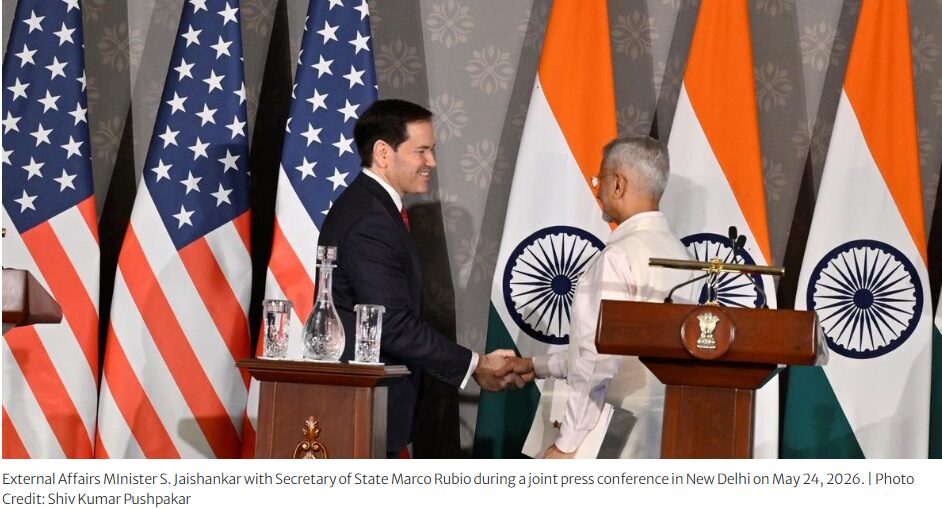
India’s External Affairs Minister S. Jaishankar outlined India’s five-point position on major global and regional issues during talks with Marco Rubio. Discussions covered regional conflicts, maritime security, trade, defence cooperation, energy security, critical minerals, artificial intelligence, and Indo-Pacific developments, reflecting the widening scope of the India–U.S. strategic partnership.
UPSC Relevance
Prelims: India–U.S. relations, Quad, critical minerals, IMEC, energy security, Indo-Pacific, nuclear cooperation.
Mains:
GS II – India and its neighbourhood, bilateral and international relations;
GS III – security, emerging technologies, energy security, economic diplomacy.
Background/Context
India–U.S. relations have evolved from Cold War-era strategic distance to a multidimensional partnership involving defence, technology, trade, maritime security, and global governance. Over the last two decades, several initiatives have accelerated cooperation:
- Civil Nuclear Agreement (2005–08)
- Major Defence Partner status (2016)
- Foundational defence agreements such as LEMOA, COMCASA and BECA
- Increasing engagement through the Quadrilateral Security Dialogue framework
- Collaboration in semiconductors, critical technologies and resilient supply chains
Recent geopolitical developments such as the Ukraine conflict, tensions in West Asia, growing competition in the Indo-Pacific and global supply chain disruptions have further strengthened the strategic importance of India–U.S. relations.
India’s Five-Point Global Approach
During the discussions, India highlighted a broad framework guiding its foreign policy approach.
Dialogue and diplomacy for conflict resolution
India reiterated that disputes should be resolved through peaceful means rather than prolonged military confrontation. This position reflects India’s strategic autonomy approach and its consistent emphasis on negotiations and diplomatic engagement.
The policy has been visible in India’s stance on conflicts in Ukraine and West Asia, where India has repeatedly advocated peace initiatives without aligning itself completely with any geopolitical bloc.
Support for safe and uninterrupted maritime commerce
India emphasized freedom of navigation and uninterrupted maritime trade routes.
Maritime chokepoints such as the Strait of Hormuz, Bab-el-Mandeb and the South China Sea are crucial for global trade and energy flows. Any disruption can affect international trade and energy security.
India’s maritime outlook also aligns with:
- SAGAR (Security and Growth for All in the Region)
- Indo-Pacific Oceans Initiative (IPOI)
Respect for international law
India stressed adherence to international law and global norms.
This includes:
- Respect for sovereignty and territorial integrity
- Observance of international conventions
- Peaceful settlement of disputes
Such principles become important in territorial disputes, maritime disagreements and regional conflicts.
Opposition to weaponisation of trade and resources
India argued against the use of economic tools as coercive instruments.
Examples include:
- Sanctions regimes
- Export restrictions on critical minerals
- Supply chain disruptions
- Strategic control over essential commodities
Recent global events have highlighted how dependence on a few countries for energy resources, semiconductors or critical minerals creates vulnerabilities.
Trusted partnerships and resilient supply chains
India stressed diversified supply chains and trusted economic partnerships to reduce risks to the global economy.
The COVID-19 pandemic and geopolitical tensions demonstrated vulnerabilities in concentrated production systems.
Initiatives supporting this objective include:
- Supply Chain Resilience Initiative (SCRI)
- India-Middle East-Europe Economic Corridor (IMEC)
- Quad technological cooperation
What are the Major Areas of India–U.S. Cooperation?
Defence and Strategic Cooperation
The two countries discussed the recently renewed ten-year defence partnership framework.
Areas of cooperation include:
- Defence technology transfers
- Joint military exercises
- Underwater domain awareness
- Defence manufacturing under “Make in India”
- Maritime security
Recent conflicts have also highlighted the need for modern warfare capabilities involving drones, AI-based systems and integrated surveillance mechanisms.
Trade and Economic Relations
India and the U.S. discussed early finalisation of an interim trade agreement which could become a stepping stone for a comprehensive bilateral trade arrangement.
Potential areas of expansion include:
- Digital economy
- Services sector
- Manufacturing
- Agricultural trade
- Technology partnerships
The United States remains one of India’s largest trading partners.
Energy Security Cooperation
India emphasized affordable and diversified energy sources.
Energy cooperation presently includes:
- LNG imports, Oil trade, Renewable energy cooperation, Strategic energy partnerships
Diversification reduces excessive dependence on specific regions and enhances long-term energy resilience.
Nuclear Cooperation
Discussions also covered opportunities arising from recent legal and regulatory developments for expanding civil nuclear cooperation.
Nuclear energy can help India achieve: Energy security, Low-carbon growth, Net-zero goals, Reduction of fossil fuel dependence
Critical Minerals and Emerging Technologies
Critical minerals such as lithium, cobalt and rare earth elements have become central to modern economic and technological systems.
India and the U.S. are cooperating in areas such as:
- Semiconductor supply chains, Artificial Intelligence, Critical minerals, Advanced manufacturing, Emerging technologies
These sectors are increasingly becoming strategic assets in global geopolitics.
Counter-terrorism Cooperation
India reiterated its “zero tolerance” approach towards terrorism.
Areas of cooperation include: Intelligence sharing, Counter-terror financing, Extradition cooperation, Narcotics control
India highlighted recent cooperation in bringing back accused individuals linked to terror activities.
What is the Significance of India–U.S. Partnership for India
A stronger partnership provides India with several strategic advantages.
Political and strategic benefits include greater influence in global institutions and stronger balancing capabilities in the Indo-Pacific region.
Economic benefits include greater investments, technology access and trade opportunities.
Security benefits include defence modernisation and maritime cooperation.
Technological gains include access to advanced technologies in AI, semiconductors and critical sectors.
Challenges in India–U.S. Relations
Despite progress, certain issues continue to create friction.
Trade disagreements
Differences remain regarding tariffs, market access and digital regulations.
Strategic autonomy concerns
India seeks partnerships without becoming part of military alliances, while the U.S. sometimes expects stronger alignment.
Technology and regulatory barriers
Restrictions on technology transfers and regulatory hurdles can slow cooperation.
Geopolitical differences
Differences in positions regarding Russia, West Asia and global conflicts occasionally emerge.
Immigration and mobility issues
Visa restrictions and movement of skilled professionals continue to remain sensitive areas.
Way Forward
Move beyond transactional engagement
The partnership should gradually shift from issue-specific cooperation towards a broader long-term strategic framework based on mutual interests.
Accelerate technology partnerships
Joint innovation in semiconductors, AI, quantum computing and critical minerals should receive greater institutional support.
Strengthen supply chain resilience
Diversification of supply chains and trusted manufacturing ecosystems can reduce dependence on single-country sources.
Expand people-to-people relations
Educational exchanges, skilled mobility arrangements and research partnerships can create stronger societal links.
Deepen coordination in global institutions
India and the U.S. should cooperate in reforming international institutions and addressing global challenges such as climate change, terrorism and health security.
Conclusion
India–U.S. relations have expanded beyond traditional diplomacy into a broad strategic partnership involving security, trade, technology and global governance. India’s five-point framework demonstrates its attempt to balance national interests, strategic autonomy and international responsibilities. The future trajectory of this partnership will likely influence not only bilateral relations but also the wider geopolitical and economic order.
Practice Questions
Question 1
Consider the following statements with reference to India’s five-point global approach:
I. India emphasizes dialogue and diplomacy as preferred tools for conflict resolution rather than prolonged military confrontation.
II. India supports trusted partnerships and resilient supply chains to reduce vulnerabilities arising from concentrated production systems.
III. India opposes the weaponisation of trade and strategic resources as instruments of coercion.
Which of the following relationships among the above statements is/are correct?
- Statement II operationalises the concerns highlighted in Statement III by creating alternative and diversified economic networks.
- Statement I contradicts Statement III because diplomatic engagement prevents economic measures from being used in international relations.
- Statement III complements Statement I by promoting stability through non-coercive mechanisms.
(a) 1 and 3 only
(b) 2 only
(c) 1, 2 and 3
(d) 3 only
Correct Answer: (a) 1 and 3 only
Question 2
Consider the following statements with reference to India–U.S. strategic cooperation:
I. India–U.S. cooperation increasingly includes emerging sectors such as artificial intelligence, critical minerals and semiconductor supply chains.
II. Defence cooperation between India and the United States has expanded beyond traditional military arrangements into technology and manufacturing domains.
III. India seeks to maintain strategic autonomy while expanding cooperation with major global powers.
Which of the following relationships among the above statements is/are correct?
- Statement I extends the trends reflected in Statement II by expanding cooperation into wider technological domains.
- Statement III contradicts Statement II because strategic autonomy prevents deeper defence cooperation.
- Statement III explains the broader framework within which Statements I and II operate.
(a) 1 only
(b) 2 and 3 only
(c) 1 and 3 only
(d) 1, 2 and 3
Correct Answer: (c) 1 and 3 only
Mains Question
- India–U.S. relations have evolved from strategic hesitation to multidimensional engagement. Discuss the factors driving this transformation and examine the challenges that remain.
- Discuss India’s five-point approach on global issues and evaluate its significance in shaping India’s foreign policy in a changing geopolitical order.