Digital-Arrest Fraud: How Cybercrime Proceeds Move Through Mule Networks
Why in News?
The Enforcement Directorate arrested two persons in a Goa-linked money-laundering probe that allegedly exposed a multi-state network moving proceeds from digital-arrest frauds.
- The probe arose from a Goa cybercrime FIR in which a woman was allegedly coerced into transferring Rs 2.6 crore to supposed secret supervision accounts.
- The ED said the connected accounts figure in 330 victim complaints and 163 FIRs across 20 states and Union Territories.
- Investigators alleged that the Goa victim’s money was fragmented within hours across more than 400 beneficiary accounts.
- The two persons were arrested under Section 19 of PMLA; the allegations remain subject to investigation and judicial determination.
- The case links the initial social-engineering fraud with the separate financial process used to disguise, move or convert its proceeds.
- It illustrates why cybercrime control needs coordination among police, banks, telecom platforms, financial-intelligence bodies and specialised investigators.
UPSC Relevance
Prelims Relevance
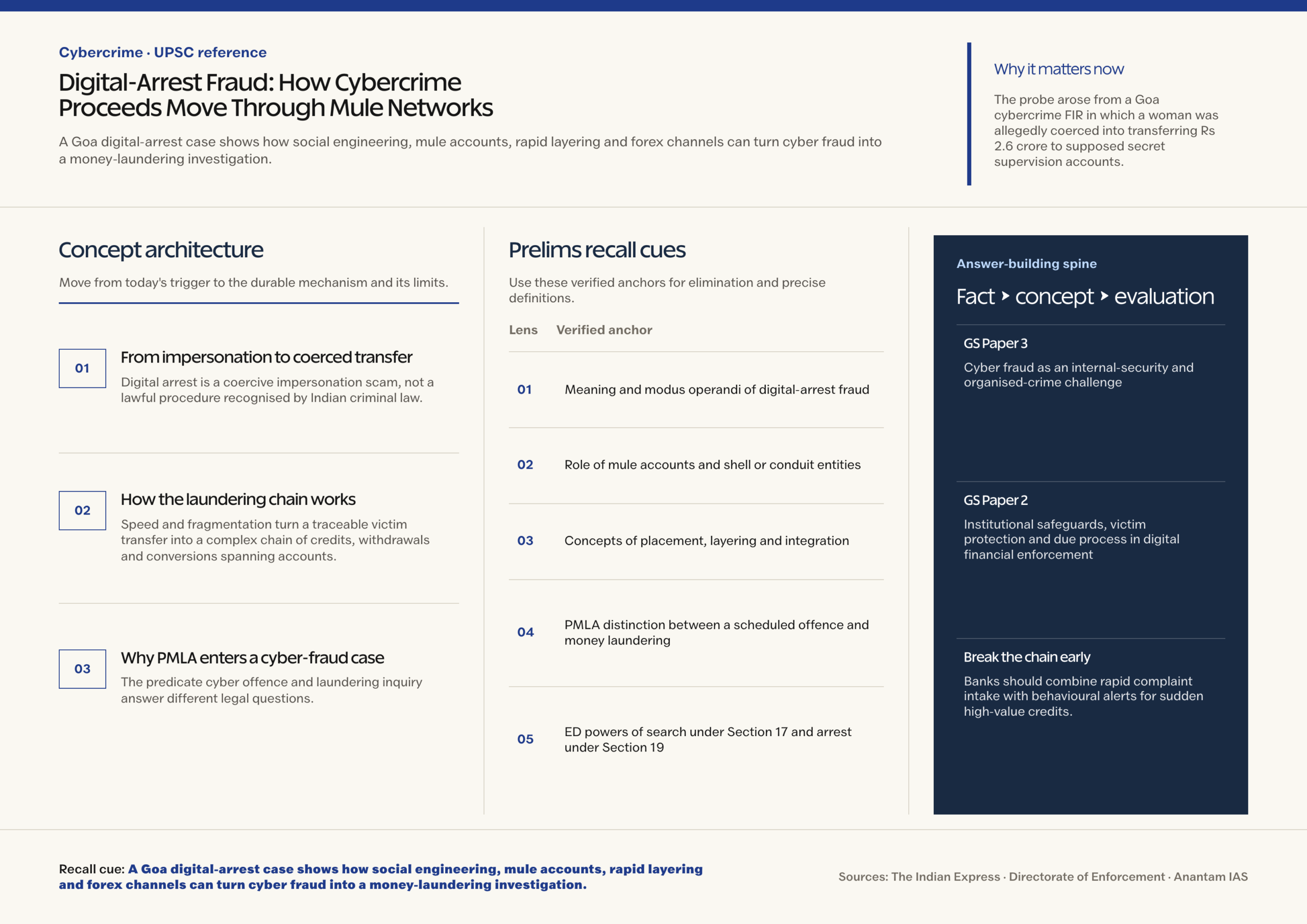
- Meaning and modus operandi of digital-arrest fraud
- Role of mule accounts and shell or conduit entities
- Concepts of placement, layering and integration
- PMLA distinction between a scheduled offence and money laundering
- ED powers of search under Section 17 and arrest under Section 19
Mains Relevance
GS Paper 3
- Cyber fraud as an internal-security and organised-crime challenge
- Technology, financial channels and inter-state coordination in proceeds tracing
GS Paper 2
- Institutional safeguards, victim protection and due process in digital financial enforcement
Essay
- Digital trust depends as much on accountable institutions and informed citizens as on technical security.
Background and Context
From impersonation to coerced transfer
Digital arrest is a coercive impersonation scam, not a lawful procedure recognised by Indian criminal law; it exploits fear of immediate detention and secrecy.
- Fraudsters pose as police, investigators, courts or regulators, claim that the target is linked to a serious offence, and present private payment instructions as official procedure.
- They use video calls, forged documents, isolation and threats of arrest to create authority, urgency and fear, often discouraging contact with family, banks or police.
- The victim is instructed to transfer money for verification, bail or supervision; a genuine agency does not demand such a transfer to clear a person.
- The first recipient is often a mule account controlled by another actor, distancing the victim-facing impersonator from later movement and withdrawal of funds.
- Fast reporting matters because banks may be able to hold funds before successive transfers disperse them beyond the first identifiable beneficiary account.
How the laundering chain works
Speed and fragmentation turn a traceable victim transfer into a complex chain of credits, withdrawals and conversions spanning accounts, entities and jurisdictions.
- At the placement stage, criminal proceeds enter accounts presented as ordinary business or personal receipts, creating the first separation between victim and principal operator.
- During layering, funds are split and routed through dormant, newly opened or intermediary accounts to multiply transactions, mix flows and obscure their criminal origin.
- Conduit companies can give transfers a commercial appearance even when nominal directors do not exercise real control over banking credentials, records or business decisions.
- The ED alleged that parts of the investigated network converted banking credits into cash and then foreign currency through licensed money-changing businesses controlled by others.
- Cash withdrawal or currency conversion can interrupt the digital trail, while integration seeks to return funds as apparently legitimate wealth, assets or business receipts.
Why PMLA enters a cyber-fraud case
The predicate cyber offence and laundering inquiry answer different legal questions, although evidence from the same transaction trail can connect the two investigations.
- Police investigate the underlying cheating, impersonation or computer-related conduct; when covered as a scheduled offence, it may generate proceeds of crime examined under PMLA.
- The ED examines whether a person knowingly assisted, possessed, used, concealed or projected those proceeds as untainted property, rather than reinvestigating every element of the victim-facing deception.
- A large transaction trail is investigative evidence, not automatic proof that every account holder, director or transaction forms part of a laundering conspiracy.
- Investigators must establish beneficial control and knowledge through account operation, communications, device records, cash handling and the economic purpose of transfers.
- Arrest, search and seizure powers remain subject to statutory conditions, recorded reasons, court supervision and procedural rights; an agency allegation is not a finding of guilt.
Way Forward
Break the chain early
- Banks should combine rapid complaint intake with behavioural alerts for sudden high-value credits, quick fragmentation and accounts inconsistent with customer profiles.
- Law-enforcement agencies need time-bound inter-state preservation requests so account, device and telecom evidence is not lost while jurisdiction is being resolved.
- Customer warnings should state the decisive rule: no police, court or regulator places citizens under digital arrest or demands money for verification.
- Enforcement should distinguish deceived or coerced account holders from knowing facilitators through control, benefit, communication and transaction evidence.
Conclusion
- Digital-arrest fraud is not only a deceptive call; it is a networked financial crime whose resilience comes from specialisation across impersonators, account recruiters, mules, shell entities and cash or currency converters.
- A strong Mains answer should connect citizen awareness with faster complaint transmission, transaction freezing, financial intelligence, inter-state evidence sharing, beneficial-ownership scrutiny and due-process safeguards.
UPSC Practice Questions
Prelims MCQ 1
With reference to digital-arrest fraud and money laundering, consider the following statements:
- Digital arrest is a procedure expressly recognised under Indian criminal law.
- Layering seeks to obscure the origin of funds through multiple transactions.
- A scheduled offence may generate proceeds of crime examined under PMLA.
How many of the above statements are correct?
(a) Only one (b) Only two (c) All three (d) None
Answer: (b) Only two
Explanation:
Statements 2 and 3 are correct. Digital arrest is a fraud tactic, not a lawful arrest procedure.
Prelims MCQ 2
Which one of the following best describes a mule account in a cyber-fraud chain?
(a) A court-controlled account for disputed funds (b) An account used to receive or move illicit funds for another actor (c) An RBI reserve account for money changers (d) A victim-compensation account maintained by police
Answer: (b) An account used to receive or move illicit funds for another actor
Explanation:
A mule account receives or transfers criminal proceeds on behalf of others, helping distance the main operators from the originating fraud.
UPSC Mains Questions
- Digital-arrest fraud combines social engineering with a layered financial network. Explain the mechanism and suggest institutional responses that can improve disruption and recovery.
- Distinguish the investigation of a predicate cyber offence from a money-laundering inquiry under PMLA. Why is this distinction important for effective and fair enforcement?
Sources: The Indian Express and Directorate of Enforcement.
Frequently Asked Questions
What is digital-arrest fraud?
It is an impersonation scam in which criminals pose as authorities, isolate a victim through calls or video, threaten arrest and demand transfers for supposed verification or supervision.
Is digital arrest a valid legal procedure?
No. Indian law does not permit an agency to keep someone under arrest through a video call or demand a money transfer to avoid arrest.
What is a mule account?
It is an account used to receive or move illicit funds for another actor. The holder may be a knowing facilitator, a recruited participant or, in some cases, deceived.
Why does the ED investigate a cyber-fraud case?
When a scheduled offence generates proceeds of crime, the ED may investigate alleged concealment, possession, use, transfer or projection of those proceeds under PMLA.
What should a person do after such a demand?
End the call, preserve messages and transaction details, contact the bank immediately, and report the incident through the official cybercrime reporting and police channels.