Digital India at 11: eSARAS and DPI-led rural digital commerce
Why in News?
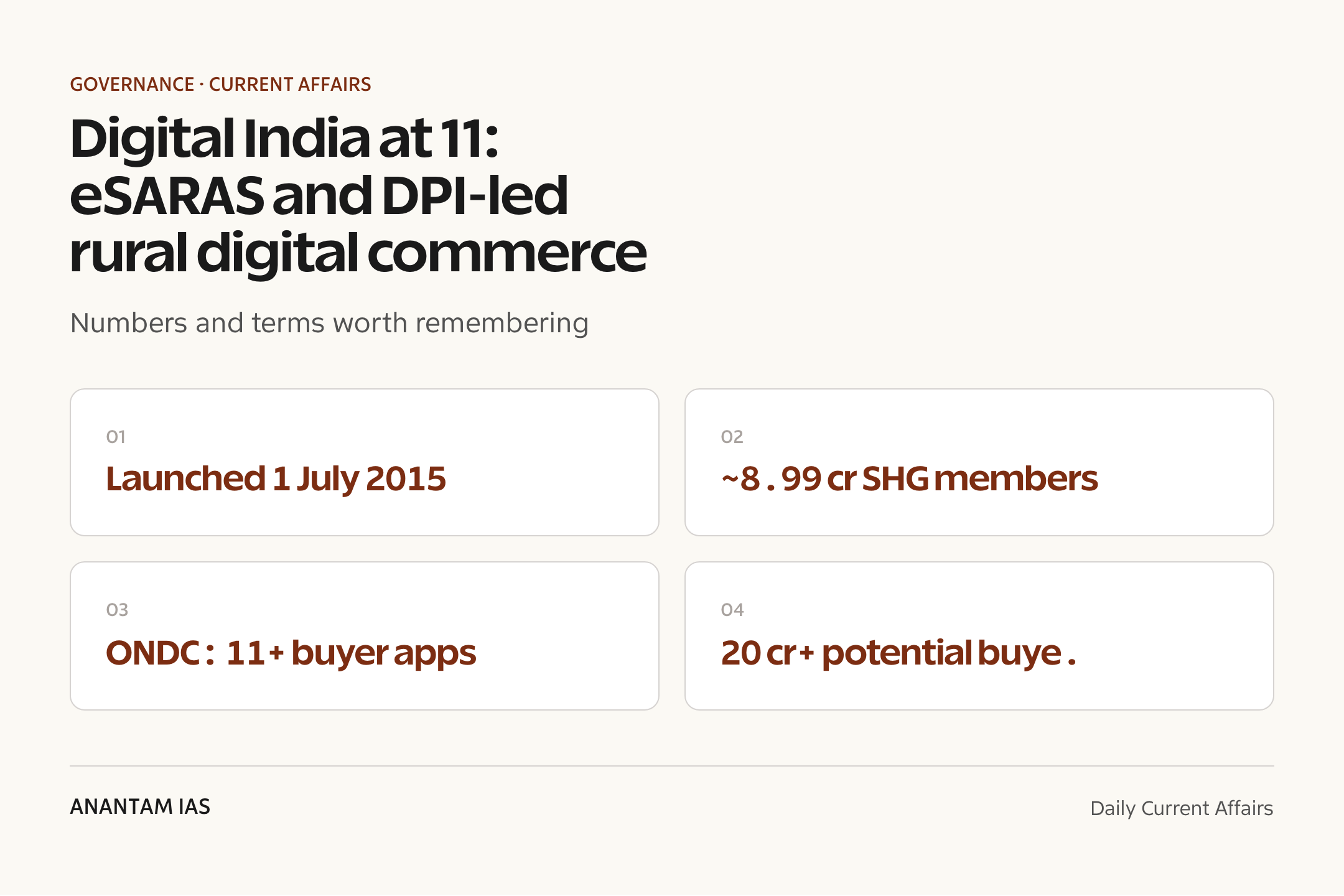
The Digital India programme, launched on 1 July 2015, completed 11 years in July 2026, and the government has spotlighted the eSARAS online marketplace as a flagship example of Digital Public Infrastructure (DPI) being channelled into rural livelihoods rather than only into payments and identity.
PIB and the Ministry of Rural Development note that eSARAS (SARAS Aajeevika), the official e-commerce portal for products made by women Self-Help Groups (SHGs), now anchors a network of nearly 9 crore SHG members under DAY-NRLM, and has been plugged into the open ONDC network to widen its market reach.
The anniversary reframes a familiar debate: after a decade of building world-scale digital rails, the test now is whether those rails can deliver tangible income to the poorest — here, rural women artisans — and not just efficiency to the already-connected.
- eSARAS is the official online marketplace of DAY-NRLM, run under the Ministry of Rural Development with Digital India Corporation (MeitY).
- The DAY-NRLM ecosystem covers about 8.99 crore registered SHG women members across 7,627 blocks.
- eSARAS products are now live on ONDC across 11+ buyer apps reaching 20 crore+ potential buyers.
- The portal esaras.in was first launched on 28 October 2022; a mobile app and a Fulfilment Centre followed.
- IANS reported on 11 July 2026 that eSARAS is boosting digital commerce for close to 9 crore SHG members.
The development matters in the context of:
- Shows how India’s DPI stack (Aadhaar, UPI, ONDC, DigiLocker) is being used for livelihoods, not just payments and identity.
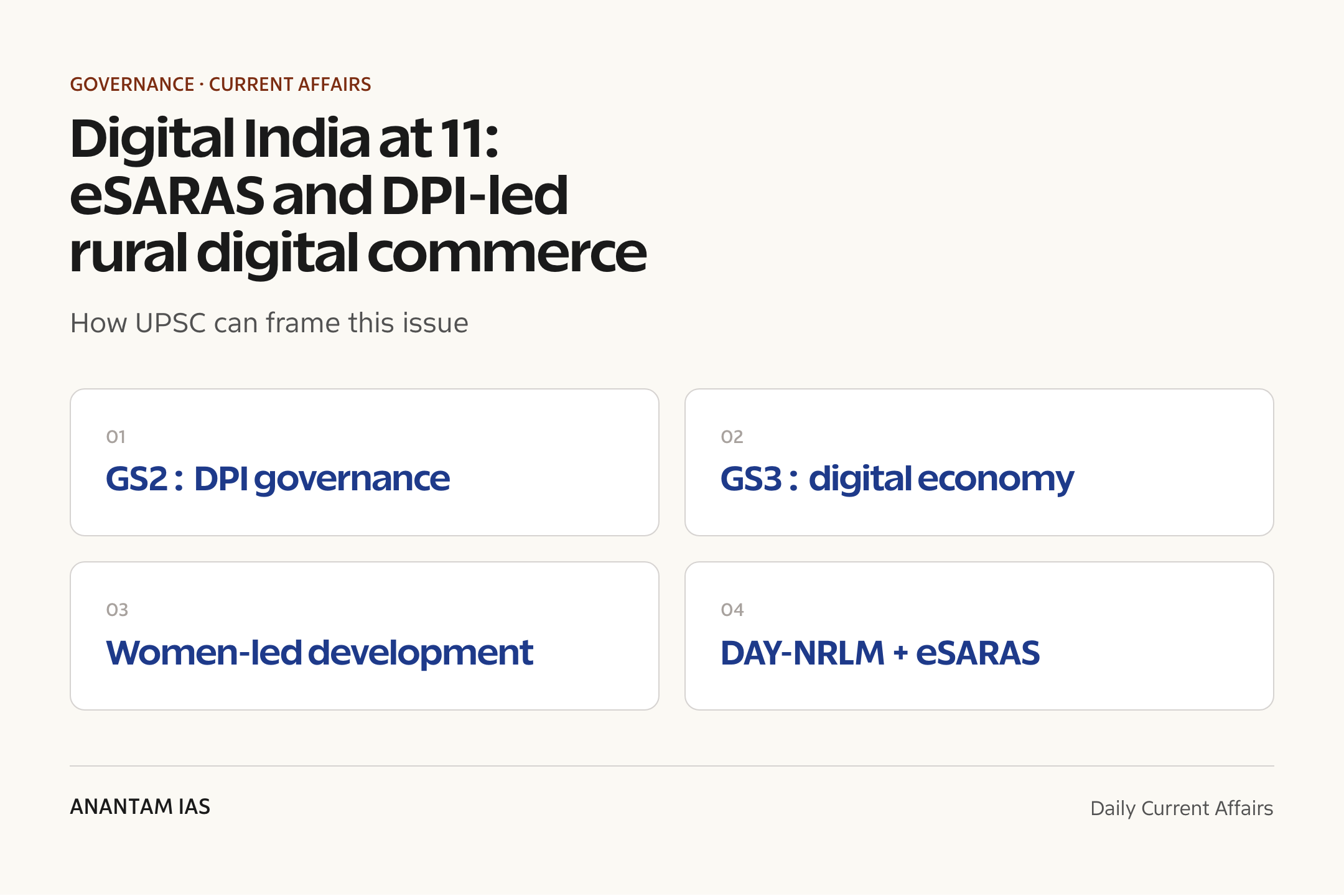
- Links women-led development and the rural craft economy to national digital markets, a live GS2 governance and GS3 economy theme.
UPSC Relevance
Prelims Relevance
- Digital India launched 1 July 2015; nodal ministry is MeitY.
- eSARAS / SARAS Aajeevika is the SHG e-commerce portal of DAY-NRLM.
- DAY-NRLM = Deendayal Antyodaya Yojana–National Rural Livelihoods Mission, under Ministry of Rural Development.
- ONDC (Open Network for Digital Commerce) is an interoperable e-commerce network, not an app.
- Digital India Corporation is a not-for-profit under MeitY.
- Digital economy contributes about 12–14% of India’s GDP.
- UMANG is a unified mobile app for government services; eSARAS is listed on it.
- SARAS Aajeevika Gallery is a permanent retail outlet at Baba Kharak Singh Marg, New Delhi.
Mains Relevance
GS Paper 2
- Digital Public Infrastructure as a governance model for last-mile welfare and market access.
- Government schemes for vulnerable sections and women’s empowerment through SHGs.
GS Paper 3
- Digital economy, e-commerce and inclusive growth for the rural non-farm sector.
- Role of technology and e-marketplaces in raising rural incomes and formalising producers.
Essay
- Technology must serve humanity: digital tools for grassroots empowerment.
- Women-led development and the dignity of rural work.
Background and Context
Digital India at 11 — the DPI backbone
The programme’s core is a stack of open, interoperable digital rails often described as India’s Digital Public Infrastructure.
- Digital India was launched on 1 July 2015 around three visions — digital infrastructure as a utility, governance and services on demand, and the digital empowerment of citizens.
- DPI is built on the ‘India Stack’ idea of open, interoperable, population-scale rails for identity, payments and data, layered so private and public players can build on top.
- Aadhaar crossed 144 crore registrations by March 2026 and underpins over 3,100 welfare schemes as a foundational digital identity.
- UPI grew from about 20 million transactions in 2017 to over 240 billion, handling nearly 49% of global real-time payments.
- DigiLocker had over 70 crore users and issued more than 850 crore documents by March 2026, cutting paperwork for citizens.
- Direct Benefit Transfer has routed over ₹51 lakh crore to bank accounts, cutting leakages and middlemen.
- ONDC extends the same open-network logic from payments to e-commerce, and eSARAS is a live test of that extension for the rural economy.
What is eSARAS?
A dedicated, government-run online marketplace built only for SHG products, so rural makers are not lost among mass sellers.
- eSARAS (SARAS Aajeevika) is the official e-commerce portal of DAY-NRLM for goods made by women SHGs and their federations.
- The SARAS brand — long known through SARAS Aajeevika Melas (fairs) held across the country — has been carried online to give those products a year-round digital shopfront.
- It is built by Digital India Corporation under MeitY with the Ministry of Rural Development, an example of two ministries pooling digital and livelihood mandates.
- The portal esaras.in was launched on 28 October 2022 for better marketing of Saras products directly to consumers.
- It sells handloom, handicrafts, processed food, honey, dairy, herbal and home-décor items — from Chanderi sarees to Pashmina and Rajasthan marble craft.
- By selling directly, it aims to give producers a fair price and buyers an authentic, traceable rural product.
Scale and grassroots architecture
eSARAS sits on one of the world’s largest women-led livelihood networks, which gives it enormous latent supply and scale.
- DAY-NRLM, launched in 2011 and renamed in 2015, mobilises poor rural women into Self-Help Groups, village organisations and cluster-level federations.
- It now covers about 8.99 crore registered SHG women members — a base larger than the population of most countries.
- The mission operates across 7,627 blocks with a community cadre of about 1.51 crore members who act as local trainers and mobilisers.
- Over 8.62 crore SHG members have a digital storefront, most directly linked to the Ministry’s network (Feb 2024).
- The design deliberately eliminates intermediaries so more of the final price reaches the artisan rather than middlemen.
- This scale is what lets a single portal aggregate craft from thousands of villages into one national catalogue.
From a portal to a full-stack ecosystem
eSARAS has evolved beyond a single website.
- A mobile app was launched alongside an eSARAS Fulfilment Centre for processing, packaging and shipping.
- A permanent SARAS Aajeevika Gallery operates at Baba Kharak Singh Marg, New Delhi.
- A premium SARAS Shakti Collection targets institutional and corporate gifting.
- eSARAS is also listed on UMANG, widening its reach to government-app users.
ONDC and DPI-led market access
The biggest leap is plugging SHG goods into open digital commerce so they surface wherever buyers already shop.
- eSARAS products are available on ONDC across 11+ buyer apps with 800+ handcrafted items listed.
- This exposes SHG products to 20 crore+ potential buyers on the network, far beyond the traffic a single government site could draw.
- ONDC (Open Network for Digital Commerce) is an open, interoperable protocol — sellers reach many buyer apps without being locked to one dominant platform or paying its high commissions.
- It unbundles e-commerce, so any compliant buyer app can discover any compliant seller, breaking the walled-garden model of large marketplaces.
- It turns eSARAS from a standalone store into a node on India’s Digital Public Infrastructure, benefiting from network effects rather than competing against them.
Capacity-building and significance
Technology is paired with training so women can run online businesses.
- SHG women get training in digital onboarding, branding, product photography, packaging and inventory.
- They also learn digital marketing, customer service and financial literacy.
- The model advances women-led development, formalises rural producers and preserves craft heritage.
- It illustrates how DPI can lift rural incomes, not just deliver payments or identity.
Gaps and challenges
Scaling digital rural commerce faces real frictions.
- Uneven digital literacy and connectivity in remote blocks limit uptake.
- Logistics, quality control and returns remain hard for scattered, small producers.
- Competition from large e-commerce brands can squeeze thin SHG margins.
- Sustained sales depend on consumer demand, not just listing more products.
Way Forward
Deepen digital skilling
- Scale hands-on training in cataloguing, pricing and after-sales so SHGs run stores independently.
- Use community cadres as local digital mentors for onboarding.
Strengthen logistics and trust
- Expand fulfilment centres and standardised packaging to cut delivery friction.
- Build quality assurance and grievance redress to earn repeat buyers.
Grow demand and integrations
- Push deeper ONDC and institutional/corporate buying, plus export linkages via GI-tagged crafts.
- Bundle credit and working capital so SHGs can meet larger orders.
Conclusion
At 11 years, Digital India’s real test has shifted from building rails to putting them to work for the poorest. eSARAS is a concrete answer — using open digital infrastructure like ONDC to place rural, women-made goods in national markets that were once out of reach for a village artisan.
The promise is real but conditional. A listing is not a sale, and a portal is not an income. If digital skilling, dependable logistics and steady consumer demand keep pace with the technology, the model can convert a marketplace into durable livelihoods for close to 9 crore women.
That is the larger lesson of Digital India’s second decade: DPI succeeds only when inclusion, not just scale, is treated as the goal — when the last-mile artisan, and not merely the transaction count, is the measure of success.
UPSC Practice Questions
Prelims MCQ 1
With reference to eSARAS, consider the following statements:
- It is the online marketplace of DAY-NRLM for products made by women Self-Help Groups.
- It is implemented by the Ministry of Rural Development along with a MeitY body.
- Its products are made available to buyers through the ONDC network.
How many of the above statements are correct?
(a) Only one (b) Only two (c) All three (d) None
Answer: (c) All three
Explanation:
eSARAS (SARAS Aajeevika) is DAY-NRLM’s SHG marketplace, built by Digital India Corporation (MeitY) with the Ministry of Rural Development, and integrated with ONDC. All three are correct.
Prelims MCQ 2
The Open Network for Digital Commerce (ONDC) is best described as:
(a) A single government-owned shopping app (b) An open, interoperable network connecting buyer and seller apps (c) A digital payments system like UPI (d) A subsidy-transfer platform
Answer: (b) An open, interoperable network connecting buyer and seller apps
Explanation:
ONDC is an open protocol that lets sellers reach many buyer apps without being tied to one platform; it is not itself an app, a payment system or a DBT tool.
UPSC Mains Questions
- Digital Public Infrastructure is often described as India’s key governance innovation. Using the example of the eSARAS marketplace, examine how DPI can widen rural and women-led livelihoods. (250 words)
- “Building digital rails is easier than ensuring inclusion.” In the light of Digital India completing 11 years, discuss the challenges in making e-commerce work for rural Self-Help Groups. (250 words)
Sources: PIB, Ministry of Rural Development and Digital India, MeitY.
Frequently Asked Questions
What is eSARAS?
eSARAS, also called SARAS Aajeevika, is the official online marketplace of DAY-NRLM that sells products made by women Self-Help Groups. It is run by the Ministry of Rural Development with Digital India Corporation, and its goods reach buyers through the ONDC network and its own portal and app.
When did Digital India start?
The Digital India programme was launched on 1 July 2015 under the Ministry of Electronics and Information Technology. It completed 11 years in July 2026, and its digital public infrastructure now spans Aadhaar, UPI, DigiLocker and ONDC, among other platforms.
What is DAY-NRLM?
DAY-NRLM is the Deendayal Antyodaya Yojana–National Rural Livelihoods Mission of the Ministry of Rural Development. It mobilises poor rural women into Self-Help Groups and their federations, providing training, credit and market linkages. It covers about 8.99 crore women members across thousands of blocks.
How does ONDC help eSARAS sellers?
ONDC is an open, interoperable e-commerce network. By integrating with it, eSARAS makes SHG products visible across more than 11 buyer apps and a base of over 20 crore potential buyers, instead of being limited to a single shopping platform.
Why is eSARAS a Digital Public Infrastructure example?
eSARAS shows DPI being used for livelihoods, not just identity or payments. It plugs rural, women-made goods into open digital rails like ONDC and UMANG, so small producers can reach national markets with institutional support for logistics and marketing.
What products are sold on eSARAS?
eSARAS offers handloom and handicraft goods, processed food, honey, dairy, herbal and home-décor items. These range from Chanderi sarees and Pashmina to Rajasthan marble craft, each linked directly to the artisan who made it.