Dilution Refrigerators: Ultra-Cold Infrastructure for Quantum Systems
Why in News?
On 24 September 2026, DRDO announced an agreement with Zero mK India Private Limited to develop an indigenous 20 mK dilution refrigerator for quantum applications.
- The development agreement falls under the Technology Development Fund; it is not an announcement of a completed refrigerator.
- The target of 20 millikelvin means 0.020 kelvin above absolute zero, not a temperature below absolute zero.
- The Solid State Physics Laboratory will monitor, mentor and support the project.
- PIB links indigenous cryogenic capability with the National Quantum Mission and reduced dependence on imported infrastructure.
- The practical bottleneck is experimental infrastructure: a quantum device must be tested in a sufficiently stable physical environment.
- Evaluate demonstrated performance separately from announced capability; equipment development, integration and reliable operation are different milestones.
UPSC Relevance
Prelims Relevance
- Cryogenics: production and study of extremely low temperatures.
- Millikelvin: one thousandth of a kelvin.
- Helium-3 and helium-4: isotopes used in dilution refrigeration.
- Mixing chamber: the low-temperature region where dilution provides cooling.
- Superconducting quantum circuits: one application requiring an ultra-cold environment.
Mains Relevance
GS Paper 3
- Enabling infrastructure in domestic deep-technology development.
- Scientific validation, skilled maintenance and quantum technology capability.
Essay
- Scientific independence depends on the instruments that make discoveries reproducible.
Background and Context
Why a quantum device needs a controlled thermal environment
A quantum processor is not just its chip: the surrounding apparatus helps establish conditions in which the chip can be prepared, controlled and measured.
- Thermal energy can produce unwanted excitations in sensitive quantum devices. Cooling reduces this disturbance, helping researchers distinguish deliberately prepared behaviour from changes caused by the surrounding environment during an experiment.
- Superconducting microwave circuits are an important example. NIST describes using a dilution refrigerator to provide their millikelvin environment and reduce thermal occupation in mechanical components of quantum transducers.
- Cooling is necessary but insufficient for such experiments. NIST also identifies vibration isolation and low-noise electrical measurements as relevant, illustrating why temperature control cannot replace careful engineering of the complete experimental system.
- Platform specificity matters: the defence release says several quantum computing platforms require this environment, not every quantum technology. Avoid treating a dilution refrigerator as a universal requirement for all devices carrying the quantum label.
- Lowest temperature and usable operation are different questions. A research instrument must sustain suitable conditions while connected to the experiment; reaching a temperature once does not establish reliable performance during repeated measurements.
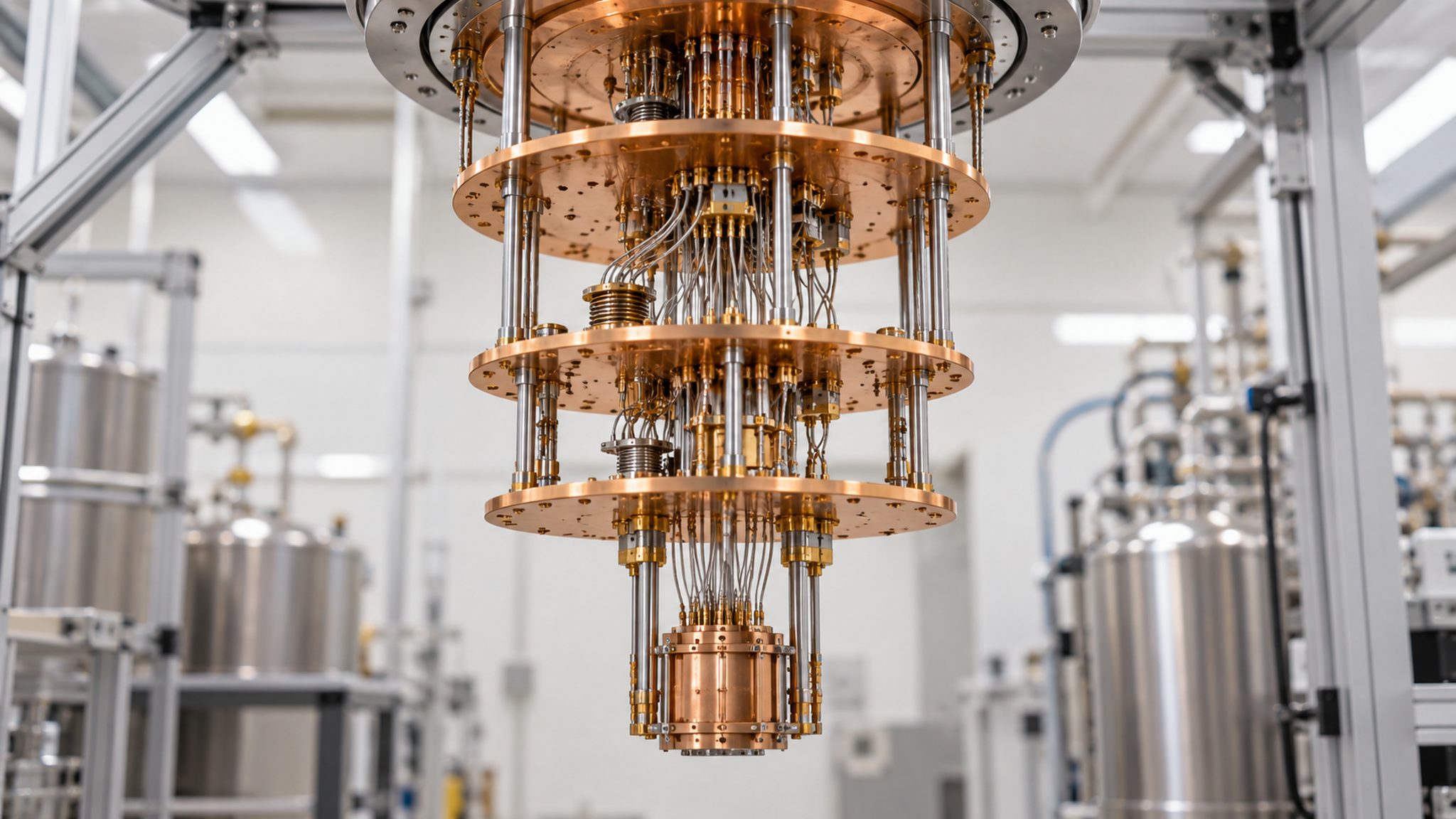
How helium dilution removes heat
Dilution refrigeration uses the behaviour of helium isotopes at low temperatures; it does not obtain cooling by mixing ordinary gases at room temperature.
- Helium-3 and helium-4 have different atomic masses but belong to the same element. The refrigerator exploits their low-temperature mixture, rather than a chemical reaction that permanently consumes them as fuel.
- At sufficiently low temperatures, the mixture separates into a helium-3-rich phase and a dilute phase containing helium-3 in helium-4. This phase behaviour supplies the physical basis for the refrigerator’s coldest stage.
- When helium-3 passes into the dilute phase, it absorbs heat. The mixing chamber couples this cooling process to the experimental load, removing thermal energy from the region that must be kept cold.
- A circulation system removes helium-3 from the dilute side and returns it through the cooling circuit. Heat exchangers help precool returning helium, enabling continuing refrigeration rather than only a single cooling event.
- The NBS thermodynamic treatment explains this mechanism. NIST’s operational account also shows why mixture monitoring matters: incorrect gas composition can disrupt temperature control and waste valuable experimental time.
What an indigenous refrigerator would establish
The policy significance lies in mastering an enabling instrument, while the actual achievement must be established through testing rather than inferred from the agreement.
- Domestic capability could make laboratories less dependent on imported cryogenic infrastructure, the objective identified by PIB. It would complement work on quantum devices by strengthening the equipment base needed to test them.
- Integration skills matter alongside fabrication: laboratories need staff able to operate, diagnose and maintain the apparatus. NIST’s mixture-diagnosis example shows how instrument knowledge can determine whether an experiment continues or loses usable time.
- Acceptance testing should examine temperature stability with a representative experimental load, repeatability and recovery after interruptions. These are proposed evaluation criteria, not performance results already reported for the Indian development project.
- Capability claims should identify what was actually tested, under which conditions and for how long. A working refrigerator would establish cryogenic capability; it would not by itself demonstrate a useful quantum computer.
- Supply resilience requires examining critical components and servicing as well as final assembly. Policymakers should distinguish domestic manufacture of a system from complete domestic sourcing, which this announcement does not establish.
Way Forward
Test the enabling capability
- Require measured acceptance criteria for stable operation under realistic experimental heat loads.
- Build maintenance and diagnostic expertise with laboratories that will use the refrigerator.
- Report development milestones separately from validated quantum-device performance.
Conclusion
- Dilution refrigeration illustrates how advanced computing depends on physical infrastructure: a stable experimental environment is part of the capability, not merely an accessory purchased after the device is developed.
- The DRDO agreement is a development step toward indigenous ultra-cold equipment. Its scientific significance should be assessed through demonstrated operation, while keeping the requirements of different quantum platforms distinct.
UPSC Practice Questions
Prelims MCQ 1
With reference to dilution refrigeration, consider the following statements:
- It uses a mixture of helium isotopes.
- A temperature of 20 mK is below absolute zero.
- Every quantum computing platform necessarily requires a dilution refrigerator.
How many of the above statements are correct?
(a) Only one (b) Only two (c) All three (d) None
Answer: (a) Only one
Explanation:
Only the first statement is correct. Twenty millikelvin is 0.020 K above absolute zero; refrigeration requirements depend on the quantum platform.
Prelims MCQ 2
Which process provides cooling at the mixing chamber of a helium dilution refrigerator?
(a) Combustion of helium with oxygen (b) Dilution of helium-3 into the helium-4-rich phase (c) Nuclear fission of helium atoms (d) Heating the quantum device above room temperature
Answer: (b) Dilution of helium-3 into the helium-4-rich phase
Explanation:
Helium-3 absorbs heat as it enters the dilute phase. Circulation sustains the process.
UPSC Mains Questions
- Explain why indigenous enabling infrastructure is important for quantum technology development. Illustrate with dilution refrigeration.
- Distinguish a technology-development agreement from demonstrated scientific capability. Suggest evaluation criteria for an indigenous cryogenic system.
Sources: PIB, Ministry of Defence and NIST, cryogenic systems and helium dilution thermodynamics.
Frequently Asked Questions
What is a dilution refrigerator?
It is a cryogenic instrument that uses helium-3 and helium-4 to achieve extremely low temperatures. Heat absorption during helium-3 dilution cools the experimental region, while circulation sustains the process.
Does 20 mK mean below absolute zero?
No. Twenty millikelvin equals 0.020 kelvin above absolute zero. The prefix milli means one thousandth; it does not indicate a negative temperature or a temperature below the physical zero point.
Has India completed this refrigerator?
The announcement concerns a development agreement between DRDO and Zero mK India Private Limited. It does not report a completed instrument, demonstrated 20 mK performance or operational deployment of the proposed refrigerator.
Do all quantum computers require this equipment?
No. Cooling requirements depend on the physical platform. Dilution refrigerators support several quantum technologies, including superconducting circuits, but the defence release does not describe them as mandatory for every quantum computing approach.