Digital Personal Data Protection Rules, 2025 Operationalised
Why in News?
The Digital Personal Data Protection Rules, 2025, notified by the Ministry of Electronics and Information Technology (MeitY) on 14 November 2025 under Section 40 of the DPDP Act, 2023, moved into phased implementation through December 2025. The subordinate Rules supply the operational machinery the Act had left blank for nearly two years, giving India its first working data-protection regime.
The Rules detail consent notices, register Consent Managers, set security and breach-notification duties, and stand up the Data Protection Board of India — with compliance staggered over up to 18 months so firms can ready their systems.
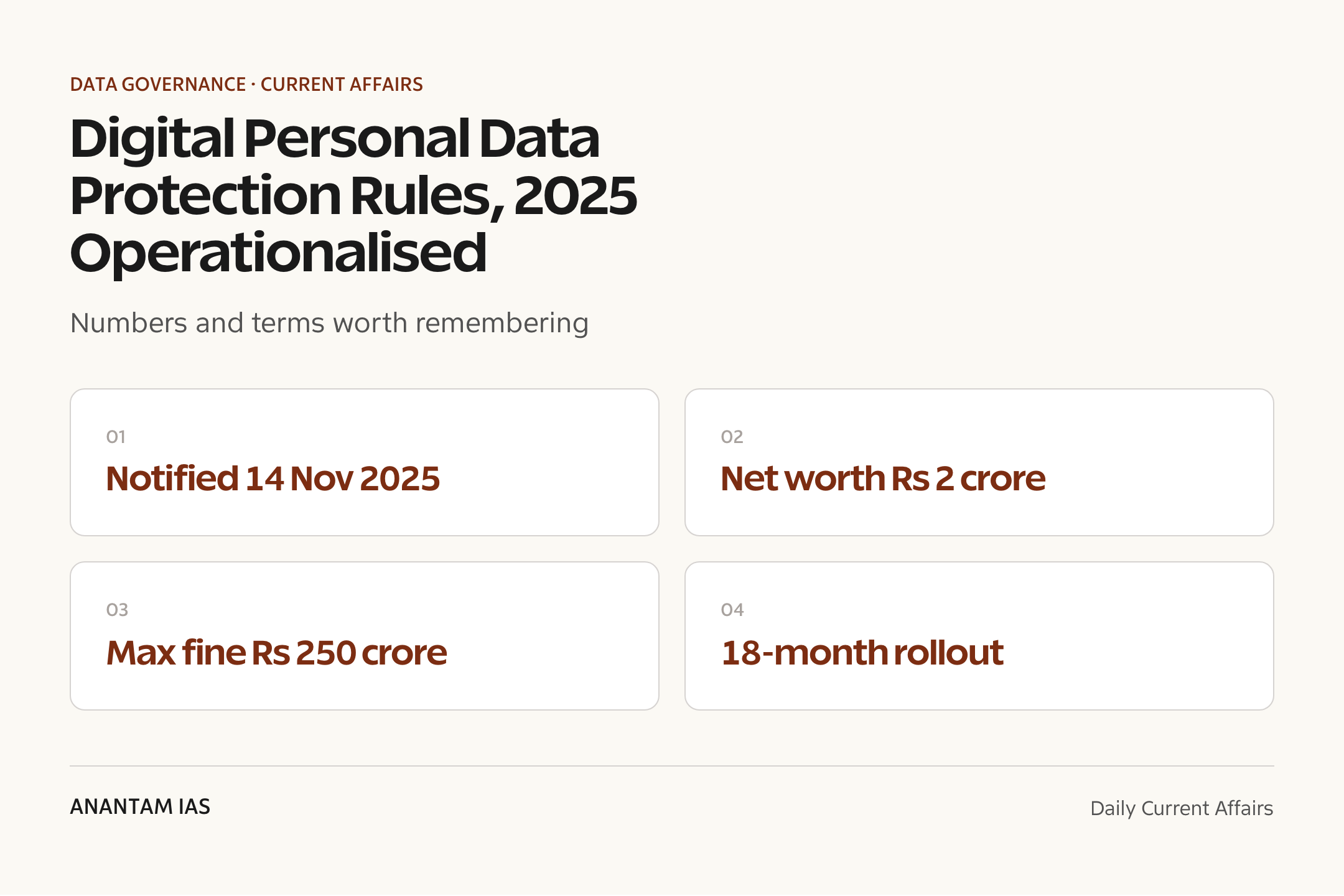
- Notified 14 November 2025 under Section 40 of the DPDP Act, 2023; provisions for the Data Protection Board commenced 13 November 2025.
- Rules 1, 2 and 17-21 took effect immediately on publication; the bulk (Rules 3, 5-16, 22-23) apply 18 months later.
- Consent Manager registration (Rule 4) is reserved for a later notification, with a minimum net worth of Rs 2 crore.
- Operationalises the DPDP Act, 2023 — India’s first comprehensive data-protection statute — which received assent on 11 August 2023.
- Anchors the right to privacy recognised in Justice K.S. Puttaswamy v. Union of India (2017) in an enforceable digital framework.
The development matters in the context of:
- India processes one of the world’s largest volumes of digital personal data yet had no horizontal privacy law until the DPDP Act, 2023.
- The Rules close the gap between a passed-but-dormant statute and on-ground enforcement, signalling India’s shift from a rights declaration to a compliance regime.

UPSC Relevance
Prelims Relevance
- DPDP Rules, 2025 — notified 14 November 2025 by MeitY under Section 40 of the DPDP Act, 2023.
- DPDP Act, 2023 — assent 11 August 2023; India’s first comprehensive data-protection law.
- Data Principal — the individual to whom the personal data relates.
- Data Fiduciary — the entity that determines the purpose and means of processing.
- Significant Data Fiduciary (SDF) — high-volume/high-risk fiduciary with extra duties (DPIA, audit).
- Consent Manager — India-incorporated entity (net worth Rs 2 crore) enabling consent give/manage/withdraw.
- Data Protection Board of India — adjudicatory body; appeals lie to the Appellate Tribunal (TDSAT).
- Maximum penalty Rs 250 crore for failure to take reasonable security safeguards; Rs 200 crore for breach-notification failure.
- Justice K.S. Puttaswamy v. Union of India (2017) — declared the right to privacy a fundamental right under Article 21.
- B.N. Srikrishna Committee (2018) — drafted the original data-protection bill.
Mains Relevance
GS Paper 2
- Governance: how subordinate rule-making operationalises a framework statute and balances individual rights with ease of doing business.
- Statutory bodies: the design, independence and adjudicatory role of the Data Protection Board of India.
GS Paper 3
- Internal security and IT: data breaches, cyber-security safeguards, and obligations on Significant Data Fiduciaries.
- Economy: compliance burden on the digital economy, start-ups and Consent Manager market design.
Essay
- Privacy in the age of data — balancing individual dignity against state and market surveillance.
- From rights on paper to rights in practice: the long road from Puttaswamy to enforceable law.
Background and Context
From Puttaswamy to a statute
The Rules are the final step in an eight-year arc that began with a constitutional ruling.
- Justice K.S. Puttaswamy v. Union of India (2017) held that the right to privacy is intrinsic to the right to life and personal liberty under Article 21.
- The judgment directed the State to craft a data-protection regime, prompting the B.N. Srikrishna Committee (2018) to draft the first bill.
- After several redrafts, the DPDP Act, 2023 received assent on 11 August 2023 but lay largely dormant pending these implementing Rules.
- The DPDP Rules, 2025, notified on 14 November 2025, supply the operational detail and finally switch on the regime.
Consent-based processing and notices
The architecture rests on free, informed, specific and revocable consent.
- Under Rule 3, a Data Fiduciary must give the Data Principal a consent notice that is clear, accessible and in simple language, presented separately from other information.
- The notice must itemise the personal data collected, the purpose, contact details, and the mechanism to withdraw consent or exercise rights.
- Consent must be as easy to withdraw as it was to give, reflecting the Act’s intent that processing follows purpose.
- Rule 5 lets the State process data for subsidies, benefits, licences and public services per the Second Schedule, including statutory schemes.
Consent Managers — a new institution
The Rules create a regulated intermediary to make consent portable and auditable.
- A Consent Manager (Rule 4) is a single point through which a Data Principal can give, review, manage and withdraw consent across Data Fiduciaries.
- Eligibility requires incorporation in India and a minimum net worth of Rs 2 crore (First Schedule), filtering out under-capitalised entities.
- Consent Managers must run interoperable platforms, maintain high security, and keep records of consents and data sharing.
- Registration takes effect on a later notification, signalling a phased build-out of this market.
Data Fiduciary obligations
Every entity that decides why and how data is processed carries baseline duties.
- Rule 6 mandates reasonable security safeguards — encryption, tokenisation, access controls, logging, and backup/recovery.
- Rule 7 requires breach notification to affected individuals without delay and to the Data Protection Board within a tight window, with details and mitigation steps.
- Rule 8 sets retention and deletion norms — data is erased once its purpose ends, with at least 48 hours’ notice before deletion and logs kept for a minimum period.
- Rule 9 requires a Data Fiduciary to publish a Data Protection Officer contact and honour access, correction and erasure requests.
Stricter duties for Significant Data Fiduciaries
Large or high-risk processors face a heavier accountability tier.
- Rule 13 requires a Significant Data Fiduciary to conduct an annual Data Protection Impact Assessment (DPIA) and independent audit.
- An SDF must verify that its algorithms do not pose a risk to Data Principals’ rights.
- Transfers of specified personal data outside India may be restricted unless the Central Government authorises them.
- Classification as an SDF turns on data volume, sensitivity, and risk to sovereignty, electoral democracy and public order.
Children and persons with disabilities
The Rules build specific safeguards for those who cannot consent for themselves.
- Rule 10 requires verifiable parental consent before processing a child’s data, using reliable age-verification — including digital lockers or authorised government platforms.
- Behavioural tracking and targeted advertising directed at children is barred under the Act.
- Rule 11 requires the verifiable consent of a lawful guardian for persons with disabilities under guardianship.
- Rule 12 carves limited exemptions for specified fiduciaries and purposes listed in the Fourth Schedule.
The Data Protection Board and penalties
Enforcement runs through a digital-first adjudicator backed by heavy fines.
- The Data Protection Board of India (Rules 17-23) functions as a digital office that can hold electronic hearings and call for information from fiduciaries.
- Appeals against Board orders lie to the Appellate Tribunal (TDSAT).
- The Act’s Schedule sets a maximum penalty of Rs 250 crore for failure to take reasonable security safeguards.
- Failure to notify a breach attracts up to Rs 200 crore; the exact quantum is set by the Board after weighing gravity, duration and due diligence.
Way Forward
Operational readiness
- Firms should map data flows, appoint Data Protection Officers, and rebuild consent journeys well before the 18-month window closes.
- MeitY should publish the Second and Fourth Schedules’ fine print and notify Consent Manager registration promptly to give the ecosystem certainty.
Capacity and trust
- The Data Protection Board needs independent staffing, technical expertise and transparent procedure to command public confidence.
- Clear cross-border transfer rules and an SDF list will reduce ambiguity for the digital economy and start-ups.
Sustained awareness so Data Principals understand their rights to access, correct, erase and grieve will decide whether the law translates into real privacy on the ground.
Conclusion
The DPDP Rules, 2025, turn a long-passed statute into a live regime, completing the journey the Puttaswamy ruling set in motion. By codifying consent, security, breach-notification and accountability, they shift India from declaring a right to enforcing it.
The phased 18-month rollout buys industry time, but the test now is institutional — whether the Data Protection Board acts with independence and whether consent genuinely empowers the citizen rather than becoming a click-through ritual.
UPSC Practice Questions
Prelims MCQ 1
With reference to the Digital Personal Data Protection Rules, 2025, consider the following statements:
- They were notified under the Information Technology Act, 2000.
- They provide for the registration of Consent Managers incorporated in India.
- All provisions came into force immediately on the date of publication.
How many of the above statements are correct?
(a) Only one (b) Only two (c) All three (d) None
Answer: (a) Only one
Explanation:
Only statement 2 is correct. The Rules were notified under Section 40 of the DPDP Act, 2023 (not the IT Act, 2000), so statement 1 is wrong. Implementation is phased over up to 18 months, so statement 3 is wrong.
Prelims MCQ 2
The right to privacy was declared a fundamental right intrinsic to Article 21 in which case?
(a) Maneka Gandhi v. Union of India (1978) (b) Justice K.S. Puttaswamy v. Union of India (2017) (c) Kesavananda Bharati v. State of Kerala (1973) (d) Shreya Singhal v. Union of India (2015)
Answer: (b) Justice K.S. Puttaswamy v. Union of India (2017)
Explanation:
The nine-judge Bench in Puttaswamy (2017) held that the right to privacy is a fundamental right protected under Article 21, the foundation the DPDP Act and Rules now operationalise.
UPSC Mains Questions
- The Digital Personal Data Protection Rules, 2025, mark India’s shift from declaring the right to privacy to enforcing it. Examine the key obligations the Rules impose on Data Fiduciaries and the institutional role of the Data Protection Board of India.
- Subordinate legislation often decides the fate of a framework statute. In light of the DPDP Rules, 2025, discuss how phased rule-making balances the protection of personal data against the compliance burden on the digital economy.
Sources: Ministry of Electronics and Information Technology (MeitY) and SCC Online.
Frequently Asked Questions
What are the DPDP Rules, 2025?
They are the subordinate rules notified by MeitY on 14 November 2025 under Section 40 of the Digital Personal Data Protection Act, 2023. They supply the operational detail the Act left blank — consent notices, Consent Manager registration, security and breach-notification duties, retention norms and the Data Protection Board — finally making India’s data-protection regime workable.
When do the Rules take effect?
Implementation is phased. Rules 1, 2 and 17-21 took effect immediately on publication; most substantive obligations (Rules 3, 5-16, 22-23) apply about 18 months later. Consent Manager registration under Rule 4 is reserved for a separate, later notification, giving firms time to build compliant systems.
Who is a Data Fiduciary and a Data Principal?
A Data Principal is the individual to whom the personal data relates. A Data Fiduciary is the entity that decides the purpose and means of processing that data. The Rules place obligations on fiduciaries and rights — access, correction, erasure and grievance redressal — with the principals.
What is a Consent Manager?
A Consent Manager is a regulated, India-incorporated intermediary through which a person can give, review, manage and withdraw consent across multiple Data Fiduciaries from one place. Eligibility requires a minimum net worth of Rs 2 crore and the ability to run secure, interoperable consent platforms.
What penalties can the Data Protection Board impose?
The Act’s Schedule sets a maximum penalty of Rs 250 crore for failure to take reasonable security safeguards and up to Rs 200 crore for failing to notify a breach. The Data Protection Board of India adjudicates and fixes the exact quantum based on the gravity, duration and due diligence shown.
How are children’s data protected?
Under Rule 10, a Data Fiduciary must obtain verifiable parental or guardian consent before processing a child’s personal data, using reliable age-verification methods. Behavioural tracking and targeted advertising aimed at children are barred, and similar safeguards apply to persons with disabilities under guardianship.