Drug-Resistant Malaria: A Growing Threat to Treatment and Elimination
Why in News?
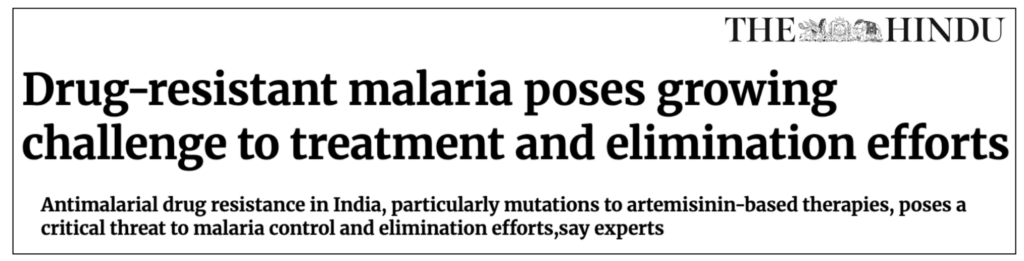
The growing spread of drug-resistant malaria poses a major challenge to effective treatment and disease elimination, as partial resistance to artemisinin—the cornerstone of modern antimalarial therapy—has emerged in parts of Asia and is confirmed or suspected in several African regions.
Resistance threatens the effectiveness of artemisinin-based combination therapies (ACTs), the gold-standard cure for the deadliest form of malaria, and complicates both India’s 2030 elimination target and the global push under the WHO.
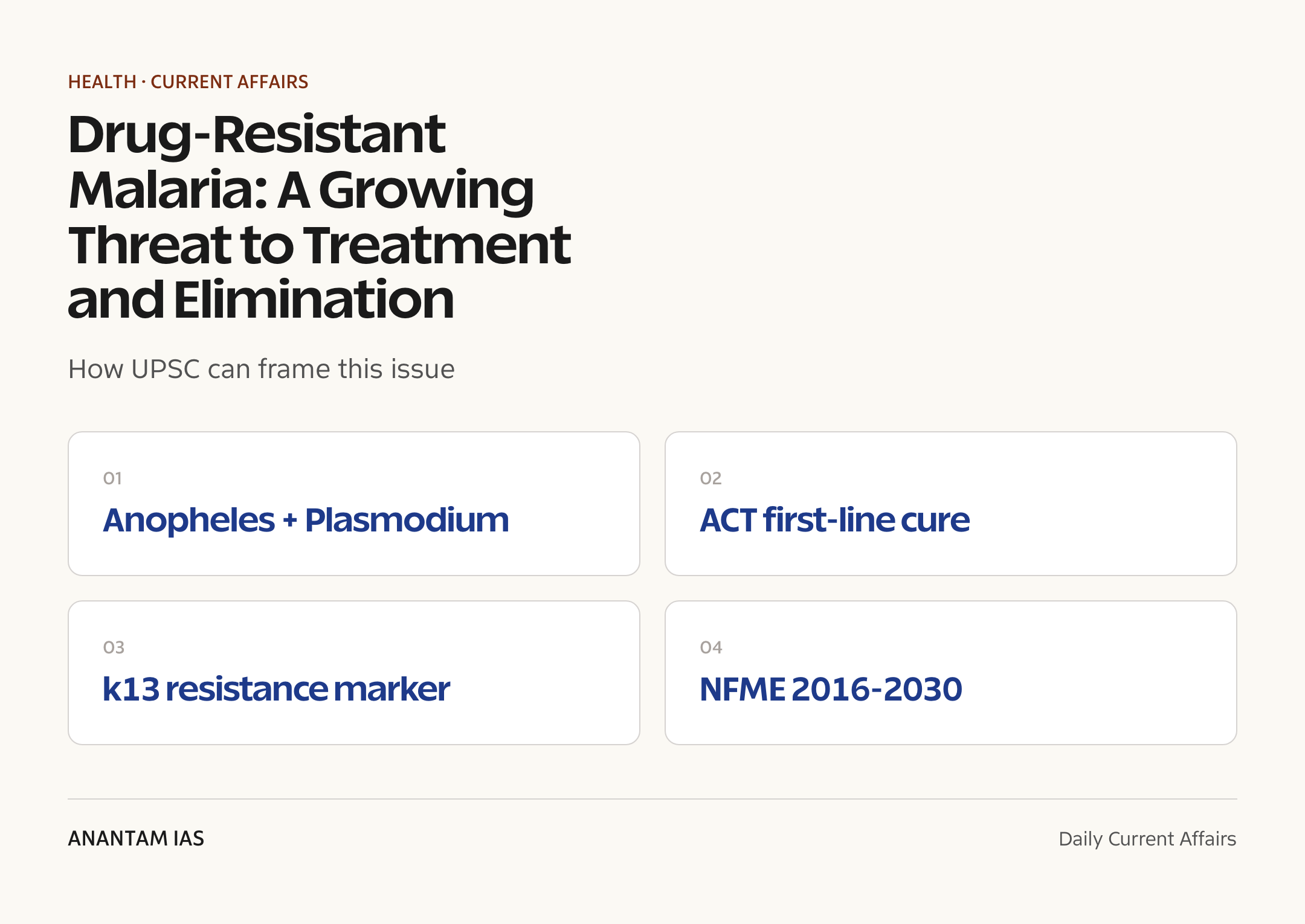
- Malaria is caused by Plasmodium parasites and spread to humans by the bite of an infected female Anopheles mosquito; P. falciparum is the deadliest species.
- ACTs pair a fast-acting artemisinin derivative with a longer-acting partner drug; they replaced chloroquine and sulfadoxine-pyrimethamine after those failed to combat resistance.
- Artemisinin partial resistance shows up as delayed parasite clearance — parasites survive longer after treatment — first detected in the Greater Mekong Subregion around 2008-09.
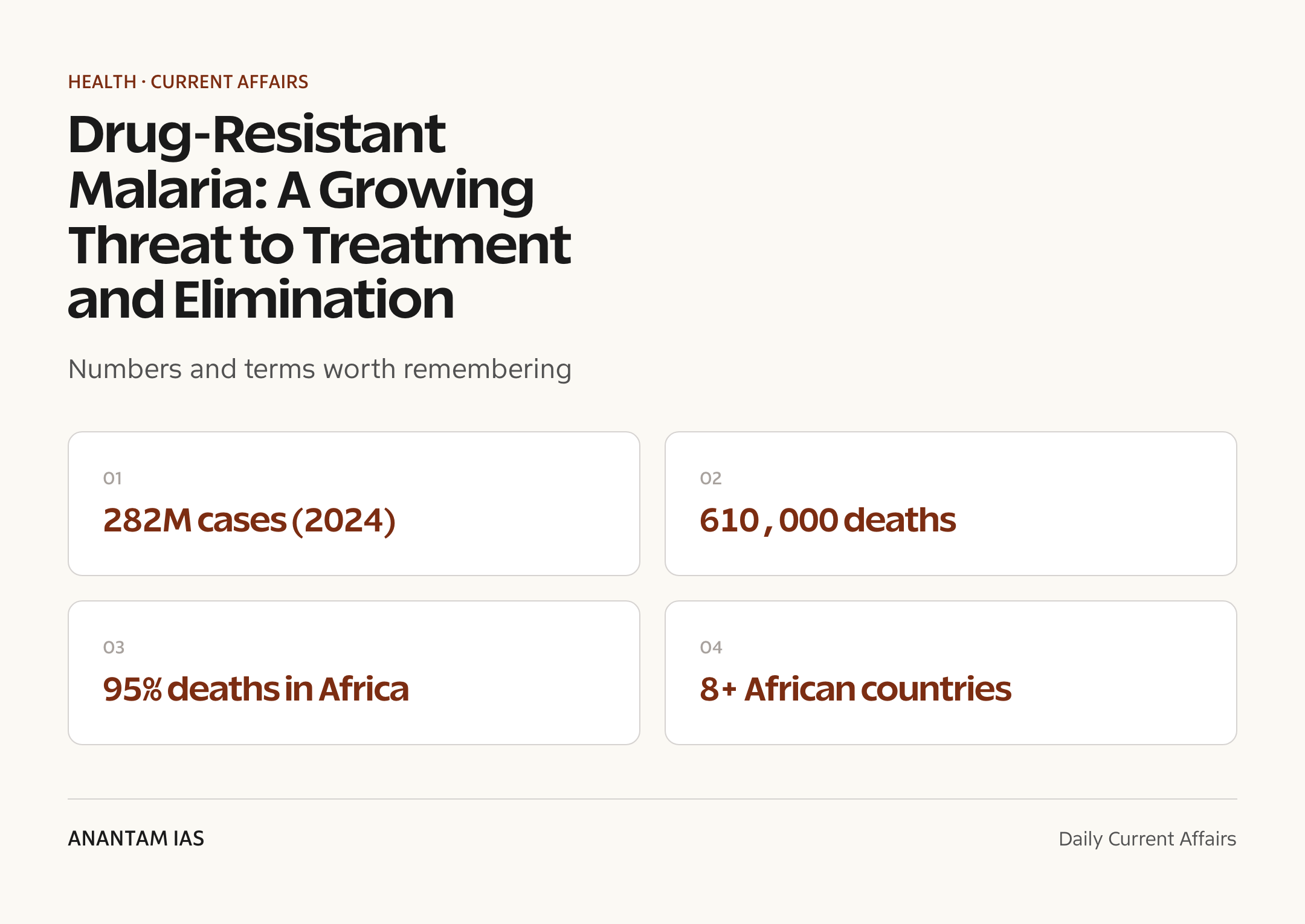
- The WHO World Malaria Report 2025 estimated about 282 million cases and 610,000 deaths globally in 2024, with roughly 95% of deaths in the African Region, mostly children under five.
- Partial artemisinin resistance is now confirmed or suspected in at least eight African countries, raising fears of treatment failure on the continent that carries most of the burden.
- In India, the parasite is monitored using the kelch13 (k13) molecular marker, with reduced sensitivity and ACT-failure signals reported from the north-east and parts of eastern India.
The development matters in the context of:
- Drug resistance matters because, unlike for chloroquine, there is no equally cheap, proven replacement ready if ACTs fail — losing artemisinin would set back decades of gains.
- India aims for zero indigenous cases by 2027 and sustained malaria-free status by 2030; resistance in border and forested pockets could reverse that trajectory.
- It is also a marker of the wider antimicrobial resistance (AMR) crisis, where over-use, sub-standard drugs and monotherapy accelerate the loss of frontline medicines.
UPSC Relevance
Prelims Relevance
- Vector & parasite: female Anopheles mosquito transmits Plasmodium (P. falciparum, P. vivax, P. malariae, P. ovale, P. knowlesi); P. falciparum is the deadliest, P. vivax the most widespread in India.
- ACT = artemisinin-based combination therapy — artemisinin derivative + a partner drug; WHO-recommended first-line for uncomplicated falciparum malaria.
- Artemisinin is derived from the plant Artemisia annua (sweet wormwood); Tu Youyou won the 2015 Medicine Nobel for its discovery.
- Artemisinin partial resistance = delayed parasite clearance, not full treatment failure; tracked via the kelch13 (k13) gene mutation.
- First reported in the Greater Mekong Subregion (Cambodia-Thailand border) around 2008-09; now in Africa and parts of South Asia.
- India’s blueprint: National Framework for Malaria Elimination (NFME) 2016-2030, by the National Centre for Vector Borne Diseases Control (NCVBDC) under the Ministry of Health and Family Welfare.
- Targets: zero indigenous cases by 2027; malaria-free status maintained through 2030; aligns with WHO’s Global Technical Strategy (GTS) 2016-2030.
- WHO World Malaria Report 2025: ~282 million cases, ~610,000 deaths globally (2024); ~95% of deaths in Africa.
- Other tools: RTS, S/AS01 (Mosquirix) and R21/Matrix-M malaria vaccines; insecticide-treated bed nets and indoor residual spraying for vector control.
Mains Relevance
GS Paper 3
- Drug resistance as a science-and-technology and public-health challenge; the economics of antimalarial R&D and the AMR threat.
- Vector-borne disease surveillance, molecular monitoring (k13) and the technology needs of an elimination programme.
GS Paper 2
- Government health interventions — NFME 2016-2030, primary-health-system readiness and global cooperation with the WHO.
GS Paper 3
- Climate change is widening the transmission window for Anopheles and complicating elimination timelines.
Essay
- Science as a race against nature — when our best cures stop working.
- Health for all: the last mile of disease elimination is the hardest.
Background and Context
What Malaria is and how it spreads
Malaria is a parasitic disease, not a bacterial or viral one, carried by a specific mosquito.
- Caused by single-celled Plasmodium parasites; transmitted by the bite of an infected female Anopheles mosquito, which needs a blood meal to develop her eggs.
- Five species infect humans: P. falciparum (deadliest, dominant in Africa), P. vivax (most widespread, common in India and can relapse), plus P. malariae, P. ovale and the zoonotic P. knowlesi.
- Symptoms — fever, chills, headache — appear after the parasite multiplies in the liver and then red blood cells; untreated falciparum can cause cerebral malaria and death.
- Not spread person-to-person directly; control so targets both the parasite (drugs) and the vector (nets, spraying).
ACTs — the drug that changed malaria treatment
Artemisinin-based combination therapy is the WHO-recommended cure for falciparum malaria.
- Artemisinin comes from Artemisia annua (sweet wormwood), used in traditional Chinese medicine; its isolation earned Tu Youyou the 2015 Nobel Prize in Medicine.
- An ACT pairs a fast-acting artemisinin derivative (artesunate, artemether) that rapidly cuts the parasite load with a longer-acting partner drug (e.g. lumefantrine, piperaquine) that clears the remainder.
- Combining two drugs with different mechanisms is deliberate — it makes resistance harder to develop, the same logic behind multi-drug TB and HIV regimens.
- ACTs became frontline therapy after chloroquine and sulfadoxine-pyrimethamine lost efficacy due to resistance through the late 20th century.
How artemisinin partial resistance works
Resistance here means the drug is slower, not yet useless — but that is an early warning.
- Partial resistance manifests as delayed parasite clearance: parasites take longer to disappear after treatment, surviving the artemisinin pulse and relying on the partner drug to finish the job.
- It is linked to mutations in the parasite’s kelch13 (k13) gene, the validated molecular marker used for surveillance worldwide.
- The danger is cumulative — if the partner drug then also weakens, the whole ACT can fail, as already seen for some combinations in the Mekong.
- First detected in the Greater Mekong Subregion around 2008-09, the WHO World Malaria Report 2025 notes it is now confirmed or suspected in at least eight African countries.
The Indian picture
India has both falciparum and vivax malaria, and early resistance signals in specific pockets.
- Studies have reported a reduction in in-vitro artemisinin sensitivity and instances of ACT failure in north-east India and parts of eastern India, tracked via the k13 marker.
- In the north-east, first-line therapy was shifted to artemether-lumefantrine (AL) as resistance emerged to the earlier artesunate-SP regimen.
- P. vivax, dominant across much of India, brings its own challenge — dormant liver stages cause relapses and need radical cure (e.g. primaquine/tafenoquine), independent of artemisinin resistance.
- Border, forested and tribal districts — with mobile populations and weaker access — are the hardest pockets to clear and the likeliest places for resistance to take hold.
India’s elimination framework
The NFME 2016-2030 sets a phased, district-by-district path to eliminate malaria.
- The National Framework for Malaria Elimination (NFME) 2016-2030 was launched in 2016 by the Ministry of Health and Family Welfare, run through the NCVBDC (formerly NVBDCP).
- It classifies districts by transmission intensity (Category 0-3) and targets zero indigenous cases by 2027 and sustained malaria-free status by 2030.
- India has made large gains — cases fell sharply over the past decade, with the WHO crediting India for being on track to cut cases by over 70% against 2015 levels.
- India accounts for the bulk of cases in the WHO South-East Asia Region, so its progress shapes the regional and global trajectory.
Why resistance imperils elimination
The ‘last mile’ of elimination is exactly where a failing drug does the most damage.
- Elimination depends on rapidly curing every confirmed case to break transmission; if ACTs slow or fail, infections persist, and the chain of transmission survives.
- There is no cheap, ready successor to artemisinin in the way ACTs replaced chloroquine — the antimalarial pipeline is thin, so losing this class is hard to recover from.
- Resistance is amplified by monotherapy, sub-standard or counterfeit drugs, incomplete dosing and unregulated drug sales — all forms of misuse that mirror the broader AMR problem.
- Climate change is extending the geographic and seasonal range of Anopheles, adding new transmission risk just as the drug toolkit narrows.
Way Forward
Sharpen surveillance
- Scale up routine k13 molecular monitoring and therapeutic-efficacy studies, especially in north-east and eastern India and along borders, to catch resistance early.
- Integrate genomic surveillance with the elimination programme so treatment policy can change district-by-district as signals appear.
Protect the drugs
- Ban and police artemisinin monotherapy, crack down on substandard and counterfeit antimalarials, and ensure full-course, supervised dosing.
- Deploy multiple first-line therapies and consider triple ACTs where resistance is emerging, to slow selection pressure.
Invest in the pipeline
- Back R&D for new antimalarials, next-generation ACTs and the wider rollout of RTS, S and R21/Matrix-M vaccines.
- Sustain vector control — insecticide-treated nets, indoor residual spraying — and manage insecticide resistance in parallel.
Strengthen primary health systems and community surveillance in last-mile districts so every fever is tested, every case treated to cure, and no infection is left to transmit.
Conclusion
Drug-resistant malaria is a slow-moving emergency: artemisinin still works, but it is working less well, and there is no easy replacement waiting in line. The same combination logic that made ACTs durable must now be defended through tight stewardship, surveillance and a refilled drug pipeline.
For India, the gap between today’s progress and the 2027-2030 elimination goal will be decided in exactly the forested, border and tribal pockets where resistance is most likely to surface. Catching it early — and protecting the drugs we still have — is what turns elimination from a target into an outcome.
UPSC Practice Questions
Prelims MCQ 1
With reference to malaria and its treatment, consider the following statements:
- Malaria is caused by a Plasmodium parasite transmitted by the bite of a female Anopheles mosquito.
- Artemisinin-based combination therapy (ACT) is the WHO-recommended first-line treatment for uncomplicated Plasmodium falciparum malaria.
- Artemisinin partial resistance refers to the complete failure of the artemisinin drug to kill any parasites.
How many of the above statements are correct?
(a) Only one (b) Only two (c) All three (d) None
Answer: (b) Only two
Explanation:
Statements 1 and 2 are correct. Statement 3 is wrong: partial resistance means delayed parasite clearance (the drug is slower and less effective), not total failure to kill parasites.
Prelims MCQ 2
The ‘National Framework for Malaria Elimination (NFME) 2016-2030’, sometimes seen in the news, is associated with which of the following?
(a) Ministry of Environment, Forest and Climate Change
(b) National Centre for Vector Borne Diseases Control under the Ministry of Health and Family Welfare
(c) Indian Council of Agricultural Research
(d) Department of Biotechnology
Answer: (b) National Centre for Vector Borne Diseases Control under the Ministry of Health and Family Welfare
Explanation:
The NFME 2016-2030 is implemented through the National Centre for Vector Borne Diseases Control (NCVBDC, formerly NVBDCP) under the Ministry of Health and Family Welfare, targeting zero indigenous cases by 2027.
UPSC Mains Questions
- The spread of artemisinin partial resistance threatens to undo decades of progress against malaria. Discuss the causes of antimalarial drug resistance and suggest measures to protect the effectiveness of artemisinin-based combination therapies. (250 words)
- Examine the challenges India faces in meeting its goal of eliminating malaria by 2030, with reference to drug resistance, the vivax parasite, climate change and last-mile health-system gaps. (150 words)
Sources: The Hindu and WHO, World Malaria Report 2025.
Frequently Asked Questions
What causes malaria and how does it spread?
Malaria is caused by single-celled Plasmodium parasites, not bacteria or viruses. It spreads to humans through the bite of an infected female Anopheles mosquito. Of the five species that infect humans, P. falciparum is the deadliest and P. vivax the most widespread in India. It does not spread directly from person to person.
What is ACT and why is it important?
ACT stands for artemisinin-based combination therapy. It pairs a fast-acting artemisinin derivative, which rapidly reduces the parasite load, with a longer-acting partner drug that clears the rest. ACTs are the WHO-recommended cure for falciparum malaria and replaced older drugs like chloroquine after they failed to resistance.
What is artemisinin partial resistance?
Partial resistance means the artemisinin component clears parasites more slowly than it should, so some survive the treatment pulse. It is detected as delayed parasite clearance and tracked through mutations in the parasite’s kelch13 (k13) gene. The drug is not yet useless, but it is an early warning that treatment could fail if the partner drug also weakens.
Where has drug-resistant malaria been found?
Artemisinin partial resistance was first detected in the Greater Mekong Subregion of Southeast Asia around 2008-09. The WHO World Malaria Report 2025 notes it is now confirmed or suspected in at least eight African countries. In India, reduced sensitivity and ACT-failure signals have been reported from the north-east and parts of eastern India.
What is India’s plan to eliminate malaria?
India follows the National Framework for Malaria Elimination (NFME) 2016-2030, run through the National Center for Vector Borne Diseases Control under the Ministry of Health and Family Welfare. It classifies districts by transmission intensity and targets zero indigenous cases by 2027 and sustained malaria-free status by 2030, in line with the WHO Global Technical Strategy.
Why does drug resistance threaten elimination?
Elimination requires curing every case quickly to break transmission. If ACTs slow or fail, infections persist and keep spreading. Unlike when ACTs replaced chloroquine, there is no cheap, proven successor ready, and the antimalarial pipeline is thin. Misuse such as monotherapy and substandard drugs, plus climate change widening mosquito range, makes the threat worse.