Drug-Resistant Shigella: Kerala’s Surveillance Warning for Diarrhoeal Disease
Why in News?
Kerala’s AMR surveillance data, highlighted on August 23 alongside a recent tertiary-centre study, showed that commonly used antibiotics are becoming unreliable against local Shigella isolates.
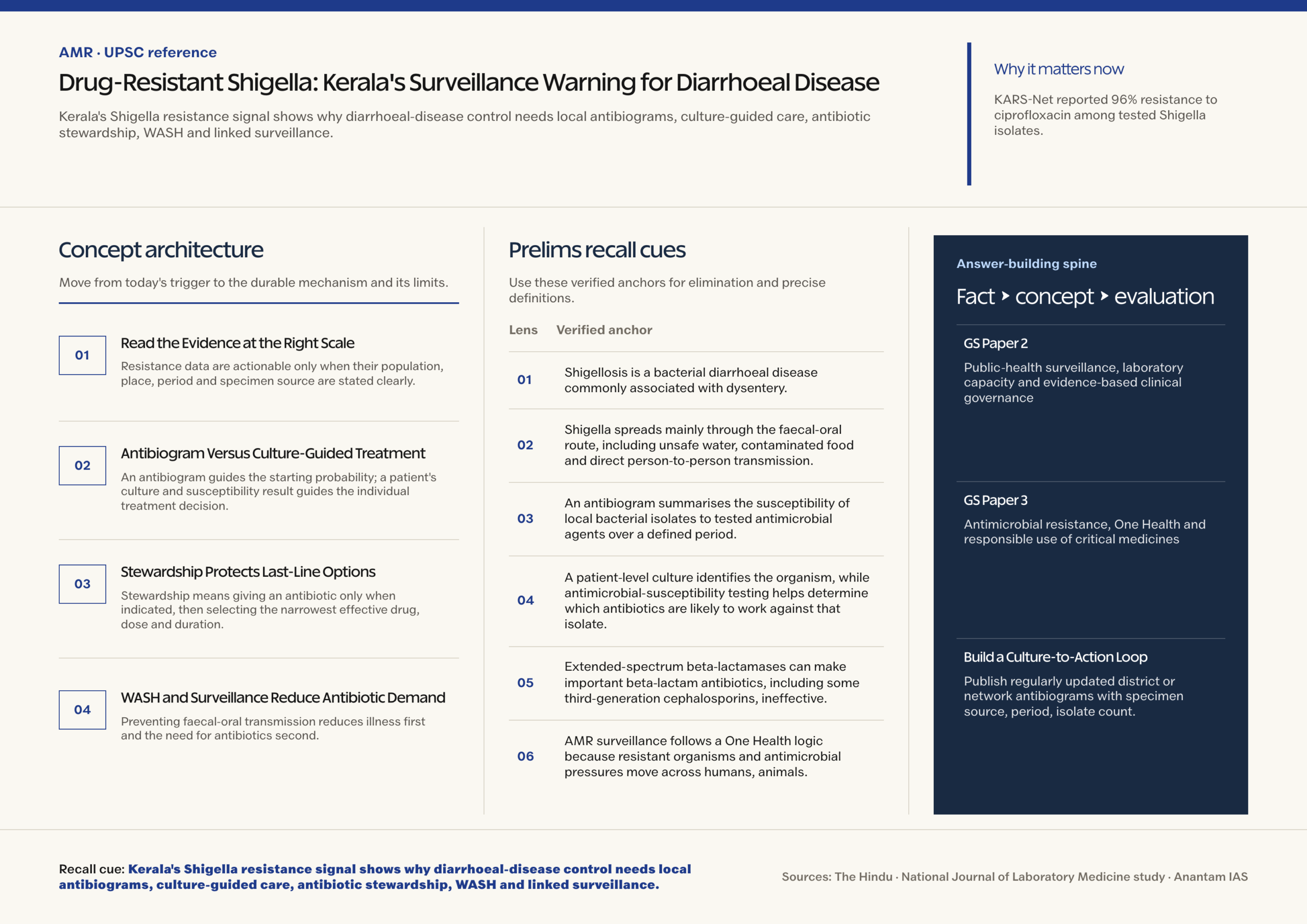
- KARS-Net reported 96% resistance to ciprofloxacin among tested Shigella isolates, making routine empirical reliance on this older option unsafe in that surveillance context.
- Resistance to ceftriaxone was reported at 36%, narrowing options for serious hospitalized cases that require timely effective treatment.
- A July study using historical isolates from a tertiary centre in north Kerala also found multidrug resistance and supported the need for regional monitoring.
- These datasets describe tested isolates and clinical settings; they do not establish the prevalence of resistant Shigella across Kerala’s entire population.
- Shigella is an enteric bacterium transmitted through the faecal-oral route, including contaminated food or water and person-to-person spread.
- Many diarrhoeal illnesses improve with appropriate rehydration, while selected severe or high-risk cases may need antibiotics based on clinical assessment and local resistance evidence.
- Resistance increases the risk of treatment failure, longer illness, costlier care and greater dependence on reserve antibiotics, linking community infection control with AMR governance.
UPSC Relevance
Prelims Relevance
- Shigellosis is a bacterial diarrhoeal disease commonly associated with dysentery.
- Shigella spreads mainly through the faecal-oral route, including unsafe water, contaminated food and direct person-to-person transmission.
- An antibiogram summarises the susceptibility of local bacterial isolates to tested antimicrobial agents over a defined period.
- A patient-level culture identifies the organism, while antimicrobial-susceptibility testing helps determine which antibiotics are likely to work against that isolate.
- Extended-spectrum beta-lactamases can make important beta-lactam antibiotics, including some third-generation cephalosporins, ineffective.
- AMR surveillance follows a One Health logic because resistant organisms and antimicrobial pressures move across humans, animals, food and the environment.
Mains Relevance
GS Paper 2
- Public-health surveillance, laboratory capacity and evidence-based clinical governance
- WASH services, outbreak response and equitable access to diagnostics
GS Paper 3
- Antimicrobial resistance, One Health and responsible use of critical medicines
Essay
- A medicine remains a public good only when institutions protect its effectiveness from avoidable misuse.
Background and Context
Read the Evidence at the Right Scale
Resistance data are actionable only when their population, place, period and specimen source are stated clearly.
- KARS-Net combines laboratory observations to identify changing susceptibility patterns, helping clinicians and health authorities detect when standard empirical choices are losing reliability across reporting sites.
- A tertiary-centre study captures patients reaching a referral hospital and may over-represent complicated illness, prior antibiotic exposure or treatment failure compared with community cases.
- The July study examined older specimens, so it supports a historical local signal rather than independently measuring the current statewide burden or present community transmission.
- Outbreak severity and resistance can occur together without proving that resistance caused particular deaths; that link needs patient-level clinical, microbiological and treatment data.
Antibiogram Versus Culture-Guided Treatment
An antibiogram guides the starting probability; a patient’s culture and susceptibility result guides the individual treatment decision.
- A local antibiogram aggregates recent isolates and shows how often each tested drug remained active within a hospital, district or surveillance network.
- For severe dysentery or an outbreak, collecting an appropriate stool specimen before antibiotics can improve organism identification and resistance tracking when clinically feasible.
- Empirical treatment may be necessary before results in a critically ill patient, but its choice should reflect local data, clinical severity and current guidelines.
- Once susceptibility results arrive, clinicians can confirm, narrow, change or stop therapy, reducing ineffective exposure, avoidable adverse effects and unnecessary pressure on broader-spectrum drugs.
Stewardship Protects Last-Line Options
Stewardship means giving an antibiotic only when indicated, then selecting the narrowest effective drug, dose and duration.
- Routine antibiotics for self-limiting watery diarrhoea create selective pressure without reliable benefit and can obscure the pathogen before a needed culture is obtained.
- Escalating every suspected case to a reserve drug would accelerate resistance and expose patients to avoidable harms; restricted agents need specialist and microbiology oversight.
- Hospitals should audit empirical prescriptions against culture results, provide rapid feedback and update treatment pathways when the local antibiogram changes materially over successive reporting periods.
- Community messaging should pair rehydration guidance and danger-sign recognition with a clear warning against self-medication and incomplete or shared antibiotic courses.
WASH and Surveillance Reduce Antibiotic Demand
Preventing faecal-oral transmission reduces illness first and the need for antibiotics second.
- Safe drinking water, functional sanitation, handwashing with soap and hygienic food preparation interrupt transmission without depending on an organism’s drug-susceptibility profile.
- Outbreak investigation should connect patient interviews, water and food testing, laboratory typing and sanitation inspection to locate a shared source or transmission chain.
- Laboratories need standard methods, quality assurance and timely reporting so district, State and national systems can compare trends without mixing incompatible data.
- Surveillance should include community and secondary-care sites, not only tertiary hospitals, to reveal geographic variation and make the denominator more representative.
Way Forward
Build a Culture-to-Action Loop
- Publish regularly updated district or network antibiograms with specimen source, period, isolate count, laboratory method and clear limits on interpretation.
- Expand stool-culture and susceptibility capacity during clusters, with rapid sample transport and results returned to treating clinicians and surveillance teams.
- Link stewardship committees to KARS-Net alerts so empirical protocols change when resistance thresholds make an existing first choice unreliable.
- Treat safe water, sanitation inspection and food hygiene as core AMR interventions because preventing infection lowers antibiotic consumption and transmission together.
Conclusion
- Kerala’s signal is not proof of uniform statewide prevalence; it is a warning that local susceptibility evidence must shape treatment and surveillance priorities.
- A strong Mains answer should join culture-guided care and stewardship with WASH prevention, because better prescribing cannot compensate for continued faecal-oral transmission.
UPSC Practice Questions
Prelims MCQ 1
With reference to an antibiogram, consider the following statements:
- It summarises antimicrobial susceptibility among bacterial isolates from a defined setting and period.
- It replaces the need for culture and susceptibility testing in every severe individual case.
- Its interpretation depends on factors such as specimen source, patient population and laboratory methods.
How many of the above statements are correct?
(a) Only one (b) Only two (c) All three (d) None
Answer: (b) Only two
Explanation:
Statements 1 and 3 are correct. An antibiogram informs empirical choices but does not replace patient-specific testing when culture is indicated and feasible.
Prelims MCQ 2
Which intervention most directly reduces both faecal-oral transmission of Shigella and the resulting demand for antibiotics?
(a) Routine prophylactic antibiotics for all contacts (b) Safe water, sanitation and hand hygiene (c) Automatic use of reserve antibiotics (d) Suspending stool cultures during outbreaks
Answer: (b) Safe water, sanitation and hand hygiene
Explanation:
WASH measures interrupt transmission and prevent illness, reducing both infection burden and antibiotic demand without adding antimicrobial selection pressure.
UPSC Mains Questions
- Why must local antibiograms be interpreted alongside patient-level culture results and the limits of surveillance data? Explain using Shigellosis as an example.
- Antimicrobial stewardship alone cannot control drug-resistant enteric disease. Discuss the complementary roles of WASH, laboratories and public-health surveillance.
Sources: The Hindu and National Journal of Laboratory Medicine study.
Frequently Asked Questions
What is Shigellosis?
Shigellosis is a bacterial intestinal infection that can cause diarrhoea or dysentery. It spreads mainly through faecally contaminated hands, food or water.
What does a local antibiogram show?
It summarises how frequently local bacterial isolates were susceptible to tested antibiotics during a defined period, helping clinicians choose evidence-based empirical therapy.
Why can a tertiary-centre study not establish statewide prevalence?
Referral hospitals see a selected patient population, often with more severe disease or prior treatment. Their isolates may not represent infections across all communities and facilities.
When is culture-guided treatment useful?
Culture and susceptibility testing are especially valuable in severe disease, outbreaks or suspected treatment failure because they identify the organism and drugs likely to remain effective.
How does WASH help control antimicrobial resistance?
Safe water, sanitation, hand hygiene and food safety prevent enteric infections, lowering antibiotic use and limiting transmission of both susceptible and resistant organisms.