India’s Proposed Drugs Law and the Design of Health Regulation
Why in News?
The Indian Express reported on 11 August 2026 that pharmaceutical and medical-device groups had objected to the latest proposed overhaul of India’s drugs law, arguing that important stakeholder suggestions were not reflected in the measure.
- The measure under discussion belongs to the continuing Drugs, Medical Devices and Cosmetics Bill process. The authoritative text publicly released by the Union Health Ministry is the 2022 draft; a December 2023 Rajya Sabha answer called.
- The 2022 draft proposed to repeal the Drugs and Cosmetics Act, 1940 and consolidate rules for quality, safety, efficacy, performance, clinical trials and clinical investigations.
- Its design kept drugs, devices and cosmetics inside one umbrella law but created a separate Medical Devices Technical Advisory Board, device-testing centres and a dedicated device chapter.
- The current disagreement should be read as a debate over consultation, institutional capacity and proportionate compliance. Industry objections do not by themselves establish that a safeguard is unnecessary, while a public-health objective does not excuse unclear.
- Until Parliament enacts a replacement and it is brought into force, the operative central statute remains the Drugs and Cosmetics Act, 1940, supported by instruments such as the Medical Devices Rules, 2017, New Drugs and.
- Medicines are chemical or biological products, while devices range from low-risk dressings to implants, diagnostic software and life-support systems. A common public-health purpose does not remove their different risk profiles and evidence pathways.
- India’s federal regulatory structure divides functions between the Centre and states. A new law must reduce uneven enforcement without making every decision dependent on one overburdened central office.
- The central policy test is a three-way balance among patient safety, predictable compliance and timely access to useful innovation. Weak surveillance can harm patients; excessive or poorly targeted compliance can delay access and burden smaller.
UPSC Relevance
Prelims Relevance
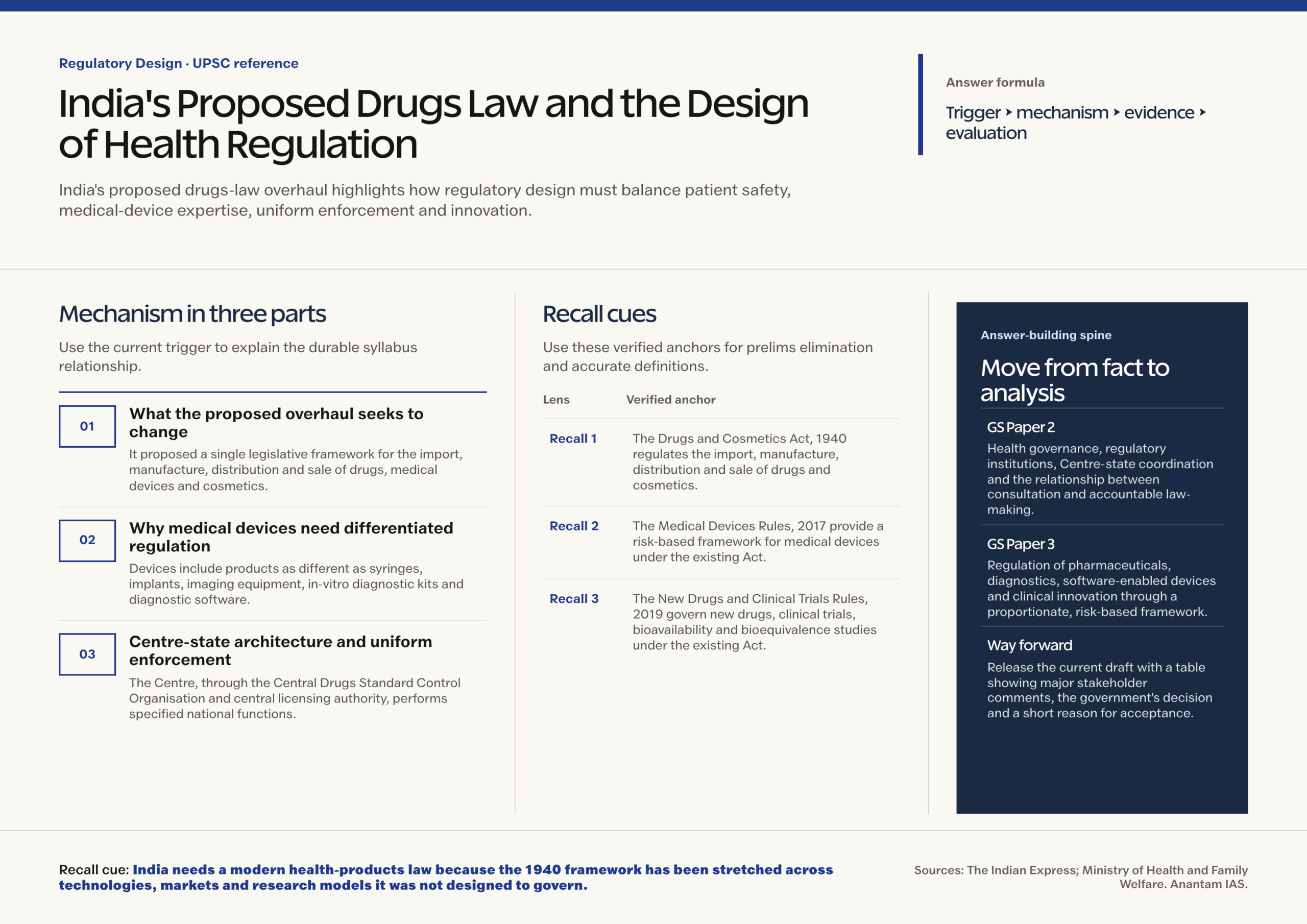
- The Drugs and Cosmetics Act, 1940 regulates the import, manufacture, distribution and sale of drugs and cosmetics; specified medical devices are covered through the statutory definition of drugs and subordinate rules.
- The Medical Devices Rules, 2017 provide a risk-based framework for medical devices under the existing Act.
- The New Drugs and Clinical Trials Rules, 2019 govern new drugs, clinical trials, bioavailability and bioequivalence studies under the existing Act.
- The 2022 draft defined a medical device separately and proposed a dedicated Medical Devices Technical Advisory Board alongside the Drugs Technical Advisory Board.
- The draft proposed central and state drug laboratories as well as central and state medical-device testing centres.
- A proposed consultative committee chaired by the Drugs Controller General of India was intended to promote uniform administration across the Union and states.
Mains Relevance
GS Paper 2
- Health governance, regulatory institutions, Centre-state coordination and the relationship between consultation and accountable law-making.
- Patient safety as a state capacity question involving inspections, laboratories, transparent recalls, adverse-event reporting and reasoned enforcement.
GS Paper 3
- Regulation of pharmaceuticals, diagnostics, software-enabled devices and clinical innovation through a proportionate, risk-based framework.
- Balancing domestic manufacturing and ease of doing business with quality assurance, traceability and post-market surveillance.
Essay
- Good regulation is neither maximum control nor minimum control; it is the credible matching of oversight to risk.
Background and Context
What the proposed overhaul seeks to change
The published 2022 draft was designed as a replacement statute, not a narrow amendment to the 1940 Act.
- It proposed a single legislative framework for the import, manufacture, distribution and sale of drugs, medical devices and cosmetics, together with clinical trials of new drugs and clinical investigations of investigational devices.
- The draft stated the regulatory objectives of quality, safety, efficacy and, for devices, performance. This matters because device evaluation may depend on engineering performance, software reliability and use conditions, not only a pharmaceutical-style composition test.
- It also brought newer market channels and research activity into the statutory design, including online sale of drugs, clinical research organisations and compensation-related obligations in trials and investigations.
- A replacement law would still require detailed rules, standards, laboratories, trained personnel and interoperable data. Broad statutory powers cannot substitute for operational capacity.
Why medical devices need differentiated regulation
A unified umbrella can coexist with product-specific pathways, but only if the differences are real in institutions and procedures.
- Devices include products as different as syringes, implants, imaging equipment, in-vitro diagnostic kits and diagnostic software. Their risks depend on intended use, invasiveness, duration of contact and failure consequences.
- The draft’s separate device definition, advisory board, testing centres and device chapter acknowledged this distinction. It did not simply rename every device as a conventional medicine.
- Industry groups have repeatedly asked for a completely separate device law and regulator. Supporters say this would build engineering expertise and proportionate rules; critics must still answer how a separate system would coordinate with hospitals, drugs.
- The sound design test is functional: low-risk products should not face the same burden as implants, but high-risk devices must face clinical evidence, traceability, incident reporting and effective recall requirements.
Centre-state architecture and uniform enforcement
India’s drug-regulation problem is partly legal and partly federal-administrative.
- The Centre, through the Central Drugs Standard Control Organisation and central licensing authority, performs specified national functions, while state regulators undertake major licensing, inspection and enforcement work under the existing framework.
- A medicine manufactured in one state may be distributed nationwide. Uneven laboratory capacity, inspection practice or enforcement can turn one state’s regulatory weakness into a national patient-safety risk.
- The 2022 draft proposed a consultative committee with central and state representatives to secure greater uniformity. A committee can coordinate policy, but it needs shared databases, standard inspection protocols, clear escalation rules and time-bound communication.
- Centralisation is not automatically uniformity. If the central authority lacks specialist staff or timely processes, shifting more approvals upward can create bottlenecks without improving outcomes.
Clinical research, compensation and public trust
Clinical regulation must protect participants before, during and after a study.
- The draft prohibited clinical trials of new or investigational drugs and clinical investigations of investigational devices without permission from the central licensing authority, subject to prescribed conditions.
- It addressed medical management and compensation for trial- or investigation-related injury or death and contemplated penalties where compensation was not paid. These safeguards need transparent causality assessment and accessible remedies.
- Ethics-committee approval, informed consent and pre-market evidence are necessary but not sufficient. Rare or long-term harms may emerge only after a product reaches a much larger population.
- Public confidence depends on publication of regulatory decisions, adverse-event signals, inspection outcomes and recall notices in usable form, while protecting legitimate personal and confidential information.
Way Forward
Publish a clause-by-clause consultation record
- Release the current draft with a table showing major stakeholder comments, the government’s decision and a short reason for acceptance, modification or rejection.
- Separate technical questions from distributive choices so Parliament can see where evidence ends and policy judgment begins.
- Guarantee dedicated device expertise, risk-based classification, specialist testing and clear pathways for software and combination products.
- Define Centre-state roles, joint inspections, cross-border enforcement and appeal mechanisms to reduce duplication and regulatory gaps.
Conclusion
- India needs a modern health-products law because the 1940 framework has been stretched across technologies, markets and research models it was not designed to govern.
- The reported industry opposition should prompt better scrutiny, not a simple choice between business and safety.
UPSC Practice Questions
Prelims MCQ 1
With reference to the publicly released draft Drugs, Medical Devices and Cosmetics Bill, 2022, consider the following statements:
- It proposed a separate Medical Devices Technical Advisory Board.
- It proposed central and state medical-device testing centres.
- It proposed that online sale of drugs could take place only under a licence or permission issued in the prescribed manner.
How many of the above statements are correct?
(a) Only one (b) Only two (c) All three (d) None
Answer: (c) All three
Explanation:
All three features appear in the Ministry of Health and Family Welfare’s 2022 draft. The draft distinguished device regulation institutionally while retaining drugs, devices and cosmetics within one proposed statute.
Prelims MCQ 2
Which one of the following correctly describes India’s current legal position while the replacement Bill remains pending?
(a) The 2022 draft automatically repealed the Drugs and Cosmetics Act, 1940 (b) Medical devices are wholly unregulated by central law (c) The Drugs and Cosmetics Act, 1940 and subordinate rules continue to operate (d) Only state governments may regulate clinical trials
Answer: (c) The Drugs and Cosmetics Act, 1940 and subordinate rules continue to operate
Explanation:
A draft does not become law on publication. The 1940 Act and rules including the Medical Devices Rules, 2017 and New Drugs and Clinical Trials Rules, 2019 continue to form the operative framework until lawfully replaced.
UPSC Mains Questions
- A unified law for drugs, medical devices and cosmetics can improve coordination but may also blur product-specific risks. Examine the institutional design needed to reconcile these concerns.
- India’s pharmaceutical regulation is as much a state-capacity challenge as a legislative challenge. Discuss with reference to Centre-state coordination, testing and post-market surveillance.
Sources: The Indian Express and Ministry of Health and Family Welfare.
Frequently Asked Questions
What is the exact name of the proposed replacement law?
The authoritative Ministry text released for consultation is titled the Drugs, Medical Devices and Cosmetics Bill, 2022. A December 2023 Rajya Sabha answer referred to the revised proposal as the draft Drugs, Medical Devices and Cosmetics Bill, 2023. The fresh.
Has the Drugs and Cosmetics Act, 1940 already been repealed?
No. Publication or circulation of a draft Bill does not repeal an existing statute. The 1940 Act and its subordinate rules remain operative unless Parliament enacts a replacement, the President gives assent and the new law commences according to its.
Why do medical-device groups seek differentiated regulation?
Medical devices are engineered products with varied risk classes, failure modes and performance evidence. Industry groups argue that a device-specific regulator or law would better reflect these features. Patient protection still requires rigorous clinical evidence for high-risk products, incident reporting.
What major device-specific institutions did the 2022 draft propose?
The draft proposed a Medical Devices Technical Advisory Board, central and state medical-device testing centres, designated device officers and a dedicated chapter on medical devices. These provisions sought to recognise device-specific expertise while retaining an umbrella statute for drugs, devices.
How should UPSC answers assess the industry-government dispute?
Avoid treating either side’s claim as conclusive. Test the proposal against patient safety, proportionality, administrative capacity, Centre-state coordination, transparency and innovation. Recommend a published response to consultation, risk-based pathways, lifecycle surveillance and strong sanctions for conduct that creates serious harm.