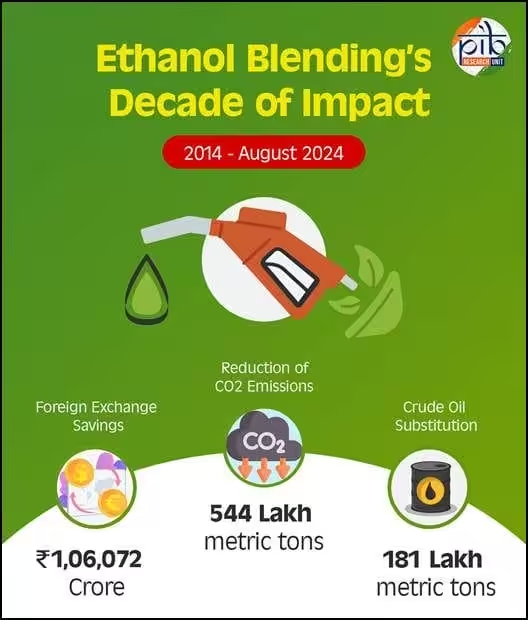
E 20 Fuel


Why in news:
The Union Minister Nitin Gadkari blamed “political conspiracy” by petrol lobby for social media outrage over shift to E20 and an expected surge in maintenance costs, while petrol prices remain unchanged.
UPSC Relevance :
Fuel and Energy has been a recurrent theme in Prelims.
UPSC PYQ Prelims 2020:
Q: According to India’s National Policy on Biofuels, which of the following can be used as raw materials for the production of biofuels?
1. Cassava
2. Damaged wheat grains
3. Groundnut seeds
4. Horse grams
5. Rotten potatoes
6. Sugar beet
Select the correct answer using the code given below:
(a) 1, 2, 5 and 6 only
(b) 1, 3, 4 and 6 only
(c) 2, 3, 4 and 5 only
(d) 1, 2, 3, 4, 5 and 6
Prelims 2025:
Q. Consider the following statements:
Statement I: Of the two major ethanol producers in the world, i.e., Brazil and the United States of America, the former produces more ethanol than the latter.
Statement II: Unlike in the United States of America where corn is the principal feedstock for ethanol production, sugarcane is the principal feedstock for ethanol production in Brazil.
Which one of the following is correct in respect of the above statements?
[A] Both Statement I and Statement II are correct and Statement II explains Statement I
[B] Both Statement I and Statement II are correct but Statement II does not explain Statement I
[C] Statement I is correct but Statement II is not correct
[D] Statement I is not correct but Statement II is correct
About E 20 fuel:
- E20 refers to a motor fuel blend consisting of 20% ethanol and 80% gasoline. It’s part of the government’s Ethanol Blending Programme (EBP).
- While the blending may lead to minor impact on vehicle mileage but it has various other benefits for the country.
- reduce the country’s dependence on crude oil imports
- cut down on greenhouse gas emissions
- boost the rural economy by boosting farmer incomes.
Ethanol
Ethanol, also known as ethyl alcohol, is a clear, colorless liquid and a key component in alcoholic beverages. However, its importance extends far beyond that, particularly as a biofuel.
- Renewable Fuel: Ethanol is considered a renewable fuel because it is produced from biomass, primarily plant-based materials.
- Fuel Blending: In the context of fuel, ethanol is a common additive to gasoline. Blends like E10 (10% ethanol, 90% gasoline) and E20 (20% ethanol, 80% gasoline) are widely used to reduce air pollution and decrease the reliance on fossil fuels.
- High Octane: Ethanol has a high octane rating, which can improve engine performance and reduce engine knocking when blended with lower-octane gasoline.
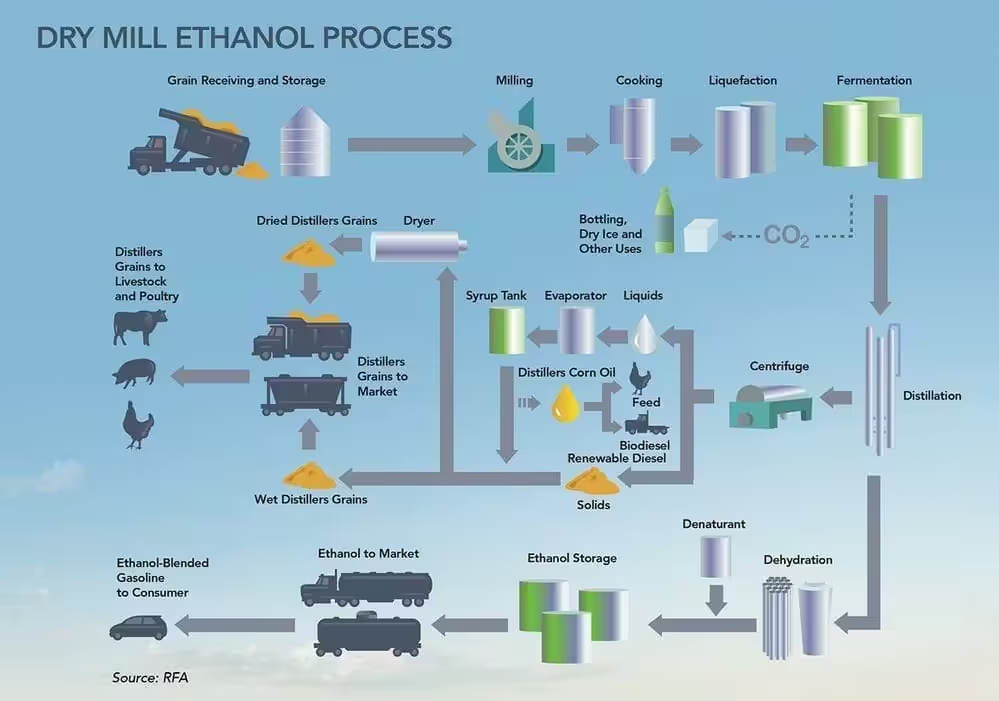
- Production Process: The production of ethanol involves the fermentation of sugars or starches from various crops.
- Other Uses: Beyond fuel, ethanol is a crucial industrial chemical. It is used as a solvent in a wide range of products, including cosmetics, medicines, paints, and cleaning products.
Largest Producers of Ethanol in World:
The United States and Brazil are by far the two largest producers of ethanol in the world, together accounting for a significant majority of the global supply.
Top producers:
- United States: The United States is the world’s largest producer of ethanol. Its production is predominantly from corn.
- Brazil: Brazil is the second-largest producer. It has a long-standing and well-established ethanol program, with sugarcane as its primary feedstock.
- India: India has rapidly increased its ethanol production and has emerged as the third-largest producer in the world.
- In India Uttar Pradesh and Maharashtra are top ethanol producing states.
National Policy on Biofuels:
Blending Targets and Goals:
- The policy initially set an indicative target of 20% ethanol blending in petrol and 5% biodiesel blending in diesel by 2030.
- However, the government has advanced the target for 20% ethanol blending to 2025-26.
- For biojet fuel, there are indicative blending targets of 1% by 2027 and 2% by 2028 for international flights originating from India.
Expansion of Feedstock:
- The policy expands the range of raw materials that can be used for biofuel production.
- For ethanol, it includes sugarcane juice, sugar-containing materials (like sugar beet and sweet sorghum), starch-containing materials (like corn and cassava), and damaged food grains (such as wheat and broken rice) that are unfit for human consumption.
- For biodiesel, it encourages the use of non-edible oilseeds, used cooking oil, and short-gestation crops.
- The policy also allows for the use of surplus food grains for ethanol production with the approval of the National Biofuel Coordination Committee.
Categorization of Biofuels:
- The policy categorizes biofuels into “Basic Biofuels” (First Generation, or 1G) like bioethanol and biodiesel, and “Advanced Biofuels” (Second Generation, or 2G) such as ethanol from agricultural residue, Municipal Solid Waste (MSW) to drop-in fuels, and Third Generation (3G) biofuels.
| Biofuel Generation | Description | Examples |
| First-Generation | Produced directly from edible food crops. This generation is often criticized for competing with food supplies. | Ethanol from corn, sugarcane, or wheat; biodiesel from soybean, palm, or rapeseed oil. |
| Second-Generation | Derived from non-food sources, such as agricultural waste, lignocellulosic biomass, and dedicated energy crops. These don’t compete with food resources. | Cellulosic ethanol from switchgrass or corn stover; biodiesel from jatropha oil or waste cooking oil. |
| Third-Generation | Produced from algae or other microorganisms. These have a high growth rate and don’t require arable land. | Biodiesel from algae; biobutanol from microalgae. |
| Fourth-Generation | Still in the research and development phase, this generation aims to genetically engineer organisms to produce biofuels more efficiently or to capture carbon during production. | “Designer” algae or bacteria engineered to produce specific hydrocarbons; fuels produced from a combination of biomass and carbon capture and storage (BECCS). |
Financial and Strategic Support:
- The policy provides a viability gap funding scheme for advanced biofuel (2G) biorefineries.
- It offers tax incentives and a higher purchase price for advanced biofuels compared to 1G biofuels.
- It encourages the development of supply chain mechanisms for biofuel production.
- The policy also aims to support research, development, and innovation in biofuel technology.
Other Schemes:
Positive Impact: