E20 Petrol: India’s Ethanol-Blending Policy and the Debate Ahead
Why in News?
The Union government stated in July 2026 that India has achieved average 20% ethanol blending in petrol in Ethanol Supply Year 2025-26, five years ahead of the earlier target.
- Average ethanol blending rose from about 12% in 2022-23 to about 14.6% in 2023-24, 19.2% in 2024-25 and 20% during November-June of 2025-26.
- The Ministry says E85 has been introduced only for certified Flex Fuel Vehicles and does not raise the nationwide base blending level above E20.
- Any proposal for blends above E20 is to follow detailed scientific and technical studies with automobile manufacturers, oil marketing companies and research institutions.
- The EBP Programme is linked to energy security, lower crude-oil use, emissions reduction and additional income opportunities in the farm economy.
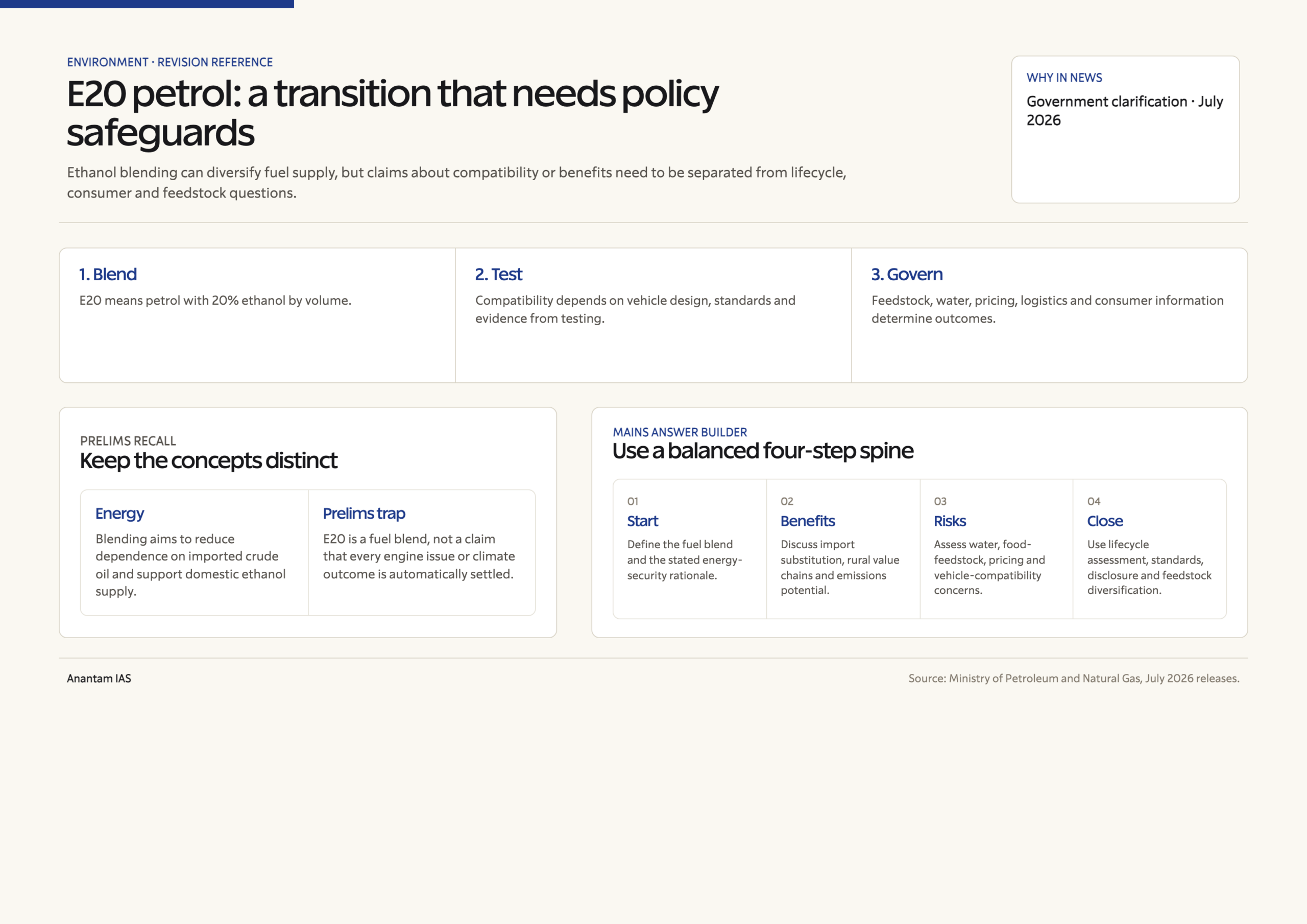
- For UPSC, distinguish a nationwide E20 petrol specification from an E85 fuel meant for a vehicle designed and certified for that fuel.
- The issue connects biofuel policy with crude-oil import dependence, agricultural markets, water management, air quality and consumer protection.
- It is a useful case for judging a transition through lifecycle safeguards and institutional capacity, not only through a single blending percentage.
- A balanced answer can assess the gains from domestic renewable fuel while examining distributional and ecological trade-offs.
UPSC Relevance
Prelims Relevance
- E20 denotes petrol containing 20% ethanol and 80% petrol by volume.
- E85 is intended for Flex Fuel Vehicles designed and certified to run on that blend; it is not the general nationwide petrol standard.
- The Ethanol Blended Petrol Programme is administered in the energy-policy space and draws on coordination among oil marketing companies, automobile makers and technical institutions.
- A higher octane rating and a lower energy content are separate fuel properties; neither alone settles real-world mileage or compatibility questions.
- Feedstock and sustainability questions remain relevant because biofuel outcomes depend on procurement rules, land and water conditions, and food-security safeguards.
- The government has said no decision has yet been taken to increase the base national blend beyond E20.
Mains Relevance
GS Paper 3
- Examine ethanol blending as an energy-security measure that can reduce exposure to imported crude oil and external price shocks.
- Evaluate the trade-offs among farm incomes, feedstock diversification, water use, food security and lifecycle environmental outcomes.
GS Paper 2
- Use the programme to explain cooperative implementation involving Union ministries, oil marketing companies, research bodies, manufacturers and state-level agricultural systems.
- Assess the role of evidence-based regulation and accountable public grievance mechanisms in a mass consumer transition.
Essay
- A transition becomes durable when its benefits are measurable and its costs are openly governed.
Background and Context
What E20 Means
E20 is petrol blended with 20% ethanol. Ethanol is an alcohol fuel that can be produced through industrial processing of permitted agricultural feedstocks, and the Ethanol Blended Petrol.
- The blending percentage is a fuel specification. It should not be confused with the share of all transport energy supplied by ethanol, nor with a mandate for every vehicle to use any higher blend.
- The Ministry reported average blending of about 12% in 2022-23, 14.6% in 2023-24, 19.2% in 2024-25 and 20% in November-June of 2025-26.
- E15-plus fuel had already been in widespread use for over three-and-a-half years and E19-E20 for over two-and-a-half years when the July 2026 clarification was issued.
- E85 contains 85% ethanol and 15% petrol. The government says it is restricted to Flex Fuel Vehicles designed and certified for E85, so it is not evidence of a nationwide move beyond.
- The relevant policy question is not whether ethanol is simply good or bad. It is whether the chosen blend, feedstock, vehicle standard and delivery system are appropriate for the public purpose claimed.
Why India Promotes Ethanol Blending
India imports a large share of the crude oil it consumes. Replacing part of petrol with domestically produced ethanol can diversify the fuel basket, reduce exposure to external.
- The July 2026 policy note reports more than ₹1.97 lakh crore in foreign-exchange savings, nearly 316 lakh metric tonnes of crude oil substituted, around 952 lakh metric tonnes of carbon-dioxide emissions reduced and more than.
- These are programme-level government estimates and should be read as indicators of the policy’s stated national gains, not as a substitute for transparent lifecycle assessment across feedstocks and regions.
- Ethanol can have a high octane number. The Ministry cites cleaner combustion and anti-knock characteristics as part of the technical rationale for E20 in vehicles using the prescribed fuel specifications.
- The programme can support diversification of farm-linked demand, but farmer benefit depends on procurement design, timely payments, price signals and the availability of feedstocks that do not undermine local food or water security.
- Import substitution is useful for energy security, yet it cannot remove the need for fuel efficiency, public transport, electrification, better urban design and a broader clean-energy transition.
Vehicle Compatibility and Consumer Protection
A fuel transition reaches households through vehicles, retail pumps, warranties and repair systems. Technical validation and clear public communication are as important as the aggregate blending target.
- The Ministry says E20 was evaluated through a phased process involving NITI Aayog, oil marketing companies, the Automotive Research Association of India, the Society of Indian Automobile Manufacturers, the Indian Institute of Petroleum and manufacturers.
- It reports no verified evidence of widespread engine failure attributable to ethanol blending across more than 20 crore two-wheelers and over 3 crore petrol cars operating on E15-plus or E19-E20 fuel.
- For certain vehicles designed for E10, the government cites a generally limited fuel-economy reduction of about 3-5%, while stressing that driving conditions, maintenance and driving habits also affect mileage.
- This does not eliminate the need for consumers to follow manufacturer guidance. Fuel labels, vehicle manuals, warranty communication, complaint channels and accessible repair information reduce avoidable uncertainty.
- The Ministry says public-sector oil marketing companies maintain grievance channels at retail outlets, through customer care, websites, mobile applications, social media, email and CPGRAMS. A credible transition requires that these channels resolve documented cases promptly.
The Sustainability Test
Biofuel policy is environmentally useful only when it is judged across the whole chain: feedstock production, land and water use, processing energy, transport, blending and the alternatives displaced.
- The policy note says a plant uses about 3-5 litres of processed water per litre of ethanol and refers to zero-liquid-discharge systems in modern distilleries. Plant water use is not the same as the full agricultural.
- Food-security safeguards are central when food grains are part of the supply chain. The note says diversion of surplus rice is subject to permission after national food-security requirements are considered.
- Feedstock choices must respond to local agro-climatic conditions. A procurement strategy that ignores groundwater stress or monoculture risks can shift environmental costs from oil imports to rural landscapes.
- Lifecycle emissions depend on how feedstocks are cultivated and processed. Energy used in distilleries, residue management and transport logistics matter alongside tailpipe performance.
- The next phase should be assessed through verifiable safeguards: feedstock traceability, regional water accounting, transparent emissions methods, efficient distilleries and regular public reporting rather than broad claims alone.
Way Forward
Measure the Whole Transition
- Publish regular, feedstock-wise and region-wise data on water conditions, procurement, lifecycle emissions, distillery energy use and grievance resolution.
- Use transparent sustainability criteria so that energy security does not produce avoidable pressure on food systems, groundwater or local ecosystems.
- Treat higher blends as a separate regulatory decision, supported by fresh testing and phased deployment rather than automatic extrapolation from E20.
Conclusion
- India’s achievement of E20 blending is a significant energy-policy milestone, but it is not a reason to stop asking hard questions.
- For UPSC, frame the debate as a governed transition: explain E20 and E85, state the energy-security rationale, then test the policy against vehicle compatibility, consumer protection, food and water safeguards and credible lifecycle evidence.
UPSC Practice Questions
Prelims MCQ 1
With reference to ethanol-blended petrol in India, consider the following statements:
- E20 contains 20% ethanol by volume.
- E85 is the nationwide base petrol standard for all vehicles in India.
- The Government has stated that a move beyond E20 would require detailed studies and consultations.
How many of the above statements are correct?
(a) Only one (b) Only two (c) All three (d) None
Answer: (b) Only two
Explanation:
Statements 1 and 3 are correct. E85 has been introduced for Flex Fuel Vehicles designed and certified for it; it is not the nationwide base petrol standard.
Prelims MCQ 2
Which one of the following is the most appropriate policy distinction between E20 and E85?
(a) E20 is a vehicle class and E85 is an agricultural input (b) E20 is a petrol blend while E85 is intended for certified Flex Fuel Vehicles (c) E20 is a crude-oil grade and E85 is a refinery tax (d) E20 is a subsidy scheme and E85 is a carbon market
Answer: (b) E20 is a petrol blend while E85 is intended for certified Flex Fuel Vehicles
Explanation:
E20 denotes petrol containing 20% ethanol. The government says E85 is exclusively for Flex Fuel Vehicles designed and certified to use it.
UPSC Mains Questions
- Ethanol blending can advance India’s energy security, but its sustainability depends on how feedstock, water, food security and consumers are governed. Discuss.
- Why should the move from E20 to any higher nationwide ethanol blend be treated as a fresh policy decision? Examine.
Sources: Ministry of Petroleum and Natural Gas, PIB and Ministry of Petroleum and Natural Gas, Ethanol Blending in India policy note.
Frequently Asked Questions
What is E20 petrol?
E20 is petrol blended with 20% ethanol by volume. It is the nationwide base blend discussed in the government’s July 2026 clarification. It is different from a higher-blend fuel designed for a particular vehicle category.
Has India decided to increase ethanol blending beyond E20?
No. The Ministry of Petroleum and Natural Gas said in July 2026 that no decision had been taken to increase the nationwide base blend beyond 20%. It said any future move would follow scientific and technical studies and consultation with.
What is the difference between E20 and E85?
E20 contains 20% ethanol. E85 contains 85% ethanol and is meant for Flex Fuel Vehicles designed and certified for that fuel. E85 availability for such vehicles does not mean that it is the standard fuel for every petrol vehicle.
Does E20 reduce mileage?
The government says any reduction in fuel economy for certain E10-designed vehicles is generally about 3-5%, while real-world fuel economy also depends on driving conditions, maintenance and driving habits. Drivers should follow manufacturer guidance for their particular vehicle.
Why is ethanol blending important for India?
Ethanol blending can reduce part of the demand for imported crude oil, diversify the transport-fuel basket and create a market linked to agricultural feedstocks. The policy must still be assessed for ecological safeguards and consumer outcomes.