Electronics Components Manufacturing Scheme: Building the Missing Value Chain
Why in News?
The Ministry of Electronics and Information Technology approved 31 more proposals under the Electronics Components Manufacturing Scheme at an industry event in New Delhi on 17 August 2026.
- The tranche takes the scheme to 106 approved projects, with 38 plants already manufacturing.
- Approved investment now stands at Rs 69,548 crore. That is committed spend, not money already on the ground.
- The scheme targets the missing middle of the value chain: sub-assemblies, bare components and capital goods, not finished phones.
- Employment and production figures in the release are forecasts, not outcomes.
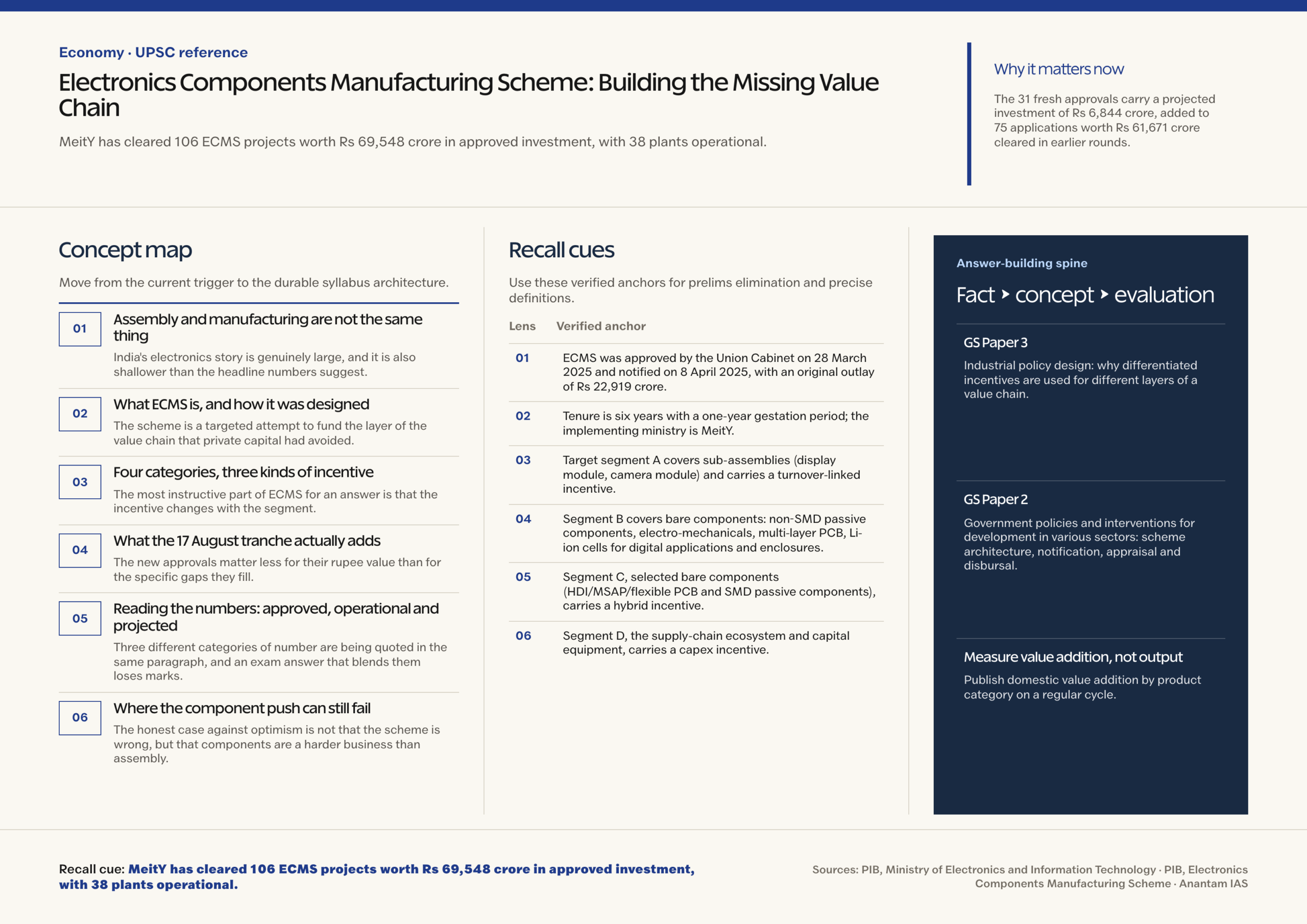
- India scaled electronics assembly far faster than it built a component base, so Domestic Value Addition stayed thin.
- Components are a harder business than assembly: low margins, high yield discipline, and long qualification cycles.
- ECMS is the instrument aimed at that gap. It is not the India Semiconductor Mission.
UPSC Relevance
Prelims Relevance
- ECMS is implemented by MeitY, not the Ministry of Heavy Industries.
- The Union Cabinet approved it on 28 March 2025; MeitY notified it on 8 April 2025.
- Incentives are turnover-linked, capex, or hybrid, depending on the target segment.
- Part of the payout is linked to employment targets.
- Capital goods used to make components sit in the scheme, not only the components themselves.
- Approved investment and operational plants are different numbers. Do not blend them.
Mains Relevance
GS Paper 3
- Why component manufacturing, not final assembly, decides Domestic Value Addition in electronics.
- Differentiated incentives: why turnover-linked, capex and hybrid tools fit different market failures.
Essay
- A large factory that imports its insides is still an assembly line.
Background and Context
Assembly is not manufacturing
India’s electronics story is large, and it is shallower than the headline output suggests.
- Phones and other finished goods can be assembled at scale while the bill of materials stays imported.
- Value addition lives in displays, camera modules, passives, enclosures and capital goods.
- Private capital avoided that layer because yields are hard and buyers qualify slowly.
- ECMS exists to fund that avoided layer, not to add another assembly incentive.
- See the broader industrial context in our note on production-linked incentives.
How the scheme is built
The exam-useful design point is that the incentive changes with the segment.
- The Cabinet approved ECMS on 28 March 2025 with an outlay of Rs 22,919 crore.
- It runs six years with a one-year gestation, aimed at Domestic Value Addition and Global Value Chains.
- Sub-assemblies get a turnover-linked incentive on incremental sales.
- Bare components and some supply-chain items get capex or hybrid support.
- That split is the answer, not the list of every product in the gazette.
How to read the 17 August numbers
Three kinds of number are being quoted together. An answer that blends them loses marks.
- Approved means 106 projects and committed investment. It is a promise after clearance.
- Operational means 38 plants have started manufacturing. That is the physical fact.
- Jobs and output in the release are projected. Treat them as forecasts.
- Capacity claims that ‘meet full domestic demand’ are ministry statements about approved capacity, not current market share.
- The scheme can still fail on yield, upstream inputs, and export-market qualification.
Where a component push still fails
The honest caution is not that the scheme is pointed at the wrong layer.
- Passive components are high-volume and low-margin. Yield, not capacity announcements, decides who wins.
- Localising a part does not localise its inputs. Anode material and electrolyte chemicals sit further upstream.
- Export buyers qualify slowly. A domestic line can run for years before it enters a global bill of materials.
- Assembly PLI and component support must be scored separately, or one hides the other.
- A first-ever domestic line is a start. It is not import independence.
Way Forward
Measure value addition, not output
- Score ECMS on Domestic Value Addition and operational plants, not on approved investment.
- Keep semiconductor, display and component schemes on separate ledgers so one does not hide the other.
- Publish yield and qualification progress, because that is where component firms actually compete.
- Do not treat a first domestic line as import independence.
Conclusion
- ECMS is aimed at the right layer: the components and capital goods that assembly never built.
- Judge it by plants actually running and by Domestic Value Addition, not by the rupee value of approvals.
- Keep semiconductor, display and component schemes in separate sentences so one does not hide the other.
UPSC Practice Questions
Prelims MCQ 1
With reference to the Electronics Components Manufacturing Scheme (ECMS), consider the following statements:
- It is implemented by the Ministry of Heavy Industries.
- It offers turnover-linked, capital expenditure and hybrid incentives depending on the target segment.
- A part of the incentive payout is linked to the achievement of employment targets.
How many of the above statements are correct?
(a) Only one (b) Only two (c) All three (d) None
Answer: (b) Only two
Explanation:
Statements 2 and 3 are correct. MeitY implements ECMS, not Heavy Industries, so statement 1 is wrong.
Prelims MCQ 2
Under the Electronics Components Manufacturing Scheme, capital goods used in electronics manufacturing typically receive which form of support?
(a) Only a tariff exemption (b) Only a production-linked incentive on finished phones (c) A capital expenditure incentive (d) A statutory preference in all government procurement
Answer: (c) A capital expenditure incentive
Explanation:
Capital goods and related parts sit in the capex-linked part of ECMS, not in a phone-assembly PLI.
UPSC Mains Questions
- India became a large assembler of mobile phones without a matching component base. Examine why that gap matters for industrial policy. (250 words)
- Differentiated incentives are the defining feature of ECMS. Discuss the rationale for turnover-linked, capex and hybrid tools. (150 words)
Sources: PIB, Ministry of Electronics and Information Technology and PIB, Electronics Components Manufacturing Scheme backgrounder.
Frequently Asked Questions
What is the Electronics Components Manufacturing Scheme?
A MeitY scheme, approved in March 2025, that subsidises domestic making of electronic sub-assemblies, bare components, supply-chain materials and capital goods rather than finished devices.
How many ECMS projects are approved, and how many plants are running?
As of the 17 August 2026 tranche, 106 projects are approved and 38 plants have started manufacturing. Those are different facts.
Are the advertised jobs already created?
No. Direct and indirect job numbers in the release are projections attached to approved projects, not verified hires.
How is ECMS different from the India Semiconductor Mission?
ECMS funds components and capital goods for electronics. The semiconductor mission funds fabs, display fabs and related chip ecosystem bets. Do not merge them.