E-Commerce Food Licensing and Datura Enforcement
Why in News?
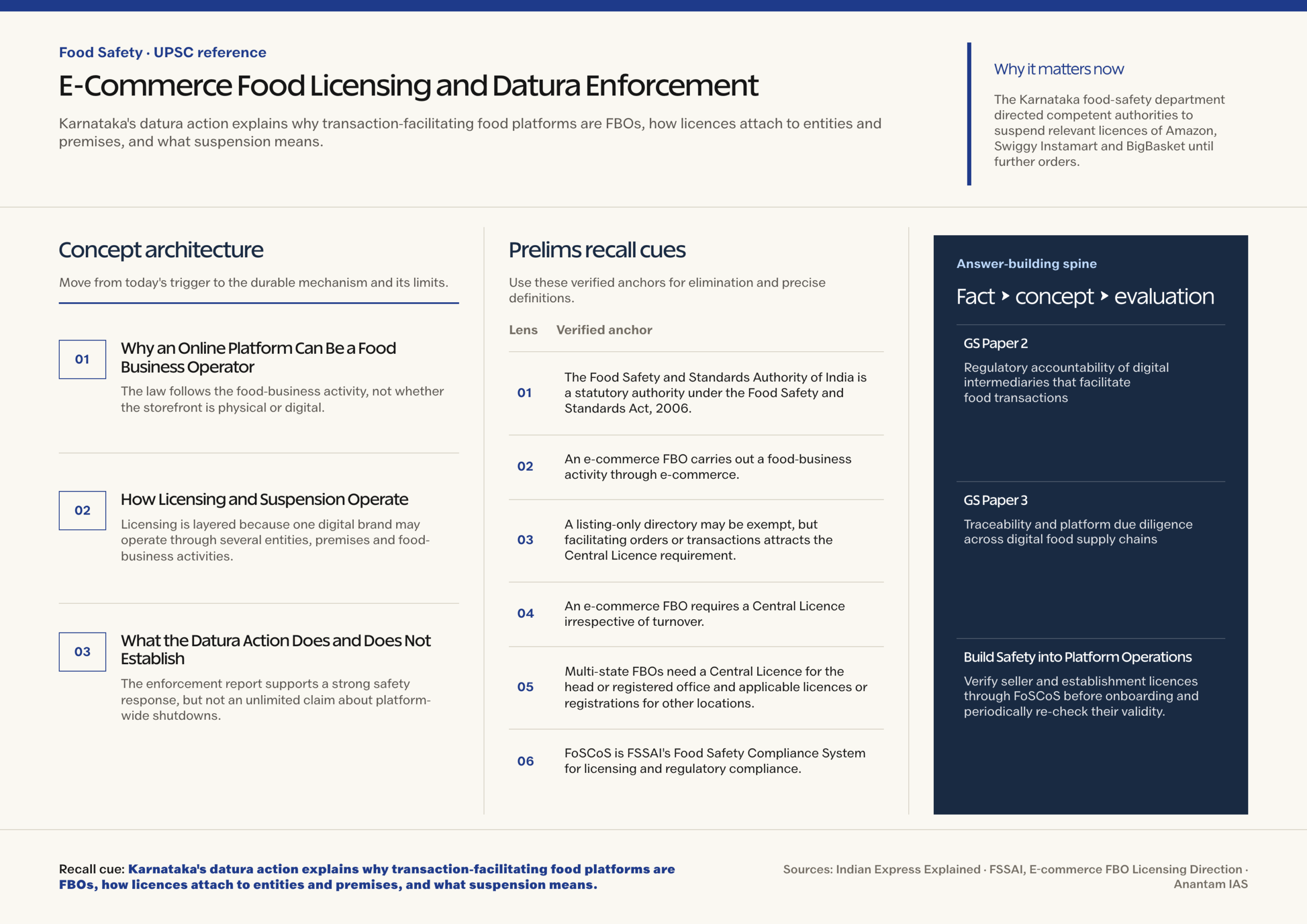
Karnataka directed suspension action against food licences linked to three e-commerce platforms after toxic datura fruits and seeds were listed for human consumption.
- The Karnataka food-safety department directed competent authorities to suspend relevant licences of Amazon, Swiggy Instamart and BigBasket until further orders.
- Officials were separately told to suspend licences or registrations of establishments and sellers supplying datura products through these platforms.
- The platforms and concerned FBOs were directed to remove the listings and stop displaying, selling or distributing datura fruits and seeds for human consumption.
- The order did not identify every licence number or covered premise, so it does not by itself establish a statewide halt to every food sale by the platforms.
- Digital intermediation does not remove food-safety responsibility when a platform facilitates orders or transactions involving food.
- A platform-level Central Licence and licences or registrations for particular operating locations can coexist, making enforcement scope dependent on the exact authorisation suspended.
- The case tests whether platform due diligence can detect hazardous listings before consumers encounter them, rather than relying only on removal after regulatory intervention.
UPSC Relevance
Prelims Relevance
- The Food Safety and Standards Authority of India is a statutory authority under the Food Safety and Standards Act, 2006.
- An e-commerce FBO carries out a food-business activity through e-commerce.
- A listing-only directory may be exempt, but facilitating orders or transactions attracts the Central Licence requirement.
- An e-commerce FBO requires a Central Licence irrespective of turnover.
- Multi-state FBOs need a Central Licence for the head or registered office and applicable licences or registrations for other locations.
- FoSCoS is FSSAI’s Food Safety Compliance System for licensing and regulatory compliance.
Mains Relevance
GS Paper 2
- Regulatory accountability of digital intermediaries that facilitate food transactions
- Proportional enforcement, reasoned orders and opportunity of hearing in public-health regulation
GS Paper 3
- Traceability and platform due diligence across digital food supply chains
- Risk-based removal, seller verification and compliance monitoring for hazardous products
Essay
- Digital markets widen consumer choice, but trust depends on making convenience compatible with traceability and public-health accountability.
Background and Context
Why an Online Platform Can Be a Food Business Operator
The law follows the food-business activity, not whether the storefront is physical or digital.
- Section 3(n) of the Food Safety and Standards Act, 2006 defines food business broadly across manufacture, processing, packaging, storage, transport, distribution, import and food services.
- An entity carrying out such an activity through e-commerce becomes an e-commerce food business operator; being an intermediary does not automatically remove regulatory responsibility.
- A website that only provides a directory may fall outside licensing, provided it is not otherwise conducting food business under the Act’s definition.
- Once the entity also facilitates orders or transactions, FSSAI’s licensing framework requires it to hold a Central Licence from the competent Central Licensing Authority.
- E-commerce FBO rules also require seller licence details and compliance arrangements, turning platform onboarding and listing controls into food-safety safeguards rather than optional marketplace features.
How Licensing and Suspension Operate
Licensing is layered because one digital brand may operate through several entities, premises and food-business activities.
- The e-commerce activity requires a Central Licence irrespective of turnover, but that licence does not necessarily cover every warehouse, seller, dark store or other operating location.
- A multi-state FBO generally needs a Central Licence for its head or registered office and separate licences or registrations for other locations according to their eligibility and activities.
- The Karnataka direction identified the Designated Officer (Central) for Central Licences and the Designated Officer (State) for State Licences or registrations as the relevant enforcement channels.
- Under Regulation 2.1.8, a licensing or registering authority may suspend or cancel an authorisation forthwith in the interest of public health, recording reasons in writing.
- Suspension stops only the food-business activities authorised by the affected licence for its duration; cancellation is a separate, more final consequence under the regulatory framework.
What the Datura Action Does and Does Not Establish
The enforcement report supports a strong safety response, but not an unlimited claim about platform-wide shutdowns.
- The immediate trigger was the reported listing of toxic datura fruits and seeds for human consumption, creating a direct product-safety risk rather than a nutrition-labelling dispute.
- Karnataka ordered removal and discontinuation of those listings and directed suspension action against platform licences and the licences or registrations of supplying establishments and sellers.
- The platforms were asked to submit compliance reports; the reported process also contemplated an opportunity of hearing before the authorities passed appropriate further orders.
- Because the order did not specify licence numbers, entities or premises, its exact operational reach depends on which authorisations the competent authorities suspend.
- For governance analysis, the key issue is preventive due diligence: verified sellers, accurate food information, hazardous-listing controls, traceable supply chains and rapid compliance escalation.
Way Forward
Build Safety into Platform Operations
- Verify seller and establishment licences through FoSCoS before onboarding and periodically re-check their validity, authorised activities and linked operating locations.
- Create risk-based controls for prohibited or hazardous food listings, with rapid human review, removal, seller suspension and regulator notification where public health may be threatened.
- Keep product, seller, warehouse and transaction records traceable so regulators can identify the exact licence, premise and supply source instead of imposing unnecessarily broad disruption.
- Use reasoned, licence-specific enforcement with hearing and compliance review, while retaining immediate public-health powers for urgent hazards.
Conclusion
- The datura episode shows that platform accountability begins when a digital service moves beyond listing and participates in the food transaction.
- A strong answer should distinguish the platform’s Central Licence from premises-level authorisations and explain why suspension affects only the activities and locations covered by the identified licence.
- Effective regulation combines rapid hazard removal with seller verification, traceability, reasoned orders and a fair compliance review.
UPSC Practice Questions
Prelims MCQ 1
With reference to e-commerce Food Business Operators in India, consider the following statements:
- An e-commerce entity that only lists food businesses must always obtain a Central FSSAI Licence.
- An e-commerce entity that facilitates food orders or transactions requires a Central FSSAI Licence.
- A multi-state FBO may require separate licences or registrations for operating locations in addition to the head-office Central Licence.
How many of the above statements are correct?
(a) Only one (b) Only two (c) All three (d) None
Answer: (b) Only two
Explanation:
Statements 2 and 3 are correct. A listing-only directory may be exempt when it does not otherwise fall within the statutory definition of food business.
Prelims MCQ 2
What is the most accurate effect of suspending an FSSAI licence?
(a) It permanently dissolves every legal entity in the corporate group (b) It stops the food-business activities authorised by that licence for the suspension period (c) It automatically cancels every seller’s licence throughout India (d) It prohibits the platform from offering all non-food goods
Answer: (b) It stops the food-business activities authorised by that licence for the suspension period
Explanation:
Suspension operates through the affected licence and its authorised activities. Its territorial and operational reach depends on the identified entity, premises and licence scope.
UPSC Mains Questions
- Why are e-commerce platforms that facilitate food transactions regulated as Food Business Operators? Explain the licensing and due-diligence implications.
- The effectiveness of digital food-safety regulation depends on both rapid hazard removal and licence-specific due process. Discuss with reference to the Karnataka datura action.
Sources: Indian Express Explained and FSSAI, E-commerce FBO Licensing Direction.
Frequently Asked Questions
Why does an e-commerce food platform need an FSSAI licence?
A platform that facilitates food orders or transactions performs a regulated food-business activity through e-commerce and must obtain a Central Licence from the competent authority.
Is a listing-only food directory also required to obtain a licence?
Not necessarily. It may be exempt when it merely lists businesses or products and does not otherwise conduct food business or facilitate orders and transactions.
Does one Central Licence cover every platform operation?
No. A head-office Central Licence may coexist with separate licences or registrations for other entities, premises and operating locations, depending on their activities and eligibility.
What did Karnataka direct in the datura case?
It directed suspension action, removal of datura listings, discontinuation of sales for human consumption and compliance reports from the platforms, establishments and sellers concerned.
Did the order stop every food sale by the platforms across Karnataka?
That cannot be concluded from the reported order alone because it did not identify every affected licence number, entity, premise or authorised activity.