Economic Survey 2025-26: Growth, Inflation and Jobs Signals for UPSC
Economic Survey 2025-26 placed India in a strong but not effortless macroeconomic position. The official brief projected 7.4 percent real GDP growth for FY26, a 6.8-7.2 percent band for FY27, unusually soft CPI inflation, record GST collections, resilient services exports and a large foreign exchange buffer.
The useful UPSC lesson is not that the economy is simply doing well. The Survey is a map of tradeoffs: high growth with uneven job quality, stable inflation with food-price vulnerability, service-sector strength with manufacturing ambitions, and fiscal consolidation with rising demand for public investment.
This article reads Economic Survey 2025-26 the way an examiner is likely to read it: as official evidence for GS-III economy answers, not as a memorisation sheet of isolated numbers.
Quick Facts
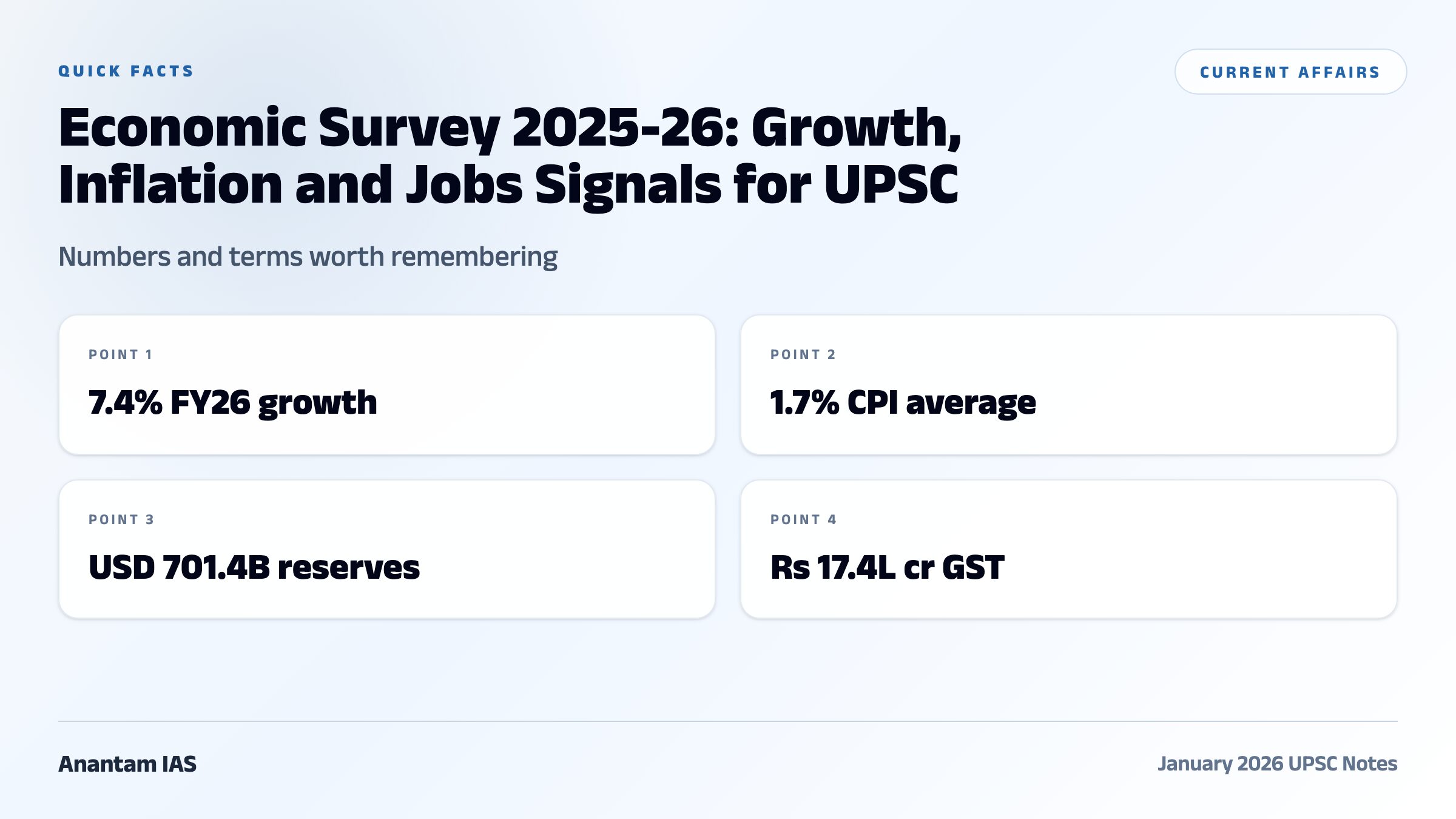
- Real GDP growth for FY26 was estimated at 7.4 percent, with FY27 projected in the 6.8-7.2 percent range.
- Average CPI inflation for FY26 was placed at 1.7 percent in the official brief.
- Services contributed about 56.4 percent of GVA, confirming the sector’s central role in Indian growth.
- Goods and services exports stood at USD 825.3 billion in FY25, with services cushioning merchandise weakness.
- Foreign exchange reserves touched USD 701.4 billion as of 3 October 2025.
- Gross GST collections reached Rs 17.4 lakh crore during April-November 2025, up 9.1 percent year on year.
- The e-Shram database crossed 31 crore registered unorganised workers.
- Official source: PIB, Ministry of Finance.
What Just Happened
The Ministry of Finance released the Economic Survey 2025-26 backgrounder at the start of the Union Budget cycle. The Survey framed the economy through growth resilience, external-sector buffers, digital public infrastructure, labour-market formalisation and the need to keep reforms moving despite global uncertainty.
The headline 7.4 percent GDP estimate matters because it arrives in a world of weak global demand, tariff stress and volatile capital flows. India’s official growth story now rests on domestic consumption, public capital expenditure, services exports and a still-cautious private investment cycle.
The Survey also gave UPSC candidates a clean set of official numbers for Mains answers. Growth, inflation, exports, GST, foreign exchange reserves and labour registration are not just statistics. They are evidence that can anchor answers on macro stability, inclusive growth, fiscal capacity and employment.
Background and Historical Context
The Economic Survey is prepared by the Economic Division of the Department of Economic Affairs under the Ministry of Finance. It is not a constitutional requirement like the Annual Financial Statement under Article 112. Its value lies in analysis: it explains the government’s reading of the economy before the Budget sets the fiscal path.
Since 1950-51, Economic Surveys have evolved from descriptive statistical volumes into policy arguments. Recent editions have placed more weight on digital public infrastructure, formalisation, climate transition, supply-chain resilience and the role of states in growth.
For UPSC, the Survey is a primary source because it combines data with policy framing. A candidate who quotes the Survey well usually writes more precise answers than one who only uses generic economy notes.
Key Features of Economic Survey 2025-26
The core policy architecture can be read through these features.
- Growth resilience: India remained one of the fastest growing major economies, but the Survey did not treat high growth as automatic.
- Soft inflation: CPI moderation created policy space, while food and fuel risks remained important.
- Services strength: IT, professional services, financial services and tourism continued to stabilise exports.
- Fiscal capacity: Higher GST collections signalled stronger tax compliance and better revenue buoyancy.
- External buffers: High forex reserves reduced vulnerability to sudden capital outflows.
- Labour formalisation: e-Shram and payroll datasets provided a wider, though still incomplete, view of work.
Why It Matters
This is a high-yield UPSC topic because it joins current news with durable syllabus themes.
- It gives official numbers for GS-III answers on growth, inflation, employment and external sector.
- It links current data to static topics such as fiscal policy, monetary policy, tax buoyancy and demographic dividend.
- It helps Prelims by refreshing terms such as GDP, GVA, CPI, forex reserves, GST buoyancy and current account.
- It gives Essay material on development models, jobs, technology and inclusive growth.
Detailed Analysis: Macroeconomy Lens
The growth number hides a composition question. A 7 percent-plus economy can still disappoint if growth is concentrated in capital-intensive sectors. The Survey’s services story is strong, but the employment challenge needs manufacturing, construction, logistics, care work and MSME productivity to carry more weight.
Low inflation should not be read as a permanent win. A year of soft CPI creates relief for households and the RBI, but India’s inflation structure is still food-sensitive. Climate shocks, global fuel prices and supply-chain disruptions can quickly change the picture.
Public finance is the quiet hinge. GST collections and digital compliance widen fiscal room, but India still has to choose carefully between welfare commitments, capex, interest payments and state-level fiscal pressures. That is the exact tension UPSC often tests.
Comparative Perspective
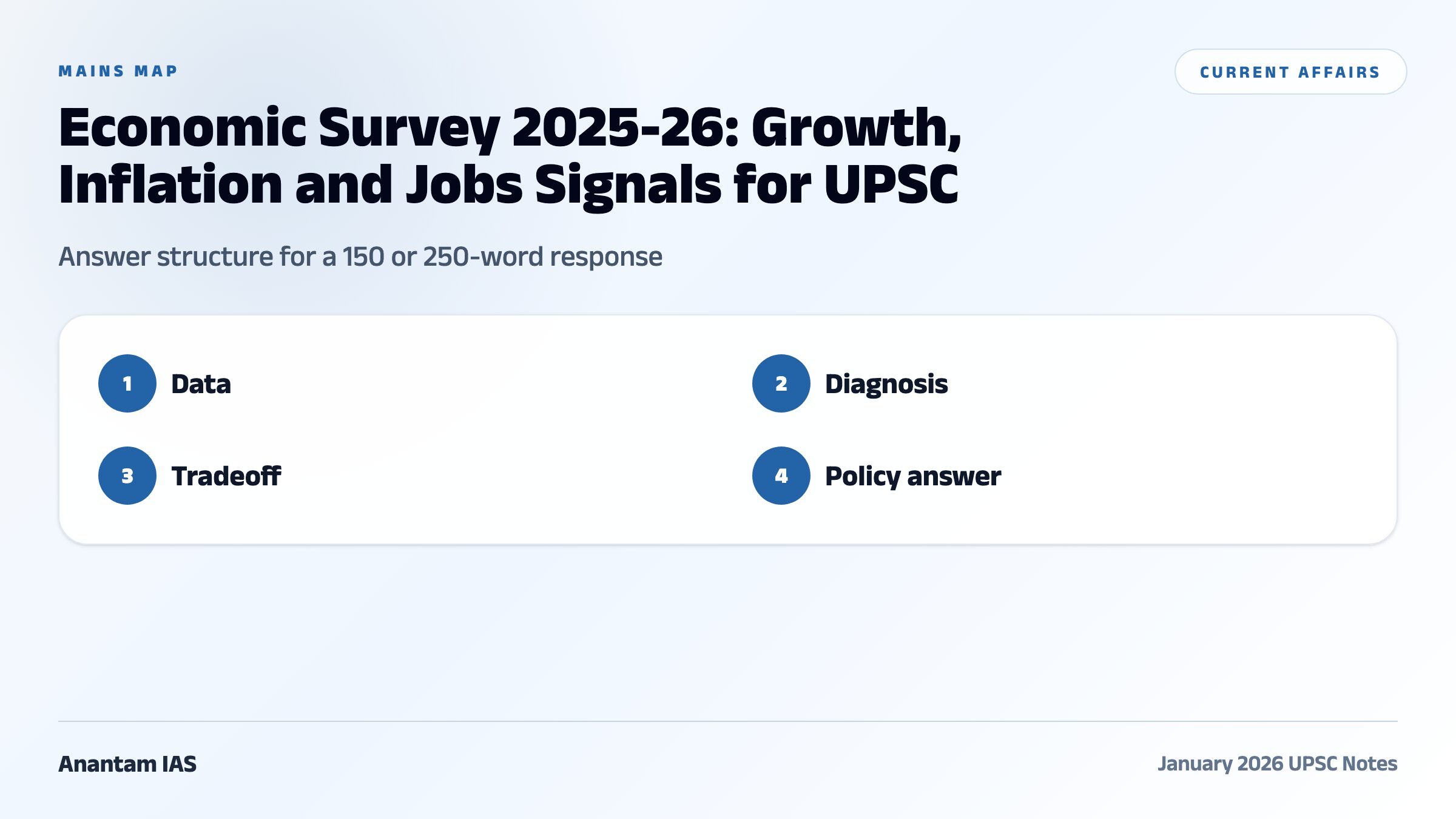
A comparison helps prevent the answer from becoming a one-dimensional news summary.
- China: growth is more manufacturing-led and export-heavy, but it now faces a property-sector drag and demographic stress.
- Vietnam: export manufacturing has risen sharply, but the economy is more exposed to external demand cycles.
- United States: services and innovation dominate, but inflation management and public debt remain central concerns.
- India: the distinctive challenge is to convert service-led growth and digital infrastructure into broad-based jobs.
Challenges
The policy or institutional promise runs into recurring constraints.
- Private investment has not yet become broad-based enough to replace the public capex impulse.
- Merchandise exports remain exposed to tariff shocks, weak global demand and shipping disruptions.
- Quality employment is still the binding constraint behind the demographic dividend.
- State finances can limit health, education and urban-infrastructure spending.
- Climate shocks can disturb food inflation and rural incomes even when headline inflation looks benign.
Prelims Pointers
- Economic Survey is prepared by the Department of Economic Affairs, Ministry of Finance.
- The Annual Financial Statement is mandated by Article 112 of the Constitution.
- GDP measures value added within the domestic territory; GNP adjusts for net factor income from abroad.
- CPI is the main inflation index used by the RBI for monetary-policy targeting.
- GST buoyancy compares tax growth with nominal GDP growth.
- Foreign exchange reserves include foreign currency assets, gold, SDRs and the reserve tranche position at the IMF.
Mains Questions
- Economic Survey 2025-26 presents India as a resilient growth economy. Discuss the conditions under which this resilience can translate into inclusive employment. (GS Paper III, 250 words)
- Examine the role of GST revenue buoyancy in strengthening India’s fiscal capacity. What are its limits? (GS Paper III, 150 words)
- Low inflation is necessary but not sufficient for macroeconomic stability. Analyse with reference to India’s food-price structure. (GS Paper III, 250 words)
- Service-sector strength has become India’s comparative advantage. Can it substitute for manufacturing-led job creation? Critically examine. (GS Paper III, 250 words)
Way Forward
India’s next macroeconomic task is to make growth more employment-dense. That means pushing labour-intensive manufacturing, urban services, logistics, tourism, care-sector jobs and MSME technology adoption together.
Inflation management needs more than monetary policy. Storage, cold chains, climate-resilient agriculture, market intelligence and faster import-export decisions matter as much as interest rates when food inflation rises.
The Survey’s optimism is useful only if it becomes reform discipline. The examiner will reward candidates who quote the 7.4 percent growth estimate but then test it against jobs, exports, fiscal constraints and climate risk.
The examiner is unlikely to reward a bare fact dump here. The better answer connects the January 2026 event to institutional design, implementation capacity and India’s long-term development priorities.
Frequently Asked Questions
What is the Economic Survey?
It is the Ministry of Finance’s annual analytical review of the economy, normally presented around the Union Budget. It is not mandated by the Constitution, but it is one of India’s most important official policy documents.
What GDP growth did Economic Survey 2025-26 estimate for FY26?
The official PIB brief placed FY26 real GDP growth at 7.4 percent and projected FY27 growth in the 6.8-7.2 percent range.
Why is the Economic Survey important for UPSC?
It gives primary-source data and policy framing for GS-III economy answers, Prelims concepts and Essay arguments on growth, welfare, jobs and fiscal policy.
Which ministry prepares the Economic Survey?
The Economic Division of the Department of Economic Affairs in the Ministry of Finance prepares it under the guidance of the Chief Economic Adviser.
How should aspirants use Survey data?
Use only high-yield numbers and connect them to themes: employment, inflation, exports, fiscal capacity, welfare and climate resilience.
Is the Economic Survey the same as the Budget?
No. The Survey analyses the economy. The Budget, including the Annual Financial Statement, sets receipts, expenditure, taxation and fiscal policy.