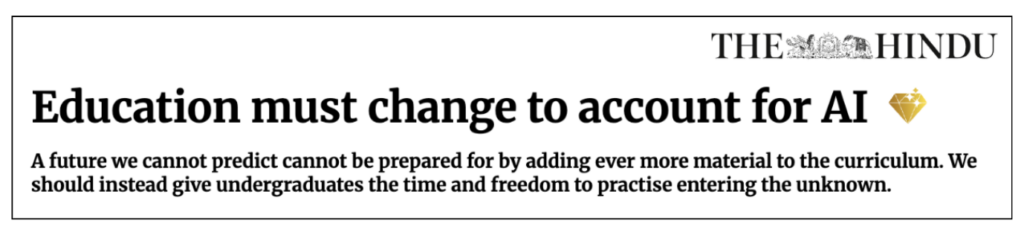
Education must change to account for AI
Context:
Rapid advances in Artificial Intelligence (AI), automation and intelligent agents are transforming the nature of work. For India, this creates an urgent need to redesign education; not merely to produce AI users, but to prepare citizens for jobs where judgement, creativity, domain expertise and adaptability complement machines.
How is AI Transforming Work?
AI agents, robotics and machine vision can convert many existing tasks into automated routines. In pharmaceuticals, AI can assist molecule screening, formulation and quality control. In vaccine production, it can support antigen design, automated bioreactors, fill-finish processes and logistics.
Consequently:
- Many routine and entry-level jobs may decline.
- Fewer workers may be required for execution, with humans concentrating on supervision and complex decisions.
- Demand will increase for workers possessing deep domain expertise, interdisciplinary understanding and sound judgement.
- Companies may become more productive without proportionately increasing employment.
The disappearance of entry-level positions creates a particular problem: such jobs traditionally allow young workers to acquire the experience necessary for becoming experts.
Limits of the existing Educational Model:
- Earlier technological revolutions were addressed by extending the duration of formal education: from basic literacy to school, college and professional degrees. This approach emphasised acquiring and retaining increasing quantities of information.
AI weakens the value of mere information retention because knowledge can be retrieved rapidly. The comparative human advantage increasingly lies in:
- Identifying what requires deep understanding.
- Distinguishing reliable information from misleading outputs.
- Synthesising knowledge from multiple disciplines.
- Exercising ethical and contextual judgement.
- Learning rapidly in unfamiliar situations.
- Formulating the right questions and verifying AI-generated answers.
The objective should not simply be to add more content, but to develop the capacity to learn and apply knowledge.
What should change in Education?
- From rote learning to problem-solving: Students should confront open-ended problems where answers are not predetermined.
- From knowledge accumulation to knowledge application: AI can retrieve information; humans must develop the ability to verify, synthesise and exercise judgement.
- Experiential learning: Greater emphasis on laboratories, field projects, apprenticeships, internships and industry-linked learning.
- AI literacy: Students across disciplines should understand AI’s capabilities, limitations, biases, ethics and responsible use.
- Interdisciplinary learning: AI increasingly intersects with medicine, agriculture, law, manufacturing, biotechnology and public policy; education must therefore break rigid disciplinary silos.
- Lifelong learning: Universities should prepare students to continuously reskill and upskill, rather than treat graduation as the endpoint of learning.
Implications for Higher Education:
The National Education Policy (NEP) 2020 provides space for multidisciplinary education, research and experiential learning. Its implementation should increasingly focus on:
- greater industry-university-research laboratory linkages;
- apprenticeships and real-world projects;
- flexible curricula that can be periodically updated;
- stronger research and innovation ecosystems;
- greater integration of AI tools into teaching while retaining human oversight;
- assessment based on reasoning, application and originality, rather than memorisation.
Key Challenges:
- Digital divide and unequal access to AI-enabled education.
- Shortage of trained faculty and AI-capable teachers.
- Risk of overdependence on AI undermining foundational learning and independent thinking.
- Algorithmic bias, privacy concerns and academic integrity.
- Unequal exposure to experiential learning between elite and mass higher-education institutions.
The AI era requires a shift from “learning more” to “learning how to learn, think and adapt”. Education policy must therefore move from curriculum-centric knowledge accumulation towards experiential learning, critical judgement, domain expertise and lifelong adaptability.