Electronic Interlocking: Route Safety and the Kavach Interface
Why in News?
Indian Railways approved electronic interlocking at seven stations in Solapur Division on 19 September 2026, supporting signalling modernisation and the future implementation of Kavach on the identified route.
- The approved project covers seven stations in Central Railway’s Solapur Division; approval does not mean the equipment is commissioned.
- Kavach, Automatic Block Signalling and Centralised Traffic Control works have also been sanctioned on the identified high-density route.
- A separate Kavach 4.0 approval concerns Lucknow Division of North Eastern Railway; it is not part of the Solapur electronic-interlocking project.
- Route-setting and train protection address different safety problems and should not be treated as interchangeable systems.
- Modernisation must connect equipment, operating rules and verification; sanctioning expenditure alone does not demonstrate an operational safety outcome.
UPSC Relevance
Prelims Relevance
- Electronic interlocking: computer-based control of the safety relationships between points and signals.
- Points: movable track components that direct a train toward a selected route.
- Kavach: India’s indigenous Automatic Train Protection system.
- SPAD: Signal Passing at Danger.
- Automatic Block Signalling: signalling concerned with train movements through successive track sections.
Mains Relevance
GS Paper 3
- Complementary safety layers in railway infrastructure.
- Technology adoption, commissioning and maintenance in high-density transport systems.
GS Paper 2
- Distinguishing project approval from verified public-service delivery.
Background and Context
What electronic interlocking protects
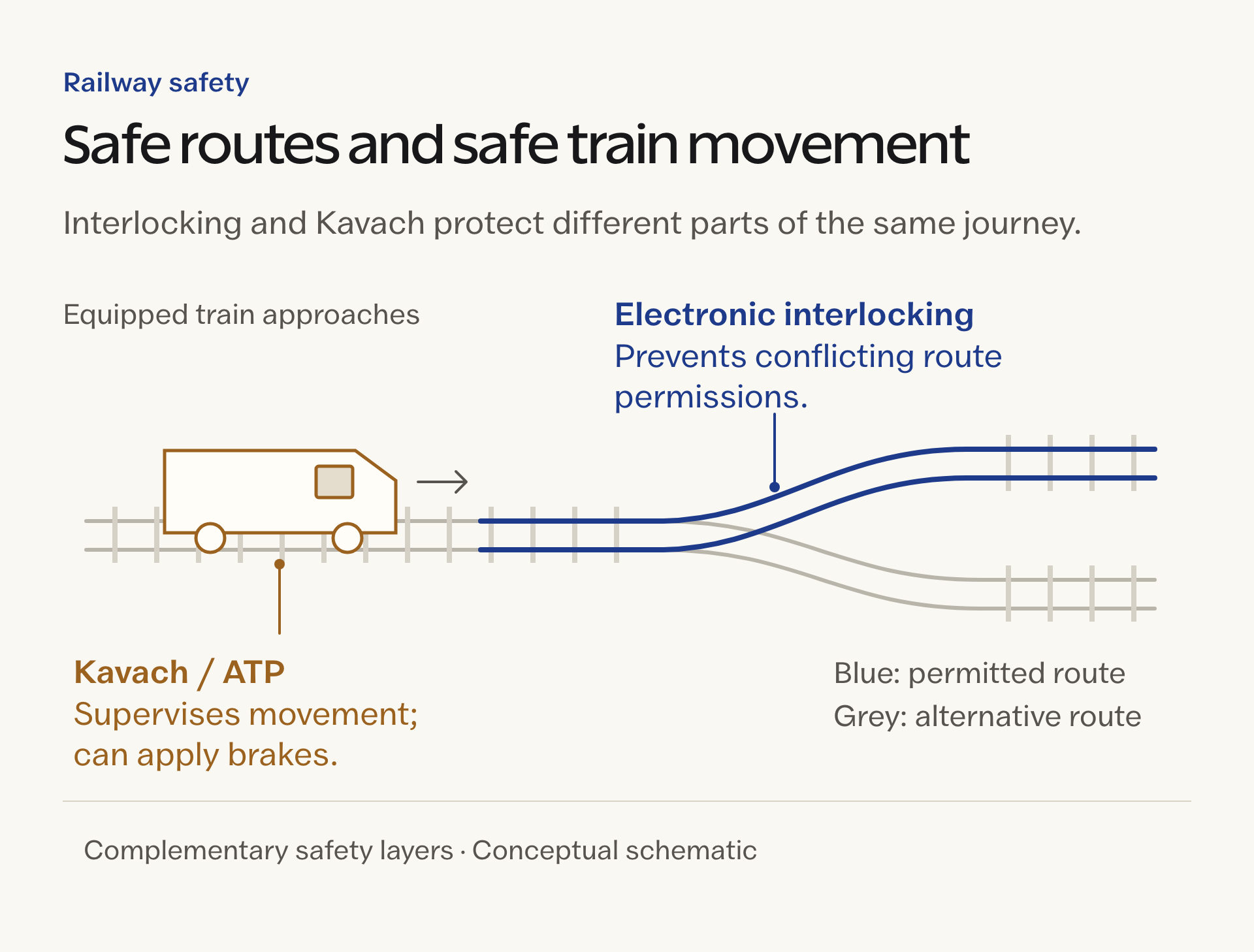
Interlocking makes permission to move depend on the safe relationship between signals, points and the route a train will take.
- Points guide trains between tracks at a junction. A signal permitting movement must correspond to the intended route; authorising a train while the points lead elsewhere would create an unsafe mismatch in operation.
- Interlocking imposes dependencies between points and signals. Indian Railways’ signalling rules require the necessary route conditions before a signal can permit movement, rather than allowing each component to be operated independently of the others.
- Conflicting routes cannot safely be authorised together. Where two proposed movements would conflict, interlocking prevents the associated permissions from being given simultaneously; this is a route-safety function, not merely an electronic display for operators.
- Route locking protects the established movement against an unsafe alteration of the points. The purpose is to preserve the conditions under which permission was given while the relevant train movement is being carried out.
- Electronic interlocking implements these safety relationships through computer-based signalling instead of conventional relay-based arrangements. PIB identifies improved control, fault detection and maintenance as benefits; the underlying need for safe route conditions remains unchanged.
How Kavach adds a train-protection layer
A safely established route still needs the approaching train to respect its movement permission and speed limits; automatic train protection addresses that operational problem.
- Kavach is an indigenous Automatic Train Protection system. It supervises train movement and can apply brakes when required, adding protection where a train might otherwise exceed an applicable limit or pass a danger signal.
- Signal Passing at Danger means a train passes a signal displaying danger without the required authority. Kavach is designed to help prevent this; interlocking alone should not be described as an onboard automatic braking system.
- The Railways’ Kavach handbook describes stationary and onboard equipment. Relevant signalling information reaches the train-protection system, while onboard functions supervise movement and support brake intervention; this is not a claim of camera-based signal reading.
- Interlocking and ATP are complementary: one establishes safe route permissions; the other helps enforce movement constraints on an equipped train. A route-setting improvement and a train-protection installation solve related but different operational safety problems.
- Brake intervention does not justify calling a railway accident-proof. Safety also depends on correct installation, reliable equipment, operating conditions and maintenance; an ATP system cannot be treated as a substitute for the wider railway safety system.
What the Solapur approval does and does not establish
The development is a sanctioned signalling upgrade, so its future operational benefits must be separated from evidence that the system is already working.
- The Solapur announcement concerns seven stations on an identified high-density route. It establishes approval for electronic-interlocking provision, not completed installation, commissioning or a verified reduction in railway incidents at those stations.
- Kavach, Automatic Block Signalling and Centralised Traffic Control are separately sanctioned works on this route. Their mention explains the integration context; it does not mean the electronic-interlocking approval commissions all three systems together.
- Automatic Block Signalling and central traffic management should not be collapsed into the interlocking function. Managing successive track sections and coordinating traffic are different tasks from preventing incompatible route permissions at a station or junction.
- The Lucknow Division approval is a separate Kavach 4.0 project. It supplies contemporary context for ATP expansion, but cannot be counted as operational coverage or as evidence of commissioning in Solapur Division.
- Implementation evidence should identify what has actually been installed, tested and brought into service. Public assessment needs these milestones because a sanction authorises work, whereas functioning safety protection depends on completing the engineering and operational process.
Way Forward
Verify the complete safety chain
- Test route dependencies and interfaces before service, including failure conditions, rather than relying only on normal-operation demonstrations.
- Train operating and maintenance staff for system faults and degraded working, with clear responsibilities for restoration.
- Report approval, installation and commissioning separately so public coverage figures describe the stage actually achieved.
Conclusion
- Electronic interlocking protects route-setting, while Kavach adds automatic train protection. Their value lies in complementary functions, not in treating every signalling upgrade as the same technology.
- The Solapur decision is an approval. A sound infrastructure answer should connect its intended benefits with testing, commissioning and maintenance, rather than assume a sanctioned project is already delivering operational protection.
UPSC Practice Questions
Prelims MCQ 1
With reference to railway signalling and train protection, consider the following statements:
- Interlocking prevents conflicting route permissions from being authorised simultaneously.
- Kavach is an Automatic Train Protection system capable of brake intervention.
- Approval of electronic-interlocking works establishes that Kavach has been commissioned on the entire route.
How many of the above statements are correct?
(a) Only one (b) Only two (c) All three (d) None
Answer: (b) Only two
Explanation:
The first two describe distinct safety functions. Approval is not commissioning, and electronic interlocking and Kavach are not interchangeable projects.
Prelims MCQ 2
Which situation most directly illustrates the purpose of interlocking?
(a) Preventing simultaneous authorisation of conflicting routes (b) Setting ticket prices for a busy corridor (c) Replacing every train’s braking equipment (d) Measuring passenger demand at a station
Answer: (a) Preventing simultaneous authorisation of conflicting routes
Explanation:
Interlocking establishes safe dependencies between points, signals and routes, preventing incompatible movements from receiving permission together.
UPSC Mains Questions
- Explain how electronic interlocking and Automatic Train Protection provide complementary layers of railway safety. (150 words)
- Railway signalling modernisation requires more than project sanctions. Discuss the importance of interfaces, testing, commissioning and maintenance. (250 words)
Sources: PIB, Ministry of Railways and PIB, Ministry of Railways.
Frequently Asked Questions
What is electronic interlocking?
Electronic interlocking is computer-based signalling that maintains safe relationships between points, signals and routes. It prevents incompatible permissions and helps ensure that an authorised movement follows a safely established route.
How is Kavach different from interlocking?
Interlocking protects route-setting and signal permissions. Kavach supervises train movement and can apply brakes when required. The systems perform complementary tasks; one cannot be treated as a complete replacement for the other.
Does the Solapur announcement mean the system is operational?
No. It announces approval for electronic interlocking at seven stations. It does not establish completed installation or commissioning, and it should not be used as evidence of operational Kavach coverage.
Is the Lucknow Kavach approval part of the Solapur project?
No. The Lucknow Division Kavach 4.0 approval is a separate project in North Eastern Railway. The electronic-interlocking approval concerns Solapur Division in Central Railway; their implementation status must be assessed separately.