Employment Linked Incentive scheme: First payouts to new workers
Why in News?
The Prime Minister is set to disburse around Rs 2,400 crore in incentives to new employees and employers under the Employment Linked Incentive (ELI) Scheme, marking the first round of payouts since the scheme was rolled out. PIB releases from the Ministry of Labour and Employment describe the transfers as going to first-time formal workers and to firms creating additional jobs, routed through the Employees’ Provident Fund Organisation (EPFO).
For UPSC, the news is a hook into a durable debate, how to convert headline GDP growth into formal, productive jobs. ELI was announced in the Union Budget 2024-25 as part of a wider employment-and-skilling package. Its design, incentivising both first-time workers and the firms that hire them, makes it a textbook case of a demand-side, formalisation-linked labour policy worth knowing in detail.
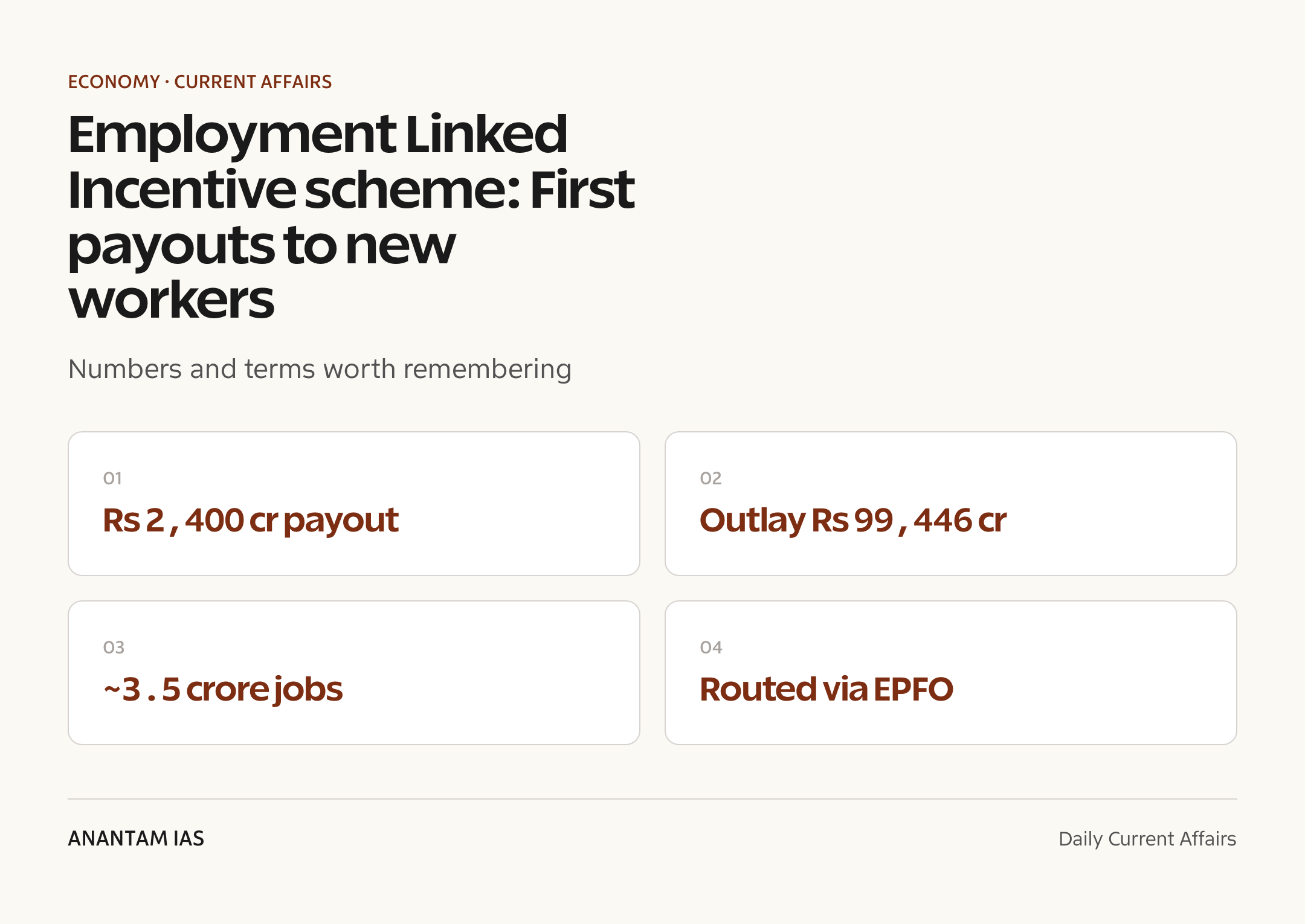
- First disbursal of around Rs 2,400 crore to new employees and employers under the ELI Scheme.
- Payouts routed through EPFO and credited via Direct Benefit Transfer (DBT) to Aadhaar-seeded accounts.
- Scheme was announced in Union Budget 2024-25 with a total outlay of about Rs 99,446 crore.
- Stated aim is to support roughly 3.5 crore jobs over a two-year window.
- Eligibility is tied to EPFO registration, so the scheme doubles as a formalisation drive.
The development matters in the context of:
- Sits within the broader jobs vs jobless-growth debate central to GS3 economy.
- Uses EPFO payroll data as both a delivery channel and a proxy for formal-job creation.
UPSC Relevance
Prelims Relevance
- ELI Scheme: announced in Union Budget 2024-25 under the employment-and-skilling package; implemented by the Ministry of Labour and Employment.
- Three parts: Part A (first-timers), Part B (manufacturing job creation), Part C (support to employers).
- Part A: one month’s wage (up to Rs 15,000) in instalments to first-time EPFO-registered employees.
- Part C: reimbursement of employer’s EPFO contribution (up to Rs 3,000/month) for two years for additional hiring.
- Delivery is through EPFO via DBT to Aadhaar-seeded accounts and the Universal Account Number (UAN).
- EPFO: a statutory body under the Employees’ Provident Funds and Miscellaneous Provisions Act, 1952.
- PLFS (Periodic Labour Force Survey): official source for unemployment, LFPR and worker-population ratio.
- Formal vs informal employment: formal jobs carry social-security cover such as EPF and ESI.
- LFPR (Labour Force Participation Rate) and the unemployment rate as key labour indicators.
- Total scheme outlay roughly Rs 99,446 crore, targeting about 3.5 crore jobs.
Mains Relevance
GS Paper 3
- Inclusive growth and employment: ELI as a tool to translate growth into formal job creation, and the limits of incentive-led schemes.
- Resource mobilisation and government budgeting: design and fiscal cost of a Rs 99,446 crore wage-subsidy programme and its expected returns.
- Effects of policies on the formalisation of the workforce, social-security coverage, and the reliability of EPFO data as a jobs proxy.
Essay
- Decent work and dignity: jobs as the bridge between economic growth and social justice.
Background and Context
Why employment is the policy fault line
ELI exists because growth alone has not delivered enough quality formal jobs.
- India’s demographic dividend needs millions of new jobs each year, yet much of the workforce remains in informal, low-productivity work.
- The jobless-growth critique argues that output can rise without a matching rise in formal, secure employment.
- Formal jobs bring social-security cover (EPF, ESI), written contracts and stable incomes, unlike most informal work.
- Raising the Labour Force Participation Rate, especially for women, is a parallel structural challenge.
- ELI is a demand-side response: it pays to create and take up formal jobs, rather than only training workers.
What the ELI scheme is
ELI is a wage-and-contribution incentive announced in Union Budget 2024-25 to spur formal hiring.
- Announced as one of the Prime Minister’s package of schemes for employment and skilling, alongside an internship initiative.
- Implemented by the Ministry of Labour and Employment, with EPFO as the delivery backbone.
- Total outlay is about Rs 99,446 crore, with a stated aim of supporting close to 3.5 crore jobs over two years.
- Benefits are credited through DBT into Aadhaar-seeded accounts, reducing leakage and middlemen.
- Eligibility hinges on EPFO registration, so each beneficiary also enters the formal social-security net.
The three parts, decoded
ELI works through three components, each targeting a different actor in the labour market.
- Part A (first-timers): one month’s wage, up to Rs 15,000, paid in instalments to employees newly registered with EPFO, subject to a wage ceiling.
- Part B (job creation in manufacturing): incentives to both employees and employers for additional employment, with a focus on the manufacturing sector.
- Part C (support to employers): reimbursement of the employer’s EPFO contribution, up to Rs 3,000 per month, for two years for each additional worker hired.
- Part A rewards workers entering the formal fold; Parts B and C cut the cost of hiring for firms.
- By splitting incentives across worker and employer, the scheme tries to lift both labour supply and demand.
EPFO as channel and as a jobs proxy
EPFO sits at the centre of ELI, both as a payment route and as a measuring stick.
- EPFO administers the provident fund for organised-sector workers under the EPF and MP Act, 1952.
- Routing benefits through EPFO ensures each beneficiary holds a UAN and a verifiable formal-employment record.
- Monthly EPFO payroll additions are widely cited as a proxy for net formal-job creation.
- The proxy has limits: it captures formalisation of existing jobs and re-joiners, not only brand-new employment.
- ELI is likely to boost EPFO enrolment, which makes payroll data more useful but also harder to read in isolation.
Reading the data: PLFS and the jobs debate
ELI must be assessed against the wider labour statistics, not its own disbursal numbers alone.
- The Periodic Labour Force Survey (PLFS) is the official survey for unemployment, LFPR and the worker-population ratio.
- Headline unemployment can look modest while underemployment and low-quality informal work remain widespread.
- Real success means a rising share of formal, social-security-covered jobs, not just a one-time subsidy outlay.
- Critics warn wage subsidies may fund hiring that would have happened anyway, the deadweight problem.
- Supporters argue the formalisation nudge and lower hiring costs can shift firm behaviour at the margin.
How ELI fits the wider policy stack
ELI is one piece of a layered strategy spanning skilling, manufacturing and social security.
- It complements supply-side efforts such as Skill India and apprenticeship and internship schemes.
- Part B’s manufacturing tilt aligns with the Make in India and production-linked push to grow factory jobs.
- Formalisation through EPFO dovetails with the labour-code agenda on social security and the e-Shram registry for unorganised workers.
- The scheme leans on existing DBT and Aadhaar plumbing, keeping delivery costs low.
- Its fiscal cost must be weighed against the Budget’s wider resource-mobilisation and consolidation goals.
Way Forward
Target net new jobs, not churn
- Tie incentives tightly to verifiable additional employment to limit deadweight and re-labelling of existing jobs.
- Audit EPFO additions against PLFS trends to confirm genuine formal-job creation.
Pair demand-side cash with supply-side skills
- Sequence ELI with skilling and apprenticeship so subsidised hires are job-ready and stay employed.
- Extend attention to women’s participation and to MSMEs that generate the bulk of jobs.
Build in evaluation and sunset clauses
- Set clear outcome metrics and independent evaluation before scaling or extending the outlay.
- Plan a credible exit so firms do not become permanently dependent on wage subsidies.
Conclusion
The first ELI payouts turn a Budget announcement into cash in workers’ and employers’ accounts, and that is the real test of any scheme. By rewarding first-time formal employees and the firms that hire additional staff, ELI attacks two problems at once: weak formal-job creation and a workforce still largely outside the social-security net.
For the exam, the durable lesson is to read ELI as a demand-side, formalisation-linked labour policy and to judge it against PLFS and EPFO data rather than disbursal headlines. Its success will depend on whether the incentives create genuinely new, lasting formal jobs, and whether they are matched by skilling, women’s participation and a credible exit plan.
UPSC Practice Questions
Prelims MCQ 1
With reference to the Employment Linked Incentive (ELI) Scheme, consider the following statements:
- It was announced in the Union Budget 2024-25 as part of an employment-and-skilling package.
- Its benefits are delivered through the Employees’ Provident Fund Organisation (EPFO).
- It provides incentives only to employers and not to employees.
How many of the above statements are correct?
(a) Only one (b) Only two (c) All three (d) None
Answer: (b) Only two
Explanation:
Statements 1 and 2 are correct: ELI was announced in the Union Budget 2024-25 and is delivered through EPFO via DBT. Statement 3 is wrong, the scheme incentivises both employees (Part A pays first-time formal workers) and employers (Parts B and C), so it is not employer-only.
Prelims MCQ 2
The ‘first-timers’ component of the ELI Scheme primarily provides which of the following?
(a) A pension to retired organised-sector workers (b) One month’s wage, subject to a ceiling, to newly EPFO-registered employees (c) An interest subsidy on education loans for new graduates (d) A capital subsidy to set up new manufacturing units
Answer: (b) One month's wage, subject to a ceiling, to newly EPFO-registered employees
Explanation:
Part A of ELI gives first-time EPFO-registered employees one month’s wage (up to Rs 15,000) in instalments, subject to a wage ceiling. The other options describe pension, education-loan and capital-subsidy measures that are not the first-timers benefit.
UPSC Mains Questions
- The Employment Linked Incentive scheme seeks to use wage and contribution subsidies to spur formal job creation. Critically examine its design and the challenges in ensuring it creates genuinely new, lasting jobs. (250 words)
- Discuss how EPFO payroll data and the Periodic Labour Force Survey can be used together to assess the success of employment schemes such as ELI. What are the limitations of each? (250 words)
Sources: PIB, Ministry of Labour & Employment and The Hindu (National).
Frequently Asked Questions
What is the ELI scheme?
The Employment Linked Incentive scheme, announced in the Union Budget 2024-25, gives cash incentives to new formal employees and to employers who create additional jobs. It is run by the Ministry of Labour and Employment, delivered through EPFO, and aims to support formal job creation while bringing more workers into the social-security net.
What are the three parts of ELI?
Part A pays first-time EPFO-registered employees one month’s wage up to Rs 15,000 in instalments. Part B incentivises both workers and employers for additional employment, with a manufacturing focus. Part C reimburses the employer’s EPFO contribution, up to Rs 3,000 a month for two years, for each additional worker hired.
How are ELI benefits paid out?
Benefits are routed through the Employees’ Provident Fund Organisation and credited via Direct Benefit Transfer into Aadhaar-seeded accounts linked to a Universal Account Number. This keeps delivery costs low, reduces leakage, and ensures every beneficiary holds a verifiable formal-employment record.
Why is ELI also a formalisation drive?
Eligibility is tied to EPFO registration, so to receive benefits a worker or firm must enter the formal system. Each beneficiary gains social-security cover and a UAN, which means ELI nudges informal jobs and workers into the organised sector alongside creating new employment.
How is the success of ELI measured?
Disbursal figures show spending, but genuine success is judged by labour data. EPFO payroll additions act as a proxy for formal-job creation, while the Periodic Labour Force Survey tracks unemployment and participation. Both must rise in quality terms for the scheme to be counted a success.
What is the main criticism of ELI?
The key concern is deadweight: wage subsidies may pay for hiring that firms would have done anyway, or merely re-label existing informal jobs as formal. Critics also stress that demand-side cash works best when paired with skilling, women’s participation and a clear exit plan.