Energy Statistics Reform: MoSPI Releases Expert Committee Report
Why in News?
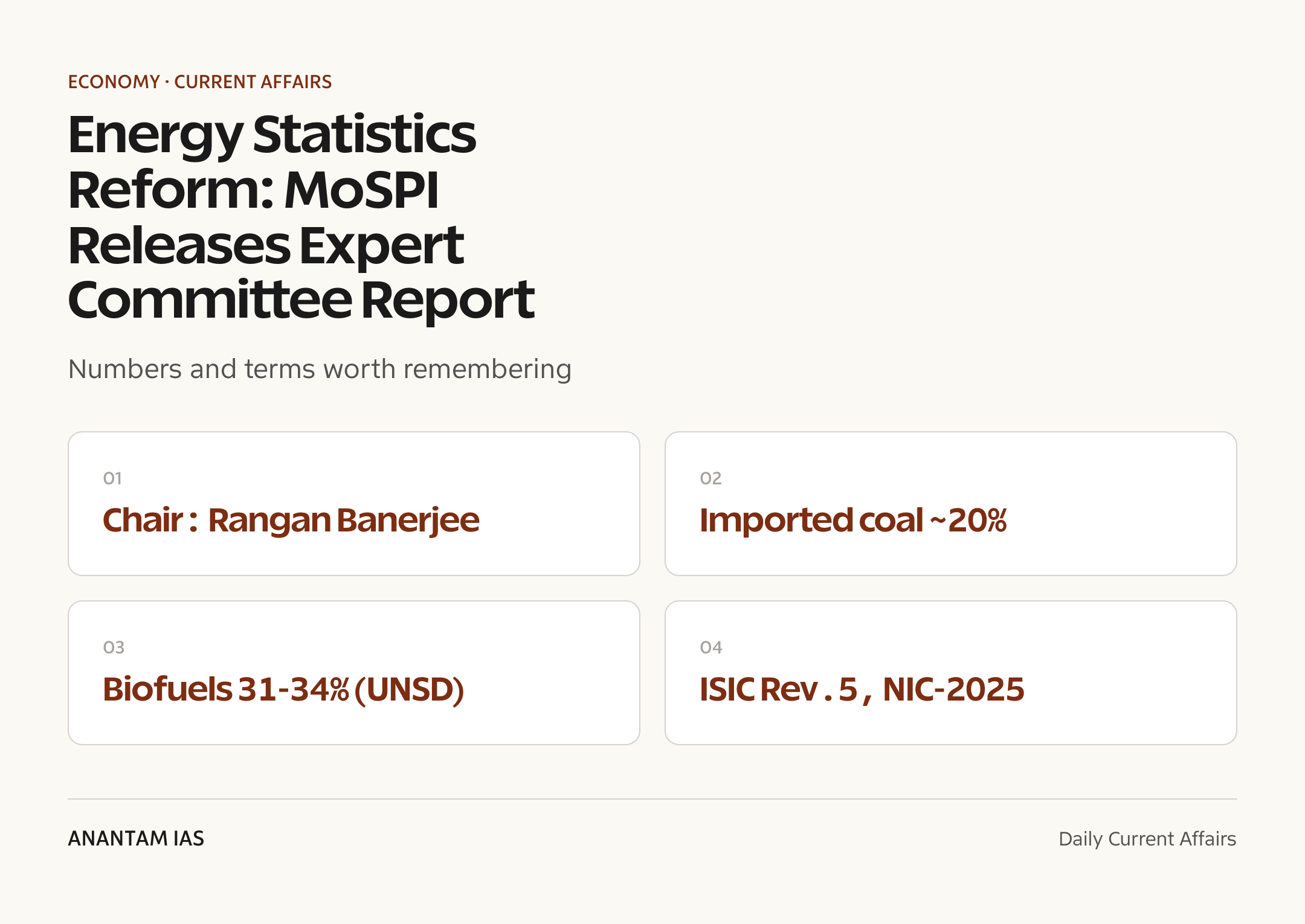
The Ministry of Statistics and Programme Implementation (MoSPI) released the report of the Expert Committee on Energy Statistics on 6 July 2026, PIB confirmed. The committee, chaired by Dr. Rangan Banerjee, Director of IIT Delhi, reviewed India’s entire energy-statistics database and the annual Energy Statistics India publication.
The report recommends aligning India’s energy data with international classification standards, adopting uniform conversion factors across energy ministries, and building new methodologies for the biggest measurement gaps — biofuels, captive power, and electricity consumed by electric vehicles (EVs).
- The committee was constituted by MoSPI under Dr. Rangan Banerjee (Director, IIT Delhi), with members from line energy ministries and research bodies such as TERI and the Alliance for an Energy Efficient Economy (AEEE).
- It recommends tabulation aligned with ISIC Rev. 5, NIC-2025 and the Standard International Energy Product Classification (SIEC).
- A new methodology covers sectoral end-use of imported coal — about 20% of India’s total coal consumption — using the Annual Survey of Industries (ASI) database.
- The UN Statistics Division (UNSD) currently estimates India’s biofuel use on its own, at roughly 31–34% of total annual energy consumption; the committee proposes India’s own methodology to bring biofuels into the national energy balance.
- The Bureau of Energy Efficiency (BEE) is asked to build a comprehensive database under the Perform, Achieve and Trade (PAT) scheme.
- Initial frameworks are proposed for measuring captive/off-grid electricity and EV electricity consumption — two of the largest unmeasured segments of India’s energy demand.
The development matters in the context of:
- Reliable energy accounts are the statistical backbone of India’s energy transition: you can’t track progress towards Net Zero by 2070 or the 500 GW non-fossil capacity goal with inconsistent data.
- India’s energy data is produced by multiple ministries — coal, petroleum, power, renewables — each with its own definitions and conversion factors, so a harmonised framework directly improves evidence-based policymaking.
- When national data is missing, international bodies like the UNSD and IEA fill gaps with their own estimates — meaning India’s official energy picture is partly written outside India.
UPSC Relevance
Prelims Relevance
- Expert Committee on Energy Statistics — constituted by MoSPI, chaired by Dr. Rangan Banerjee, Director, IIT Delhi; report released July 2026.
- Energy Statistics India — MoSPI’s annual publication presenting the national flow-of-energy, energy balance tables and sustainable-energy indicators.
- SIEC — Standard International Energy Product Classification; ISIC Rev. 5 and NIC-2025 — industrial classifications recommended for energy-data tabulation.
- Energy balance — an accounting framework showing energy supply, transformation and final consumption in a common unit for one reference year.
- Imported coal is about 20% of India’s total coal consumption; its end-use split is to be refined using the ASI database.
- UNSD World Energy Balances estimates India’s biofuel share at about 31–34% of total annual energy consumption, based on its own estimation.
- PAT (Perform, Achieve and Trade) — market-based energy-efficiency trading mechanism run by BEE under the National Mission for Enhanced Energy Efficiency.
- Captive power — electricity generated by an industry primarily for its own use, largely outside grid-level metering statistics.
Mains Relevance
GS Paper 3
- Statistical infrastructure as public infrastructure: how harmonised energy accounts underpin energy-transition planning, Net Zero tracking and climate finance credibility.
- Data gaps in biofuels, captive power and EV charging distort estimates of energy demand, emissions intensity and efficiency gains — with direct consequences for policy design.
- Institutional coordination problem: multiple line ministries producing inconsistent energy data, and MoSPI’s role as the harmonising statistical agency.
GS Paper 2
- Expert committees as instruments of governance reform — composition, consultative process and the challenge of getting line ministries to implement cross-cutting recommendations.
- India’s obligations to international statistical systems (UNSD, IEA reporting) and the sovereignty question when foreign bodies estimate national data.
Essay
- What gets measured gets managed — statistics as the quiet infrastructure of the green transition.
- India’s climate ambition is only as credible as India’s data.
Background and Context
India's energy statistics ecosystem — and why it's fragmented
India’s energy numbers are stitched together from many producers, each measuring differently.
- MoSPI compiles the annual Energy Statistics India publication — national flow-of-energy tables, graphs and sustainable-energy indicators aligned to international guidelines (see mospi.gov.in).
- But the primary data comes from line ministries — Coal, Petroleum and Natural Gas, Power, New and Renewable Energy — plus bodies like the Central Electricity Authority (CEA) and BEE.
- Each source historically used its own definitions, classifications and conversion factors, producing inconsistencies when the numbers are combined into one national energy balance.
- The committee’s core diagnosis: India needs one harmonised framework meeting International Standards on Energy Statistics, not several parallel ministry databases.
The committee: mandate and composition
MoSPI set up the panel to audit the whole system, not just one publication.
- Chaired by Dr. Rangan Banerjee, Director, IIT Delhi — an energy-systems academic rather than a ministry insider.
- Members included senior representatives of line energy ministries and domain experts from TERI (The Energy and Resources Institute) and AEEE.
- Mandate: review the Energy Statistics India publication and the full energy-statistics database — coverage, definitions, classification systems, data sources and estimation methodologies.
- The panel held several rounds of technical consultations with ministries, agencies and subject experts before finalising recommendations, PIB noted.
Recommendation 1: speak the world's statistical language
The first fix is classification — putting Indian energy data into internationally comparable boxes.
- Adopt tabulation categories aligned with ISIC Rev. 5 (the UN’s international industrial classification), NIC-2025 (its Indian counterpart) and SIEC (the standard classification of energy products).
- All line energy ministries should use uniform conversion factors — the multipliers that turn tonnes of coal or litres of fuel into common energy units — so inter-ministerial data stops disagreeing.
- Alignment matters because global datasets (UNSD, IEA energy balances) can only ingest Indian data cleanly if the categories match international norms.
- This mirrors the wider statistical-reform push under which India updated its industrial classification to NIC-2025.
Recommendation 2: fix the coal and electricity blind spots
Two big consumption puzzles get an ASI-based solution.
- Imported coal — around 20% of total coal consumption — and domestic coal sold via auction are currently lumped under a ‘miscellaneous’ category, hiding who actually burns it.
- The committee’s methodology mines the Annual Survey of Industries (ASI) database, which captures industry-wise coal consumption, to build a sectoral end-use split.
- The same ASI-based approach is recommended for industry-wise end-use consumption of electricity.
- BEE should develop and maintain a comprehensive database under the PAT scheme — turning an efficiency-trading programme into a rich source of industrial energy data (beeindia.gov.in).
Recommendation 3: bring biofuels into India's own energy balance
India’s biggest energy-data gap is the fuel much of rural India actually uses.
- There’s no consolidated national data on biofuel consumption — firewood, crop residue, dung cake and modern biofuels used by households and small industry.
- In the absence of Indian data, the UN Statistical Division (UNSD) plugs its own estimate into the World Energy Balances: roughly 31–34% of India’s total annual energy consumption.
- That means a third of India’s official energy picture rests on a foreign statistical guess — a striking sovereignty-of-data problem.
- The committee recommends a comprehensive Indian methodology to incorporate the biofuel component into the national energy balance table.
Recommendation 4: measure the new economy — captive power and EVs
The energy transition is creating consumption that today’s statistics simply don’t see.
- Captive and off-grid electricity — industrial plants generating for their own use, rooftop and off-grid solar — largely escapes grid-based metering statistics.
- EV electricity consumption is invisible in current accounts: charging shows up as ordinary household or commercial demand, so the transport sector’s shift from petroleum to electricity can’t be tracked.
- The committee proposes an initial methodological framework for both, explicitly flagged as needing refinement by users and researchers before full incorporation into the energy-balance database.
- As EV adoption accelerates under schemes like PM E-DRIVE, this gap grows every year it stays unfixed.
Why harmonised energy data matters for Net Zero
Energy statistics are the measurement layer beneath every climate commitment India has made.
- India’s Net Zero by 2070 pledge and its 2030 targets — including 500 GW of non-fossil capacity — need credible baselines and trend data to be monitored honestly.
- Emissions inventories reported under the UNFCCC are built on energy-consumption data; bad energy statistics flow straight into bad carbon accounting.
- Investors and multilateral lenders price climate finance partly on data credibility — internationally comparable statistics lower the cost of scepticism.
- MoSPI stressed that implementation will need sustained inter-ministerial coordination — the same coordination failure the fragmented data reflects.
Way Forward
Institutionalise the harmonisation
- Notify uniform conversion factors and the SIEC/NIC-2025 tabulation standard across all line energy ministries with clear timelines, rather than leaving adoption voluntary.
- Create a standing inter-ministerial energy-statistics mechanism under MoSPI to own the energy balance and arbitrate definitional disputes.
Close the measurement gaps
- Pilot the biofuel consumption methodology with household-survey instruments so the UNSD estimate can be replaced by measured Indian data.
- Mandate anonymised data-sharing from DISCOMs, charging-point operators and captive generators so EV and off-grid electricity can be separated from general demand.
- Fast-track the BEE-PAT database so industrial efficiency data feeds directly into national energy accounts.
Alongside these, MoSPI should publish the refined methodologies openly and invite academic scrutiny — the committee itself frames the captive-power and EV frameworks as first drafts that researchers must stress-test.
Conclusion
The Rangan Banerjee committee’s report is unglamorous but foundational. India’s energy transition is being steered with a dashboard that can’t see biofuels, misclassifies a fifth of its coal, and can’t tell an EV charging from a geyser running. Fixing the statistics fixes the steering.
For aspirants, the exam thread is clear: this links statistical reform (MoSPI, NIC-2025, international standards) with energy security and climate policy (energy balance, PAT, Net Zero). Track its implementation alongside your monthly current affairs revision — committee reports like this often surface in Prelims two cycles later.
UPSC Practice Questions
Prelims MCQ 1
With reference to the Expert Committee on Energy Statistics, which released its report in July 2026, consider the following statements:
- The committee was constituted by the Ministry of Power and chaired by the Chairperson of the Central Electricity Authority.
- It recommended aligning India’s energy statistics with international classifications such as ISIC Rev. 5 and the Standard International Energy Product Classification (SIEC).
- Imported coal accounts for about one-fifth of India’s total coal consumption.
How many of the above statements are correct?
(a) Only one (b) Only two (c) All three (d) None
Answer: (b) Only two
Explanation:
Statement 1 is incorrect — the committee was constituted by MoSPI and chaired by Dr. Rangan Banerjee, Director, IIT Delhi. Statements 2 and 3 are correct: it recommended ISIC Rev. 5/NIC-2025/SIEC alignment, and imported coal is about 20% of India’s total coal consumption.
Prelims MCQ 2
The Perform, Achieve and Trade (PAT) scheme, recently in news in the context of energy-statistics reform, is implemented by which body?
(a) Central Electricity Regulatory Commission (CERC) (b) Bureau of Energy Efficiency (BEE) (c) Central Electricity Authority (CEA) (d) NITI Aayog
Answer: (b) Bureau of Energy Efficiency (BEE)
Explanation:
PAT is a market-based energy-efficiency mechanism for energy-intensive industries run by the Bureau of Energy Efficiency. The Expert Committee on Energy Statistics recommended that BEE build a comprehensive database under PAT to strengthen industrial energy data.
UPSC Mains Questions
- Robust energy statistics are a prerequisite for a credible energy transition. In the light of the Expert Committee on Energy Statistics (2026), examine the major data gaps in India’s energy accounts and their policy consequences. (250 words)
- Statistical fragmentation across ministries is a governance problem, not merely a technical one. Discuss with reference to India’s energy-statistics system and suggest institutional mechanisms for harmonisation. (250 words)
Source: PIB, Ministry of Statistics & Programme Implementation.
Frequently Asked Questions
What is the Expert Committee on Energy Statistics?
It’s a committee constituted by the Ministry of Statistics and Programme Implementation (MoSPI) and chaired by Dr. Rangan Banerjee, Director of IIT Delhi. It reviewed India’s energy-statistics database and the annual Energy Statistics India publication, and its report was released on 6 July 2026.
What are the committee’s key recommendations?
Adopt international classifications (ISIC Rev. 5, NIC-2025, SIEC), use uniform conversion factors across energy ministries, refine coal and electricity end-use data using the ASI database, build a BEE database under the PAT scheme, and create methodologies for biofuels, captive power and EV electricity consumption.
Why are biofuels a major data gap for India?
India has no consolidated national data on biofuel consumption, so the UN Statistical Division estimates it independently — at roughly 31–34% of India’s total annual energy consumption. The committee wants an Indian methodology so the national energy balance rests on measured domestic data.
What is an energy balance?
An energy balance is an accounting framework that presents a country’s energy supply, transformation and final consumption in a common energy unit for a reference year. It shows how energy flows from production and imports through conversion (like power plants) to end users.
Why is EV electricity consumption hard to measure?
EV charging is billed as ordinary household or commercial electricity, so it can’t be separated from general demand in current statistics. Without that split, India can’t accurately track the transport sector’s shift from petroleum to electricity or plan grid capacity for it.
How does this reform connect to Net Zero?
India’s Net Zero 2070 pledge and 2030 targets need credible baselines. Emissions inventories are built on energy-consumption data, so harmonised, internationally comparable energy statistics directly improve carbon accounting, transition monitoring and the credibility India presents to climate-finance providers.