Engineering Education in the AI Era: Why India’s Colleges Need a Reset
Why in News?
An Indian Express Expert Explains column argued that engineering education, the pipeline meant to power India’s AI and semiconductor ambitions, is steadily losing its sheen even as demand for engineers rises.
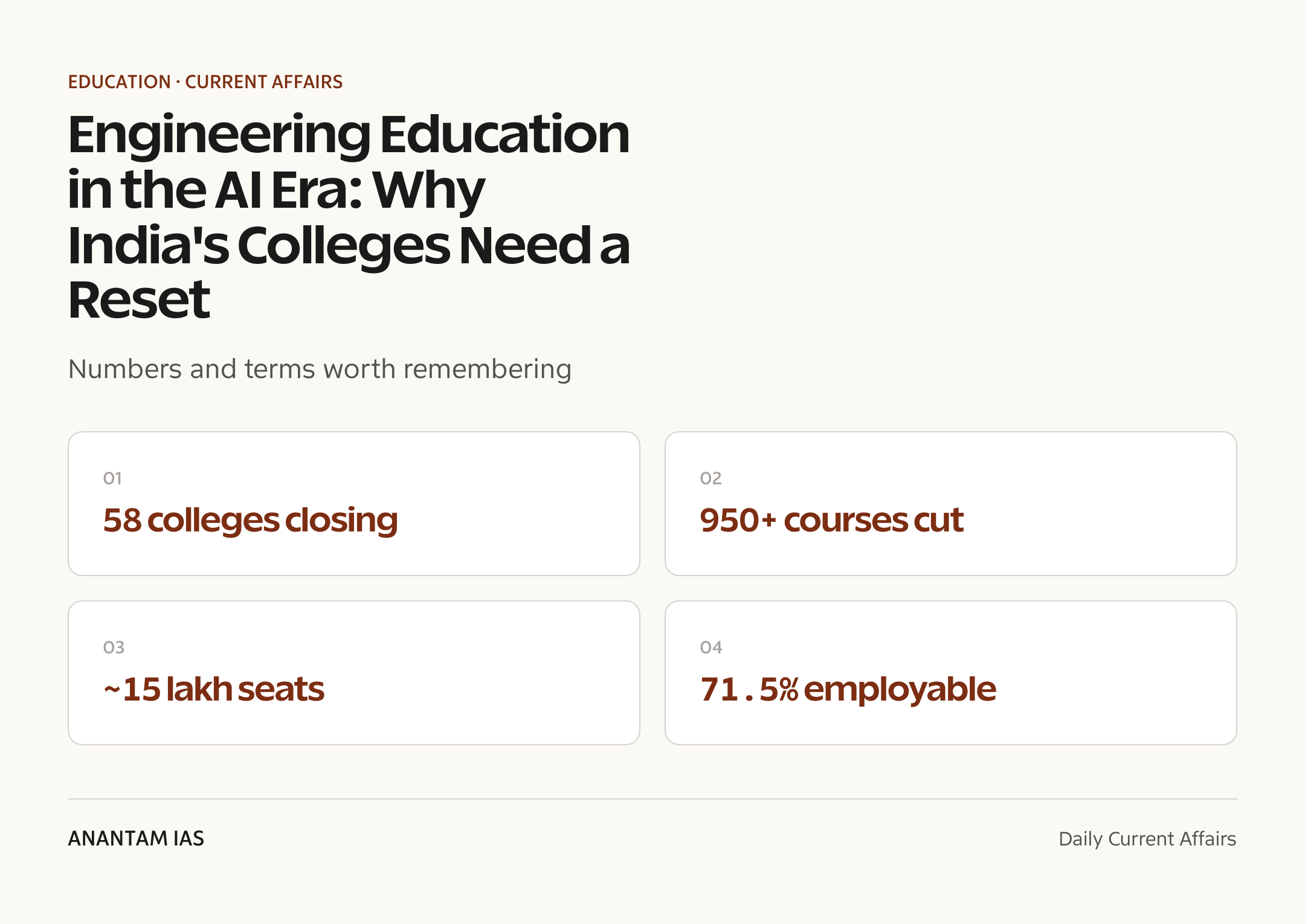
The trigger is the AICTE decision in 2025-26 to place 58 engineering colleges under progressive closure and discontinue more than 950 engineering and technical courses.
The closures land at a moment when the India Skills Report 2025 shows engineering graduates are among the most employable streams yet the wider talent base remains uneven, sharpening a debate the author labels ‘Engineering Education 2.0’.
- The real crisis is the widening gap between what a technology-driven economy needs and what a large section of colleges delivers, not falling relevance of engineering.
- IITs and a handful of premier institutions still draw the brightest students; hundreds of lower-tier colleges face declining admissions, weak faculty and outdated curricula.
- India has an approved undergraduate intake of nearly 15 lakh engineering seats, yet 20-40% of seats in many traditional branches stay vacant each year.
- The reform question is quality, relevance and employability, framed by the author as ‘Engineering Education 2.0’.
The development matters in the context of:
- Engineering talent is the cornerstone of India’s push in AI, semiconductors, quantum, advanced manufacturing and clean energy, making the pipeline a strategic, not just academic, concern.
- Demand-driven concentration of admissions in a few institutions is eroding the financial viability of the rest, turning closure into a structural outcome.
- The debate connects education governance (GS2) with the human-capital foundations of the technology economy (GS3).
UPSC Relevance
Prelims Relevance
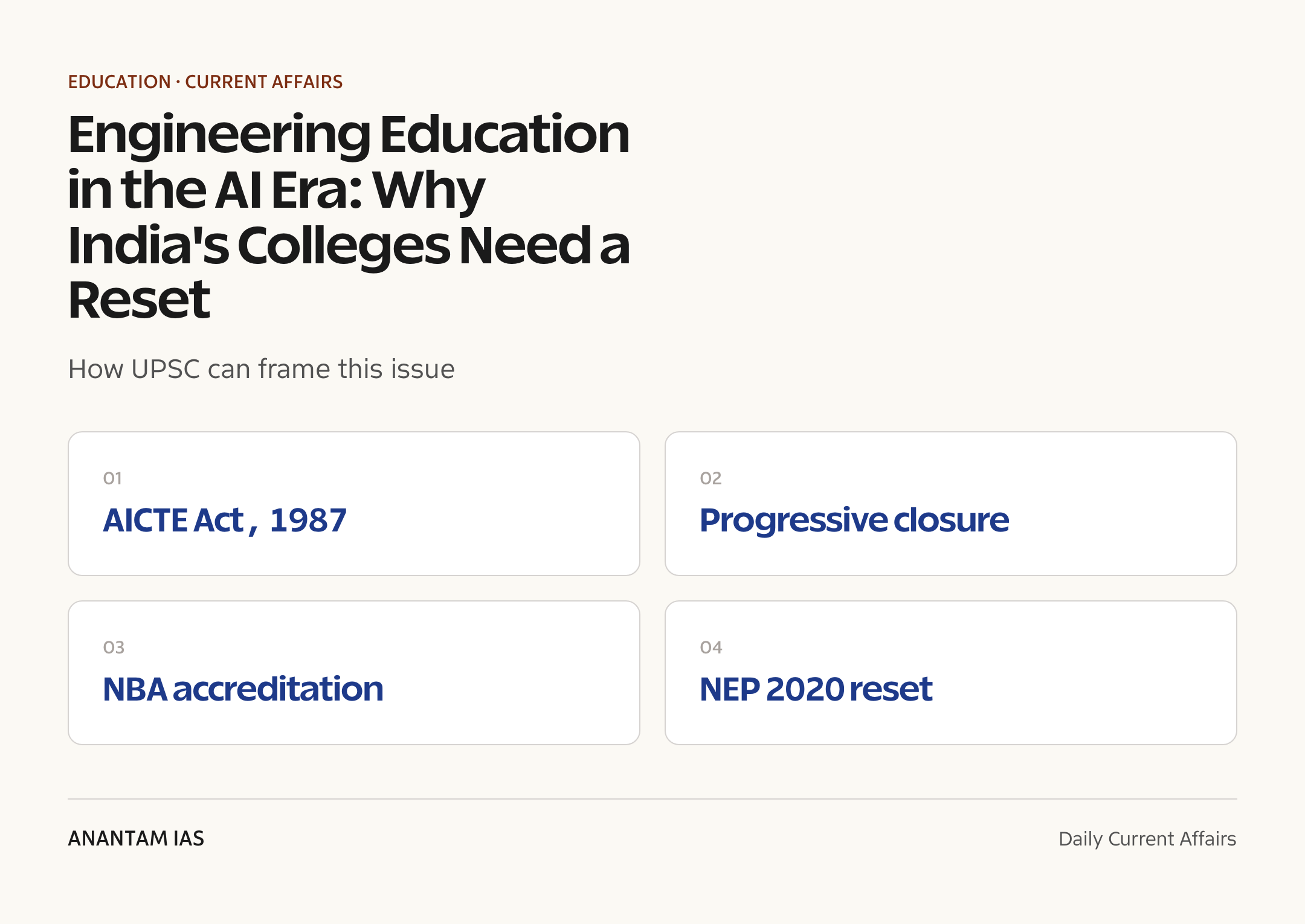
- AICTE (All India Council for Technical Education) is India’s apex statutory regulator for technical education under the AICTE Act, 1987; it traces its origins to an advisory body set up in 1945.
- Every engineering institution needs AICTE approval before admitting students; approval is a continuous compliance process, not a one-time licence.
- Progressive closure bars fresh admissions but lets existing batches graduate, ensuring an orderly exit of non-viable institutions.
- National Board of Accreditation (NBA) runs outcome-based accreditation aligned with the Washington Accord, replacing the older input-based approach.
- India became a permanent signatory to the Washington Accord in 2014, giving accredited degrees international mobility.
- Institutes of National Importance (INIs): India has 79 — 23 IITs, 31 NITs and 25 IIITs; most enjoy statutory autonomy from AICTE approval.
- Regional engineering colleges were upgraded into NITs; IIITs were added under the INI network.
- AICTE imposed a moratorium on new engineering institutions in 2020 and lifted it in 2023.
- Education sits in the Concurrent List of the Seventh Schedule of the Constitution.
- NEP 2020 promotes multidisciplinary, flexible, outcome-oriented higher and technical education and targets a 50% Gross Enrolment Ratio by 2035.
- Approved UG engineering intake is about 15 lakh seats; IITs account for ~19,000, NITs ~25,000 and IIITs ~11,000.
Mains Relevance
GS Paper 2
- Regulation of technical education and the role of statutory bodies like AICTE and NBA
- Issues in the design, implementation and delivery of education policy (NEP 2020)
- Education as a Concurrent List subject and Centre-State-institution coordination
GS Paper 3
- Human-capital foundations for AI, semiconductors and deep-tech growth
- Skill development, employability and the education-employment mismatch
Essay
- Technology can widen opportunity only if the talent pipeline keeps pace with it.
- Quality over quantity: the crisis of numbers in Indian higher education.
- Will artificial intelligence create work or take it? The engineer’s dilemma.
Background and Context
AICTE and the regulatory architecture
The regulator sets the rules of entry, expansion and exit for technical education.
- AICTE began as an advisory body in 1945 and was given statutory teeth by the AICTE Act, 1987, which empowers it to plan, coordinate, regulate and promote technical education across the country.
- It prescribes binding norms for faculty ratios, physical infrastructure, laboratories, land, governance and financial viability, and no engineering college can admit students without its approval.
- Approval is contingent on year-after-year compliance; on periodic assessment AICTE may allow expansion, cut intake, impose restrictions or withdraw approval altogether.
- The 2016 Supreme Court position and later clarifications confirmed AICTE’s regulatory writ over technical programmes even where universities are involved, though jurisdictional overlaps with the UGC recur.
- Most INIs — the IITs, leading NITs and IIITs — operate with statutory autonomy and sit outside routine AICTE approval, a structural fault-line that concentrates prestige at the top.
Accreditation, NBA and the Washington Accord
Quality assurance has moved from counting inputs to measuring what graduates can actually do.
- The National Board of Accreditation (NBA) benchmarks programmes on measurable learning outcomes and graduate attributes rather than only buildings, seats and staff on paper.
- This outcome-based accreditation is aligned with the Washington Accord, the international agreement for mutual recognition of engineering qualifications.
- India became a permanent signatory to the Washington Accord in 2014, so an NBA-accredited degree carries recognition among member economies and eases global mobility for graduates.
- Accreditation is voluntary for many colleges, which weakens it as a filter; a large share of programmes remain un-accredited, blurring the quality signal students rely on.
- Reformers want NBA status tied firmly to funding, intake expansion and reputation, so that quality assurance becomes the decisive gate rather than an optional badge.
What 'progressive closure' means
Closure here is a managed exit, not an abrupt shutdown.
- Under progressive closure, an institution is barred from admitting fresh students but continues until existing batches graduate, protecting those already enrolled.
- It is typically invoked for persistently low admissions, failure to recruit and retain qualified faculty, or continued non-compliance with academic and infrastructure norms.
- In 2025-26, AICTE placed 58 colleges under progressive closure and discontinued 950+ courses, extending a multi-year trend of shrinking capacity in weak institutions.
- The Indian Express column framed these closures as a ‘necessary regulatory correction to years of indiscriminate expansion’ rather than a sign that engineering itself is in decline.
- The mechanism doubles as a student-protection tool: it prevents new intake into a failing college while guaranteeing that current students are not stranded mid-degree.
How India got here: expansion after Y2K
A supply boom followed the global IT surge, then quality lagged behind capacity.
- Until the late 1990s, engineering was largely confined to IITs, regional engineering colleges, a few state colleges and private institutions concentrated in Maharashtra, Karnataka and Tamil Nadu.
- The Y2K episode and the global IT boom triggered an unprecedented expansion, with thousands of new private colleges opening across metropolitan, urban and even rural India.
- Much of this growth was enrolment-led and profit-driven, outpacing the supply of trained faculty, laboratories and industry linkages that real engineering education requires.
- The Union government simultaneously expanded INIs — sanctioning new IITs and IIITs and upgrading regional colleges into NITs.
- As gross access widened, the policy conversation shifted from expansion to excellence, with NBA accreditation increasingly treated as a prerequisite for further programme growth.
The AI shock and the demand shift
Industry demand tilted sharply toward computing, and student choices followed.
- From the mid-2010s the AI revolution pushed demand toward computer science, AI, data science, machine learning and allied disciplines, while mechanical, electrical, civil and core branches saw sustained decline.
- Post-COVID-19, AICTE relaxed the NBA-accreditation requirement for raising intake or adding programmes, letting institutions pivot faster to market demand for computing seats.
- Reputed and premier colleges expanded high-demand seats while rationalising traditional branches, concentrating fresh admissions in a small set of trusted institutions.
- Hundreds of lower-tier colleges were left with depleted enrolments, eroding their financial viability and pushing many toward the closure list.
- The demand shift also strains India’s core-sector pipeline — manufacturing, energy and infrastructure still need mechanical and civil engineers even as students abandon those branches.
The IIT-NIT-IIIT versus private-college divide
A small elite thrives while a long tail of institutions struggles to stay viable.
- The 79 INIs — 23 IITs, 31 NITs and 25 IIITs — combine autonomy, public funding, research culture and brand to attract the strongest applicants and recruiters.
- Selective public institutions field better faculty depth, laboratories, placement networks and industry tie-ups, so their graduates command a clear labour-market premium.
- The vast self-financed private sector, which absorbs the bulk of the ~15 lakh seats, ranges from a few strong universities to many under-resourced colleges dependent on tuition alone.
- This produces a two-track system: a globally competitive top layer and a large middle-and-bottom tier where quality, teaching and outcomes are highly uneven.
- Closing the gap, not just closing colleges, is the durable challenge — the reset has to lift the vast middle, not simply protect the elite.
Faculty shortage and the industry-academia gap
Weak teaching capacity and thin links to industry are the deepest structural failings.
- Chronic faculty shortages and high vacancy rates, especially of doctorate-qualified teachers, cripple the bottom tier and are cited as the single biggest weakness in weak colleges.
- Reliance on underpaid, ad-hoc or under-qualified staff entrenches rote learning and outdated content in classrooms far from the frontier of the field.
- The industry-academia gap means curricula lag real-world tools and practices; many graduates have never touched current software stacks, fabrication or design workflows.
- Thin internships, live projects and faculty industry-exposure leave students with theory but little applied capability, feeding the employability problem.
- AICTE schemes such as mandatory internships, model curricula and faculty-development programmes aim to bridge this, but uptake and enforcement remain patchy across the tail.
The numbers behind the seat glut
Capacity now far exceeds where students actually want to study.
- Approved UG engineering intake is about 15 lakh seats: IITs ~19,000, NITs ~25,000, IIITs ~11,000, with the remainder in the private and state sector.
- Even in NITs and IIITs, several thousand seats stay unfilled each year; in many traditional programmes 20-40% of seats remain vacant.
- The mismatch between concentrated student demand and dispersed institutional capacity makes survival hard for a large segment of colleges.
- For many, progressive closure is now an inevitable consequence of a demand-driven ecosystem, not merely a regulatory penalty.
- The lifting of the 2020 moratorium in 2023 means new capacity can again be added — but selectively, in high-demand fields, deepening the concentration.
The employability gap
Even for those who graduate, job-readiness is uneven.
- The India Skills Report 2025 (Wheebox-CII-AICTE) rated engineering graduates about 71.5% employable — high among streams, but with wide variation across institutions.
- Overall graduate employability rose to roughly 54.8% in 2025 from 51.25% in 2024, underlining a persistent skills gap across Indian higher education.
- The core weaknesses flagged are outdated curricula, weak faculty, rote learning and thin industry linkage in the bottom tier.
- Employability is uneven not just by institution but by skill domain — demand for AI, cloud and data talent far outstrips supply, while generic degrees add little premium.
- The result is ‘jobless’ potential: opportunity is not scarce, but employable, high-quality talent can be — the essence of the education-employment mismatch.
AI, entry-level jobs and curriculum reform
The same technology reshaping demand is also reshaping the entry-level job it prepares students for.
- Generative AI is automating parts of routine coding, testing and support work, squeezing some entry-level tech roles that once absorbed fresh engineering graduates.
- This raises the essay-worthy question of whether AI is a job-destroyer or a job-transformer — historically technology has shifted the nature of work rather than ending it, but the transition can be painful and unequal.
- The premium is moving toward engineers who can build, deploy and supervise AI systems rather than perform tasks that AI now handles, changing what a degree must teach.
- Curricula are being urged to embed AI, machine learning, data science, cybersecurity and semiconductor design as mainstream content, not optional electives.
- The durable insight is that employability is now a moving target: static syllabi date quickly, so continuous, industry-aligned curriculum reform becomes a survival requirement, not a luxury.
NEP 2020, skilling and apprenticeships
The policy scaffolding for a reset already exists; the task is delivery.
- NEP 2020 envisions multidisciplinary, flexible and outcome-oriented higher and technical education, with multiple entry-exit, a credit framework and a target Gross Enrolment Ratio of 50% by 2035.
- It pushes stronger industry-academia linkage, research and holistic learning, dissolving the rigid silo that separated engineering from the sciences, humanities and management.
- Skilling instruments — the National Apprenticeship Promotion Scheme, apprenticeships under the Apprentices Act, 1961, and internship mandates — aim to give students real workplace exposure alongside the degree.
- Aligning technical education with Skill India and sectoral missions on semiconductors, electronics and clean energy is meant to convert enrolment into employable, deployable talent.
- The gap is execution: policy intent is sound, but faculty capacity, funding and regulatory follow-through decide whether the vast middle of the ecosystem actually improves.
The reform blueprint: Engineering Education 2.0
The proposed reset moves from quantity and compliance to quality and outcomes.
- Continuously align curricula with AI, data science, cybersecurity, semiconductor design, robotics and sustainability, while keeping strong foundations in mathematics, science and core engineering.
- Shift from rote learning to competency-based education — project-based learning, interdisciplinary problem-solving, design thinking, internships and stronger industry-academia collaboration, in line with NEP 2020.
- Move regulation from input-based compliance to outcome-based accountability, judging institutions by employability, research, patents, startups and industry engagement.
- Replicate the excellence of IITs and leading NITs across the wider ecosystem while enabling the orderly exit of persistently non-performing colleges.
- Treat closure as one instrument among many — pairing exit of the unviable with capacity-building, faculty investment and quality upgrades for colleges that can be saved.
Way Forward
Curriculum and pedagogy
- Institutionalise rolling curriculum reviews so emerging fields like AI and chip design enter syllabi without multi-year lag.
- Mandate meaningful internships, capstone projects and faculty industry-exposure to close the theory-practice gap.
Regulation and quality
- Rebalance AICTE oversight toward outcome metrics — employability, research output, patents and startups — rather than only inputs.
- Strengthen NBA outcome-based accreditation as the signal of quality, tied to funding and expansion.
Faculty and equity
- Invest in faculty recruitment, retention and continuous upskilling, the single biggest weakness of the bottom tier.
- Protect students of closing colleges through transparent teach-out, credit transfer and migration safeguards.
Conclusion
India’s ambition to lead the AI and semiconductor era rests less on how many engineers it produces than on how good they are. The AICTE closures are a symptom of a demand-driven correction, but the durable fix is a quality reset across the vast middle of the ecosystem — the private and state-sector colleges that educate most of the country’s engineers.
The policy pieces already fit together: a statutory regulator in AICTE, an outcome-based quality gate in NBA and the Washington Accord, a reform frame in NEP 2020, and skilling instruments from apprenticeships to internships. What remains is execution — faculty investment, industry linkage and rolling curriculum reform that keeps pace with a fast-moving field.
For UPSC, the story is a clean bridge between education governance and the technology economy: a regulator, a policy frame and a strategic goal of deep-tech leadership that only holds together if the talent pipeline is genuinely world-class.
UPSC Practice Questions
Prelims MCQ 1
With reference to the All India Council for Technical Education (AICTE), consider the following statements:
- It is a statutory body established under an Act of Parliament.
- All Institutes of National Importance require its prior approval to admit students.
- ‘Progressive closure’ allows a college to continue teaching existing batches while barring fresh admissions.
How many of the above statements are correct?
(a) Only one (b) Only two (c) All three (d) None
Answer: (b) Only two
Explanation:
AICTE is statutory under the AICTE Act, 1987 (1 correct). Most INIs, such as IITs, enjoy statutory autonomy and are outside routine AICTE approval, so statement 2 is wrong. Progressive closure bars fresh admissions while letting existing batches graduate (3 correct).
Prelims MCQ 2
The outcome-based accreditation of engineering programmes in India is carried out by which body, benchmarked against which international agreement?
(a) AICTE; the Bologna Process (b) National Board of Accreditation; the Washington Accord (c) UGC; the Seoul Accord (d) NAAC; the Canberra Accord
Answer: (b) National Board of Accreditation; the Washington Accord
Explanation:
The National Board of Accreditation (NBA) runs outcome-based accreditation aligned with the Washington Accord, which governs mutual recognition of engineering qualifications; India has been a permanent signatory since 2014.
UPSC Mains Questions
- India’s approved engineering intake of nearly 15 lakh seats coexists with the progressive closure of colleges and 20-40% vacant seats in traditional branches. Examine the structural causes of this paradox and suggest reforms to make engineering education future-ready. (250 words)
- “India’s deep-tech ambitions will be constrained not by a shortage of opportunities but by a shortage of employable engineers.” Critically analyse in the light of the education-employment mismatch and the reforms envisaged under NEP 2020. (250 words)
Sources: The Indian Express (Explained) and India Skills Report 2025 (Wheebox-CII-AICTE).
Frequently Asked Questions
What did AICTE do in 2025-26?
AICTE placed 58 engineering colleges under progressive closure and discontinued more than 950 engineering and technical courses. Progressive closure bars these institutions from admitting fresh students while allowing already-enrolled batches to complete their degrees, ensuring an orderly exit of persistently non-viable colleges rather than an abrupt shutdown that would harm students.
What is ‘progressive closure’?
It is an AICTE regulatory mechanism for the orderly exit of non-viable technical institutions. The college cannot admit new students but continues to run until its existing batches graduate. It is typically invoked for persistently low admissions, inability to recruit and retain qualified faculty, or continued non-compliance with academic, infrastructure and operational norms.
Why are engineering seats going vacant?
Industry demand has shifted sharply toward computer science, AI and data science, so students crowd into a small set of strong institutions and high-demand branches. Traditional branches like mechanical and electrical, and hundreds of lower-tier colleges, are left with 20-40% vacancies, eroding their finances even though India’s total approved intake is about 15 lakh seats.
How employable are Indian engineering graduates?
The India Skills Report 2025 (Wheebox-CII-AICTE) rated engineering graduates about 71.5% employable, among the higher figures across streams. But the number hides wide variation: top institutions place well, while much of the bottom tier struggles with outdated curricula, weak faculty and thin industry linkage, producing the education-employment mismatch reformers want to fix.
What is ‘Engineering Education 2.0’?
It is the reform vision described in the Indian Express column: a shift from quantity to quality, from input-based compliance to outcome-based accountability, and from capacity expansion to global competitiveness. It means aligning curricula with AI, semiconductors and sustainability, adopting competency-based learning, and judging colleges by employability, research and industry engagement.
How does this connect to NEP 2020?
NEP 2020 pushes multidisciplinary, flexible and outcome-oriented higher and technical education, with stronger industry-academia links and project-based learning. The engineering reset operationalises these ideas for technical education, so the policy frame (NEP 2020), the regulator (AICTE) and the strategic goal of deep-tech leadership are closely linked in UPSC answers.