ESIC Reform Debate: Public Social Insurance and Privatisation Risks
Why in News?
A Safe In India report released on 4 September warned against default privatisation of ESIC and called for evidence, retained public control and reversible private arrangements.
- The report proposed raising the ESIC coverage wage ceiling from ₹21,000 to ₹33,000; this is a recommendation, not an adopted rule.
- It argued that private participation should proceed only where worker, employer or institutional outcomes demonstrably improve.
- ESIC’s reported tie-ups with 2,836 hospitals expand treatment options but may also leave delays and out-of-pocket spending unresolved.
- ESIC’s Director General linked future coverage growth to the Code on Social Security and an upgraded digital benefits platform.
- Social insurance pools contributions and risks; it is different from tax-funded assistance and from purchasing an individual commercial policy.
- The central governance question is whether reform expands entitlement, provider capacity and accountability together.
UPSC Relevance
Prelims Relevance
- ESIC administers the Employees’ State Insurance scheme under the Employees’ State Insurance Act, 1948.
- ESI is a contributory social-insurance arrangement covering medical care and specified cash benefits.
- A wage ceiling determines coverage eligibility; changing it requires an official government decision.
- Empanelment purchases services from outside providers without automatically transferring ownership or statutory responsibility.
- Cream-skimming occurs when providers prefer lower-risk or more profitable patients.
Mains Relevance
GS Paper 2
- Social insurance, public health capacity and accountable service purchasing
- Regulatory capacity, universal access and grievance redress
GS Paper 3
- Formalisation and social protection amid changing employment arrangements
Essay
- Public purpose depends less on who delivers a service than on who guarantees access, bears risk and answers when delivery fails.
Background and Context
What ESIC Is Designed to Do
ESI pools contributions so illness, maternity, injury, disability or death does not leave an insured worker facing risk alone.
- The institution combines statutory entitlement, contribution collection, medical infrastructure, contracted care and cash benefits within one social-insurance system.
- Risk pooling works because contributions are shared across many insured persons rather than priced separately for each individual’s medical profile.
- Coverage expansion can protect more workers, but eligibility must be matched by clinics, hospitals, specialists, claims capacity and understandable grievance routes.
- Digital systems can reduce discretion and delays, yet exclusion, data errors and weak appeals can turn automation into a new access barrier.
- Medical and cash benefits require different delivery chains, so reform must coordinate clinical care, certification, contribution records and payment without forcing workers between disconnected offices.
Private Participation Is Not One Thing
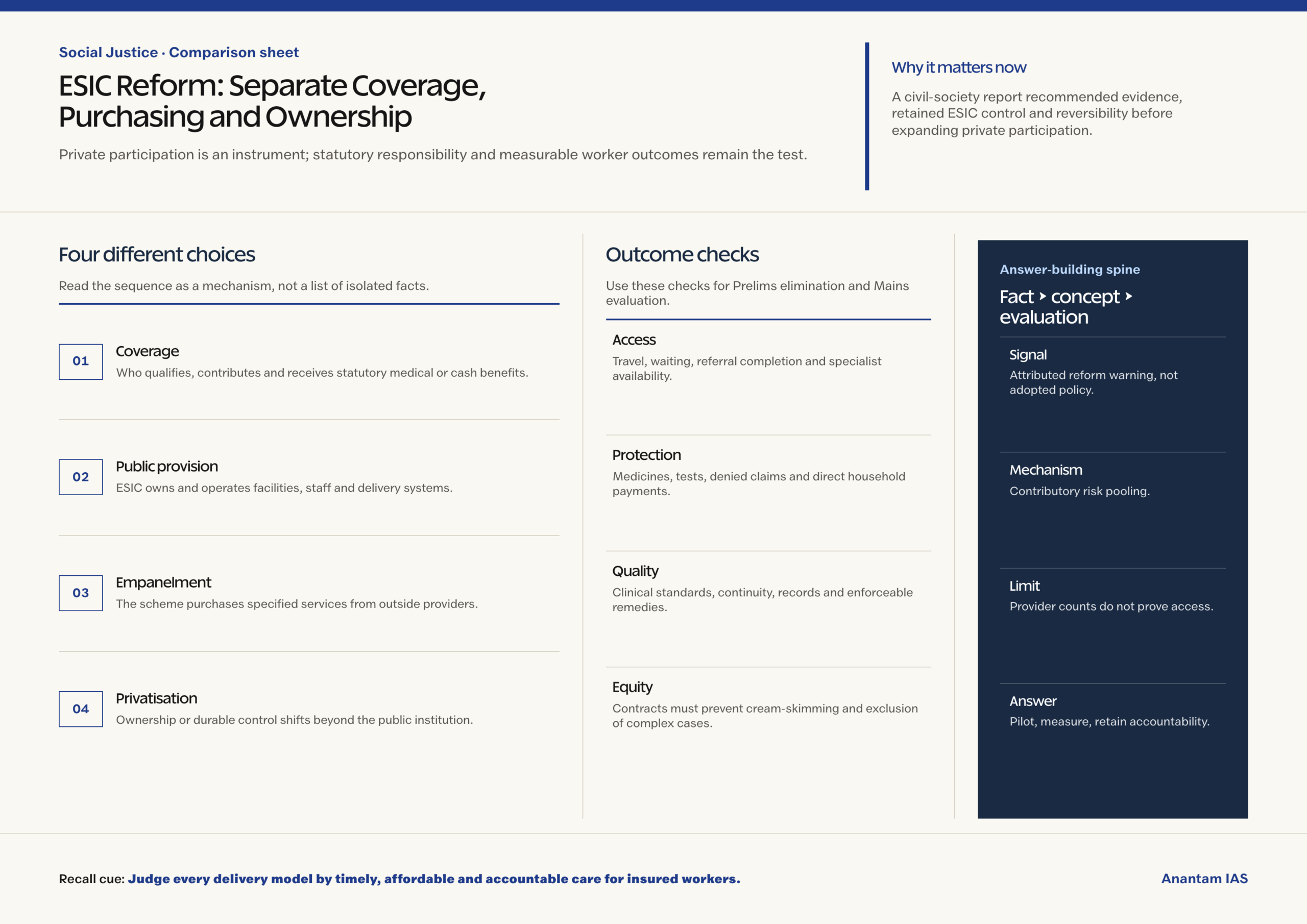
Contracting a hospital, buying a diagnostic service and selling an institution are different choices with different accountability consequences.
- Empanelment can add specialist or geographic capacity when ESIC facilities cannot meet demand, while the public scheme remains responsible for entitlement.
- Purchasing fails when tariffs, referrals or reimbursements delay treatment or push insured persons toward costs that the statutory scheme should absorb.
- Private providers may select profitable services or lower-risk patients unless contracts, audits and payment design prevent cream-skimming.
- A reversible pilot with measurable outcomes is safer than permanent structural change justified only by assumed private-sector efficiency.
- Contract design matters because fee-for-service, bundled payments and capitation create different incentives for volume, prevention, referral and treatment of complex cases.
Test Reform Against Worker Outcomes
The report is advocacy evidence, not government policy, so its recommendations should be assessed through transparent outcome measures.
- Access should measure travel time, waiting time, referral completion and specialist availability, not merely the number of empanelled institutions.
- Financial protection should track medicines, diagnostics, informal payments and denied claims because nominal coverage can coexist with high out-of-pocket spending.
- Quality requires clinical standards, infection control, continuity of care, patient records and enforceable remedies across both ESIC and contracted facilities.
- Public reporting should compare outcomes before and after reform and disclose who bears cost, clinical risk and responsibility for failed delivery.
- Worker participation can reveal hidden barriers such as wage-record errors, employer non-registration, denied referrals and reimbursement delays that aggregate hospital statistics overlook.
Coverage Expansion Changes the Institution
Bringing new worker groups into ESI changes contribution flows, provider demand, administrative capacity and the meaning of a covered establishment.
- Gig and platform workers may lack one identifiable employer, requiring new contribution and record-sharing rules rather than simple extension of existing payroll processes.
- A higher wage ceiling can reduce coverage cliffs, but contribution affordability and health-system capacity must be assessed together.
- Transition rules should protect existing beneficiaries from longer queues or weaker services while new groups are enrolled.
Way Forward
Reform With Retained Accountability
Capacity gaps can justify contracting, but public authority must keep the rules, data, audit power and duty to secure treatment.
- Publish measurable access, quality and financial-protection indicators for ESIC facilities and empanelled providers.
- Use time-bound pilots with independent evaluation and clear exit clauses before scaling structural changes.
- Strengthen specialist recruitment, referral tracking, medicine availability and worker-facing grievance resolution.
- Expand coverage only with funded provider capacity and safeguards against digital or documentation exclusion.
Conclusion
- The core test is not a public-versus-private slogan; it is whether workers receive timely, affordable and accountable care under a guaranteed social-insurance entitlement.
- A strong answer should separate ownership, contracting and regulation, then judge each reform by access, quality, financial protection and reversibility.
UPSC Practice Questions
Prelims MCQ 1
With reference to Employees’ State Insurance, consider the following statements:
- It is a contributory social-insurance arrangement.
- Empanelling a private hospital necessarily transfers ESIC ownership to that hospital.
- A wage ceiling can affect eligibility for coverage.
How many of the above statements are correct?
(a) Only one (b) Only two (c) All three (d) None
Answer: (b) Only two
Explanation:
Statements 1 and 3 are correct. Empanelment is a purchasing arrangement and does not by itself transfer institutional ownership.
Prelims MCQ 2
Which safeguard most directly reduces cream-skimming by contracted health providers?
(a) Removing all reporting requirements (b) Paying only for profitable procedures (c) Risk-sensitive contracts, audits and enforceable access rules (d) Replacing statutory entitlement with voluntary charity
Answer: (c) Risk-sensitive contracts, audits and enforceable access rules
Explanation:
These tools discourage provider selection of only easier or more profitable patients and preserve equitable access.
UPSC Mains Questions
- Private participation in social insurance should be treated as a governed instrument, not an ideological default. Examine with reference to ESIC.
- How should India expand social-insurance coverage without creating nominal entitlements unsupported by provider capacity and grievance redress?
Source: The Hindu.
Frequently Asked Questions
What is ESIC?
The Employees’ State Insurance Corporation administers a statutory contributory social-insurance scheme providing medical care and specified cash benefits to covered workers and families.
Has the ESIC wage ceiling been raised to ₹33,000?
No. The reported figure is a recommendation in a non-government report; the current figure cited by the source is ₹21,000 unless officially changed.
Is hospital empanelment the same as privatisation?
No. Empanelment purchases services from an external provider while the public scheme can retain ownership, rules, financing and statutory responsibility.
What is cream-skimming?
It is provider selection of lower-risk or more profitable patients or services, which can leave costly or complex cases underserved.
How should ESIC reform be judged?
Use measurable access, clinical quality, out-of-pocket cost, claim resolution, equity and accountability outcomes rather than provider counts alone.