Euthanasia: Legal Framework & Ethical Considerations
Why in News?
The Supreme Court’s recent judgment in the Harish Rana v. Union of India (2026) case reaffirms the right to die with dignity under Article 21, allowing withdrawal of life support and emphasising patient autonomy.
| UPSC Relevance: GS-2 Polity and Governance: Fundamental Rights; GS-4 Ethics: Ethics in human actions. Mains: Right to Life (Dynamism in the interpretation); Euthanasia: Ethical considerations |

Right to Die with Dignity:
- Article 21 of the Indian Constitution guarantees every citizen a fundamental Right to life with Dignity. The Right to Die with Dignity is recognised as a fundamental right under Article 21, interpreting it as part of the Right to Life.
- India’s legal framework allows passive euthanasia (withdrawing life support) for terminally ill patients or those in a permanent vegetative state.
India’s legal framework on Euthanasia:
- Euthanasia: Euthanasia is the act of deliberately ending a person’s life to relieve suffering. In voluntary euthanasia, consent is given by a patient. In non-voluntary euthanasia, a patient cannot consent, e.g., in a coma.
- Legal status in India:
- Active Euthanasia: killing a patient by active means, e.g., injecting a patient with a lethal dose of a drug. Active Euthanasia is illegal in India.
- Passive Euthanasia: refusal of treatment, or withdrawal of life support, to allow a patient to die. Legal in India.
Developments regarding the ‘Right to Die with Dignity’:
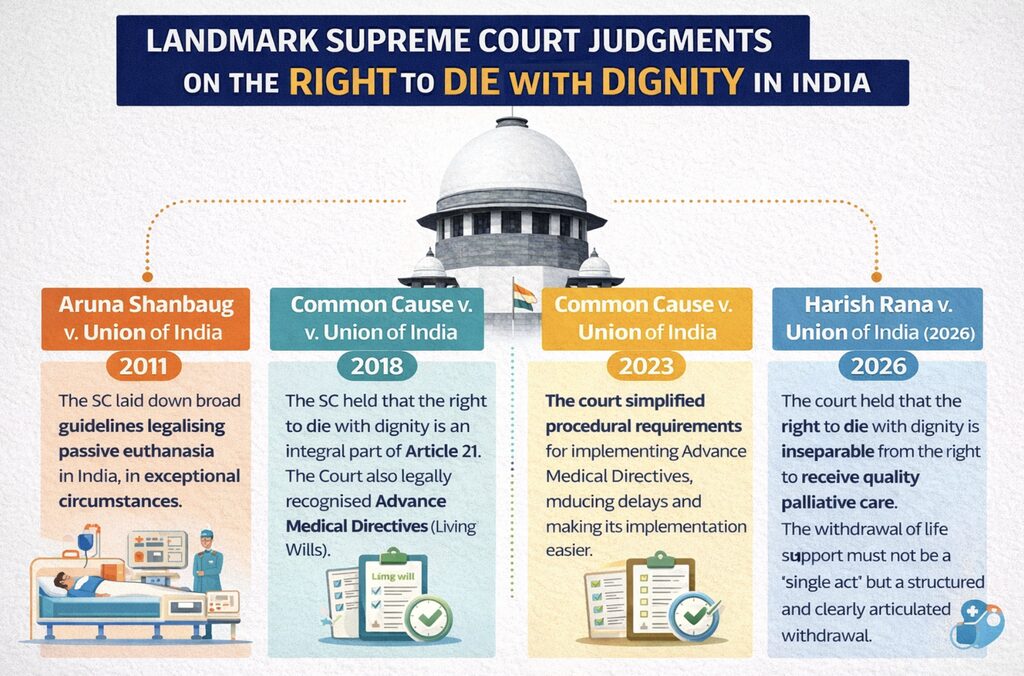
- Aruna Shanbaug v. Union of India (2011): The SC laid down broad guidelines legalising passive euthanasia in India, in exceptional circumstances. It allowed withdrawal of life-sustaining treatment from patients in a permanent vegetative state.
- Common Cause v. Union of India (2018): The SC held that the right to die with dignity is an integral part of Article 21. The Court also legally recognised Advance Medical Directives (Living Wills).
- Common Cause v. Union of India (2023): The court simplified procedural requirements for implementing Advance Medical Directives, reducing delays and making its implementation easier.
- Harish Rana v. Union of India (2026): The court held that the right to die with dignity is inseparable from the right to receive quality palliative care. The withdrawal of life support must not be a ‘single act’ but a structured and clearly articulated withdrawal.
| Harish Rana v. Union of India (2026) case: Case: The SC upheld the right to die with dignity of 32-year-old Harish Rana (in a persistent vegetative state for nearly 13 years) by allowing the withdrawal of the applicant’s Clinically Assisted Nutrition and Hydration (CANH). This was the first time the SC had implemented its own 2018 Constitution Bench guidelines for what it had then called ‘passive euthanasia’. The SC ruled that: • Euthanasia will refer strictly to active euthanasia, which remains impermissible.’ • Passive Euthanasia (an obsolete term) will be replaced by ‘Withdrawing or Withholding of Medical Treatment.’ • Withholding of life-sustaining interventions should not be a “single act” nor an “act of abandonment” of unconscious or incompetent patients in a persistent vegetative state (PVS). The process of withdrawal of CANH must be part of a well-structured, tailored, robust and articulated palliative care plan for a PVS patient. • The right to die with dignity is inseparable from the right to receive quality palliative and End-of-Life (EOL) care. It is imperative to ensure that the withdrawal process is not marred by pain, agony, or suffering. The SC urged the Centre to initiate specific legislation detailing the procedure for life support withdrawal. |
Euthanasia- Ethical and Social Implications:
| Implications | Arguments against Passive Euthanasia | Arguments supporting Passive Euthanasia |
| Sanctity of Life | Birth and death are natural processes; hence, nature should decide when a person dies and how the body responds to illness. Any interference with the rules of nature may be considered unethical. Religious traditions often emphasise the preservation of life. | Life is the period between birth and death, and it is spent in a society where dignity is of utmost importance. Both the birth and the death should be dignified. Right to die with dignity assumes greater significance. |
| Economic Implications | Risk of Slippery Slope: Possible misuse, especially vulnerable people (elderly, disabled and poor) may face coercion. The decision may be driven by financial constraints, social neglect, and family pressure. Hence, it would amount to disguised abandonment. | Relief for Families: Long-term life-support treatment without any hope of recovery would put the family under severe economic stress, especially in the middle- and lower-income groups. In this context, the right to die with dignity appears to be justified. |
| Medical Ethics | Potential for Misdiagnosis: Medical science is not infallible; a diagnosis of a terminal condition could be incorrect, or a sudden medical breakthrough could offer a cure. Contradicts core Hippocratic Oath: Do no harm. | Alleviation of Suffering: It allows terminally ill patients to end prolonged, excruciating pain when medical treatment only offers a “lingering death”. Aligns with physicians’ duty to relieve suffering. |
Ethical Aspects of Euthanasia:
The ethical principles enshrined in granting passive euthanasia:
- Principle of Autonomy: It grants the patient, or, in cases of terminal illness, their next of kin, the right to make decisions. E.g., Living wills grant individuals autonomy to refuse life-prolonging treatment.
- Principle of Beneficence: Doctors must act in the patient’s best interest. Prolonging suffering without hope of recovery is not beneficial.
- Principle of Non-Maleficence: Avoid unnecessary suffering caused by prolonged artificial life support. Also, the decision to allow passive euthanasia should not cause harm.
- Principle of Justice: must be protected to ensure that no injustice is done to the patient.
- Theory of Double Effect (proposed by St. Thomas Aquinas): According to this theory, every action creates two effects, and the one that is less harmful or beneficial should be considered ethical.
- In the case of passive euthanasia, the action (withdrawal of life support, or CANH in the Harish Rana case) leads to two effects: (i) death of the patient, and (ii) relief from suffering.
- If the decision is taken without malice, the act can be considered ethical as the patient was relieved of his pain.
| What is a living will? • A living will (or Advance Medical Directive) is a legal document that allows individuals to specify their preferences for medical treatment in situations where they may become incapacitated, vegetative state, or unable to communicate their decisions. • This directive ensures that a person’s wishes regarding life-sustaining treatments are respected, even when they cannot express them due to medical conditions. • The SC legally recognised advance directives in the Common Cause vs. Union of India (2018) case. |
Practice Question
Q. “Right to life under Article 21 includes the right to die with dignity, especially in cases of terminal illness.” Discuss the ethical justification for allowing withdrawal of life-sustaining treatment in terminally ill patients. (GS-4)
UPSC Mains PYQ 2023
Q. “The Constitution of India is a living instrument with capabilities of enormous dynamism. It is a constitution made for a progressive society.” Illustrate with special reference to the expanding horizons of the right to life and personal liberty.