EVEREST Methalox Engine: What Astrobase Has Built and What Remains Untested
Why in News?
Bengaluru-based Astrobase Space Technologies unveiled EVEREST , an integrated 80-tonne-class liquid-rocket engine designed around the full-flow staged-combustion cycle and liquid oxygen-methane propellants.
- IN-SPACe’s 2026 industry-delegation profile identifies Astrobase’s project as a privately built high-thrust FFSC engine for reusable launch systems.
- The official profile lists liquid oxygen and methane, or methalox, as the propellant combination and gives a planned vacuum thrust of 800 kN.
- The same IN-SPACe document lists a 50%-110% throttle range; these are design or advertised performance specifications, not results of a completed full-scale qualification campaign.
- The unveiled hardware was described as fully integrated, meaning major engine assemblies had been brought together. Integration alone does not establish ignition reliability, stable combustion, rated thrust, endurance, restart capability or reuse life.
- Reports on the programme refer to earlier sub-scale hot-fire work and turbopump trials. Those tests reduce technical risk, but they do not substitute for firing the complete full-scale EVEREST engine under representative conditions.
- The development links advanced propulsion with India’s post-2020 policy of allowing non-government entities to build launch vehicles, satellites and space infrastructure.
- For UPSC, the useful distinction is between a technology announcement, a component test, a sub-scale hot-fire, an integrated engine hot-fire, qualification, and flight heritage. Each is a different rung of evidence.
- Methalox propulsion is attractive for reusable launchers because methane can burn with less soot than kerosene and can support repeat operations, but operational reusability still depends on thermal margins, inspection needs, turnaround systems and demonstrated engine.
UPSC Relevance
Prelims Relevance
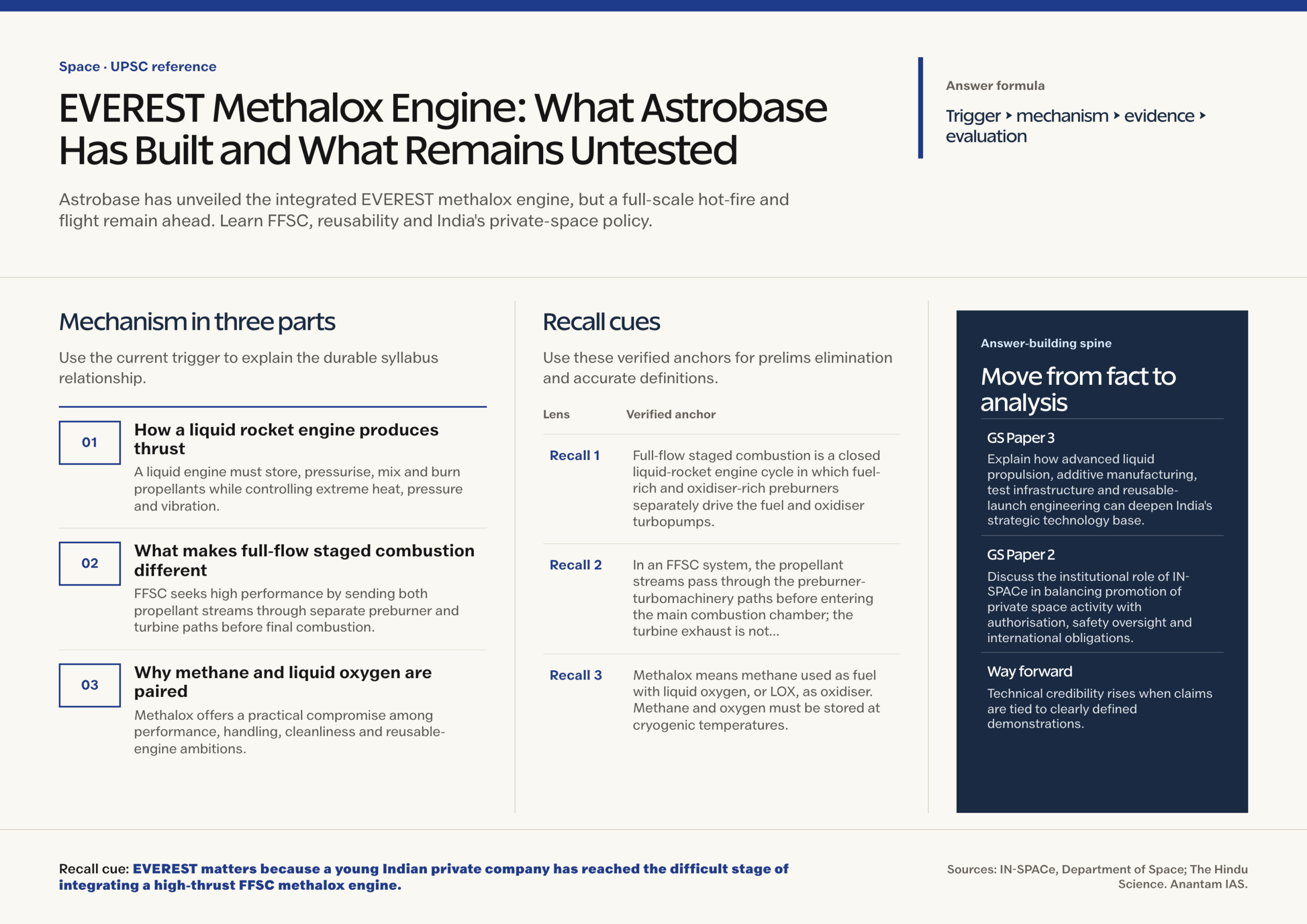
- Full-flow staged combustion is a closed liquid-rocket engine cycle in which fuel-rich and oxidiser-rich preburners separately drive the fuel and oxidiser turbopumps.
- In an FFSC system, the propellant streams pass through the preburner-turbomachinery paths before entering the main combustion chamber; the turbine exhaust is not dumped overboard as in an open gas-generator cycle.
- Methalox means methane used as fuel with liquid oxygen, or LOX, as oxidiser. Methane and oxygen must be stored at cryogenic temperatures.
- A preburner produces hot gas to drive a turbine, while a turbopump raises propellant pressure before injection into the main chamber.
- A fuel-rich preburner operates with excess fuel; an oxidiser-rich preburner operates with excess oxidiser. FFSC must manage both demanding chemical environments.
- Thrust, measured in newtons, is not the same as specific impulse. Thrust measures force, while specific impulse indicates propellant efficiency under stated conditions.
Mains Relevance
GS Paper 3
- Explain how advanced liquid propulsion, additive manufacturing, test infrastructure and reusable-launch engineering can deepen India’s strategic technology base.
- Assess the advantages and engineering risks of FFSC methalox engines without treating an unveiling as a qualification or flight milestone.
GS Paper 2
- Discuss the institutional role of IN-SPACe in balancing promotion of private space activity with authorisation, safety oversight and international obligations.
- Connect space-sector reform with transparent milestone reporting, public support for high-risk technology and accountable use of state-backed facilities or funds.
Essay
- Technological sovereignty is built through patient testing and institutional learning, not by announcements alone.
Background and Context
How a liquid rocket engine produces thrust
A liquid engine must store, pressurise, mix and burn propellants while controlling extreme heat, pressure and vibration.
- The fuel and oxidiser are carried in separate tanks. Turbopumps raise their pressure so injectors can feed them into the combustion chamber against the chamber’s high pressure.
- Combustion creates high-temperature, high-pressure gas. The nozzle expands and accelerates this gas, producing thrust in the opposite direction under Newton’s third law.
- An engine cycle describes how energy is supplied to the turbopumps and what happens to the turbine-driving gas. Cycle choice shapes efficiency, complexity, chamber pressure, thermal load and maintainability.
- A complete engine demonstration must prove stable ignition, combustion stability, control response, shutdown, structural margins and repeatability across the intended operating envelope.
What makes full-flow staged combustion different
FFSC seeks high performance by sending both propellant streams through separate preburner and turbine paths before final combustion.
- One preburner runs fuel-rich and drives the fuel-side turbine; another runs oxidiser-rich and drives the oxidiser-side turbine. Their gas streams later meet in the main chamber.
- Because turbine power can be distributed across two propellant paths, designers can pursue high mass flow and chamber pressure while keeping turbine inlet temperatures more manageable than a single-stream arrangement might require.
- Separate turbopump shafts can reduce the need for a dynamic seal separating fuel and oxidiser on one shaft, addressing one important hazard path. The architecture still creates major sealing, ignition, materials and control challenges elsewhere.
- FFSC is not automatically superior for every launcher. Its gains must justify two preburners, complex plumbing, precise mixture control, demanding start transients and a larger test programme.
Why methane and liquid oxygen are paired
Methalox offers a practical compromise among performance, handling, cleanliness and reusable-engine ambitions.
- Methane generally produces less soot than kerosene-based rocket fuel. Lower carbon deposition can ease inspection and help protect cooling channels and injectors during repeated firing.
- Liquid oxygen supplies the oxidiser because rockets cannot rely on atmospheric oxygen throughout ascent. Both propellants are cryogenic, so insulation, tank management and pre-launch operations remain demanding.
- Methane is denser and easier to contain than liquid hydrogen, though hydrogen can offer higher specific impulse in suitable engines. Methane’s characteristics can support more compact tanks than hydrogen for a given propellant mass.
- Cleaner combustion helps reusability, but reuse is a system result. Engine durability, vehicle structures, landing loads, heat protection, health monitoring and ground turnaround must all work together.
The EVEREST evidence ladder
The strongest way to assess the announcement is to separate what exists from what the programme still has to prove.
- Demonstrated at announcement: Astrobase displayed integrated full-scale hardware designed and manufactured for an 80-tonne-class FFSC methalox engine.
- Reported earlier work: the development programme had conducted sub-scale combustion testing and high-speed turbopump trials. These validate parts of the design and test approach, not the integrated engine’s rated performance.
- Not yet demonstrated publicly: a full-scale integrated hot-fire at rated conditions, the advertised 800 kN vacuum thrust, stable throttling across 50%-110%, repeated starts, long-duration endurance and multiple-use life.
- Still further away: clustered-engine operation, stage-level static firing, vertical take-off and landing, orbital insertion, recovery and rapid turnaround.
- A credible answer should call EVEREST a major integration milestone, not an operational engine or a flown reusable-launch capability.
Way Forward
Publish a milestone-based test record
- Separate component, sub-scale, integrated, qualification and flight tests in public communication.
- Report test duration, operating point, thrust class and whether a result was a design target or measured outcome, subject to legitimate commercial and security limits.
- Use independent technical review for state-supported milestones and avoid country-rank claims that mix designs, ground-tested engines and flight-proven systems.
Conclusion
- EVEREST matters because a young Indian private company has reached the difficult stage of integrating a high-thrust FFSC methalox engine.
- The correct assessment is deliberately measured: integration is real progress, while full-scale hot-fire performance, qualification, reuse and flight remain to be proved.
UPSC Practice Questions
Prelims MCQ 1
With reference to full-flow staged-combustion rocket engines, consider the following statements:
- They use separate fuel-rich and oxidiser-rich preburner paths to drive turbopumps.
- Their turbine-driving gases are necessarily discarded without entering the main combustion chamber.
- A fully integrated engine assembly can be treated as flight-qualified even before a full-scale hot-fire test.
How many of the above statements are correct?
(a) Only one (b) Only two (c) All three (d) None
Answer: (a) Only one
Explanation:
Statement 1 is correct. FFSC is a closed cycle: turbine-driving propellant streams proceed to the main chamber rather than being dumped overboard. Integration is a manufacturing milestone, not hot-fire, qualification or flight proof.
Prelims MCQ 2
Which one of the following best describes methalox propulsion?
(a) Liquid hydrogen fuel with methane as oxidiser (b) Methane fuel with liquid oxygen as oxidiser (c) Kerosene fuel with nitrous oxide as oxidiser (d) Solid methane mixed with ammonium perchlorate
Answer: (b) Methane fuel with liquid oxygen as oxidiser
Explanation:
Methalox combines methane as the fuel and liquid oxygen, or LOX, as the oxidiser. The combination is studied for reusable launch systems because of its performance and relatively cleaner combustion compared with kerosene.
UPSC Mains Questions
- The unveiling of an integrated engine is not the same as demonstrating an operational propulsion system. Using the EVEREST methalox engine as context, explain the technology-readiness ladder for a reusable rocket engine. (150 words)
- Discuss the potential and limitations of full-flow staged-combustion methalox engines for reusable launch vehicles. Why must reusability be evaluated at the vehicle and operations level? (250 words)
Sources: IN-SPACe, Department of Space and The Hindu Science.
Frequently Asked Questions
What is the EVEREST rocket engine?
EVEREST is Astrobase Space Technologies’ integrated 80-tonne-class liquid rocket engine designed to use liquid oxygen and methane in a full-flow staged-combustion cycle. IN-SPACe material lists a planned 800 kN vacuum thrust and 50%-110% throttle capability. At unveiling, those were programme.
Has EVEREST completed a full-scale hot-fire test?
No public evidence cited with the unveiling established a completed full-scale integrated hot-fire. Reports refer to earlier sub-scale hot-fire work and turbopump trials, while the complete engine’s firing remained a future milestone. This distinction matters because only an integrated test.
What does full-flow staged combustion mean?
FFSC uses two preburner paths: one fuel-rich and one oxidiser-rich. They drive separate turbopumps, and the resulting propellant-rich gases then enter the main chamber for final combustion. The cycle can support high performance and reusable-engine goals, but it demands difficult.
Why is methane considered useful for reusable rockets?
Methane generally burns with less soot than kerosene, which can reduce deposits in injectors and cooling passages. It also offers practical density and handling advantages over liquid hydrogen. These benefits can help repeated operation, but they do not by themselves.
What is the role of IN-SPACe in private space activity?
IN-SPACe is an autonomous agency under the Department of Space. It promotes, enables, authorises and supervises space activities by non-government entities and coordinates access to public space infrastructure where applicable. Its role makes it central to both commercial growth and.