Ex-Kosovo President convicted by The Hague
Why in News?
Former Kosovo President Hashim Thaçi was sentenced to 25 years’ imprisonment by the EU-backed Kosovo Specialist Chambers (KSC) in The Hague for war crimes committed during the 1998-99 Kosovo conflict. Three other former Kosovo Liberation Army leaders were also convicted.
| UPSC Relevance: GS-2 International Relations: Locations in News; Europe Prelims: Location of Kosovo |
Kosovo: From autonomy to contested independence
- Within Yugoslavia: Kosovo was an autonomous province within Serbia, one of socialist Yugoslavia’s six constituent republics.
- Erosion of autonomy: Slobodan Milošević’s policies curtailed Kosovo’s autonomy in 1989, intensifying resentment among its ethnic Albanian majority.
- Rise of the KLA: The Kosovo Liberation Army emerged as an ethnic Albanian armed organisation seeking independence. Thaçi became a senior political and military leader.
- Kosovo War 1998-99: Fighting between the KLA and Serbian/Yugoslav forces involved widespread atrocities and displacement. NATO’s Operation Allied Force of 1999 eventually forced Serbia to withdraw all its troops from Kosovo following the Kumanovo peace agreement.
- Declaration of independence: Kosovo declared independence in 2008. Serbia continues to claim it as part of its territory; Kosovo remains outside the UN.
Why was Thaçi convicted?
Hashim Thaçi was convicted of war crimes including murder, torture, and arbitrary detention for targeting political opponents and perceived collaborators during the 1998-1999 conflict. The tribunal found that he actively participated in and encouraged these abuses as a top leader of the Kosovo Liberation Army.
What are the Kosovo Specialist Chambers?
- Established through Kosovo’s constitutional and legal framework in 2015, with international support.
- Located in The Hague, Netherlands, and staffed internationally.
The KSC is separate from the International Criminal Court (ICC) and the International Court of Justice (ICJ).
India does not recognise Kosovo’s independence.
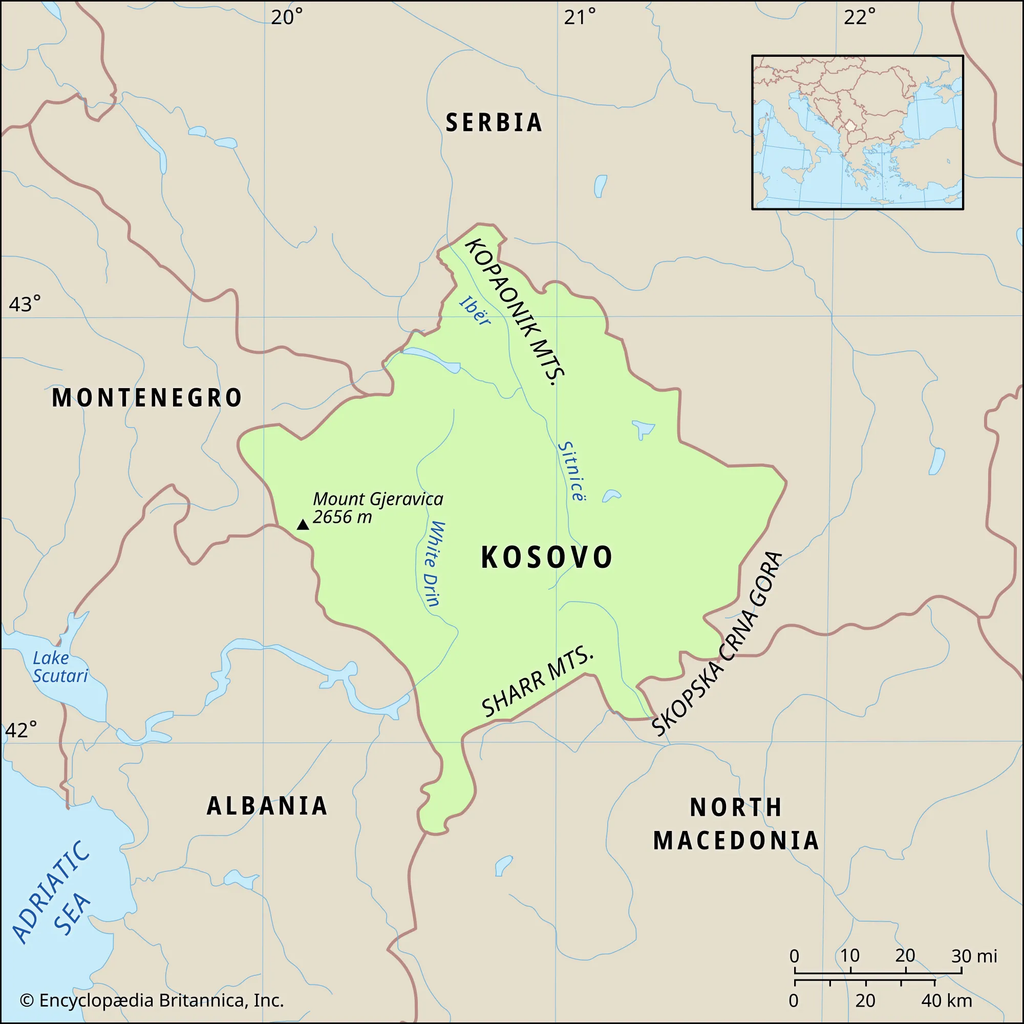
Location of Kosovo:
- Location: Landlocked territory with partially recognised statehood in the Balkan Peninsula, southeastern Europe.
- Capital: Pristina
- Neighbours: Serbia to the north and east; North Macedonia to the southeast; Albania to the southwest; Montenegro to the west.
- Map trap: It has no coastline, and does not border Greece, Bulgaria or Croatia.
- Population: Predominantly ethnic Albanian
- Drainage significance: Although landlocked, its rivers drain towards three seas: Adriatic, Black and Aegean.
Practice Prelims MCQ:
Q. With reference to Kosovo, consider the following statements:
- Kosovo shares a boundary with Albania and North Macedonia.
- It has a coastline on the Adriatic Sea.
- Its river systems drain towards the Adriatic, Black Sea, and Aegean Sea.
Which of the statements given above are correct?
(a) 1 and 2 only
(b) 1 and 3 only
(c) 2 and 3 only
(d) 1, 2 and 3
Answer: (b) Kosovo is landlocked; drainage into a sea does not imply a coastline.