Why Extradition Requests Fail on Procedure and Prison Assurances
Why in News?
The Indian Express reported on 17 August 2026 that the Ministry of Home Affairs had asked States and Union Territories to process extradition requests on time and develop suitable facilities in central jails for persons returned from abroad.
- The reported communication was sent to Chief Secretaries and Directors General of Police after a review involving States, Union Territories and central agencies.
- The MHA reportedly flagged delays in sending provisional-arrest requests and formal extradition requests even after fugitives had been traced or arrested abroad.
- States and agencies were advised to prepare dossiers in advance where an INTERPOL Red Notice existed, so the formal request could move quickly once the person was located.
- The review also covered dedicated extradition cells, adequate staffing, pending cases, possible withdrawals, and prison facilities capable of supporting assurances sought by foreign authorities.
- The report said India had brought back 274 fugitives from 36 countries since 2021 through extradition and deportation efforts. These routes are legally distinct and should not be treated as one procedure.
- Extradition is a State-to-State legal process, not the automatic overseas operation of an Indian arrest warrant.
- Police and prisons largely involve State-level administration, while foreign relations and diplomatic transmission lie with the Union. Extradition exposes this federal coordination chain in a single case.
- A delay can be decisive because the requested country applies its own law and the relevant treaty. The time allowed after provisional arrest may expire before a complete formal request arrives.
UPSC Relevance
Prelims Relevance
- The Extradition Act, 1962 is the principal Indian statute governing surrender and return of fugitive criminals.
- The Ministry of External Affairs is India’s Central Authority for extradition; its Consular, Passport and Visa Division is the nodal division.
- For an outbound request, the investigating agency or, in an appropriate complaint case, the court prepares the request. The State or Union Territory channel, MHA, MEA and the Indian mission may all have coordinating roles.
- A Red Notice is an INTERPOL request to locate and provisionally arrest a wanted person pending extradition or similar action. It is not an international arrest warrant, and each country applies its own law.
- Under Section 2(c) of the Act, an extradition offence for a treaty State depends on the applicable treaty or arrangement. For a non-treaty State, the statutory definition uses an offence punishable by at least one year.
- Dual criminality asks whether the underlying conduct is criminal in both the requesting and requested States; the offences need not carry identical names.
Mains Relevance
GS Paper 2
- Centre-State coordination in transnational criminal justice and the division between State police and prisons, central ministries, diplomatic missions and foreign authorities.
- How rule-of-law safeguards such as dual criminality, speciality, limitation, non-discrimination and fair-treatment assurances make extradition legitimate rather than merely faster.
GS Paper 3
- Use of INTERPOL channels, advance dossiers and specialised cells to prevent fugitives from exploiting procedural delay.
- Institutional capacity required for cross-border investigations, authenticated evidence, identity proof, translation and chain-of-custody documentation.
Essay
- The effectiveness of law depends not only on the severity of punishment but also on the credibility of institutions and the fairness of procedure.
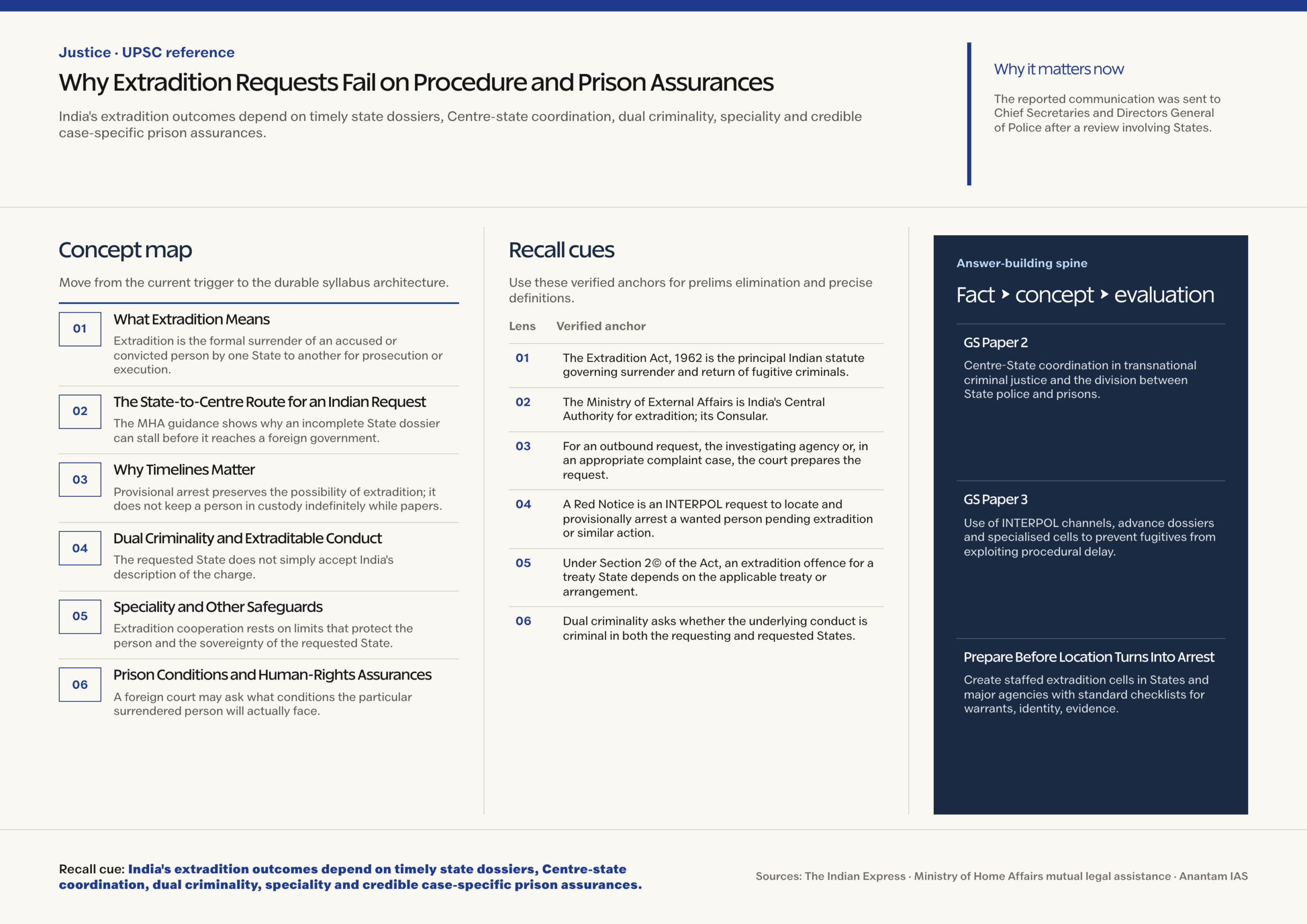
Background and Context
What Extradition Means
Extradition is the formal surrender of an accused or convicted person by one State to another for prosecution or execution of a sentence.
- The requesting State must show a legal basis under the applicable treaty, arrangement, convention or domestic law. A treaty does not remove the requested State’s duty to apply its own procedure.
- Extradition differs from deportation. Deportation removes a person under immigration law, while extradition responds to a criminal-justice request and carries treaty and statutory safeguards.
- It also differs from mutual legal assistance, which helps obtain evidence, serve documents, trace assets or execute other investigative requests without necessarily surrendering a person.
- The applicable treaty matters case by case. Offence thresholds, evidence requirements, provisional-arrest periods, nationality clauses and refusal grounds are not identical across all partners.
The State-to-Centre Route for an Indian Request
The MHA guidance shows why an incomplete State dossier can stall before it reaches a foreign government.
- The investigating agency or court prepares the extradition request using the MEA template and sends it through the relevant Head of Department, ministry or State or Union Territory Home Department to the IS-II Division of.
- MHA conducts a preliminary examination and may return the request for rectification. If it is generally in order, it goes to the CPV Division of MEA.
- MEA examines the dossier, obtains the required approval and transmits it through the Indian mission or embassy to the foreign country. The foreign executive or court then applies its domestic law and the treaty.
- A dossier normally needs a coherent factual narrative, identity material, an open arrest warrant, relevant offence and penalty provisions, authenticated evidence, limitation confirmation, and the assurances required by the partner State.
- Advance preparation after a Red Notice reduces the risk that translation, authentication, page certification or missing evidence consumes the short period following provisional arrest.
Why Timelines Matter
Provisional arrest preserves the possibility of extradition; it does not keep a person in custody indefinitely while papers are prepared.
- The requested country may release the person if the formal request and supporting documents do not arrive within its stipulated period.
- MEA’s guidance notes that provisional-arrest periods often range from 45 to 60 days under relevant treaties. That is a general range, not a deadline that can be assumed in every outbound case.
- Section 34B’s 60-day rule governs a fugitive provisionally arrested in India after an urgent foreign request. It should not be copied mechanically into a request India sends abroad.
- Release after a missed deadline may not legally bar a later request, but the person may move, conceal identity or leave the jurisdiction, forcing agencies to locate and arrest the person again.
Dual Criminality and Extraditable Conduct
The requested State does not simply accept India’s description of the charge.
- Dual criminality focuses on whether the alleged conduct would amount to a crime in both States. Different statutory names do not necessarily defeat the test.
- For treaty partners, the treaty defines the extraditable-offence threshold. For non-treaty States under Section 2(c)(ii), the Act refers to conduct punishable with imprisonment of at least one year under both systems.
- Weak cases, minor disputes or allegations without the required offence threshold can consume diplomatic and investigative capacity. The reported MHA review asked agencies to identify matters unsuitable for extradition or proposed for withdrawal.
- A Red Notice does not cure a failure of dual criminality, evidence, identity or treaty eligibility. It is a cooperation alert based on a national warrant or court order.
Way Forward
Prepare Before Location Turns Into Arrest
- Create staffed extradition cells in States and major agencies with standard checklists for warrants, identity, evidence, offence provisions, translations, limitation and treaty requirements.
- Use a secure dashboard to flag document gaps, foreign deadlines and the officer responsible at each State, MHA, MEA and mission stage.
- Review Red Notice cases periodically so stale, weak or legally ineligible requests are withdrawn and viable cases remain ready.
Conclusion
- Extradition is often described as diplomacy, but its weakest link may be a State investigation file that reaches the Centre late or cannot support the assurance made abroad.
- The durable lesson is that procedure creates credibility .
UPSC Practice Questions
Prelims MCQ 1
With reference to extradition in India, consider the following statements:
- The Ministry of External Affairs is India’s Central Authority for extradition matters.
- An INTERPOL Red Notice is an international arrest warrant binding every member country.
- The rule of speciality restricts prosecution after surrender to offences permitted by the terms of extradition.
How many of the above statements are correct?
(a) Only one (b) Only two (c) All three (d) None
Answer: (b) Only two
Explanation:
Statements 1 and 3 are correct. MEA’s CPV Division is the nodal division for extradition, and speciality limits prosecution after surrender. A Red Notice requests location and provisional arrest subject to national law; it is not an international arrest warrant.
Prelims MCQ 2
Which one of the following best describes dual criminality in extradition law?
(a) The accused must have committed the offence in two countries (b) Two courts must independently convict the accused (c) The underlying conduct must constitute an offence in both the requesting and requested States (d) The offence must carry identical statutory names and punishment in both States
Answer: (c) The underlying conduct must constitute an offence in both the requesting and requested States
Explanation:
Dual criminality generally tests the criminal nature of the conduct in both legal systems. Identical labels or identical punishments are not necessary unless a specific treaty provision creates a narrower requirement.
UPSC Mains Questions
- Extradition is a test of federal coordination as much as international cooperation. Discuss with reference to the roles of State agencies, MHA, MEA and foreign authorities.
- Why are dual criminality, the rule of speciality and detention assurances central to a lawful extradition process? Explain.
Sources: The Indian Express and Ministry of Home Affairs, Guidelines on Mutual Legal Assistance in Criminal Matters.
Frequently Asked Questions
What is extradition?
Extradition is the formal process by which one State surrenders an accused or convicted person to another State for prosecution or execution of a sentence. It operates through treaties, arrangements, conventions and domestic law, and remains subject to the requested.
Is an INTERPOL Red Notice an international arrest warrant?
No. A Red Notice asks law-enforcement authorities worldwide to locate and provisionally arrest a wanted person pending extradition, surrender or similar action. Each member country decides its legal effect under national law, and INTERPOL itself does not arrest people.
What is dual criminality?
Dual criminality means the conduct underlying the request must be criminal in both the requesting and requested States. The statutes need not use identical names. The applicable treaty and domestic law determine the precise threshold and punishment requirement in a.
What is the rule of speciality?
Speciality protects a surrendered person from being prosecuted for unrelated prior offences outside the terms accepted by the requested State. Section 21 of the Extradition Act permits the extradition offence, certain lesser offences disclosed by the same facts, and offences.
Why do prison conditions affect extradition?
A requested State may refuse surrender where the person faces a real risk of prohibited or inhumane treatment. It may seek credible assurances about the actual place and conditions of detention. Those assurances must fit the treaty, the requested State’s.