Extreme Heat During Pregnancy and Adverse Birth Outcomes in India
Why in News?
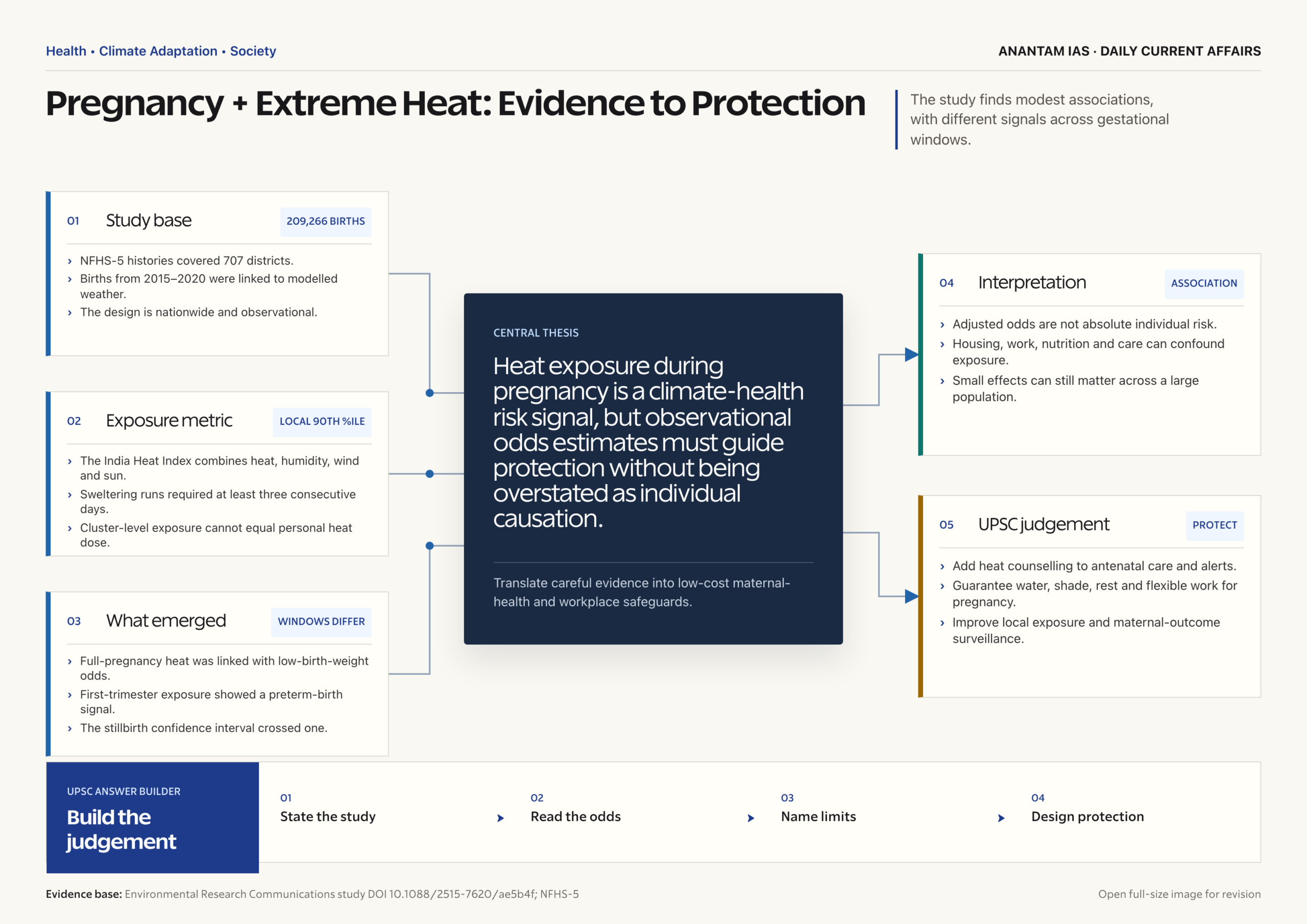
A nationwide analysis highlighted by The Hindu has linked extreme heat during pregnancy with modest increases in the odds of low birth weight and preterm birth during specific exposure windows in India.
- The researchers studied births recorded for 2015–2020 among women aged 15–49 in the National Family Health Survey-5, whose fieldwork was conducted in 2019–2021.
- They linked daily, gridded heat estimates to survey clusters and counted runs of at least three consecutive sweltering days, when the local India Heat Index exceeded its 90th percentile.
- For the full pregnancy, each additional consecutive sweltering day was associated with about 1% higher adjusted odds of low birth weight (aOR 1.010; 95% CI 1.001–1.018).
- The clearest trimester-specific associations were with preterm birth in the first trimester (aOR 1.036; 95% CI 1.009–1.064) and low birth weight in the second trimester (aOR 1.010; 95% CI 1.002–1.018).
- The third-trimester estimate for stillbirth was elevated (aOR 1.029), but its 95% confidence interval of 0.998–1.060 included 1; it should not be presented as a statistically established effect.
- Pregnancy increases metabolic and cardiovascular demands while the mother also dissipates heat generated by the foetal-placental unit. Prolonged hot and humid conditions can narrow the body’s margin for safe thermoregulation.
- Low birth weight, preterm birth and stillbirth are not interchangeable outcomes. Their definitions, mechanisms and policy responses differ, even when they share maternal, environmental and health-system risk factors.
- The study’s value lies in its national geographical coverage and its use of a multi-variable heat-stress index, not in a claim that one national temperature threshold fits every district.
UPSC Relevance
Prelims Relevance
- The National Family Health Survey is India’s Demographic and Health Survey and provides nationally representative information on population, health and nutrition.
- NFHS-5 fieldwork was conducted during 2019–2021; this study reconstructed pregnancy exposure for births occurring from 2015 to 2020.
- The survey uses a two-stage design stratified by rural and urban areas. A village segment is the primary sampling unit in rural areas, while a census enumeration block performs that role in urban areas.
- The India Heat Index combines air temperature, relative humidity, wind speed and downward short-wave solar radiation rather than using air temperature alone.
- In this study, a sweltering day had a daily mean India Heat Index above the cluster-specific 90th percentile for the study period; a consecutive event required at least three such days.
- The researchers defined low birth weight as reported birth weight below 2,500 grams and preterm birth as delivery before 37 completed weeks.
Mains Relevance
GS Paper 2
- Evaluate whether maternal and child health services treat extreme heat as an antenatal risk alongside anaemia, nutrition, hypertension, infection and access barriers.
- Discuss the role of ASHAs, ANMs, primary health centres and district health authorities in heat-risk communication, early identification and continuity of antenatal care.
GS Paper 3
- Use the study as evidence for integrating climate projections, heat-health surveillance and local vulnerability into district Heat Action Plans.
- Explain why humidity, wind and solar radiation matter for physiological heat stress and why climate-zone-specific thresholds can complement conventional temperature alerts.
Essay
- Climate change is experienced through the body before it appears in an economic balance sheet.
Background and Context
How the NFHS-5 study was designed
The researchers combined retrospective birth histories with modelled meteorological exposure; they did not follow pregnancies prospectively in real time.
- NFHS-5 collected household and individual data from women aged 15–49 through a nationally representative, cross-sectional survey. The birth-history records covered dates, reported gestation, birth weight and vital status for recent births.
- The initial dataset contained 232,920 births across 707 districts. The researchers excluded 23,654 records missing cluster geolocation, delivery date, birth weight, pregnancy duration or live-birth information, leaving 209,266 births.
- The analytical sample included 166,001 rural births and 43,265 urban births. The reported outcomes comprised 29,873 low-birth-weight births, 2,341 preterm births and 1,740 stillbirths.
- Separate extended generalised linear mixed models with a logit link estimated associations for each outcome. Individual survey weights were applied and cluster structure was included in the modelling.
- The adjusted models included maternal BMI, age, education, anaemia, smoking, birth order and foetal sex, alongside wealth, residence, cooking fuel, climate zone and ambient PM2.5. Adjustment reduces measured confounding but cannot eliminate unmeasured or poorly measured.
How extreme heat exposure was reconstructed
The exposure metric was designed to represent physiological heat stress under diverse Indian climates, not just a high thermometer reading.
- Hourly meteorological fields came from the National Centre for Medium-Range Weather Forecasting at about 0.1° spatial resolution, roughly 10 kilometres: air temperature, relative humidity, wind speed and downward solar radiation.
- The study calculated an hourly India Heat Index, averaged it to a daily mean and assigned it to each rural or urban survey cluster using the cluster’s geocode.
- For each participant, researchers estimated the period from conception to birth and the three trimester windows. A day was labelled sweltering when daily mean IHI exceeded the cluster-specific 90th percentile.
- The principal metric counted days in runs of at least three consecutive sweltering days. The local percentile makes the threshold responsive to climate-zone differences, but it also means sweltering exposure is relative to local conditions.
- Exposure was assigned by residential cluster. It does not directly reveal the woman’s indoor temperature, occupation, time outdoors, access to shade or cooling, hydration, mobility during pregnancy or personal heat strain.
What the trimester results actually show
The strongest defensible reading is that different gestational windows showed different statistical signals, with generally small effect estimates.
- Across the complete gestation, each extra consecutive sweltering day was associated with 1% higher adjusted odds of low birth weight. Odds are not the same as absolute risk and the estimate should not be multiplied.
- First-trimester exposure was associated with 3.6% higher odds of preterm birth per additional day (aOR 1.036; 95% CI 1.009–1.064). The confidence interval stayed above 1.
- Second-trimester exposure was associated with 1% higher odds of low birth weight per additional day (aOR 1.010; 95% CI 1.002–1.018). This supports a possible foetal-growth vulnerability window, not a proven mechanism.
- The third-trimester stillbirth estimate was 1.029, but the interval extended from 0.998 to 1.060. Calling this a confirmed rise in stillbirth would overstate the statistical evidence.
- In a duration sensitivity analysis, 3–4 consecutive sweltering days were associated with higher low-birth-weight odds (OR 1.044; 95% CI 1.002–1.087), while the 5–6 and seven-or-more-day categories were not statistically significant. The absence of a.
Plausible climate-health pathways
The paper discusses biologically plausible pathways, but it did not measure placental biomarkers or prove that any one pathway produced the observed outcomes.
- Pregnancy raises metabolic heat production and cardiac demand. When ambient heat and humidity limit heat loss, the mother may experience greater thermoregulatory and cardiovascular strain.
- Dehydration can reduce plasma volume and may affect uteroplacental blood flow. Heat strain may also alter uterine activity and hormonal signalling, providing a plausible link with preterm delivery.
- Reduced uteroplacental perfusion can constrain oxygen and nutrient delivery to the foetus. Heat-related oxidative stress and inflammation may also disrupt placental function, offering possible pathways to restricted foetal growth and low birth weight.
- Risk is shaped by exposure and adaptive capacity together. Heavy work, poor ventilation, unreliable drinking water, undernutrition, anaemia and limited healthcare access can compound physiological stress.
- These pathways are hypotheses supported by wider literature. Prospective cohorts with individual heat monitors, clinical records and maternal, placental and foetal biomarkers are needed to test them directly in India.
Way Forward
Make antenatal care heat-responsive
- Train ASHAs, ANMs and facility staff to recognise heat exhaustion, dehydration and warning signs in pregnancy and to communicate practical steps in local languages.
- Use forecast-triggered calls or visits for high-risk pregnancies, protect continuity of check-ups during heatwaves and keep antenatal waiting areas shaded, ventilated and supplied with safe water.
- Avoid rigid universal advice: clinical risk, trimester, work intensity, travel, comorbidities and household cooling capacity should shape counselling and referral.
Conclusion
- The study provides important population-scale evidence that prolonged extreme heat during pregnancy is associated with adverse birth outcomes in India, with the clearest statistical signals appearing in different trimesters for preterm birth and low birth weight.
- The evidence also demands restraint.
UPSC Practice Questions
Prelims MCQ 1
With reference to the study on extreme heat and pregnancy outcomes in India, consider the following statements:
- The India Heat Index used in the study incorporated air temperature, humidity, wind speed and solar radiation.
- A sweltering day was defined using a cluster-specific percentile rather than one absolute national temperature threshold.
- The third-trimester stillbirth estimate had a 95% confidence interval entirely above 1.
How many of the above statements are correct?
(a) Only one (b) Only two (c) All three (d) None
Answer: (b) Only two
Explanation:
Statements 1 and 2 are correct. The study used a multi-variable India Heat Index and a local 90th-percentile threshold. Statement 3 is incorrect because the third-trimester stillbirth interval was 0.998–1.060, which includes 1.
Prelims MCQ 2
Which one of the following is the most accurate interpretation of the study’s finding for low birth weight across the full pregnancy?
(a) Every sweltering day caused a 1% fall in birth weight (b) Each additional consecutive sweltering day was associated with about 1% higher adjusted odds of low birth weight (c) Exposure raised the absolute probability of low birth weight by exactly one percentage point (d) All women exposed to three sweltering days delivered a low-birth-weight baby
Answer: (b) Each additional consecutive sweltering day was associated with about 1% higher adjusted odds of low birth weight
Explanation:
The adjusted odds ratio was 1.010 with a 95% confidence interval of 1.001–1.018. This is an observational association in odds, not proof of causation, an exact absolute-risk change or a deterministic outcome.
UPSC Mains Questions
- Extreme heat during pregnancy is both a climate-adaptation problem and a maternal-health equity problem. Discuss with reference to recent Indian evidence. (250 words)
- What does the NFHS-5 study on heat and adverse birth outcomes establish, and what does it not establish? Explain how its findings should shape district Heat Action Plans. (250 words)
Sources: Environmental Research Communications and The Hindu.
Frequently Asked Questions
What did the India-wide extreme heat and pregnancy study find?
Among 209,266 births, each additional consecutive sweltering day across pregnancy was associated with about 1% higher adjusted odds of low birth weight. First-trimester exposure was associated with preterm birth, while second-trimester exposure was associated with low birth weight. These are.
How did the researchers define extreme heat?
They calculated the India Heat Index from temperature, relative humidity, wind speed and solar radiation. A sweltering day exceeded the survey cluster’s 90th-percentile daily mean IHI, and a consecutive event required at least three such days. The threshold was locally.
Why can the study not prove that heat caused adverse births?
It combined retrospective NFHS birth histories with modelled cluster-level outdoor exposure. It did not directly measure each woman’s personal heat, indoor conditions, hydration or biomarkers. Recall error, exposure misclassification and unmeasured factors such as occupation, disease, nutrition and healthcare use.
Which trimester appeared most sensitive to heat?
The statistical signal depended on the outcome. First-trimester exposure was associated with higher preterm-birth odds, and second-trimester exposure with higher low-birth-weight odds. The third-trimester stillbirth estimate was elevated, but its confidence interval included 1, so it was not conventionally statistically.
What are the possible biological pathways between heat and pregnancy outcomes?
Plausible pathways include thermoregulatory and cardiovascular strain, dehydration, altered uteroplacental blood flow, uterine activity, inflammation, oxidative stress and impaired placental function. The study discussed these pathways but did not measure them directly; prospective biomarker studies are needed to test them.