FCRA Amendment Bill Sent to a Joint Parliamentary Committee
Why in News?
On 12 August 2026 , the Lok Sabha adopted a motion referring the Foreign Contribution (Regulation) Amendment Bill, 2026 to a Joint Parliamentary Committee after sustained objections from Opposition parties and civil-society and minority organisations.
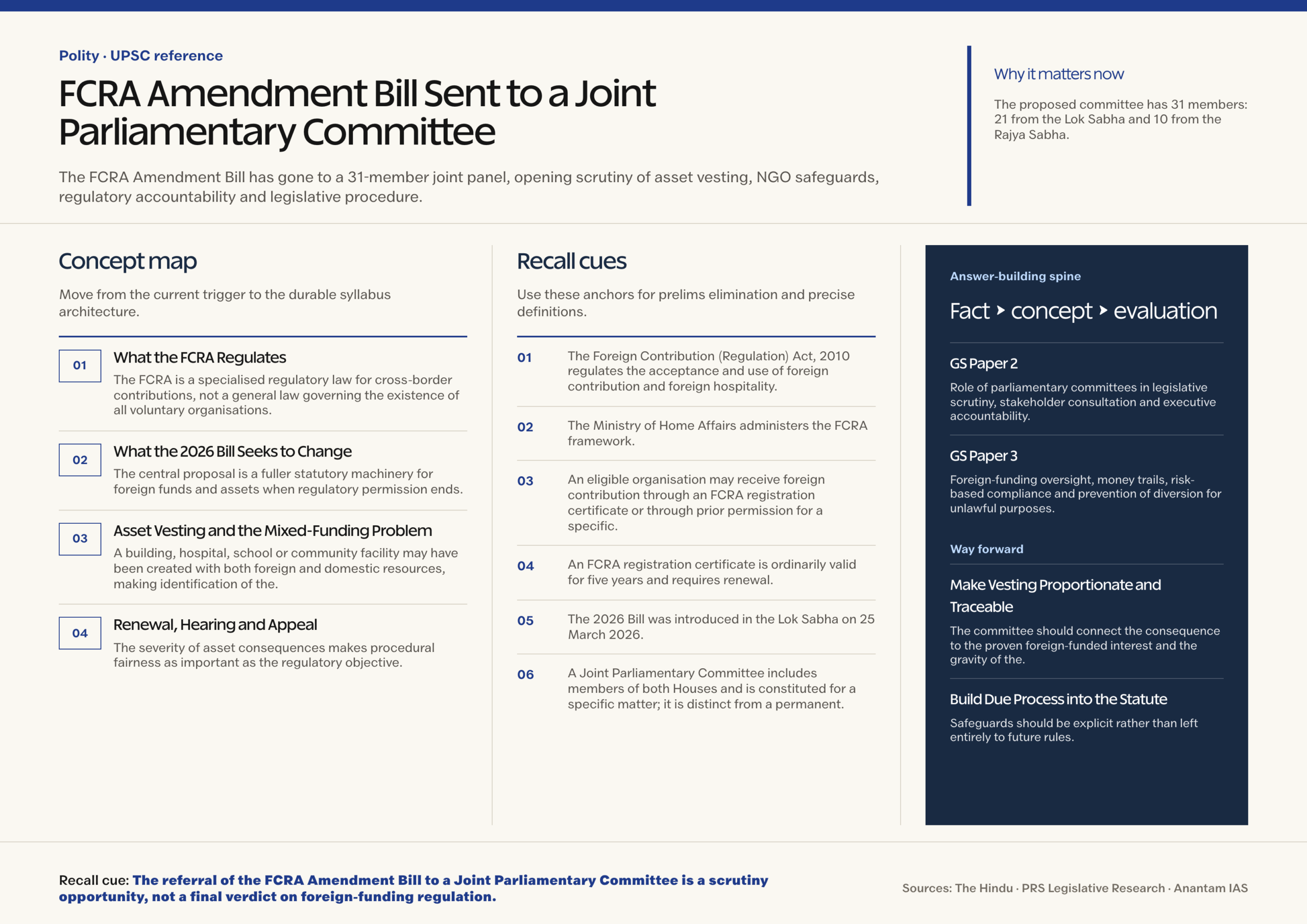
- The proposed committee has 31 members: 21 from the Lok Sabha and 10 from the Rajya Sabha.
- Lok Sabha members are to be nominated by the Speaker, while Rajya Sabha members are to be nominated by the Chairman of that House.
- The committee must report to the Lok Sabha by the last day of the first week of the 2026 Winter Session.
- The Bill was introduced in the Lok Sabha on 25 March 2026 but was not taken up for passage during the Budget Session.
- The referral followed demands for deeper scrutiny of the proposed Designated Authority, the treatment of assets partly financed by domestic funds, and remedies available when registration is not renewed.
- The policy challenge is to reconcile national-interest regulation of cross-border funds with the autonomy and continuity of lawful charities, educational bodies, hospitals, research organisations and faith-based welfare institutions.
- The constitutional question is not whether foreign contributions may be regulated; it is whether coercive consequences are backed by clear standards, notice, hearing, review and proportionate treatment.
- The parliamentary question is how committees improve legislation by collecting evidence, comparing competing claims and identifying drafting gaps that a floor debate may not resolve.
UPSC Relevance
Prelims Relevance
- The Foreign Contribution (Regulation) Act, 2010 regulates the acceptance and use of foreign contribution and foreign hospitality.
- The Ministry of Home Affairs administers the FCRA framework.
- An eligible organisation may receive foreign contribution through an FCRA registration certificate or through prior permission for a specific source and purpose.
- An FCRA registration certificate is ordinarily valid for five years and requires renewal.
- The 2026 Bill was introduced in the Lok Sabha on 25 March 2026.
- A Joint Parliamentary Committee includes members of both Houses and is constituted for a specific matter; it is distinct from a permanent Department-related Standing Committee.
Mains Relevance
GS Paper 2
- Role of parliamentary committees in legislative scrutiny, stakeholder consultation and executive accountability.
- Application of natural justice, reasoned decision-making and effective appeal to high-impact administrative action.
GS Paper 3
- Foreign-funding oversight, money trails, risk-based compliance and prevention of diversion for unlawful purposes.
- Design of custody, asset-management and disposal mechanisms for organisations that lose regulatory permission.
Essay
- Strong regulation earns legitimacy when state power is matched by clear rules, fair procedure and review.
Background and Context
What the FCRA Regulates
The FCRA is a specialised regulatory law for cross-border contributions, not a general law governing the existence of all voluntary organisations.
- It governs acceptance and use of a contribution from a foreign source, including covered articles, currency and foreign securities, so that such flows do not harm sovereignty, security, public order or other protected interests.
- The law prohibits specified categories, including candidates for election, judges, public servants, legislators and political parties, from accepting foreign contribution.
- Other eligible persons and associations generally require registration or prior permission and must comply with designated banking, accounting, utilisation and reporting rules.
- Regulation of the funding channel must be distinguished from regulation of an organisation’s lawful activities financed entirely from domestic resources.
What the 2026 Bill Seeks to Change
The central proposal is a fuller statutory machinery for foreign funds and assets when regulatory permission ends.
- A certificate may cease because it is cancelled or surrendered, because no renewal application is made, because renewal is denied, or because renewal is not obtained before expiry.
- The Bill proposes a Designated Authority in which covered foreign contribution and assets created wholly or partly from that contribution may provisionally vest.
- The Authority may supervise assets and activities during the provisional period. If registration is restored, renewed or freshly granted within the prescribed period, the unutilised contribution or assets are to be returned under the proposed scheme.
- If regulatory status is not restored within the prescribed period, vesting may become permanent. The Authority may use assets for public purposes, transfer them to public agencies, or dispose of them through a prescribed process.
- For a permanently vested asset that is wholly or partly a place of worship, the proposed authority must preserve its religious character and entrust management in the prescribed manner.
Asset Vesting and the Mixed-Funding Problem
A building, hospital, school or community facility may have been created with both foreign and domestic resources, making identification of the covered asset a central drafting issue.
- A sound law should distinguish the traceable foreign-funded share from the domestic-funded share where the two are distinct or reasonably ascertainable.
- Rules are needed for valuation, records, liabilities, depreciation, later domestic improvements and assets that provide an ongoing public service.
- Temporary custody should not silently become irreversible deprivation merely because an organisation encounters an administrative delay in renewal.
- The JPC can test whether the Bill’s return, transfer and disposal provisions adequately protect third parties such as employees, students, patients, beneficiaries, creditors and co-owners.
Renewal, Hearing and Appeal
The severity of asset consequences makes procedural fairness as important as the regulatory objective.
- The existing Act provides specified remedies in some situations, including cancellation, but PRS Legislative Research identified a gap regarding an effective appeal when renewal is denied and cessation triggers vesting.
- The committee should examine mandatory notice, disclosure of reasons, reasonable opportunity to respond, time-bound decisions and an independent appellate route before permanent vesting.
- An interim mechanism is needed so essential welfare services continue while a renewal or appeal remains pending.
- Judicial review under constitutional jurisdiction remains important, but accessible statutory review can correct error faster and reduce avoidable litigation.
Way Forward
Make Vesting Proportionate and Traceable
- Define methods to identify and value the foreign-funded component of a mixed asset, with audited records and an opportunity for the organisation to contest the calculation.
- Set a clear outer limit for provisional control and require a reasoned order before permanent vesting, transfer or sale.
- Protect ongoing public services through temporary management plans that preserve access for students, patients and other beneficiaries.
Conclusion
- The referral of the FCRA Amendment Bill to a Joint Parliamentary Committee is a scrutiny opportunity , not a final verdict on foreign-funding regulation.
- A durable law should protect India from misuse of foreign funds while preserving lawful social work and public confidence.
UPSC Practice Questions
Prelims MCQ 1
With reference to the Foreign Contribution (Regulation) Amendment Bill, 2026, consider the following statements:
- It was introduced in the Lok Sabha.
- It proposes a Designated Authority for specified foreign contribution and assets when an FCRA certificate ceases.
- It proposes to increase the general maximum imprisonment for contravention from one year to five years.
How many of the above statements are correct?
(a) Only one (b) Only two (c) All three (d) None
Answer: (b) Only two
Explanation:
Statements 1 and 2 are correct. The Bill was introduced in the Lok Sabha on 25 March 2026 and proposes a Designated Authority. Statement 3 is reversed: the Bill proposes to reduce the maximum imprisonment from five years to one year.
Prelims MCQ 2
Which one of the following best describes the status of a recommendation made by a Joint Parliamentary Committee examining a Bill?
(a) It automatically becomes part of the Bill (b) It binds the President but not Parliament (c) It is advisory, and Parliament decides whether to accept it (d) It has the same force as a Supreme Court judgment
Answer: (c) It is advisory, and Parliament decides whether to accept it
Explanation:
A parliamentary committee examines the referred matter and submits recommendations. The House or Houses retain legislative authority over the Bill and may accept, modify or reject those recommendations.
UPSC Mains Questions
- Parliamentary committees are instruments of both legislative competence and democratic accommodation. Discuss with reference to the referral of the Foreign Contribution (Regulation) Amendment Bill, 2026 to a Joint Parliamentary Committee.
- How should India balance national-security oversight of foreign contributions with procedural fairness and the autonomy of lawful civil-society organisations? Suggest safeguards for asset vesting and disposal.
Sources: The Hindu and PRS Legislative Research.
Frequently Asked Questions
What happened to the FCRA Amendment Bill on 12 August 2026?
The Lok Sabha adopted a motion sending the Foreign Contribution (Regulation) Amendment Bill, 2026 to a 31-member Joint Parliamentary Committee. The committee is to examine the proposal and report by the last day of the first week of the 2026.
Does referral to a JPC mean the Bill has become law?
No. Referral is a stage of parliamentary scrutiny. The committee will examine the Bill and recommend changes, but its report is advisory. Parliament must still consider the legislation, pass an agreed text through the required process, and obtain presidential assent.
What is the main asset-related proposal in the Bill?
The Bill proposes a Designated Authority to receive, supervise, manage and, in specified circumstances, dispose of foreign contribution and assets created wholly or partly from it when an organisation’s FCRA certificate is cancelled, surrendered or deemed to have ceased.
Why are mixed-funded assets a difficult issue?
A school, hospital or building may combine foreign donations, domestic donations and later local investment. Fair administration requires a traceable method to identify the covered foreign-funded share, protect other ownership interests and avoid disrupting beneficiaries while valuation or renewal is.
What due-process safeguards should the JPC examine?
Key safeguards include prior notice, access to relevant material, a meaningful hearing, written reasons, a fixed period for provisional control, independent and time-bound appeal, and interim protection against an irreversible sale while a renewal or vesting dispute is under review.