Urea Supply Holds, but DAP Risks Persist
Why in News?
Indian Express reported on 3 August 2026 that India had avoided the feared kharif urea shortage after the West Asia conflict disrupted LNG and fertiliser trade, but the supply position for DAP and complex fertilisers remained less comfortable.
- Domestic urea production fell to 17.5 lakh tonnes in March 2026 from 24.7 lakh tonnes in March 2025 as LNG supplies were disrupted, but recovered to 21 lakh tonnes in April, 25.2 lakh tonnes in May and 25.4 lakh tonnes in June.
- Cumulative urea output in April-June 2026 reached 71.5 lakh tonnes, 5.4% above the 67.9 lakh tonnes produced in the same quarter of 2025, according to Fertiliser Association of India data cited by Indian.
- Urea imports during April-June 2026 rose to 25.1 lakh tonnes from 8.4 lakh tonnes a year earlier as public-sector firms placed large tenders and LNG buyers widened sourcing beyond Qatar and the UAE.
- The Department of Fertilizers reported all-India kharif availability up to 21 July at 166.78 lakh tonnes for urea against a seasonal requirement of 112.09 lakh tonnes, and 40.29 lakh tonnes for DAP against.
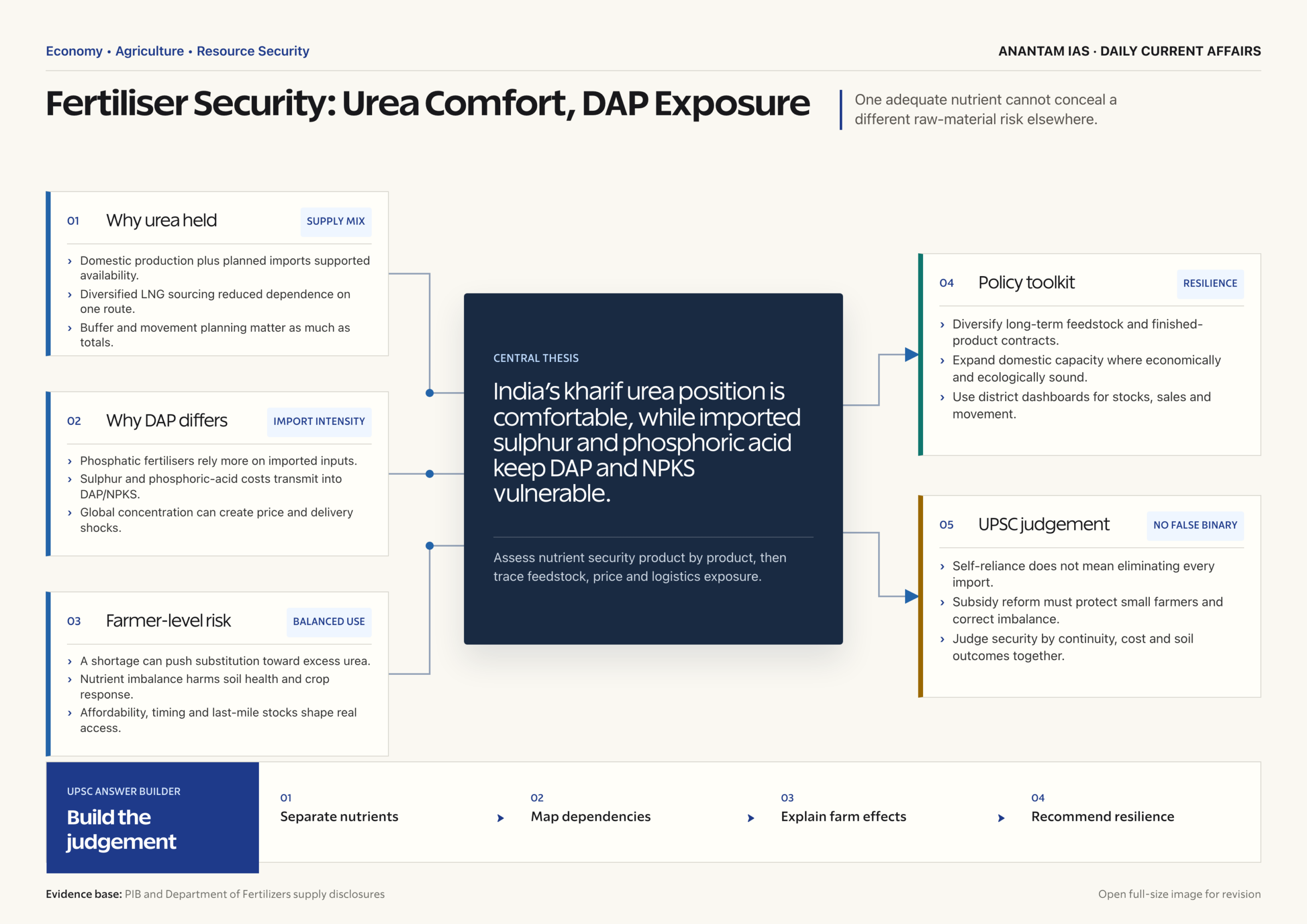
- Those aggregate figures do not remove the forward risk: Indian Express reported falling domestic output and imports of DAP and complex fertilisers, alongside sharp increases in the prices of sulphur and phosphoric acid.
- The immediate achievement is a shortage avoided, not a claim of structural self-reliance. Urea supply was protected by costlier spot LNG, accelerated imports and public subsidy support.
- DAP security is harder because India needs finished fertiliser as well as imported intermediates such as phosphoric acid, sulphur and ammonia; disruption at any link can constrain domestic production.
- The crisis connects farm input availability with energy security, maritime chokepoints, fiscal policy and balanced soil nutrition, making it a strong GS Paper 3 case study.
UPSC Relevance
Prelims Relevance
- Urea supplies nitrogen; DAP supplies nitrogen and phosphorus; MOP is the principal potassic fertiliser; NPKS complexes contain different combinations of nitrogen, phosphorus, potassium and sulphur.
- The Nutrient Based Subsidy scheme has applied to notified phosphatic and potassic fertilisers since 1 April 2010; urea remains outside NBS under a separate controlled-price regime.
- Under NBS, subsidy is linked to nutrient content and paid to the manufacturer or importer after Point-of-Sale sale; P&K maximum retail prices are formally decontrolled but expected to remain reasonable.
- For kharif 2026, the Centre extended special support of ₹3,500 per metric tonne over NBS for domestic and imported DAP and imported TSP to maintain DAP at ₹1,350 per 50 kg bag.
- The Integrated Fertilizer Management System tracks movement of subsidised fertilisers, while State-wise and month-wise requirements inform Union supply plans.
- Sulphur is converted into sulphuric acid, which helps process phosphate rock into phosphoric acid; these acids are crucial intermediates for DAP, SSP and complex fertilisers.
Mains Relevance
GS Paper 3
- Assess how imported energy, raw-material concentration and maritime chokepoints shape agricultural input security.
- Distinguish physical availability from affordability, fiscal cost, last-mile distribution and balanced nutrient use.
GS Paper 2
- Examine Union-State coordination in seasonal requirement assessment, allocation, monitoring and last-mile distribution.
- Use transparent stock, movement and price data as an example of accountable crisis governance.
Essay
- Food security begins before sowing: resilience depends not only on grain stocks but also on energy, nutrients, logistics and institutions.
Background and Context
How the Urea Shock Was Absorbed
India responded to the March production drop by protecting both sides of the urea balance: gas for domestic plants and finished urea from abroad.
- Before the conflict, Qatar and the UAE supplied 53-54% of India’s LNG imports, mostly under long-term contracts. The shipping blockade and damage to liquefaction infrastructure disrupted that familiar route.
- GAIL and Indian Oil diversified purchases toward suppliers including the United States, Oman, Nigeria, Angola, Congo, Indonesia, Trinidad and Norway. This widened the source base but involved greater reliance on the higher-cost spot market.
- Indian Potash Limited and National Fertilizers secured 25 lakh tonnes and 17 lakh tonnes of imported urea through tenders floated on 4 April and 27 May. The landed price ranges were $935-959 and $444.9-449.3.
- Rashtriya Chemicals and Fertilizers issued another tender on 29 July for 17 lakh tonnes, split between western and eastern coast ports, with bids scheduled to open on 11 August.
- This response explains the recovery from the March production shock. It does not make the cost disappear: fixed farmer prices shift much of the higher LNG, import and freight burden to the fertiliser subsidy.
What the Official Availability Data Show
Two Lok Sabha replies released by PIB on 24 July present the national supply position as adequate, but the definitions matter.
- For 1 April-21 July 2026, urea requirement was 112.09 lakh tonnes, cumulative availability 166.78 lakh tonnes, DBT sales 97.98 lakh tonnes and closing stock 68.79 lakh tonnes.
- For DAP over the same period, requirement was 32.35 lakh tonnes, availability 40.29 lakh tonnes, sales 23.52 lakh tonnes and closing stock 16.77 lakh tonnes. MOP and NPKS availability also exceeded stated.
- The official primary indicator of comfort is availability above requirement; the secondary indicator is availability above sales. These are aggregate all-India measures, not proof that every retailer had the right grade on every day.
- Requirements are assessed by the Department of Agriculture and Farmers Welfare with States. The Department of Fertilizers issues monthly supply plans, tracks movement through iFMS and holds weekly reviews; States control distribution inside their borders.
- The data support the claim that a major national shortage had not materialised by late July. They should be read as a dated stock-and-flow picture, not a guarantee against later raw-material or regional bottlenecks.
Why DAP and Complex Fertilisers Remain Exposed
The phosphatic chain has more vulnerable links than the urea chain, and source diversification has not advanced equally across them.
- Indian Express reported that April-June production of DAP, complex fertilisers and SSP declined from the year-earlier quarter, while imports also fell. No equivalent phosphatic recovery accompanied the urea rebound.
- Imported phosphoric acid rose from $1,055 per tonne in January-March 2025 to $1,360 in April-June 2026 and $1,700 for July-September 2026, on a cost-plus-freight basis.
- Sulphur landed prices had already reached $500-550 per tonne before the West Asia war, against a normal range of $150-250. Supply disruption from Russia and major West Asian producers pushed current import prices to around $1,100.
- Ammonia import prices rose to $850-900 per tonne in May before easing to $650-700. Ammonia supplies nitrogen for complex fertilisers, while sulphuric and phosphoric acids are indispensable to several phosphatic grades.
- India contracted 13.5 lakh tonnes of DAP through an IPL tender on 28 April at $930-935 per tonne, above $725-750 a year earlier. No later DAP import was reported as contracted by the article’s publication.
The Subsidy Architecture Behind Affordability
Urea and DAP reach farmers through different policy regimes, but crisis support makes the practical boundary less neat.
- Urea has a government-notified maximum retail price and sits outside NBS. The state compensates eligible producers and importers for the gap between controlled farmer price and recognised cost.
- DAP, MOP and notified complexes fall under NBS, where per-kilogram support is fixed for nutrients such as N, P, K and S. Companies formally set retail prices, subject to the expectation of reasonableness.
- For kharif 2026, the Centre added ₹3,500 per tonne for DAP and imported TSP over NBS. The support covers specified factory-to-farm costs, international-price movements, a GST component and a reasonable return of 4% of.
- This keeps a 50 kg DAP bag at ₹1,350, but it can require supplementary fiscal support when raw-material prices outrun the subsidy assumptions. The earlier fertiliser subsidy shock explains this budgetary transmission.
- Sale-based DBT pays companies after recorded PoS sales; it is not a cash transfer into the farmer’s bank account. Better transaction visibility can reduce leakage but does not remove global price exposure.
Way Forward
Secure the Full Phosphatic Chain
- Diversify long-term sources of sulphur, phosphoric acid, ammonia, rock phosphate and finished DAP; use Indian missions and industry consortia to widen supplier options.
- Create transparent seasonal buffer norms for critical intermediates and fertilisers, with triggers for release and replenishment rather than permanent stock accumulation.
- Make temporary DAP support responsive to verified input costs while publishing the fiscal implication and sunset or review conditions.
Conclusion
- India’s kharif response converted a plausible urea shortage into a manageable supply position.
- The unresolved risk lies in sulphur, phosphoric acid, DAP and complex fertilisers.
UPSC Practice Questions
Prelims MCQ 1
With reference to India’s fertiliser supply and subsidy system, consider the following statements:
- Urea is covered under the Nutrient Based Subsidy scheme.
- Movement of subsidised fertilisers is tracked through the Integrated Fertilizer Management System.
- Under fertiliser DBT, subsidy is released to manufacturers or importers after recorded Point-of-Sale sales.
How many of the above statements are correct?
(a) Only one (b) Only two (c) All three (d) None
Answer: (b) Only two
Explanation:
Statements 2 and 3 are correct. Urea remains outside NBS under a separate controlled-price and subsidy regime; NBS applies to notified phosphatic and potassic fertilisers.
Prelims MCQ 2
Why can a shortage of sulphur constrain the production of DAP and complex fertilisers?
(a) Sulphur is the principal source of potassium in MOP (b) Sulphuric acid helps convert phosphate rock into phosphoric acid used in phosphatic fertilisers (c) Sulphur directly replaces natural gas in urea plants (d) Sulphur is required only for coating finished urea bags
Answer: (b) Sulphuric acid helps convert phosphate rock into phosphoric acid used in phosphatic fertilisers
Explanation:
Sulphur is used to make sulphuric acid, a key processing input for producing phosphoric acid from phosphate rock. Phosphoric acid is then used in DAP and several complex fertilisers.
UPSC Mains Questions
- India avoided a major kharif urea shortage in 2026, yet its DAP and complex-fertiliser supply chains remain exposed. Analyse the reasons for this divergence and suggest a chain-wide strategy for fertiliser security. (250 words)
- A comfortable national fertiliser-availability figure is not the same as durable agricultural input security. Discuss with reference to affordability, raw-material dependence, last-mile distribution, fiscal cost and balanced nutrient use. (250 words)
Sources: PIB, Department of Fertilizers and Indian Express Explained.
Frequently Asked Questions
Why did India not face a major urea shortage in kharif 2026?
The government diversified LNG sourcing so domestic plants could recover output, while public-sector firms contracted much larger urea imports. April-June production reached 71.5 lakh tonnes and imports 25.1 lakh tonnes. Softer fertiliser demand under deficient monsoon rainfall also helped supplies.
Why is DAP supply still considered risky?
DAP depends on a chain of imported finished product and intermediates, especially phosphoric acid, sulphur and ammonia. Domestic DAP and complex-fertiliser output fell year-on-year, imports were weaker, and sulphur prices rose to around $1,100 per tonne, making future production and.
What did the official kharif availability data show?
Up to 21 July 2026, official all-India availability was 166.78 lakh tonnes of urea against requirement of 112.09 lakh tonnes, and 40.29 lakh tonnes of DAP against 32.35 lakh tonnes required. These cumulative national figures show broad comfort but cannot.
How does sulphur affect phosphatic fertiliser production?
Sulphur is processed into sulphuric acid, which helps break down phosphate rock and produce phosphoric acid. Phosphoric acid is a central input for DAP and several complex fertilisers. A sulphur shortage can reduce domestic output even when a factory has.
Is DAP covered by the Nutrient Based Subsidy scheme?
Yes. DAP and other notified phosphatic and potassic fertilisers are covered by NBS, in force since 1 April 2010. For kharif 2026, the Centre also extended ₹3,500 per tonne of special support over NBS to maintain DAP at ₹1,350 per.