Access to FIRs: The Accused’s Rights Under BNSS
Why in News?
On 25 August 2026, the Supreme Court directed Ghaziabad Police to supply journalist Abhishek Upadhyay the FIR against him and granted interim protection from coercive action.
- The case was W.P. (Crl.) No. 339/2026; the Court enabled the petitioner to seek suitable relief after receiving the FIR.
- The episode highlights a statutory gap: BNSS Section 173(2) immediately serves the informant or victim, not expressly the accused.
- Section 230 BNSS supplies the accused an FIR and other prosecution papers later, after a police-report case reaches the Magistrate.
- Early access during investigation is principally protected by judicial directions, especially Youth Bar Association of India v. Union of India (2016).
- Knowing the allegations allows an accused to seek legal advice and pursue pre-arrest bail, oppose remand or challenge coercive action before liberty is curtailed.
- The key exam trap is to separate an accused’s route to a certified copy from the broader rule requiring non-sensitive FIRs to be uploaded publicly.
UPSC Relevance
Prelims Relevance
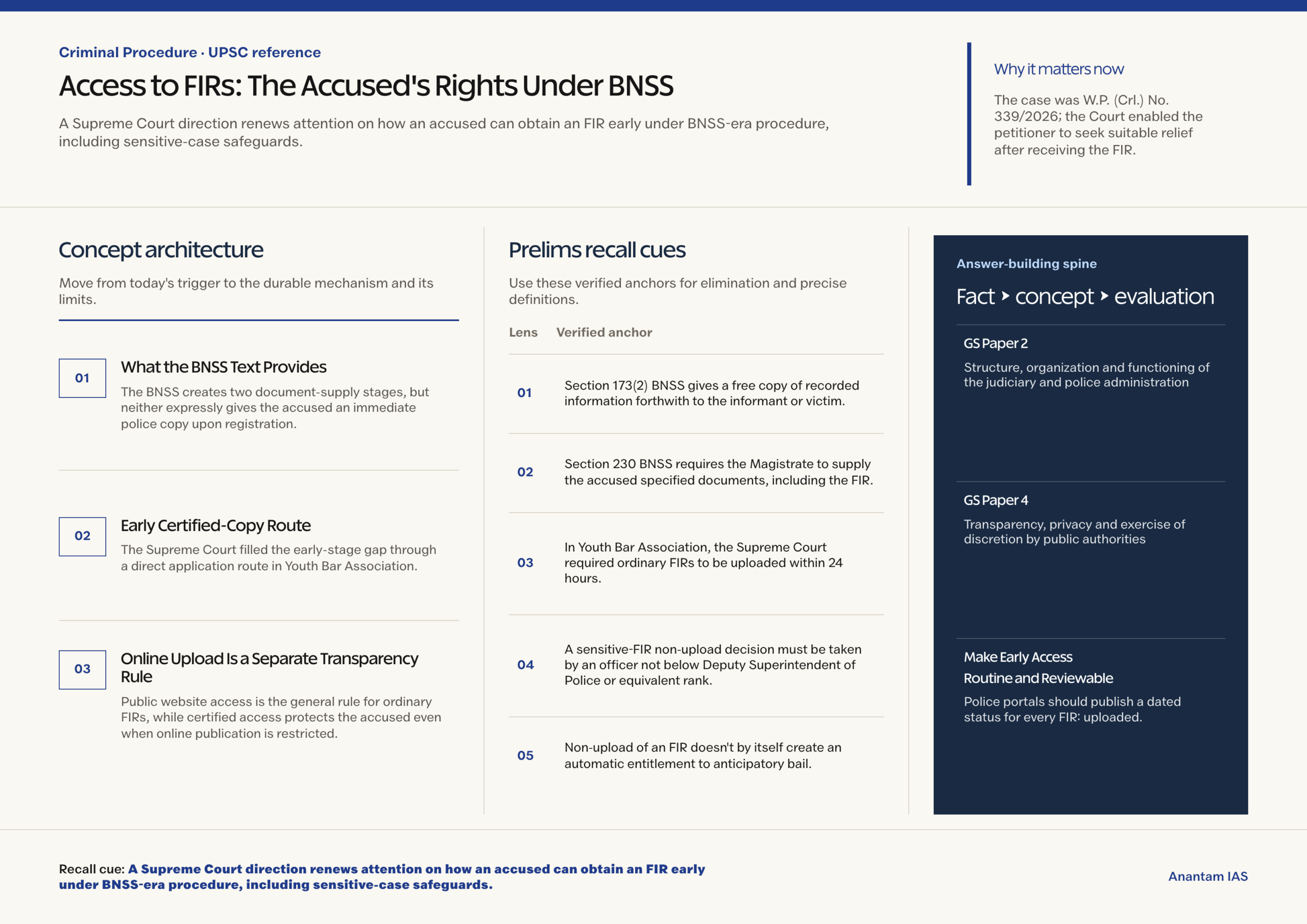
- Section 173(2) BNSS gives a free copy of recorded information forthwith to the informant or victim.
- Section 230 BNSS requires the Magistrate to supply the accused specified documents, including the FIR, within 14 days of production or appearance.
- In Youth Bar Association, the Supreme Court required ordinary FIRs to be uploaded within 24 hours, subject to limited extensions for connectivity difficulties.
- A sensitive-FIR non-upload decision must be taken by an officer not below Deputy Superintendent of Police or equivalent rank.
- Non-upload of an FIR doesn’t by itself create an automatic entitlement to anticipatory bail.
Mains Relevance
GS Paper 2
- Structure, organization and functioning of the judiciary and police administration
- Fundamental rights, fair procedure and institutional accountability in criminal investigation
GS Paper 4
- Transparency, privacy and exercise of discretion by public authorities
Essay
- Procedural fairness matters most at the stage when State power first places personal liberty at risk.
Background and Context
What the BNSS Text Provides
The BNSS creates two document-supply stages, but neither expressly gives the accused an immediate police copy upon registration.
- Under Section 173(2), the police must give the recorded information forthwith and free of cost to the informant or victim. The accused isn’t named.
- Section 230 applies when proceedings are instituted on a police report and the accused is produced before or appears before the Magistrate.
- The Magistrate must furnish the FIR, police report, proposed witness statements, recorded confessions or statements and other forwarded documents free of cost.
- This supply must occur without delay and no later than 14 days from the accused’s production or appearance. Electronic supply counts as furnishing.
- Section 230 is a later case-paper disclosure safeguard. It doesn’t replace the need to know the accusation while investigation and arrest risk are live.
Early Certified-Copy Route
The Supreme Court filled the early-stage gap through a direct application route in Youth Bar Association.
- A person who reasonably suspects being named may apply through a representative to the police officer concerned or Superintendent of Police for a certified FIR copy.
- On that application and payment of the prescribed court-copy fee, the police route must supply the copy within 24 hours.
- Once police forward the FIR to the Magistrate or Special Judge, the accused may apply there; the court should provide a certified copy within two working days.
- These routes are distinct from Section 230’s later bundle of prosecution documents. They let the accused understand the case while pre-trial remedies still matter.
- An FIR can inform applications for anticipatory bail, arguments against remand and other lawful protection. It doesn’t prove guilt or determine the remedy’s outcome.
Online Upload Is a Separate Transparency Rule
Public website access is the general rule for ordinary FIRs, while certified access protects the accused even when online publication is restricted.
- Youth Bar Association directed police or State websites to upload non-sensitive FIRs within 24 hours, generally extendable for unavoidable or geographical connectivity problems.
- Sexual offences, POCSO, terrorism, insurgency and privacy-sensitive matters illustrate the non-exhaustive category that may be withheld from public online publication.
- The non-upload decision requires an officer of at least DSP-equivalent rank and must be communicated to the jurisdictional Magistrate.
- An identified aggrieved person may approach the SP or Police Commissioner. A three-officer committee must decide the grievance within three days.
- Even in a sensitive case, the accused may seek a certified copy from the court receiving the FIR, to be provided within three days. Prior public upload isn’t required.
Way Forward
Make Early Access Routine and Reviewable
- Police portals should publish a dated status for every FIR: uploaded, delayed for connectivity or withheld through a reasoned sensitive-case decision.
- Police stations and courts should offer a trackable certified-copy application with receipts, deadlines and electronic delivery where legally permissible.
- Training should distinguish public disclosure from accused access so privacy protection doesn’t become a blanket reason to deny procedural fairness.
- Courts should record non-supply early and grant case-specific relief without treating website failure alone as automatic grounds for anticipatory bail.
Conclusion
- The durable distinction is simple: Section 173(2) serves the informant or victim, Section 230 supplies later case papers, and Youth Bar Association enables earlier accused access.
- A strong Mains answer should balance personal liberty and fair procedure with victim privacy, using reasoned withholding and prompt certified-copy routes rather than blanket secrecy.
UPSC Practice Questions
Prelims MCQ 1
With reference to access to a First Information Report under the BNSS and Supreme Court directions, consider the following statements:
- Section 173(2) BNSS expressly requires the police to give the accused a free FIR copy forthwith.
- Section 230 BNSS includes the FIR among documents to be furnished by the Magistrate in a police-report case.
- An accused may seek a certified copy from the court after the FIR has been forwarded there.
How many of the above statements are correct?
(a) Only one (b) Only two (c) All three (d) None
Answer: (b) Only two
Explanation:
Statements 2 and 3 are correct. Section 173(2) names the informant or victim, while early accused access is secured through judicial certified-copy directions.
Prelims MCQ 2
Which one of the following correctly describes the sensitive-FIR safeguard in Youth Bar Association of India v. Union of India?
(a) A sensitive FIR can never be supplied to the accused (b) Any investigating officer may withhold it online without recording institutional responsibility (c) Online publication may be withheld through the prescribed process, while the accused may still seek a certified court copy (d) Failure to upload automatically entitles the accused to anticipatory bail
Answer: (c) Online publication may be withheld through the prescribed process, while the accused may still seek a certified court copy
Explanation:
The judgment protects sensitive information from routine public upload but preserves a court-based certified-copy route for the accused.
UPSC Mains Questions
- The right of an accused to know the allegations cannot depend entirely on public website disclosure. Examine the BNSS provisions and judicial safeguards governing early access to FIRs.
- How can criminal procedure reconcile transparency, personal liberty and victim privacy when an FIR is classified as sensitive? Discuss with reference to institutional safeguards.
Sources: The Hindu Explains and Supreme Court of India, Youth Bar Association order.
Frequently Asked Questions
Does Section 173(2) BNSS give the accused an immediate FIR copy?
No. It requires a free copy forthwith for the informant or victim. Early accused access during investigation rests mainly on judicial directions for certified copies.
When does Section 230 BNSS require supply of the FIR?
In a police-report case, the Magistrate must furnish the accused specified papers, including the FIR, within 14 days from the accused’s production or appearance.
Must every FIR be uploaded publicly within 24 hours?
The general rule covers non-sensitive FIRs, subject to limited connectivity extensions. Sensitive matters involving privacy, sexual offences, POCSO, terrorism or insurgency may follow the withholding process.
Can an accused obtain a sensitive FIR that isn’t online?
Yes. The accused or authorized representative may apply to the court receiving the FIR for a certified copy, which Youth Bar Association says should come within three days.
Does non-upload of an FIR automatically justify anticipatory bail?
No. The Supreme Court expressly rejected an automatic benefit on that ground. A court considers the governing bail provision and the case’s facts independently.