Fleet Support Ships: Extending Naval Endurance at Sea
Why in News?
On 5 October 2026, the Ministry of Defence announced the first Fleet Support Ship’s launch and the fifth ship’s keel laying for 6 October at Hindustan Shipyard Limited, Visakhapatnam.
- The first vessel belongs to a programme of five Fleet Support Ships being built for the Indian Navy.
- The announcement describes launch and keel laying as scheduled events; it does not establish completed launch, delivery or commissioning.
- The ships are intended to replenish warships at sea, extending naval endurance and reach across the Indian Ocean Region.
- A warship’s deployment depends on logistics as well as combat equipment: consumable supplies can constrain how long it remains away from harbour.
- Construction progress and operational availability answer different questions. A launch milestone cannot establish that the Navy already has an additional deployable support ship.
UPSC Relevance
Prelims Relevance
- Fleet Support Ship: a vessel intended to replenish deployed naval ships.
- Replenishment: resupplying fuel, water, ammunition and stores at sea.
- Launch: placing a ship’s hull afloat, distinct from commissioning.
- Keel laying: a ship-construction milestone, distinct from launch.
- Hindustan Shipyard Limited: the Visakhapatnam shipyard building this fleet support programme.
Mains Relevance
GS Paper 3
- Naval logistics as an enabler of maritime reach and sustained presence.
- Domestic shipbuilding capability and the distinction between construction milestones and usable defence capacity.
Essay
- Sustained capability depends on support systems that are less visible than frontline assets.
Background and Context
Why Warships Need Replenishment at Sea
Fleet support ships address a practical constraint: a deployed warship consumes supplies and cannot sustain its mission indefinitely without replenishment.
- The Ministry’s acquisition announcement identifies fuel, water, ammunition and stores as supplies the vessels will carry to naval ships at sea, enabling longer operations without returning to harbour for those replenishment needs.
- Endurance concerns how long a ship can sustain its activity. Replenishment supports that endurance by restoring consumable supplies; it does not imply that the receiving vessel can operate indefinitely without maintenance or crew support.
- Operational reach also depends on sustaining ships after they arrive in an area. A vessel may be able to sail a considerable distance, yet its continuing presence still requires a dependable supply arrangement.
- The useful comparison is between returning to harbour for supplies and receiving them at sea. Avoiding a supply-driven return can preserve time in the operating area, although actual benefits depend on the deployment.
- These ships provide a support function for the fleet. Their strategic contribution should be explained through sustained operations, rather than assuming that greater supply capacity automatically adds the combat capabilities of a frontline warship.
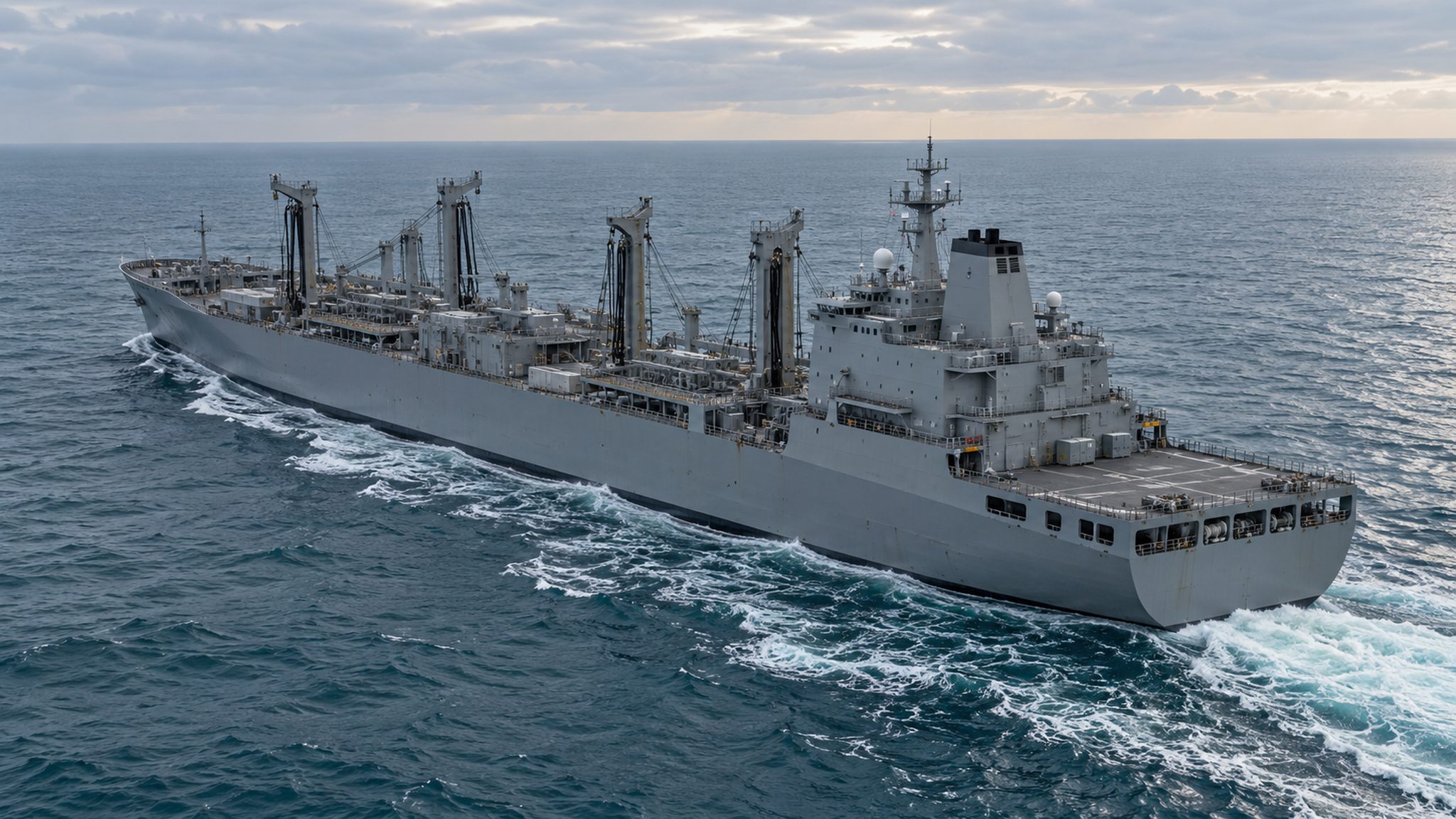
Launch Is a Construction Milestone
The same shipbuilding programme can contain vessels at different stages; a planned launch and a keel laying do not describe equivalent progress.
- Keel laying marks progress in construction of a ship’s structure. The scheduled event for the fifth vessel belongs to this stage; it must not be reported as the fifth ship entering water or service.
- Launch places a hull afloat. The current announcement describes the first vessel entering the Bay of Bengal, but a hull reaching water does not establish that all equipment is integrated or operationally accepted.
- Fitting out involves completing and integrating shipboard equipment and systems. The Ministry’s Taragiri launch release, for example, explicitly places outfitting after launch on the route towards delivery to the Navy.
- Trials check ship and system performance, while commissioning marks entry into naval service. These are distinct milestones; individual programmes can still have further integration or operational work after commissioning, as official carrier documentation illustrates.
- For this news item, the verified status is scheduled construction milestones. The announcement supplies no basis to claim completed delivery, commissioning or operational deployment of the first ship, nor completion of the entire programme.
What Support Ships Change, and What They Do Not
Assess the programme through its intended logistics function and the evidence of progress, while keeping promised capability separate from capability already available.
- The intended benefit is sustained naval presence across the Indian Ocean Region. Replenishment capacity helps explain this objective, but the announcement does not quantify additional patrol days, transfer rates or mission-specific gains in endurance.
- Fleet readiness depends on the availability of the support vessel as well as the receiving ships. A replenishment capability is useful only when ships, supplies and personnel can be brought together for the required operation.
- The shipyard’s construction capacity matters for building successive large vessels. Facilities and production milestones demonstrate industrial progress; they are not interchangeable with acceptance of completed ships or evidence that the fleet’s operational availability has increased.
- Series construction means several vessels progress through production, potentially at different stages. The first ship’s scheduled launch alongside the fifth ship’s keel laying illustrates that distinction without showing when every vessel will become available.
- Use evidence matched to the claim: construction releases for building progress, delivery or commissioning announcements for induction, and deployment evidence for actual employment. This avoids turning a planned ceremony into proof of an operational capability.
Way Forward
Track Capability Beyond the Ceremony
- Report launch, delivery and commissioning separately, updating the ship’s status only when the relevant milestone is confirmed.
- Evaluate replenishment readiness through available ships, trained personnel, usable systems and dependable supplies, rather than the hull count alone.
- Assess industrial progress alongside the completion and acceptance of successive vessels, keeping projected deployment benefits distinct from demonstrated outcomes.
Conclusion
- Fleet Support Ships matter because maritime presence requires continued supply. Their value lies in helping warships stay deployed for longer, connecting naval reach with the practical ability to sustain operations away from harbour.
- The present development remains an announced launch and keel laying. An accurate answer should explain the logistics mechanism while distinguishing shipbuilding progress from delivery, commissioning and the later availability of an operational support capability.
UPSC Practice Questions
Prelims MCQ 1
With reference to Fleet Support Ships, consider the following statements:
- They can support prolonged naval deployments by replenishing ships at sea.
- A ship’s launch automatically establishes its commissioning into naval service.
- The Ministry identifies fuel, water, ammunition and stores among the supplies these ships will provide.
How many of the above statements are correct?
(a) Only one (b) Only two (c) All three (d) None
Answer: (b) Only two
Explanation:
Statements 1 and 3 describe the intended support role. Launch and commissioning are separate milestones; placing a hull afloat does not establish induction into service.
Prelims MCQ 2
Which best explains the strategic contribution of replenishment at sea?
(a) It eliminates every future maintenance requirement (b) It converts all support ships into frontline combatants (c) It helps deployed ships sustain operations without returning to harbour for replenishment (d) It makes ship trials unnecessary after launch
Answer: (c) It helps deployed ships sustain operations without returning to harbour for replenishment
Explanation:
Restoring consumable supplies can extend deployed endurance. It does not remove maintenance, trials or the distinction between combat and logistics roles.
UPSC Mains Questions
- Explain how replenishment at sea contributes to naval endurance and strategic reach. Why should logistics capability be assessed alongside frontline combat assets?
- Distinguish launch, fitting out, trials and commissioning in naval shipbuilding. Discuss the risks of treating construction milestones as evidence of operational readiness.
Sources: PIB, Ministry of Defence and PIB, Ministry of Defence: Fleet Support Ship Acquisition.
Frequently Asked Questions
What is a Fleet Support Ship?
It is a naval support vessel intended to replenish deployed ships with fuel, water, ammunition and stores. This logistics role helps the fleet operate for longer without returning to harbour for replenishment.
Has the first ship already been commissioned?
The verified announcement schedules a launch for 6 October; it does not report commissioning. Launch places a hull afloat, while commissioning is a separate milestone marking entry into naval service.
Why does replenishment at sea matter?
It restores supplies consumed during deployment and can reduce the need to return to harbour for replenishment. This supports endurance, although maintenance and other operational requirements continue to limit sustained activity.
Is keel laying the same as launch?
No. Keel laying marks structural construction progress, while launch places a hull afloat. The announced events concern different vessels at different stages: the first ship’s launch and the fifth ship’s keel laying.
Does launch mean the vessel is fully ready?
No. Fitting out, integration, trials and acceptance can remain after launch. Readiness must be assessed through the relevant later evidence rather than inferred from the hull entering water alone.