Foreign Direct Investment

Context:
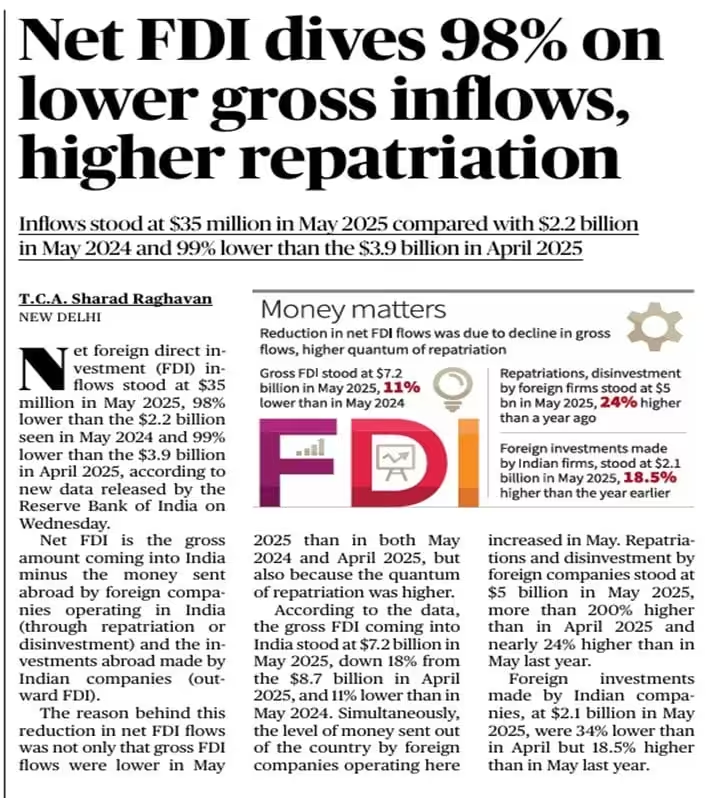
Net foreign direct investment (FDI) in-flows stood at $35 million in May 2025, 98% lower than the $2.2 billion seen in May 2024 and 99% lower than the $3.9 billion in April 2025, according to new data released by the Reserve Bank of India.
UPSC Relevance:
CSE in prelims as well as in mains examination has focused on FDI. A case in point is a following PYQ
Mains PYQ 2014
Q1: Foreign direct investment in the defence sector is now set to be liberalized. What influence this is expected to have on Indian defence and economy in the short and long run?
Mains PYQ 2013
Q2: Though India allowed foreign direct investment (FDI) in what is called multi brand retail through joint venture route in September 2012, the FDI ,even after a year, has not picket up. Discuss the reasons.(2013)
Consider the following:(2021)
Foreign currency convertible bonds
Foreign institutional investment with certain conditions
Global depository receipts
Non-resident external deposits
Which of the above can be included in Foreign Direct Investments?
A 1, 2 and 3 only
B 3 only
C 2 and 4 only
D 1 and 4 only
What is FDI
Foreign direct investment are the net inflows of investment to acquire a lasting management interest (10 percent or more of voting stock) in an enterprise operating in an economy other than that of the investor.
or
‘FDI’ or ‘Foreign Direct Investment’ means investment through capital instruments
by a person resident outside India in an unlisted Indian company; or in ten per cent
or more of the post issue paid-up equity capital on a fully diluted basis of a listed
Indian company.(According to Ministry of Commerce and Industry FDI Policy 2020)
Routes of FDI investment in India
Automatic route: It means the entry route through which investment by a person
resident outside India does not require the prior approval of the Reserve Bank of
India or the Central Government.
Examples: Agriculture & Animal Husbandry, Air-Transport Services (Non Scheduled Air Transport Service / Helicopters services/ seaplane services requiring DGCA approval), Airports (Greenfield + Brownfield), Asset Reconstruction Companies, Auto-components, Automobiles etc.
Government Route: means the entry route through which investment by a person
resident outside India requires prior Government approval and foreign investment
received under this route shall be in accordance with the conditions stipulated by
the Government in its approval.
Examples: Banking (Public sector) – 20%, Broadcasting Content Services (FM Radio, uplinking of news and current affairs TV Channels)– 49%, Uploading/Streaming of ‘News & Current affairs’ through digital media – 26%, Investment by Foreign airlines – 49%.etc.
Data Summary-GOI
India has attracted total FDI inflow of USD 70.97 bn during the financial year 2022-23. Total FDI inflows in the country in the last 23 years (April 2000 – March 2023) are USD 919 bn while the total FDI inflows received in the last 9 years (April 2014- March 2023) was USD 595.25 bn which amounts to nearly 65% of total FDI inflow in last 23 years.
Top 5 sectors receiving highest FDI Equity Inflow during FY 2022-23 are Services Sector (Fin., Banking, Insurance, Non Fin/ Business, Outsourcing, R&D, Courier, Tech. Testing and Analysis, Other) (16%), Computer Software & Hardware (15%), Trading (6%), Telecommunications (6%) and Automobile Industry (5%).
Mauritius (26%), Singapore (23%), USA (9%), Netherland (7%) and Japan (6%) emerge as top 5 countries for FDI equity inflows into India FY 2022-23.
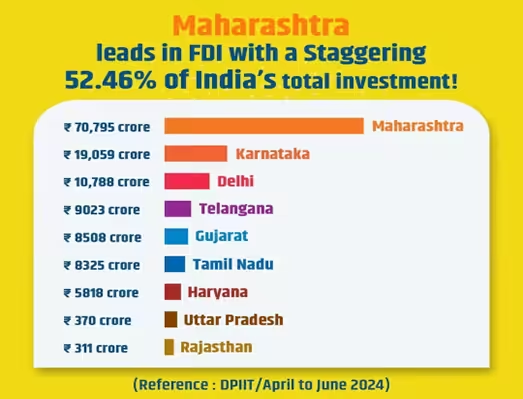
Top 5 States receiving highest FDI Equity Inflow during FY 2022-23 are Maharashtra (29%), Karnataka (24%), Gujarat (17%), Delhi (13%), and Tamil Nadu (5%).

Advantages of FDI:
Increased Employment and Economic Growth
Human Resource Development
Development of Backward Areas
Provision of Finance & Technology
Increase in Exports
Exchange Rate Stability
Stimulation of Economic Development
Improved Capital Flow
Creation of a Competitive Market
Disadvantages of FDI:
Increase Regional disparity
Growth and benefit only particular sector
Burden on local resources
Job loss due to automation
Environment loss due to increase carbon emission
Round tripping of money by big MNC companies for profit
Monopolization of markets by large multinational corporations, potentially harming small businesses and consumers