France’s Under-15 Social Media Ban: A Digital Governance Test
Why in News?
On 21 July 2026, both houses of the French Parliament definitively adopted a compromise bill restricting access to online social-networking services for children under 15 years. The Hindu described it as the first national under-15 social-media ban adopted in the European Union.
The measure is a test of digital governance, not just a ban. Its success depends on privacy-preserving age assurance, a workable division of powers between France and the European Union, proportionate restrictions on children’s rights, and enforceable duties for cross-border platforms.
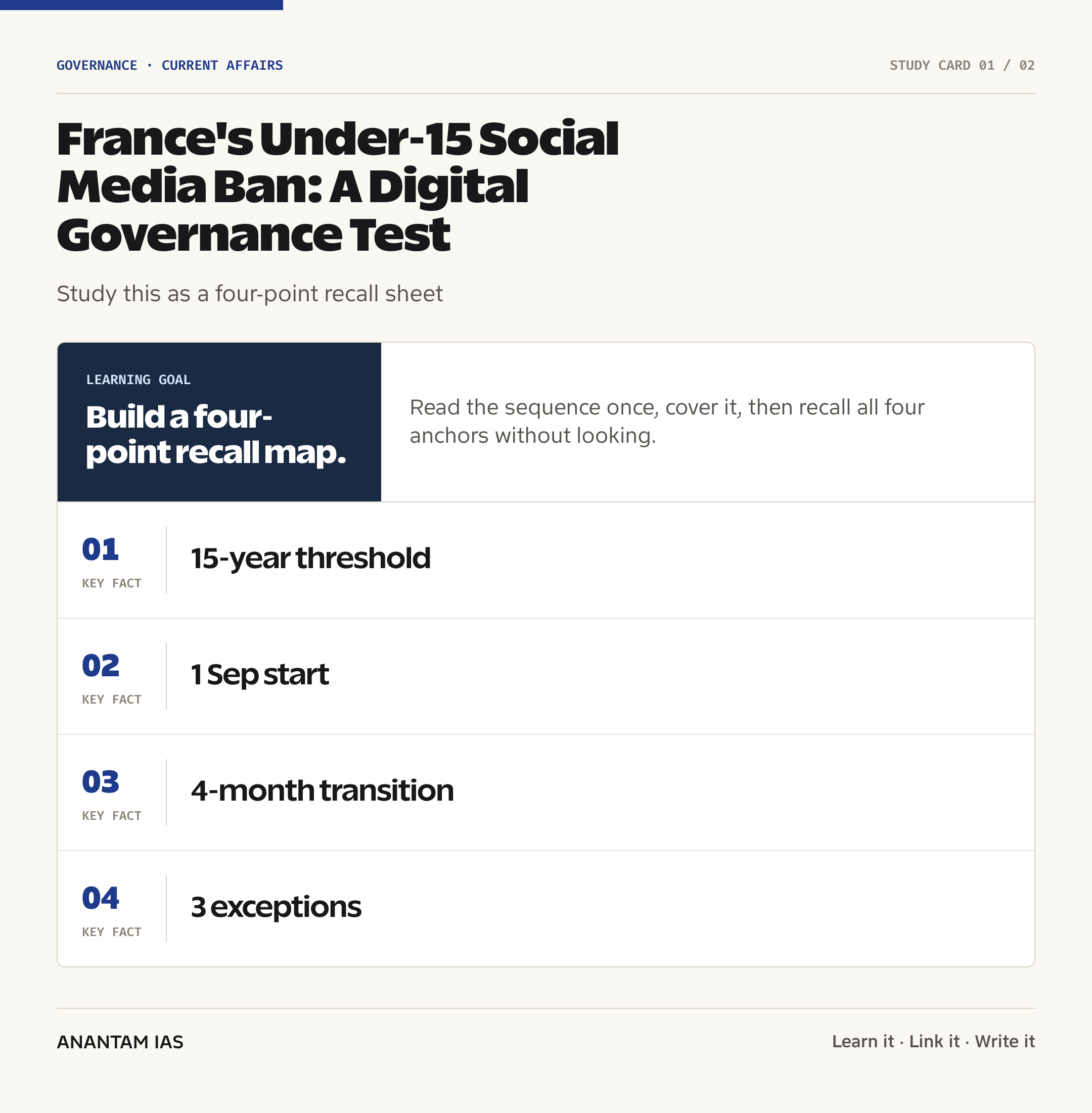
- The rule is scheduled to apply to new access from 1 September 2026; accounts created earlier receive a four-month transition.
- The adopted text exempts online encyclopedias, educational or scientific directories, and open-source development or educational-project platforms.
- As of 23 July 2026, the text had been definitively adopted by Parliament but had not yet been confirmed as promulgated in the official statute book.
- The compromise removed a proposed national platform blacklist and avoided creating a parallel French enforcement structure that could conflict with the Digital Services Act.
The development matters in the context of:
- The development matters in the context of balancing child protection with freedom of expression, access to information and adolescent autonomy.
- It tests whether age assurance can be accurate without turning every user’s identity into a platform-held data point.
- It illustrates the difficulty of regulating global platforms through a national law inside the EU Single Market.
- For India, comparison with the Digital Personal Data Protection Act, 2023 requires constitutional, institutional and access-related analysis.
UPSC Relevance
Prelims Relevance
- France’s threshold: access to covered social-networking services is restricted for persons below 15 years.
- Commencement: the adopted text specifies 1 September 2026 for new access and a four-month transition for pre-existing accounts.
- Exceptions: online encyclopedias, educational or scientific directories, and specified open-source platforms are outside the prohibition.
- DSA Article 28: platforms accessible to minors must provide a high level of privacy, safety and security through appropriate and proportionate measures.
- Data minimization: DSA compliance does not itself require platforms to process extra personal data merely to decide whether a user is a minor.
- Age verification: proves that a person crosses a legal age threshold; age estimation gives a probability rather than verified identity.
- Zero-knowledge proof: can confirm an age condition without disclosing a name, exact birth date or browsing history.
- India’s DPDP Act: defines a child as a person below 18 and requires verifiable parental consent before covered processing of a child’s personal data.
- Platform duty of care: places preventive responsibility on service design, defaults and risk mitigation, not only on parental control.
Mains Relevance
GS Paper 2
- Governance: institutional coordination across national legislatures, regulators and supranational EU authorities.
- Social justice: protection of children from addictive design, grooming, cyberbullying and harmful commercial practices.
- Rights: proportionality between child welfare, privacy, expression, association and access to information.
- Comparative policy: lessons and limits for India’s child-online-safety framework.
GS Paper 3
- Science and technology: age assurance, anonymous credentials, interoperability and circumvention risks.
- Cybersecurity: risks created when identity documents, biometric estimates or parental credentials become attack surfaces.
- Platform regulation: algorithmic risk assessment, safety by design and cross-border enforcement.
Essay
- Technology and childhood: protection should expand a child’s capabilities, not merely close digital spaces.
- Liberty and paternalism: a legitimate protective aim still needs a proportionate and reviewable means.
- Digital federalism: national democratic choices increasingly operate within transnational regulatory systems.
Background and Context
Legal Status and Legislative Evolution
The headline “ban” must be separated from the measure’s precise stage in France’s legislative process.
- The National Assembly first adopted a general under-15 prohibition in January 2026; the Senate later preferred a graded model that would ban access to services considered particularly harmful and require parental authorization for others.
- A joint parliamentary committee agreed on a compromise on 20 July, and both houses adopted it on 21 July. Parliamentary adoption was final, but promulgation and any constitutional review remained separate legal steps as of 23 July.
- The final compromise returned to a general access prohibition rather than a national blacklist. This is narrower in drafting than a detailed platform-liability code because it states the access rule but leaves several operational questions to the existing European framework.
- France’s 2023 digital-majority law had contemplated parental authorization below 15, but implementation stalled over EU-law problems.
- The adopted bill separately extends school phone restrictions to lycées, complementing the access rule with an education measure.
Scope, Threshold and Exceptions
The measure uses an age threshold but depends on legal definitions to decide which services are actually covered.
- The proposed Article 6-9 states that access to an online social-networking service supplied by an online platform is prohibited to minors under 15.
- The terms online platform and social-networking service draw on EU definitions. The Senate names Instagram, TikTok, Facebook and Snapchat as core services, while hybrid services may need case-specific interpretation.
- The adopted exceptions cover online encyclopedias, educational or scientific directories, and platforms for developing and sharing free software or open-source educational digital projects.
- The final text does not retain a general parental-consent route for ordinary covered networks, unlike the 2023 French model.
- Because the rule is directed at access by minors, operational compliance still needs a lawful mechanism through which services can distinguish under-15 users without building a universal identity register.
- New access is scheduled to be covered from 1 September 2026. For accounts created before that date, the prohibition applies after four months, effectively creating a transition into January 2027 if the text enters into force as planned.
Age Assurance Without Identity Surveillance
A legal threshold works only if age can be established with enough confidence and with no unnecessary identity disclosure.
- Self-declared birth dates are easy to bypass. More reliable methods include document-based verification, national electronic identity, bank-held age attestations, facial age estimation and trusted third-party credentials.
- Each method trades off accuracy, inclusion, privacy, cost and cybersecurity. Document checks can exclude users, facial estimation can produce demographic error, and identity stores can become breach targets.
- The European Commission’s age-verification solution was technically ready in April 2026 and can be adapted to thresholds such as 15. It is designed to return an anonymous yes-or-no proof of age rather than a name or exact birth date.
- Zero-knowledge proof technology allows a user to prove that a statement such as “age 15 or above” is true without revealing the underlying identity data. Unlinkable proofs also reduce cross-service tracking.
- France’s CNIL emphasizes minimization, proportionality, robustness, simplicity, standardization and an independent third party, making privacy a design condition.
- No system is bypass-proof: VPNs, borrowed credentials and account sharing require risk-based enforcement and evidence that the barrier materially reduces exposure.
Interaction with the EU Digital Services Act
France can set a domestic age rule, but platform obligations and cross-border supervision sit within the EU’s harmonized digital-services regime.
- Article 28 of the DSA requires platforms accessible to minors to adopt appropriate and proportionate measures ensuring a high level of privacy, safety and security.
- The DSA also bars profiling-based advertising to a recipient whom the platform knows with reasonable certainty to be a minor, while clarifying that this duty does not compel extra personal-data collection solely to determine age.
- The Commission’s 2025 minors-protection guidelines recommend accurate, reliable, robust, non-intrusive and non-discriminatory age assurance. They are non-binding but can inform enforcement.
- France notified an earlier version through the EU’s Technical Regulation Information System. The Commission questioned features that could create national platform duties overlapping with the DSA.
- The compromise removed the French platform blacklist and redundant Arcom powers. Suspected failures by providers in other EU states must move through DSA cooperation.
- This creates an enforcement dependency: a national norm still relies on EU-level service classification, common age standards and action against cross-border platforms.
Child Rights and the Proportionality Test
Child protection is a legitimate objective, but the restriction must still be suitable, necessary and balanced.
- Potential harms include grooming, cyberbullying, harmful content, addictive design and commercial profiling. Prevention need not wait for perfect causal evidence.
- Children also hold rights to expression, association, participation, privacy and access to information. Social networks may support peer contact, civic learning, creative work and access to help, especially for isolated groups.
- A general ban faces the proportionality question: could less restrictive measures, such as safe defaults, chronological feeds, night-time limits, restricted direct messaging, recommender controls and advertising bans, achieve much of the protective aim?
- France’s Council of State had reportedly preferred a graded approach, combining a ban for high-risk services with parental authorization for others. The final general rule may face constitutional review on this ground.
- The exceptions preserve educational and knowledge access, but rapidly changing service features can make fixed categories over-inclusive or under-inclusive.
- A rights-respecting system needs appeal, correction and redress for false age determinations and must avoid routine identity disclosure by adults.
Platform Duties and Enforceability
The hardest policy question is who must do what when an underage account is detected.
- A workable regime needs duties at the level of account creation, existing-account review, recommender design, default privacy, reporting and audit. A bare prohibition directed at children can otherwise become symbolic.
- The final French clause does not itself specify a new platform fine, a single mandatory verification technology or penalties for children. This avoids criminalizing minors but increases reliance on DSA supervision and implementation standards.
- Regulators need metrics for underage-account prevalence, false rejections, appeals and exposure to harmful recommendations.
- Platforms should not be allowed to treat successful age gating as a substitute for safety by design. Users aged 15 to 17 remain minors and still require high privacy and safety under the DSA.
- Independent researchers need privacy-safe access to test discrimination by gender, ethnicity, disability, device access and documentation status.
- Public policy should combine enforcement with digital literacy, parental support, school counselling and mental-health services.
Lessons and Limits for India
India can learn from the governance architecture without copying France’s threshold or institutional design.
- India’s DPDP Act, 2023 defines a child as a person below 18. Section 9 requires verifiable parental consent before covered processing and bars detrimental processing, behavioural monitoring and targeted advertising directed at children.
- The DPDP Rules, 2025 describe parental verification, but key child-data duties follow phased commencement. India has no French-style national account ban.
- Students can revise India’s framework through DPDP Act study notes and the DPDP Rules overview.
- The French debate supports an Indian shift from simple consent boxes toward platform accountability: child-safe defaults, restricted profiling, algorithmic risk audits, effective grievance redress and transparent regulator-platform coordination.
- Any Indian age-assurance framework must satisfy Articles 14, 19 and 21 and account for unequal access to identity documents, devices and parental digital literacy.
- A phased pilot should publish evidence on accuracy, exclusion, circumvention, data retention and child outcomes before India considers a universal threshold.
- For the wider debate, compare India’s emerging social-media approach with the case against relying on a ban as a complete solution.
Way Forward
Use Privacy-Preserving Age Proof
- Adopt anonymous threshold credentials that reveal only whether the user meets the age condition.
- Separate the credential issuer from the platform so neither party can reconstruct identity and browsing history.
- Ban the use of age-assurance data for advertising.
Regulate Design, Not Only Entry
- Require high-privacy defaults, limits on unsolicited adult contact, controllable recommendation systems and meaningful break prompts.
- Audit engagement-maximizing features such as infinite scroll, autoplay and repeated push notifications for risks to minors.
- Preserve access to educational, health and civic resources.
Build Accountable Enforcement
- Clarify the roles of national regulators, Digital Services Coordinators and the European Commission before commencement.
- Publish compliance metrics and appeal routes, and direct lawful sanctions at providers rather than children.
Follow an Evidence-Led Indian Path
- Implement and evaluate the DPDP child-data safeguards before layering a broad access prohibition on top.
- Commission India-specific research across age, gender, disability, income, language and location.
Conclusion
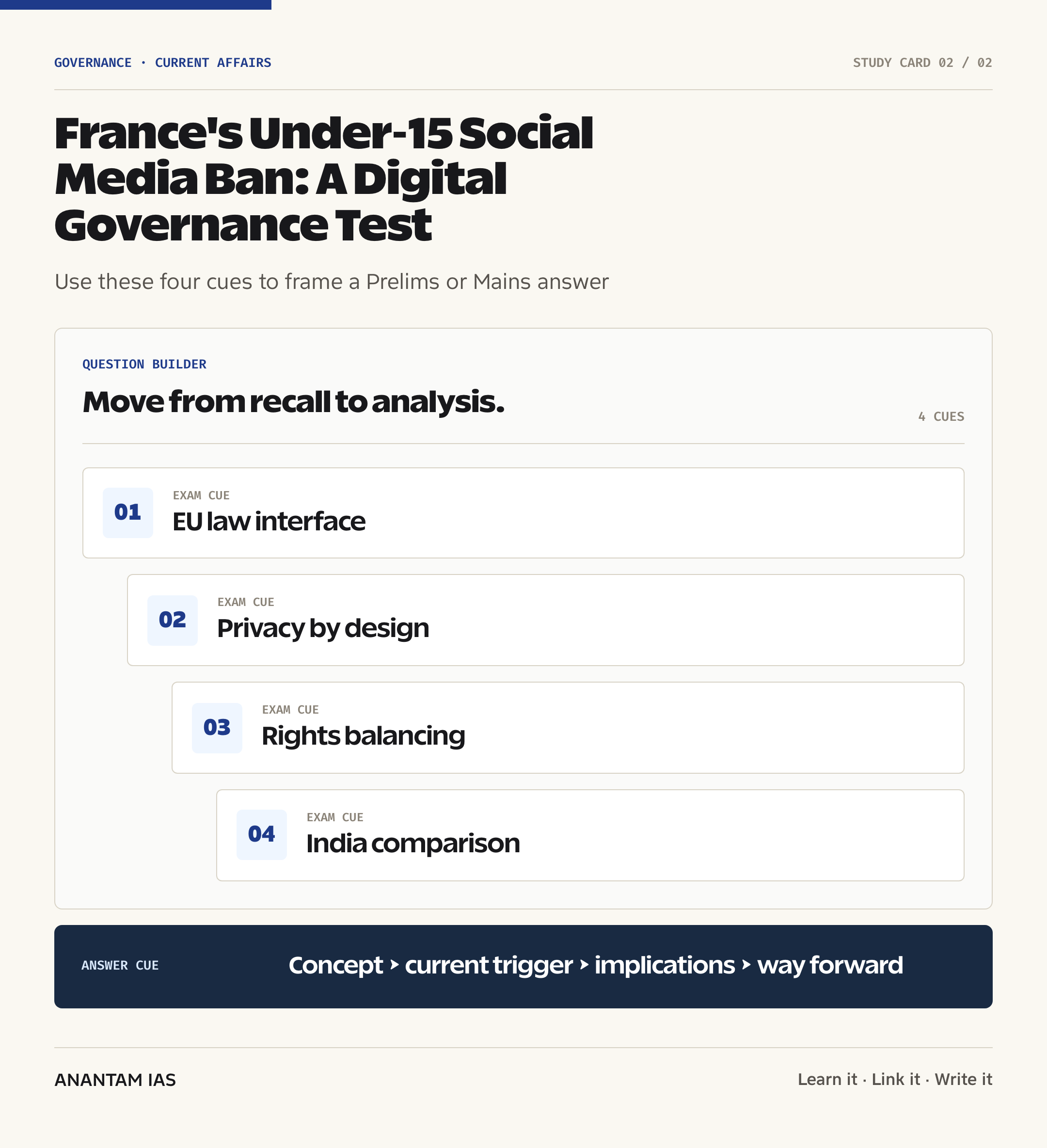
France’s measure is important because it exposes the full chain of digital governance: Parliament can set a threshold, but technology, regulators, courts and transnational enforcement decide whether that threshold protects children in practice.
The sound policy test is not “ban or no ban”. It is whether the state can reduce demonstrable harm through proportionate, privacy-preserving and reviewable measures while retaining children’s access to knowledge, participation and remedy.
For India, the durable lesson is to make platform design and data practices accountable, test age-assurance systems for exclusion and surveillance, and treat children as rights-holders rather than only as risks to be managed.
UPSC Practice Questions
Prelims MCQ 1
With reference to France’s definitively adopted 2026 social-media measure, consider the following statements:
- It restricts access to covered social-networking services for minors below 15 years.
- It provides a general parental-consent exception for ordinary covered social networks.
- It exempts online encyclopedias and specified educational, scientific and open-source platforms.
How many of the above statements are correct?
(a) Only one (b) Only two (c) All three (d) None
Answer: (b) Only two
Explanation:
Statements 1 and 3 are correct. The final compromise uses a general under-15 access restriction with specified public-interest exceptions; it does not retain a general parental-consent route for ordinary covered networks.
Prelims MCQ 2
Which one of the following best describes the Digital Services Act’s approach to minors?
(a) It creates one uniform EU-wide minimum age for every online service (b) It requires all users to disclose official identity documents to platforms (c) It requires appropriate and proportionate protection for minors and restricts profiling-based advertising to known minors (d) It transfers exclusive enforcement over all platforms to national parliaments
Answer: (c) It requires appropriate and proportionate protection for minors and restricts profiling-based advertising to known minors
Explanation:
DSA Article 28 establishes privacy, safety and security duties for platforms accessible to minors and limits profiling-based advertising. It does not itself fix one EU-wide social-media age or mandate universal identity-document disclosure.
UPSC Mains Questions
- France’s under-15 social-media restriction shows that setting an age threshold is easier than governing its implementation. Examine the challenges of age assurance, privacy protection, cross-border platform enforcement and proportionality in regulating children’s access to social media.
- Child online safety requires a shift from parental consent toward platform accountability, but the two need not be mutually exclusive. Discuss with reference to safety-by-design, algorithmic risk, targeted advertising and grievance redress.
- What lessons can India draw from France and the European Union while implementing the child-data provisions of the Digital Personal Data Protection framework? Identify the constitutional and inclusion safeguards needed before considering access restrictions.
Sources: French Senate, definitively adopted parliamentary text and The Hindu Explained.
Frequently Asked Questions
Is France’s under-15 ban already law?
As of 23 July 2026, both houses of Parliament had definitively adopted the compromise text. Parliamentary adoption was complete, but promulgation and any constitutional review were separate steps. It is most accurate to call it a definitively adopted measure, not an already implemented ban.
When is the restriction scheduled to begin?
The adopted text specifies 1 September 2026 for new access. Accounts created before that date receive a four-month transition, so the rule would apply to them after that period if the measure enters into force as scheduled.
Which services are exempt?
The text exempts online encyclopedias, educational or scientific directories, and platforms used to develop and share free software or open-source educational digital projects. Other borderline services may require interpretation under the incorporated EU definitions.
Can parents authorize an under-15 account?
The final 2026 compromise does not retain a general parental-authorization exception for ordinary covered social networks. This differs from France’s 2023 digital-majority model, which had contemplated parental permission below 15.
How can age be checked privately?
A privacy-preserving credential can return only a yes-or-no proof that a user crosses the age threshold. Zero-knowledge proofs and independent issuers can avoid revealing the person’s name, exact birth date or browsing history to the platform.
What is the main lesson for India?
India should first make child-data and platform-safety duties effective, test age-assurance systems for exclusion and surveillance, and build independent redress. France offers useful design questions, but its age threshold and EU enforcement structure cannot be copied directly.