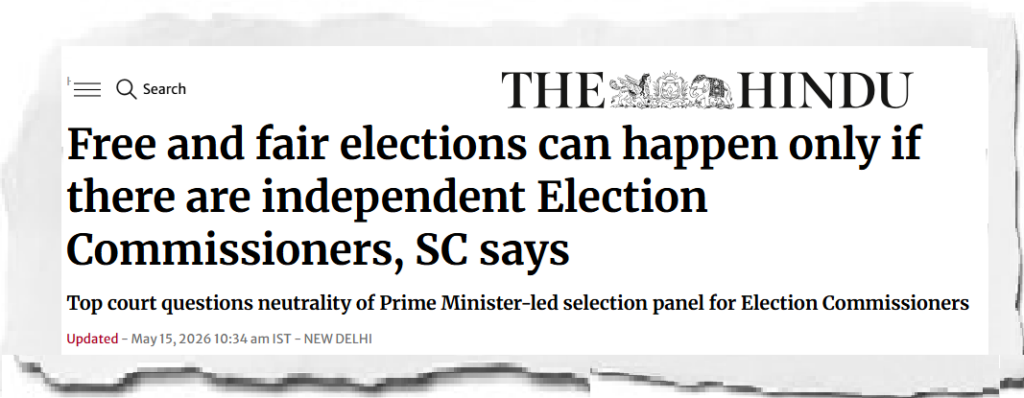
Free and fair elections can happen only if there are independent Election Commissioners, SC says
Why in News?
The Supreme Court has raised concerns regarding the Chief Election Commissioner and other Election Commissioners (Appointment, Conditions of Service, and Term of Office) Act, 2023, while hearing petitions challenging the law. The Court observed that free and fair elections require an independent Election Commission and questioned the dominance of the Executive in the appointment process of Election Commissioners.
UPSC Relevance
Prelims: Election Commission of India, Article 324, basic structure doctrine, constitutional bodies, Anoop Baranwal judgment, separation of powers
Mains:
GS Paper 2 – constitutional bodies, electoral reforms, separation of powers, independence of institutions, Parliament and judiciary, federal democracy;
GS Paper 3 – governance and accountability;
Essay – democracy, constitutional morality, institutional independence
Background and Context
The Election Commission of India (ECI) is one of the most important constitutional institutions responsible for ensuring free and fair elections in the country. It conducts elections to:
- Parliament
- State Legislatures
- Offices of the President and Vice-President
The framers of the Constitution recognised that democracy can survive only if elections remain impartial, credible and insulated from political interference.
The constitutional basis of the Election Commission is provided under Article 324, which vests the “superintendence, direction and control” of elections in the Election Commission.
For decades, however, appointments of the Chief Election Commissioner (CEC) and Election Commissioners (ECs) were made solely by the Executive without a dedicated parliamentary law regulating the process.
This led to growing concerns regarding:
- Institutional independence
- Executive dominance
- Transparency in appointments
The issue gained constitutional significance after the Supreme Court’s judgment in the Anoop Baranwal case in 2023.
Constitutional Position of the Election Commission
Article 324 and Constitutional Status
Article 324 establishes the Election Commission as a constitutional body entrusted with conducting elections.
The Article provides:
- Appointment of the CEC and ECs by the President
- Parliament’s authority to make laws regarding appointments
- Security of tenure for the CEC
The Election Commission occupies a unique constitutional position because elections form the foundation of representative democracy.
Importance in Democratic Governance
The Election Commission plays a crucial role in:
- Conducting elections impartially
- Maintaining electoral rolls
- Enforcing the Model Code of Conduct
- Regulating political parties and campaign practices
Its credibility directly affects:
- Public trust in democracy
- Legitimacy of governments
- Constitutional stability
The Supreme Court has repeatedly held that free and fair elections form part of the basic structure of the Constitution.
The Anoop Baranwal Judgment (2023)
Background of the Case
In Anoop Baranwal v. Union of India, the Supreme Court examined the absence of a transparent appointment mechanism for Election Commissioners.
The Court observed that prolonged executive control over appointments could undermine institutional independence.
Interim Appointment Mechanism
The Constitution Bench created an interim selection committee comprising:
- The Prime Minister
- The Leader of Opposition in Lok Sabha
- The Chief Justice of India
The Court clarified that this arrangement would continue until Parliament enacted a law under Article 324(2).
The judgment was viewed as an attempt to:
- Introduce checks and balances
- Protect institutional neutrality
- Strengthen electoral democracy
The 2023 Appointment Act
Key Provisions
Parliament subsequently enacted the Chief Election Commissioner and other Election Commissioners (Appointment, Conditions of Service, and Term of Office) Act, 2023.
The law replaced the Chief Justice of India in the selection committee with:
- A Cabinet Minister nominated by the Prime Minister
Thus, the selection committee now consists of:
- Prime Minister
- Cabinet Minister nominated by PM
- Leader of Opposition
Criticism of the Law
Critics argue that the law gives overwhelming control to the Executive because:
- Two out of three members belong to the ruling government
- Decisions need not be unanimous
- The Leader of Opposition may become merely symbolic
Petitioners before the Supreme Court contended that the Act effectively nullified the spirit of the Anoop Baranwal judgment.
Supreme Court’s Concerns
Need for Institutional Independence
The Supreme Court observed that free and fair elections can exist only when the Election Commission is genuinely independent.
The Court emphasised:
Independence must not only exist in reality but must also appear to exist.
This reflects an important constitutional principle:
- Public confidence in institutions depends both on actual impartiality and visible neutrality.
Executive Dominance in Appointments
Justice Dipankar Datta questioned the absence of a “neutral” member in the selection committee.
The Court highlighted concerns that:
- A Cabinet Minister may not independently oppose the Prime Minister
- Executive dominance could compromise perceptions of impartiality
The observations reflect broader constitutional anxieties regarding concentration of power.
Elections and Basic Structure Doctrine
The Court reiterated that:
- Free and fair elections are part of the basic structure of the Constitution
This principle originates from landmark cases such as:
- Kesavananda Bharati Case
- Indira Gandhi v. Raj Narain
The judiciary has consistently held that democracy and electoral integrity are fundamental constitutional values beyond ordinary political majorities.
Government’s Arguments
Parliament’s Legislative Authority
The Union government argued that Parliament is constitutionally empowered under Article 324(2) to enact laws regarding appointments.
It contended that:
- The Supreme Court cannot dictate the exact form of legislation
- Parliament is not bound to reproduce judicial suggestions verbatim
The Attorney-General argued that the Anoop Baranwal judgment only created a temporary arrangement until Parliament legislated on the matter.
Separation of Powers Argument
The government further argued that:
- The judiciary cannot become a “second chamber of Parliament”
This reflects the constitutional doctrine of separation of powers, under which:
- Legislature makes laws
- Executive implements laws
- Judiciary interprets laws
The government warned against excessive judicial intervention in legislative policymaking.
Broader Constitutional and Governance Issues
Independence of Constitutional Bodies
The debate raises wider concerns regarding the independence of constitutional institutions such as:
- Election Commission
- Central Bureau of Investigation (CBI)
- Comptroller and Auditor General (CAG)
- Information Commission
Institutional independence is essential for:
- Accountability
- Rule of law
- Democratic legitimacy
Checks and Balances
Modern constitutional democracies rely upon checks and balances to prevent concentration of power.
Independent appointment mechanisms are often viewed as safeguards against:
- Political capture
- Executive overreach
- Partisan appointments
Several democracies adopt collegium-style or bipartisan appointment systems for sensitive constitutional posts.
Judicial Review and Constitutional Morality
The case also touches upon the judiciary’s role in preserving constitutional morality.
Constitutional morality refers to:
Adherence to constitutional principles such as accountability, institutional integrity and democratic fairness beyond mere legal technicalities.
The Court’s intervention reflects concerns that formal legality alone may not sufficiently protect democratic institutions.
Comparative International Practices
Several democratic countries have adopted relatively independent appointment systems for electoral authorities.
South Africa
South Africa uses an independent panel for recommending appointments to its Electoral Commission.
Canada
Election management bodies operate with significant institutional autonomy and parliamentary oversight.
United Kingdom
Electoral administration involves parliamentary scrutiny and independent regulatory frameworks.
These models aim to:
- Minimise partisan influence
- Enhance institutional credibility
- Build public confidence
Challenges
Executive Dominance
The present structure may allow the ruling government disproportionate influence over appointments.
Perception of Bias
Even if commissioners act independently, the perception of executive control can weaken public trust.
Institutional Credibility
Frequent political controversies surrounding appointments may gradually erode institutional legitimacy.
Ambiguity in Appointment Criteria
The absence of clearly defined eligibility standards and transparent selection procedures raises concerns regarding arbitrariness.
Judicial-Legislative Tensions
The dispute also reflects continuing tensions between parliamentary sovereignty and judicial review.
Way Forward
Establishing a Broad-Based Selection Committee
A more balanced appointment committee involving representatives from the judiciary, opposition and civil society may strengthen institutional independence.
Transparent Selection Procedures
The appointment process should include:
- Publicly known eligibility criteria
- Merit-based evaluation
- Institutional transparency
Parliamentary Scrutiny
Parliamentary committees may be involved in reviewing appointments to improve democratic accountability.
Fixed and Secure Tenure
Greater protection of tenure and post-retirement safeguards can reduce executive influence over Election Commissioners.
Strengthening Institutional Autonomy
Administrative and financial autonomy of the Election Commission should be enhanced to ensure operational independence.
Electoral Reforms
Broader electoral reforms involving political funding transparency, internal democracy within political parties and stronger enforcement powers for the Election Commission are also necessary.
Conclusion
The ongoing constitutional debate over the appointment of Election Commissioners goes beyond a mere institutional dispute. It concerns the foundational principles of Indian democracy itself. Free and fair elections constitute the backbone of constitutional governance, and their credibility depends significantly upon the independence of the Election Commission.
The Supreme Court’s observations reflect growing concerns regarding executive dominance over constitutional institutions. At the same time, the case also raises important questions regarding separation of powers and Parliament’s legislative authority. A balanced institutional framework that protects both democratic accountability and institutional independence will be essential for preserving public trust in India’s electoral system.
UPSC Practice Questions
- Consider the following statements regarding the Election Commission of India:
I. The Election Commission of India is a constitutional body established under Article 324.
II. The Constitution explicitly prescribes the appointment procedure for Election Commissioners.
III. Free and fair elections have been recognised by the Supreme Court as part of the basic structure of the Constitution.
Which of the statements given above are correct?
(a) I and II only
(b) I and III only
(c) II and III only
(d) I, II and III
Correct Answer: (b) I and III only
Explanation:
Statement I is correct because Article 324 establishes the Election Commission of India.
Statement II is incorrect because the Constitution does not explicitly prescribe a detailed appointment mechanism and leaves it to Parliament under Article 324(2).
Statement III is correct because the Supreme Court has recognised free and fair elections as part of the basic structure doctrine.
- With reference to the Anoop Baranwal judgment, consider the following statements:
I. The Supreme Court created an interim appointment committee for Election Commissioners until Parliament enacted a law.
II. The committee included the Chief Justice of India as one of its members.
III. The judgment permanently amended Article 324 of the Constitution.
Which of the statements given above are correct?
(a) I and II only
(b) II and III only
(c) I and III only
(d) I, II and III
Correct Answer: (a) I and II only
Explanation:
Statements I and II are correct because the Supreme Court introduced an interim selection mechanism including the Prime Minister, Leader of Opposition and Chief Justice of India.
Statement III is incorrect because the judiciary cannot amend the Constitution; the arrangement was temporary until Parliament enacted a law.
Mains:
- Examine the constitutional and institutional issues involved in the appointment of the Chief Election Commissioner and Election Commissioners in India.
- “The independence of the Election Commission is indispensable for preserving the democratic character of the Indian Constitution.” Discuss.