Free Coaching Scheme: What Low Enrolment Reveals About Delivery Gaps
Why in News?
A parliamentary committee reported that only 2,790 students enrolled against 10,500 planned slots under the Union government’s Free Coaching Scheme over three years.
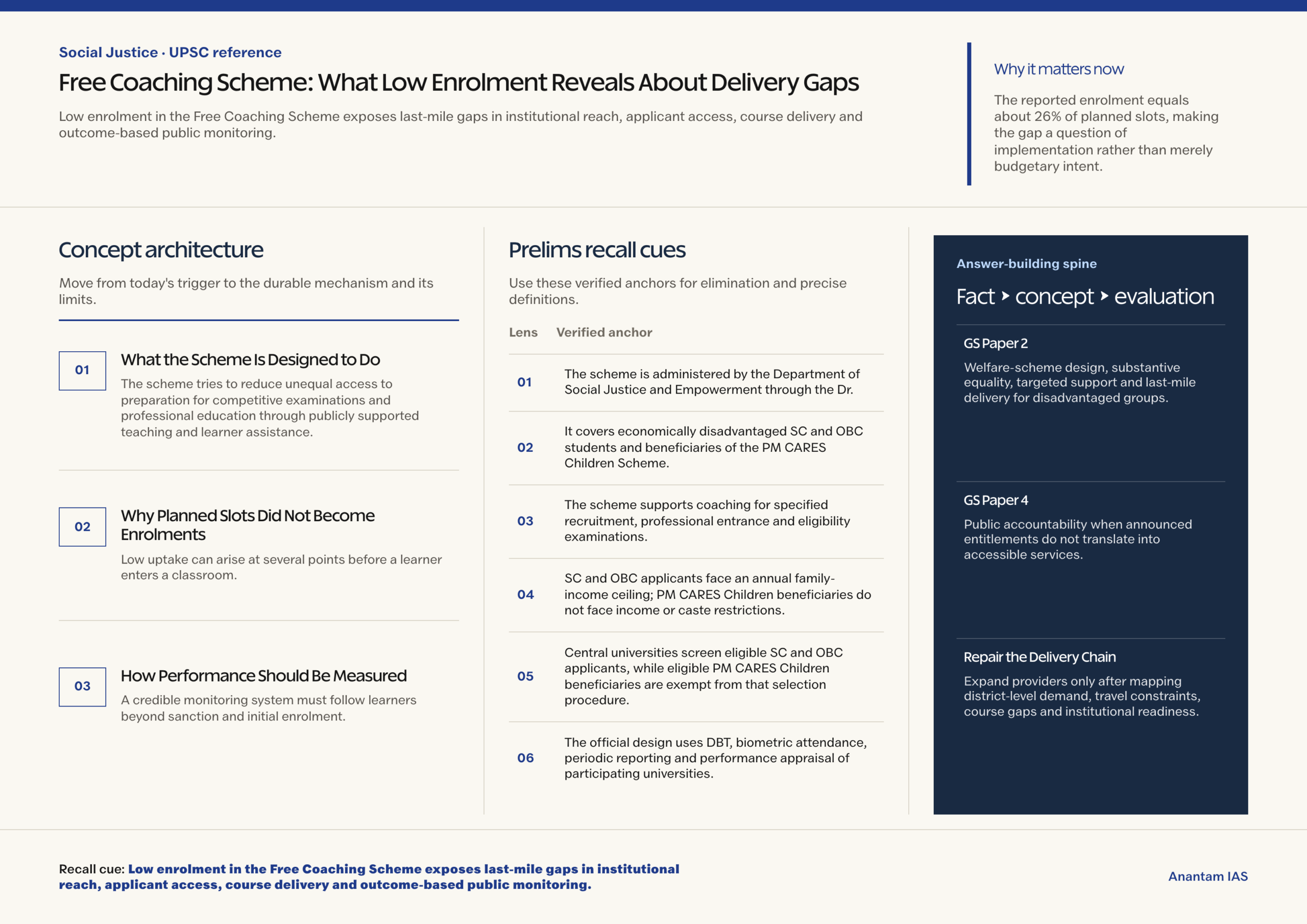
- The reported enrolment equals about 26% of planned slots, making the gap a question of implementation rather than merely budgetary intent.
- The committee found that limited university participation and delayed proposals continued despite earlier changes in the scheme’s administrative design.
- The Ministry said only 14 Central universities were actively providing coaching, restricting geographic access and use of available slots.
- Proposed changes include participation by State universities and a student-centric mode, but their design and operational roadmap require scrutiny.
- A welfare scheme cannot create substantive equality if eligible students cannot discover it, complete its procedures or reach a participating institution.
- The correct performance chain is eligible population → application → selection → attendance → examination outcome; enrolment measures only one link.
- For UPSC answers, separate allocation, capacity, access, delivery quality and outcomes instead of treating expenditure or announced slots as proof of success.
UPSC Relevance
Prelims Relevance
- The scheme is administered by the Department of Social Justice and Empowerment through the Dr. Ambedkar Foundation and empanelled Central universities.
- It covers economically disadvantaged SC and OBC students and beneficiaries of the PM CARES Children Scheme.
- The scheme supports coaching for specified recruitment, professional entrance and eligibility examinations.
- SC and OBC applicants face an annual family-income ceiling; PM CARES Children beneficiaries do not face income or caste restrictions.
- Central universities screen eligible SC and OBC applicants, while eligible PM CARES Children beneficiaries are exempt from that selection procedure.
- The official design uses DBT, biometric attendance, periodic reporting and performance appraisal of participating universities.
Mains Relevance
GS Paper 2
- Welfare-scheme design, substantive equality, targeted support and last-mile delivery for disadvantaged groups.
- Institutional capacity, digital access, regional reach, accountability and outcome-based monitoring.
GS Paper 4
- Public accountability when announced entitlements do not translate into accessible services.
- Fairness in eligibility and selection rules, transparency of results and responsibility for implementation failure.
Essay
- Equality of opportunity depends not only on opening a programme but on making its access pathway usable for those it is intended to serve.
Background and Context
What the Scheme Is Designed to Do
The scheme tries to reduce unequal access to preparation for competitive examinations and professional education through publicly supported teaching and learner assistance.
- Its objective is to provide quality coaching to economically disadvantaged SC and OBC students and eligible PM CARES Children beneficiaries who might otherwise be priced out of preparation.
- Covered examinations include major public recruitment tests, professional entrance examinations and selected eligibility tests, so course availability must match varied qualification stages and career pathways.
- The Dr. Ambedkar Foundation implements the programme through empanelled Central universities, whose coaching centres operate as Dr. Ambedkar Centres of Excellence within a centrally coordinated delivery chain.
- Participating universities advertise courses, receive online applications, verify eligibility and select SC and OBC candidates through their own pre-declared screening procedures.
- Payments move through Direct Benefit Transfer, while biometric attendance and staged releases connect public support with participation, course continuity and verified attendance over time.
Why Planned Slots Did Not Become Enrolments
Low uptake can arise at several points before a learner enters a classroom, so each stage needs a distinct diagnosis and remedy.
- A narrow network of active institutions creates a geographic access gap; nominally available coaching may remain impractical for students far from campuses or unable to relocate affordably.
- An online-only application, documentary verification, Aadhaar-linked banking and academic conditions create an administrative access chain that can exclude otherwise eligible applicants without assisted support.
- University-specific screening can match students to limited seats, but inconsistent calendars, course offerings and selection methods may create unequal access across locations.
- Delayed institutional proposals reveal a supply-side capacity problem: the scheme depends on universities having faculty, infrastructure, timely approvals, predictable funding and incentives to run viable batches.
- The income ceiling is a design choice, but changing it alone cannot fix weak outreach, missing local institutions, procedural friction, unsuitable course availability or poor information about demand.
How Performance Should Be Measured
A credible monitoring system must follow learners beyond sanction and initial enrolment.
- Start with a public delivery funnel: eligible applicants, completed applications, verified candidates, selected students, actual attendance, course completion, examination attempts, outcomes and time taken between stages.
- Disaggregate results by social category, gender, geography, disability and examination type to identify whether apparently neutral processes reproduce barriers or concentrate benefits among easier-to-reach groups.
- Track reasons for rejection, withdrawal and non-attendance; these failure-point data reveal whether the constraint is awareness, documentation, travel, course timing, digital access or teaching quality.
- The official guidelines already provide for attendance records, periodic reports, physical verification and outcome-linked appraisal; data quality and public reporting determine whether these become accountability tools.
- Measure learning and examination outcomes alongside enrolment, but avoid punishing institutions for serving harder-to-reach students through simplistic success-rate comparisons.
Way Forward
Repair the Delivery Chain
- Expand providers only after mapping district-level demand, travel constraints, course gaps and institutional readiness; wider coverage should not dilute teaching standards.
- Create assisted application channels, publish a unified calendar and send time-bound status updates so procedural friction does not silently eliminate eligible students.
- Use common minimum standards for faculty, contact hours, study material and grievance handling while preserving local course flexibility based on student demand.
- Publish institution-level funnel and outcome data, commission independent evaluation and use corrective support before renewal or expansion decisions.
Conclusion
- The enrolment shortfall shows that announced capacity is not delivered opportunity; access depends on reachable institutions, usable procedures, relevant courses and accountable execution.
- In a Mains answer, organise reform around the delivery funnel: outreach, access, institutional capacity, teaching quality, completion and independently verified outcomes.
UPSC Practice Questions
Prelims MCQ 1
With reference to the Scheme of Free Coaching for SCs, OBCs and beneficiaries of the PM CARES Children Scheme, consider the following statements:
- It is implemented by the Dr. Ambedkar Foundation through empanelled Central universities.
- Beneficiaries of the PM CARES Children Scheme face the same family-income ceiling as SC and OBC applicants.
- Eligible PM CARES Children beneficiaries are exempt from the university selection procedure.
How many of the above statements are correct?
(a) Only one (b) Only two (c) All three (d) None
Answer: (b) Only two
Explanation:
Statements 1 and 3 are correct. Statement 2 is incorrect because eligible PM CARES Children beneficiaries face neither income nor caste restrictions under the scheme.
Prelims MCQ 2
Which indicator would best reveal where eligible candidates are being lost before coaching begins?
(a) Total scheme expenditure alone (b) Number of examinations listed in the guidelines (c) Stage-wise data from application to verification, selection and attendance (d) Number of press releases about the scheme
Answer: (c) Stage-wise data from application to verification, selection and attendance
Explanation:
A stage-wise delivery funnel identifies the point of exclusion. Aggregate spending or announcements cannot show whether outreach, documentation, selection or attendance caused the shortfall.
UPSC Mains Questions
- Low enrolment in a welfare scheme may reflect a delivery-chain failure rather than weak demand. Examine this proposition with reference to the Free Coaching Scheme for disadvantaged students.
- Design an outcome-monitoring framework for publicly funded coaching that balances measurable examination results with equity, regional access and institutional accountability.
Sources: The Hindu and Department of Social Justice and Empowerment, Scheme Guidelines applicable from 2024-25.
Frequently Asked Questions
Who is covered by the Free Coaching Scheme?
It covers eligible Scheduled Caste and Other Backward Class students and beneficiaries of the PM CARES Children Scheme preparing for specified recruitment, entrance and eligibility examinations.
Why does low enrolment indicate more than low demand?
Students can be lost through weak outreach, distant institutions, online-only applications, document checks, screening, unsuitable courses or delayed university participation before a class begins.
What role do Central universities play?
Empanelled Central universities advertise courses, accept applications, verify eligibility, select eligible SC and OBC students, deliver coaching, record attendance and report performance through the scheme framework.
How should the scheme’s success be measured?
Monitoring should cover the full delivery funnel, learning quality, completion, examination attempts and outcomes, disaggregated by category, gender, geography, disability and examination type.
Would raising the income ceiling solve the enrolment gap?
It may widen eligibility, but cannot by itself repair limited institutional reach, procedural friction, delayed proposals, course mismatches or weak outreach and monitoring.