Free-Space QKD: Combining Quantum Keys With Post-Quantum Security
Why in News?
On 3 October 2026, MeitY reported a free-space quantum key distribution demonstration by QNu Labs, BISAG-N and IIT Gandhinagar, combining quantum-generated keys with post-quantum cryptography for encrypted test messages.
- The field trial took place on the night of 27–28 September, before the public announcement.
- The 5.56 km link connected BISAG-N and IIT Gandhinagar using free-space optical equipment.
- PIB reported a quantum bit error rate below 5% and a secure-key generation rate of 230–260 bits per second.
- The generated keys were integrated with Vedic Kavach, a post-quantum cryptography platform, to encrypt and decrypt test messages.
- The development concerns secure key distribution and cryptographic integration; it does not establish an operational national quantum network.
- Quantum resilience requires examining the whole communication system, including its hardware, software and behaviour when a component becomes unavailable.
UPSC Relevance
Prelims Relevance
- Quantum key distribution: shared secret keys using quantum communication.
- Free-space optical link: light travels between terminals without a connecting optical fibre.
- Post-quantum cryptography: algorithms designed to resist quantum-computer attacks.
- Quantum bit error rate and secure-key rate measure different features of a link.
- BISAG-N is an autonomous scientific society under MeitY.
Mains Relevance
GS Paper 3
- Indigenous secure communication technology and protection of sensitive information.
- Evaluating field demonstrations before procurement and infrastructure deployment.
Essay
- Technological self-reliance depends on verifiable performance as well as indigenous development.
Background and Context
What the Field Demonstration Established
The trial joined a physical optical link to a software security platform, allowing the partners to demonstrate an integrated communication chain.
- QNu Labs supplied the hardware-based QKD device, while BISAG-N supplied the post-quantum platform. IIT Gandhinagar provided one endpoint in the field environment connecting the two participating institutions during the trial.
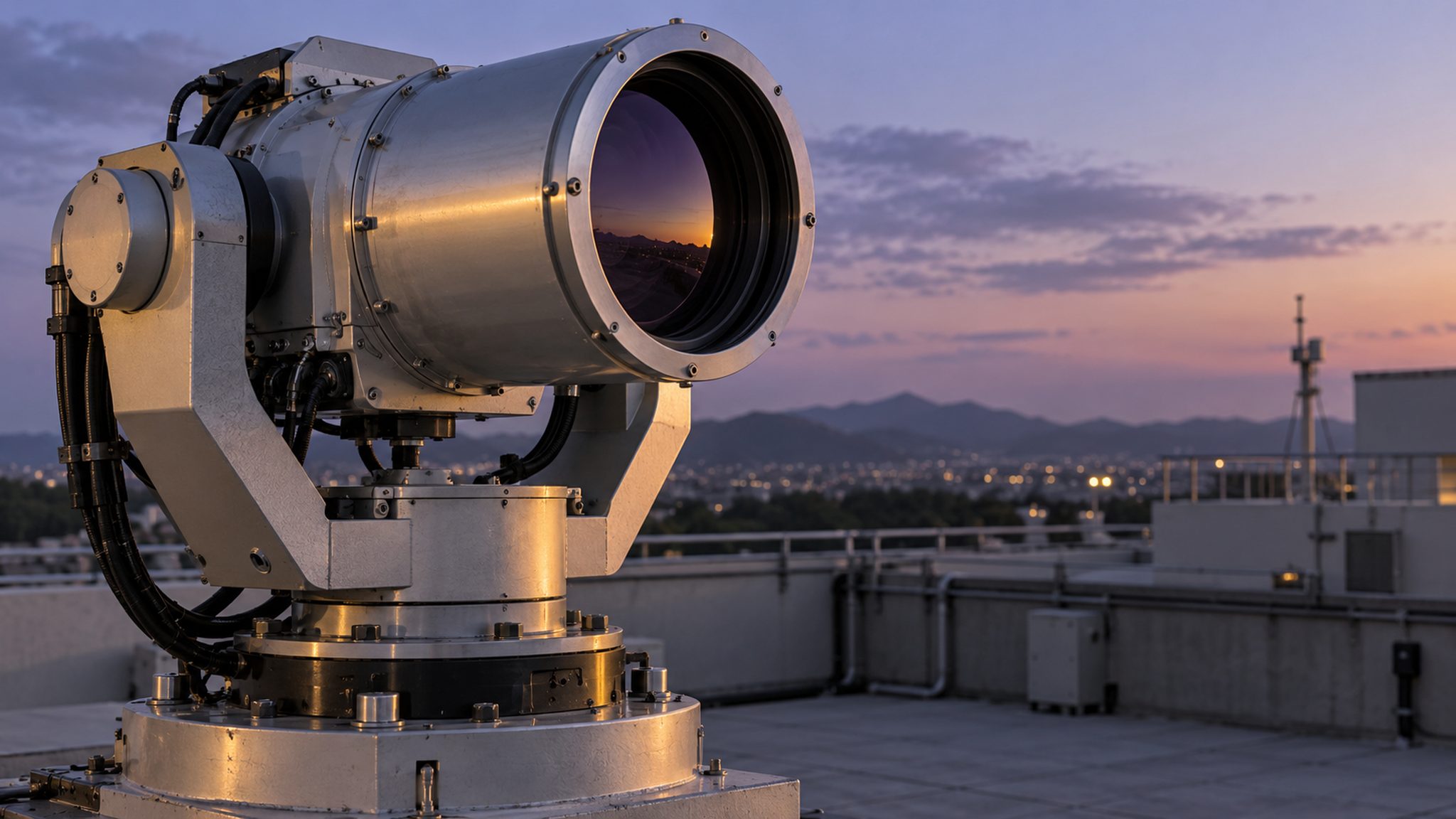
- Free-space describes the optical channel between terminals. Unlike a fibre link, it does not require a continuous optical cable between those endpoints; the reported demonstration used a pointing, acquisition and tracking system.
- The tracking system supported operation of the optical link. The release reports the resulting error and key rates, but does not provide a complete engineering account of alignment performance under different field conditions.
- The secure-key rate measures the production of cryptographic key material. It must not be presented as the bandwidth available for messages, video or other application traffic carried by an encrypted communication service.
- According to the PIB release, test messages were encrypted and decrypted successfully. This supports an integration demonstration, without establishing performance across a larger network or continuous public operation.
Why QKD and Post-Quantum Cryptography Are Different
The two approaches address the quantum-security problem differently: one relies on a quantum communication channel, while the other changes mathematical algorithms.
- QKD establishes shared secret key material using quantum communication. The keys themselves are ordinary digital bits used in cryptographic operations; the term does not mean every protected message must become a quantum state.
- Post-quantum cryptography, or PQC, runs on conventional computers. Its algorithms are designed around mathematical problems expected to resist both classical and quantum attacks, rather than requiring a quantum computer at each endpoint.
- As NIST explains, PQC includes approaches for protecting information and for digital signatures. Signature functions concern authentication, which is distinct from keeping the contents of a message confidential.
- The demonstrated system combined QKD hardware with PQC software and quantum random number generation. Randomness, key distribution and message protection are related functions, but naming one does not establish that all others are secure.
- PIB says the integrated architecture provides resilience during quantum-channel unavailability. Read this as a stated architectural benefit: the release does not disclose detailed outage tests or the precise fallback rules used in those circumstances.
How to Judge the Security Claim
A useful assessment separates successful operation in a reported trial from the evidence needed to rely on a system for sensitive services.
- A low quantum bit error rate is a link-performance result, not a certificate of complete cybersecurity. The reported figure should be discussed alongside the tested configuration and the limits of information publicly disclosed.
- NIST notes that physical device imperfections can create vulnerabilities in quantum cryptography. Quantum principles alone do not remove engineering flaws; practical security depends on the devices that implement those principles.
- The phrase quantum-resistant describes a security objective, not immunity from every attack. For an answer on public infrastructure, distinguish resistance to cryptanalytic attacks from dependable service operation and secure implementation of the overall system.
- The trial offers a basis for further development, including longer-distance links. The release presents satellite-based quantum communication as a future direction; it does not report that this trial established a functioning satellite network.
- For policymakers, the next question is deployment readiness: what independent testing, operating conditions and recovery procedures justify reliance? These are assessment criteria, rather than additional achievements that can be inferred from the announcement.
Way Forward
Test the Complete Communication Chain
- Require independent evaluation of hardware and software before treating a demonstration as evidence for sensitive operational use.
- Publish outage and recovery results so users can understand which protections continue when the quantum channel is unavailable.
- Assess key management and authentication alongside link performance; procurement should specify the security functions being tested.
Conclusion
- The demonstration shows an Indian effort to combine free-space QKD with PQC for encrypted communication. Its value lies in the integration demonstrated, while deployment claims must remain tied to publicly reported evidence.
- For UPSC, distinguish key distribution from message bandwidth and quantum hardware from post-quantum algorithms. A balanced answer recognises technological progress while asking how the complete system performs beyond one field trial.
UPSC Practice Questions
Prelims MCQ 1
With reference to quantum-secure communication, consider the following statements:
- Post-quantum cryptography can operate on conventional computers.
- A QKD secure-key generation rate is necessarily the message bandwidth of the communication service.
- QKD uses quantum communication to establish shared key material.
How many of the above statements are correct?
(a) Only one (b) Only two (c) All three (d) None
Answer: (b) Only two
Explanation:
Statements 1 and 3 are correct. The secure-key generation rate measures key material produced, not the message throughput of the associated application.
Prelims MCQ 2
Which conclusion is supported by the reported BISAG-N–IIT Gandhinagar field trial?
(a) A nationwide quantum communication service became operational. (b) The system became immune to all cybersecurity attacks. (c) QKD-generated keys were integrated with a PQC platform to protect test messages. (d) The trial established a satellite-based quantum network.
Answer: (c) QKD-generated keys were integrated with a PQC platform to protect test messages.
Explanation:
PIB reported successful encryption and decryption of test messages using the integrated system. It did not report nationwide or satellite-network deployment, or demonstrate immunity from all attacks.
UPSC Mains Questions
- Explain how quantum key distribution and post-quantum cryptography differ. Discuss why an integrated approach still requires evaluation of the complete communication system. (150 words)
- A successful technology demonstration is an input to infrastructure policy, not sufficient proof of deployment readiness. Discuss with reference to free-space quantum-secure communication. (250 words)
Sources: PIB, Ministry of Electronics & IT and NIST.
Frequently Asked Questions
What is free-space QKD?
Free-space quantum key distribution uses an optical channel between terminals to establish shared cryptographic keys. Light crosses the space between endpoints instead of travelling through a continuous connecting optical fibre.
Does post-quantum cryptography require quantum computers?
No. Post-quantum cryptography uses algorithms that run on conventional computers and are designed to resist quantum attacks. It differs from QKD, which depends on quantum communication hardware and a suitable channel.
Does the secure-key rate show message bandwidth?
No. The reported secure-key rate describes how quickly usable cryptographic key material was generated. It should not be read as the speed of an encrypted message, video stream or internet connection.
Did India launch a national quantum network through this trial?
No. The announcement describes a field demonstration between BISAG-N and IIT Gandhinagar, including encrypted test messages. Longer-distance and satellite-based communication are development directions, not operational networks established by this reported trial.