French Carrier Strike Group visits India to strengthen naval ties
Why in News?
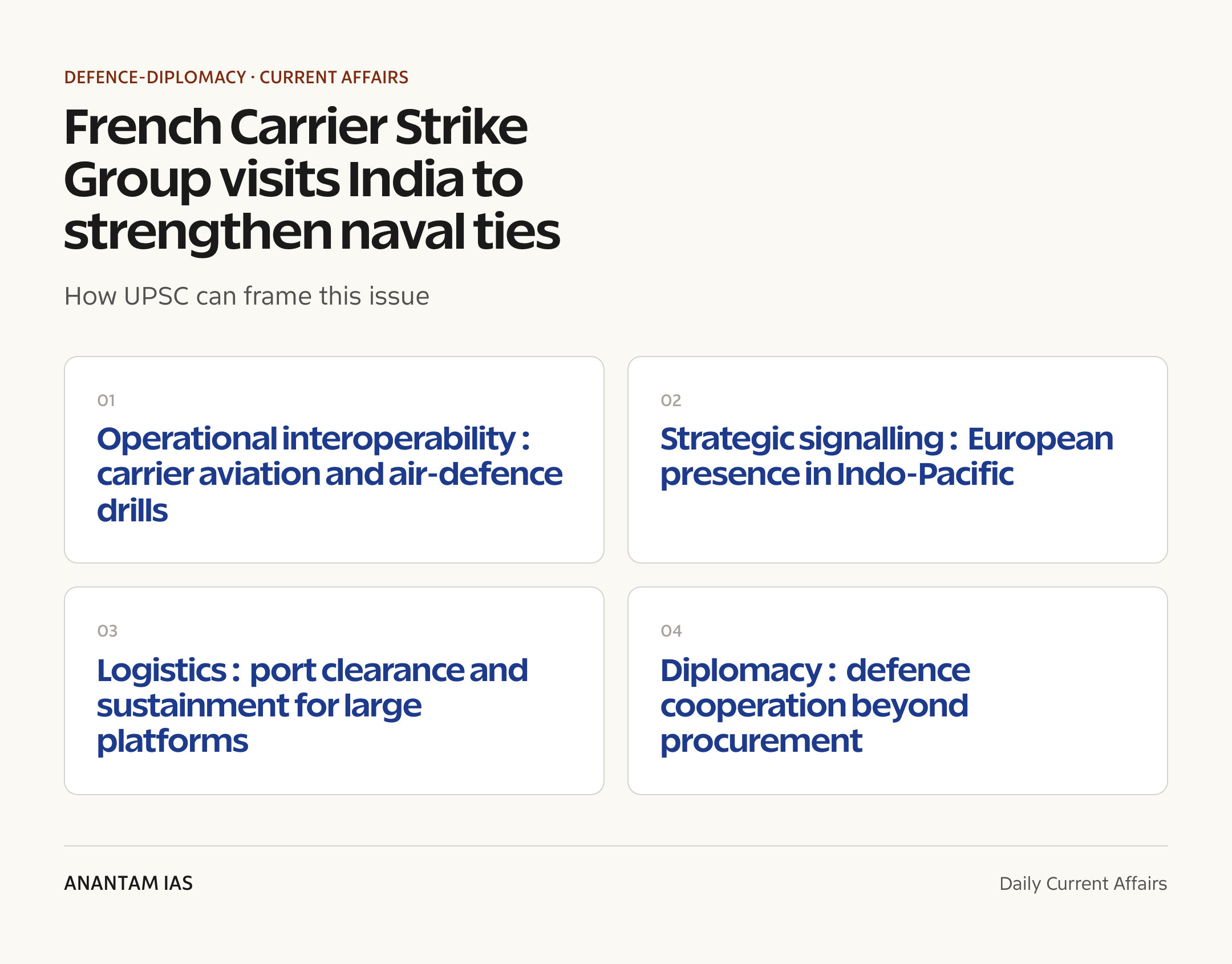
High-end naval engagement with France underscores expanding India-France defence cooperation, practical efforts to increase maritime interoperability, and strategic signalling in the Indo-Pacific.
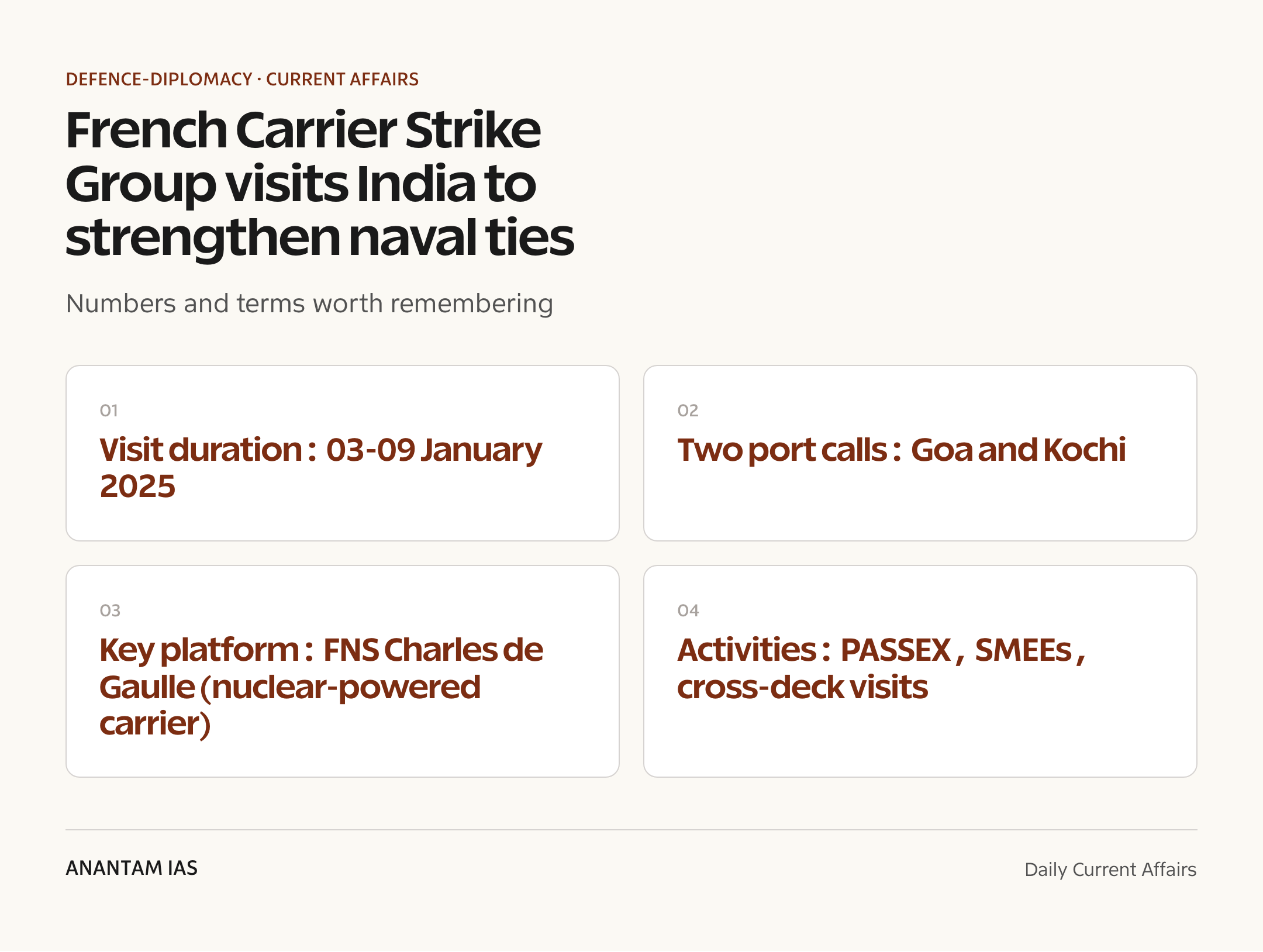
- Visit by the nuclear-led French Carrier Strike Group (including FNS Charles de Gaulle) signals high-level naval cooperation and trust.
- Port calls at Goa and Kochi combined with a sea Passage Exercise (PASSEX) increase operational interoperability between the two navies.
- Subject Matter Expert Exchanges and cross-deck visits expand technical and procedural alignment in areas such as aviation operations, air defence and C2.
- The engagement forms part of a broader India-Europe strategic outreach amid evolving security dynamics in the Indo-Pacific.
- Regular carrier-level interactions raise the policy profile of defence ties beyond equipment contracts toward operational partnership.
The development matters in the context of:
- India-France defence relationship history and recent momentum
- Maritime security environment in the Indo-Pacific and role of carrier groups
- Operational interoperability: PASSEX, cross-deck visits, SMEEs and their practical value
- Implications for regional balance, partnerships and multilateral cooperation
- Linkages with India’s maritime doctrines and naval modernisation
- Legal and logistical issues around foreign carrier visits and nuclear-powered vessels
UPSC Relevance
Prelims Relevance
- Identify key naval platforms: Charles de Gaulle as France’s nuclear-powered carrier and its significance.
- Understand port call locations: Goa and Kochi as strategic Indian naval hubs.
- Basic facts on PASSEX, SMEEs and cross-deck visits as standard naval diplomacy tools.
- Know timelines and stakeholders: visit dates 03-09 Jan 2025; Western Fleet and Southern Naval Command involvement.
Mains Relevance
GS2 International Relations
- Assess India’s defence diplomacy strategy and its operationalisation through naval exercises and visits.
- Examine the role of bilateral maritime cooperation in safeguarding India’s maritime interests and contributing to regional security architectures.
- Analyse geopolitical implications of European naval presence in the Indo-Pacific and its effect on strategic partnerships.
- Discuss interoperability challenges between navies and policy measures to institutionalise operational cooperation.
Essay
- Material for essays on India as a net security provider, maritime security and regional order in the Indo-Pacific.
- Examples for essays on India’s strategic partnerships with major powers and the role of defence diplomacy.
- Evidence to support arguments about operationalisation of the SAGAR vision and Act East policy.
Background and Context
India-France defence ties: an overview
Longstanding bilateral cooperation across equipment, training and strategic dialogue.
- India and France have a multi-decade defence relationship including major equipment deals and technology transfers.
- High-level mechanisms include annual strategic dialogue, defence ministers’ meetings and service-level interactions.
- Defence trade has included fighter jets, submarines, naval equipment and joint research initiatives.
- Operational exchanges such as exercises Varuna (naval) and Garuda (air) institutionalise interoperability.
- Shared strategic interests include maritime security, counterterrorism and a stable Indo-Pacific security environment.
Role and capability of a carrier strike group
Carrier strike groups project air, surface and subsurface power across maritime domains.
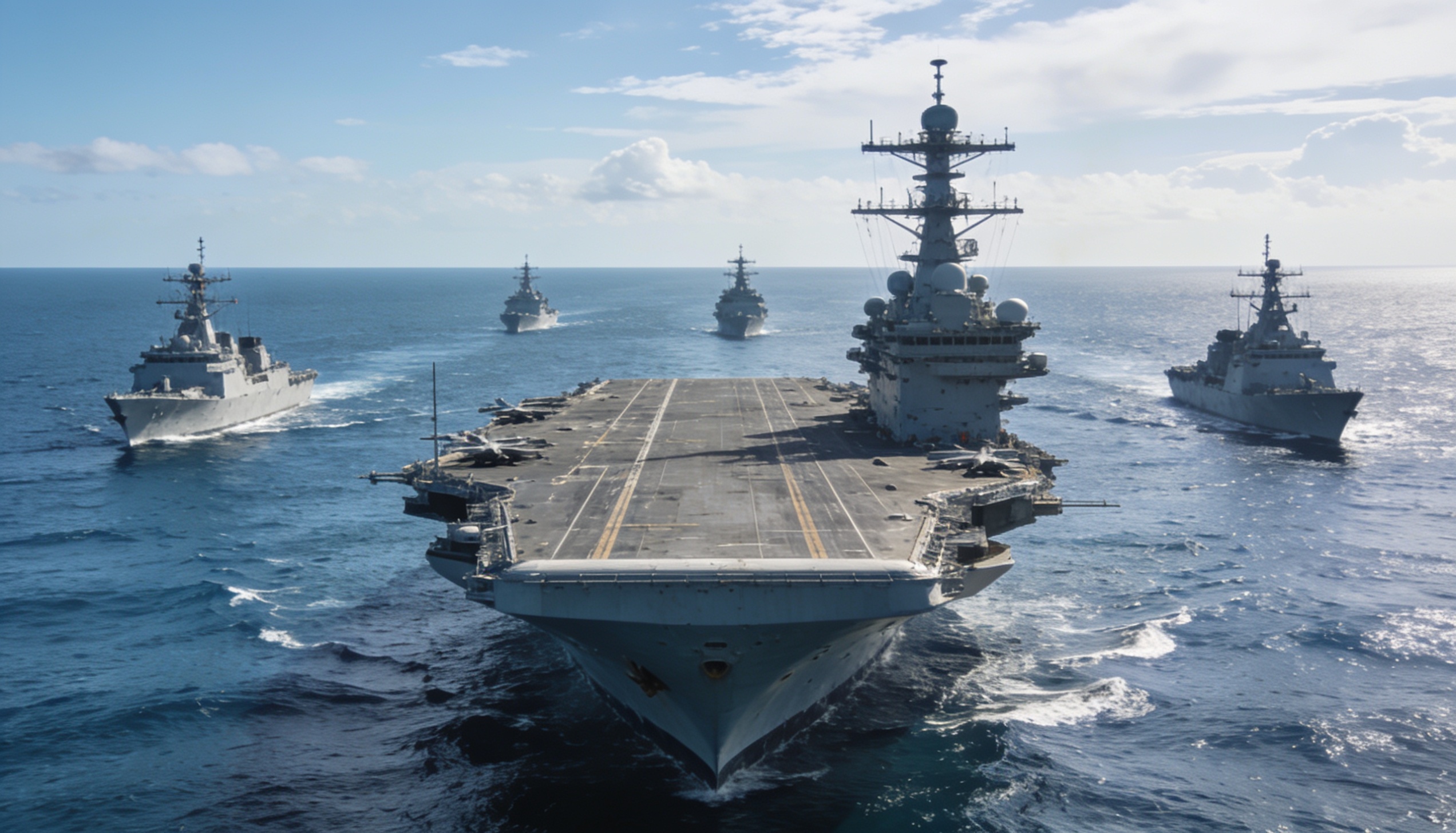
- A carrier strike group is typically centred on an aircraft carrier plus escort ships including destroyers, frigates and replenishment vessels.
- FNS Charles de Gaulle is France’s flagship with fixed wing carrier aviation capability and nuclear propulsion that provides endurance.
- Carrier groups enable air superiority at sea, power projection ashore and integrated air and missile defence.
- They represent high-end platforms for interoperable operations like carrier aviation deck procedures and C2 linkages.
- Their presence contributes to deterrence, maritime security patrols and humanitarian assistance when needed.
PASSEX, SMEEs and cross-deck visits: what they achieve
Routine naval interactions build shared procedures, trust and tactical coordination.
- PASSEX (Passage Exercise) focuses on combined manoeuvres, communication drills and tactical interoperability at sea.
- Subject Matter Expert Exchanges (SMEEs) enable technical staff to discuss maintenance, aviation ops, damage control and logistics.
- Cross-deck visits let personnel observe each other’s platforms and standard operating procedures in real conditions.
- These activities generate common procedures for replenishment, air operations and maritime domain awareness sharing.
- Outcomes include smoother coordination during combined missions and faster mutual assistance in crises.
India’s maritime doctrine and carrier operations
India is building credible carrier-based capabilities as part of its maritime strategy.
- Indian Navy operates aircraft carriers to secure sea lanes, protect maritime trade and assert presence in the region.
- Carrier operations integrate with surface, sub-surface and naval aviation assets under task force doctrines.
- Interoperability with partner navies multiplies operational reach during multinational operations and contingencies.
- Carrier visits and exercises help the Indian Navy test tactics, train personnel and refine joint procedures.
- India’s carrier strategy aligns with broader goals like SAGAR (Security And Growth for All in the Region).
Strategic context: Indo-Pacific dynamics
The Indo-Pacific sees increased naval activity from regional and extra-regional powers.
- Maritime disputes, competition for sea lines of communication and evolving alliance patterns shape operational deployments.
- European navies, including France, are enhancing presence to support rules-based order and maritime security cooperation.
- India’s partnerships with France, Australia, Japan and the US are part of a layered approach to regional security.
- Carrier-level cooperation signals commitment to joint operations and burden-sharing in maintaining maritime commons.
- Such engagements can be calibrated to avoid escalation while reinforcing deterrence and crisis response capacity.
Legal and practical considerations for foreign carrier visits
Visits by foreign carrier groups involve diplomatic, logistical and regulatory arrangements.
- Nuclear-powered vessels require specific notification, port clearance and safety protocols under national law.
- Logistics include berth allocation, fuel, victualling, maintenance support and crew welfare during harbour phase.
- Information sharing is limited by security considerations even during professional exchanges.
- Visits are coordinated at multiple levels: Ministry of Defence, embassies, naval commands and local authorities.
- Public diplomacy aspects include official receptions, cultural engagements and limited media access.
Way Forward
Institutionalise higher-frequency carrier-level interactions
- Establish a calendar for regular PASSEX and carrier-group exchanges with clear objectives for each visit.
- Create a bilateral carrier operations working group to codify shared procedures and safety protocols.
- Pilot combined carrier strike rehearsals focusing on air-deconfliction and integrated air defence.
- Record lessons learned in a shared database accessible to designated staff from both navies.
Deepen technical and logistics cooperation
- Expand SMEEs to cover repair, aviation maintenance and nuclear-propulsion support contingencies where permissible.
- Set up joint logistics planning cells to streamline replenishment at sea and port servicing for large platforms.
- Explore limited co-development of carrier aviation support infrastructure and simulation-based training.
- Negotiate standing arrangements for port access and expedited clearances for future visits.
Operationalise multilateral maritime cooperation
- Use India-France carrier interactions to build trilateral and quad-like exercises that include regional partners.
- Integrate information sharing protocols for maritime domain awareness during combined patrols and exercises.
- Promote interoperability standards for communication, data links and search-and-rescue coordination.
- Leverage joint humanitarian assistance and disaster relief drills to demonstrate non-combat utility of carriers.
Policy and public diplomacy measures
- Communicate the defensive and cooperative nature of visits to domestic and regional audiences to reduce misperception.
- Include academic and think-tank exchanges to analyse strategic implications and publish joint findings.
- Use port calls for people-to-people outreach such as professional seminars and cultural programmes.
- Ensure transparency on safety protocols and environmental safeguards during visits of large naval platforms.
Conclusion
The French Carrier Strike Group visit advances practical India-France maritime cooperation beyond equipment deals into operational partnership. Regular carrier-level interactions will help the Indian Navy refine procedures, build trust with partners, and contribute to a cooperative maritime order in the Indo-Pacific while managing risks through clear protocols and public diplomacy.
UPSC Practice Questions
Prelims MCQ 1
Which of the following best describes a Passage Exercise (PASSEX) between two navies?
(a) A scheduled port call for diplomatic engagement between ships (b) A short, tactical at-sea exercise to practice coordination, communication and manoeuvres (c) A joint maintenance exercise for repair and logistics in harbour (d) An intelligence-sharing framework signed between navies
Answer: (b) A short, tactical at-sea exercise to practice coordination, communication and manoeuvres
Explanation:
PASSEX is an at-sea activity focused on combined manoeuvres, communications drills and tactical coordination to enhance interoperability between navies.
Prelims MCQ 2
FNS Charles de Gaulle, the flagship of the French Carrier Strike Group, is characterised by which of the following features?
(a) Diesel-electric propulsion and helicopter-only aviation (b) Nuclear propulsion and fixed-wing carrier aviation capability (c) Sail propulsion and unmanned aerial vehicles (d) Hybrid gas-turbine propulsion and no carrier aircraft
Answer: (b) Nuclear propulsion and fixed-wing carrier aviation capability
Explanation:
FNS Charles de Gaulle is a nuclear-powered aircraft carrier that operates fixed-wing carrier aircraft, giving it high endurance and air-power projection capability.
UPSC Mains Questions
- {‘question’: ‘Examine how carrier strike group visits help operationalise India’s maritime diplomacy. Provide examples of tasks such visits help to achieve and the constraints they face.’, ‘model_answer’: ‘Carrier strike group visits operationalise maritime diplomacy by enabling practised interoperability, signalling strategic resolve, and facilitating logistics cooperation. Tasks achieved include PASSEX to harmonise communications and manoeuvres; SMEEs to exchange technical best practices in aviation and damage control; cross-deck visits for procedural familiarisation; and joint planning for humanitarian assistance and disaster relief. Constraints include security sensitivities that limit information sharing, legal issues around nuclear-powered vessels, port logistics and berthing capacity, environmental and safety concerns, and potential strategic signalling that may be perceived as provocative by other regional actors. Effective diplomacy requires careful planning, transparency, and institutional mechanisms to translate episodic visits into sustained capability gains.’}
- {‘question’: ‘Discuss the strategic implications of enhanced India-France naval cooperation for the Indo-Pacific regional order.’, ‘model_answer’: “Enhanced India-France naval cooperation contributes to a rules-based maritime order by increasing combined capacity for patrols, exercises and crisis response. It strengthens India’s partnerships with European powers and diversifies strategic linkages beyond traditional bilateral ties. Cooperative deployments help protect sea lines of communication and deter coercive behaviour. At the same time, increased presence of extra-regional navies requires calibrated messaging to avoid escalation, and must be complemented by regional diplomacy that includes littoral states. Operational interoperability should be matched by legal agreements and logistics arrangements to ensure sustainability and legitimacy of activities in regional waters.”}
Source: PIB, Ministry of Defence.
Frequently Asked Questions
q
a
q
a
q
a
q
a
q
a
q
a