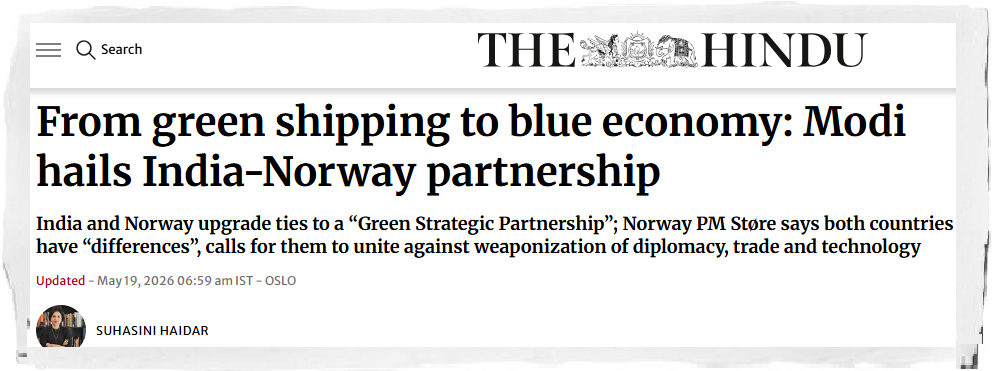
From green shipping to blue economy: Modi hails India-Norway partnership
Why in News?
India and Norway upgraded bilateral relations to a Green Strategic Partnership during Prime Minister Narendra Modi’s visit to Oslo in May 2026. The two countries signed agreements in areas such as health, space, digital public infrastructure, and triangular development cooperation, while reaffirming support for a rules-based international order and peaceful resolution of conflicts.
UPSC Relevance
Prelims:
EFTA, Blue Economy, Arctic region, Green Shipping, Digital Public Infrastructure (DPI), Nordic countries.
Mains:
GS II (India and bilateral relations, international groupings),
GS III (Blue Economy, renewable energy, energy security, technology partnerships, economic development).
Background/Context
India and Norway have maintained cordial relations through cooperation in maritime industries, renewable energy, fisheries, and climate initiatives. Norway is among the world’s leading maritime economies and a major exporter of oil and natural gas. India, with its growing economy and renewable energy ambitions, seeks technology partnerships and investments to support sustainable growth.
The bilateral relationship received a further push after the Trade and Economic Partnership Agreement (TEPA) signed between India and the European Free Trade Association (EFTA) countries.
India–Norway Green Strategic Partnership
Expanding Areas of Cooperation
The Green Strategic Partnership seeks to deepen collaboration in sectors related to sustainable development and future technologies. Cooperation spans renewable energy, maritime technologies, food security, digital innovation, and climate action.
The partnership combines India’s large market, demographic advantages and technological capacity with Norway’s expertise in green technologies and capital investments.
Green Shipping Cooperation
Green shipping refers to reducing carbon emissions and environmental impacts from maritime transport through cleaner fuels and technologies.
Cooperation may include:
- Development of cleaner maritime technologies.
- Adoption of alternative fuels such as green hydrogen and ammonia.
- Sustainable port infrastructure and logistics systems.
- Decarbonisation of shipping routes.
Blue Economy Cooperation
The Blue Economy promotes sustainable use of ocean resources for economic growth while ensuring ecological protection.
Potential areas include fisheries management, marine biotechnology, offshore renewable energy, marine conservation and sustainable coastal development.
Technology and Innovation Partnerships
Both countries agreed to strengthen cooperation in:
- Digital Public Infrastructure (DPI).
- Space technologies.
- Health systems and biotechnology.
- Research and innovation ecosystems.
Triangular Development Cooperation
India and Norway signed an agreement to jointly assist countries of the Global South.
Such cooperation aims to:
- Support sustainable development projects.
- Promote capacity building.
- Share technical expertise.
- Enhance South-South cooperation.
Significance for India
Diversification of Strategic Partnerships
As geopolitical tensions reshape global politics, India seeks to diversify partnerships beyond traditional powers. Norway offers opportunities in technology, green industries and maritime sectors.
Energy Security and Green Transition
Norway’s expertise in energy systems and offshore technologies can support India’s transition toward cleaner energy sources and energy security goals.
Strengthening India’s Blue Economy Vision
India has increasingly prioritised maritime development through initiatives such as:
- Sagarmala Programme.
- Deep Ocean Mission.
- Maritime India Vision 2030.
Partnership with Norway can strengthen these efforts.
Support for India–Europe Relations
The agreement demonstrates broader engagement between India and Europe amid changing global supply chains and geopolitical uncertainties.
Challenges
Geopolitical Differences
India and Norway do not always share identical positions on international issues such as the Russia–Ukraine conflict. Such differences may occasionally create diplomatic friction.
Balancing Strategic Autonomy
India aims to maintain relations with multiple powers simultaneously. Deepening partnerships should not constrain India’s broader strategic flexibility.
Technology Access and Dependence
While technology cooperation brings opportunities, long-term dependence on external technologies could affect domestic capacity building.
Trade and Regulatory Differences
Differences in standards, environmental regulations and market access policies may pose implementation challenges.
Way Forward
Strengthen Maritime and Green Technology Collaboration
India and Norway should expand cooperation in green shipping, offshore renewable energy and sustainable maritime infrastructure to achieve long-term climate objectives.
Promote Joint Research and Innovation
Greater collaboration between universities, industries and research institutions can support technology development and knowledge transfer.
Expand Blue Economy Initiatives
Joint projects in fisheries, marine conservation and coastal development can create sustainable economic opportunities.
Enhance Global South Cooperation
The triangular development framework can be used to jointly support developing countries through capacity building and sustainable development programmes.
Maintain Strategic Dialogue
Regular consultations on geopolitical developments can help both countries manage differences and strengthen mutual trust.
Conclusion
The India–Norway Green Strategic Partnership represents an evolving dimension of India’s foreign policy that combines economic cooperation with sustainability goals. While geopolitical complexities persist, expanding collaboration in green technologies, maritime sectors and global development initiatives can create long-term strategic benefits for both countries.
Practice Questions
1. With reference to the Blue Economy, consider the following statements:
- It focuses exclusively on offshore energy production.
- It promotes sustainable use of ocean resources for economic growth.
- Marine biodiversity conservation forms part of the Blue Economy approach.
Which of the statements given above is/are correct?
(a) 1 only
(b) 2 only
(c) 2 and 3 only
(d) 1, 2 and 3
Correct Answer: (c)
Explanation: Blue Economy seeks sustainable use of ocean resources while balancing economic development and ecological protection. It includes fisheries, marine conservation, shipping, tourism and renewable energy.
2. Consider the following countries:
- Norway
- Switzerland
- Iceland
- Liechtenstein
Which of the above are members of EFTA?
(a) 1 and 2 only
(b) 2, 3 and 4 only
(c) 1, 2, 3 and 4
(d) 1, 3 and 4 only
Correct Answer: (c)
Explanation: The European Free Trade Association (EFTA) consists of Norway, Switzerland, Iceland and Liechtenstein.
Mains Questions
- “India’s strategic partnerships increasingly combine economic cooperation with geopolitical balancing.” Discuss with reference to India’s relations with European countries.
- Examine the significance of India’s Green Strategic Partnership with Norway in strengthening India’s blue economy and sustainable development goals.