From weed to wealth: Assam women turn water hyacinth into livelihoods near rhino habitat
Why in News?
Women living in villages around the Laokhowa-Burhachapori Wildlife Sanctuary in Assam have transformed invasive water hyacinth into marketable products through a livelihood initiative supported by the International Rhino Foundation and implemented by Aaranyak. The initiative seeks to generate sustainable livelihoods while strengthening conservation efforts around wildlife habitats.
UPSC Relevance
Prelims:
Ecology & Environment: Characteristics, impacts, and management of invasive alien species like water hyacinth (Eichhornia crassipes).
Geography: Location, contiguous topography, and riverine ecosystem features of Laokhowa-Burhachapori Wildlife Sanctuary, Kaziranga National Park, Orang National Park, and the Brahmaputra riverine chapori (floodplain islands) landscape.
Species in News: Conservation status, protection under the Wild Life (Protection) Act (WLPA), 1972, and habitat requirements of the Greater One-Horned Rhinoceros, Royal Bengal Tiger, and Bengal Florican.
Mains
- GS Paper II (Governance & Social Justice): Women empowerment through Self-Help Groups (SHGs), role of NGOs and civil society organizations in state welfare, and rights-based balancing of eviction drives with rehabilitative livelihoods.
- GS Paper III (Environment & Internal Security): Protected Area Management, community-based conservation models, combating illegal encroachment and poaching, habitat fragmentation, eco-corridors, and the management of invasive bio-threats.
Background and Context
The Laokhowa-Burhachapori Wildlife Sanctuary (LBWLS) complex, covering 114.19 sq. km on the southern bank of the Brahmaputra River, serves as a vital ecological corridor connecting Kaziranga National Park to the east with Orang National Park and Pobitora Wildlife Sanctuary to the west.
During the 1980s, intense anthropogenic pressures, including armed civil unrest, illegal poaching, and massive encroachment by fringe communities for paddy cultivation and commercial fisheries – virtually wiped out local populations of rhinos, tigers, and wild buffaloes. Much of the sanctuary’s land was illegally occupied and modified into agricultural fields.
Between February 2023 and early 2026, the Assam Forest Department and local district administrations executed a series of large-scale anti-encroachment operations. These operations cleared more than 2,000 hectares of forest and unsurveyed government land, removing thousands of illegal agricultural fields and settlements.
The successful restoration of this habitat allowed the Greater One-Horned Rhinoceros to return to the Laokhowa landscape after a 40-year absence. However, these enforcement drives also displaced numerous families and cut off local agricultural livelihoods, creating a pressing need for economic rehabilitation. To address this and prevent local communities from turning to illegal logging or assisting poachers, conservationists launched the water hyacinth craft initiative to transform an ecological nuisance into an alternative revenue model.
The Ecological Hazard of Water Hyacinth
Water hyacinth (Eichhornia crassipes), natively found in the Amazon basin, ranks among the world’s most aggressive invasive aquatic weeds. Supported by the nutrient-rich, wet alluvial floodplains of the Brahmaputra, it spreads across the wetlands of central Assam, creating deep ecological disruptions:
- Physical Suffocation of Wetlands: The weed multiplies rapidly, forming thick, dense mats across freshwater bodies. This blocks sunlight from reaching submerged aquatic flora, effectively halting photosynthesis.
- Deoxygenation and Chemical Alteration: As large volumes of dead water hyacinth decay, it depletes dissolved oxygen levels in the water column. This causes widespread fish mortality, disrupts the food chain for riverine birds, and degrades the water quality required by native species.
- Disruption of Megafauna Foraging: Dense weed infestations choke out native grasses and aquatic plants that form the primary diet of the Greater One-Horned Rhinoceros, Asian Elephant, and Wild Water Buffalo, altering their natural movement and foraging habits.
The Socio-Economic Transformation Model
The water hyacinth initiative offers a replicable model for rural economic development by converting an environmental hazard into high-value utility goods:
- Grassroots Institutional Setup: The project organizes fringe-village women into dedicated Self-Help Groups (SHGs), such as the Pragati SHG in Singimari village and the Bonani SHG in Kaliadinga village.
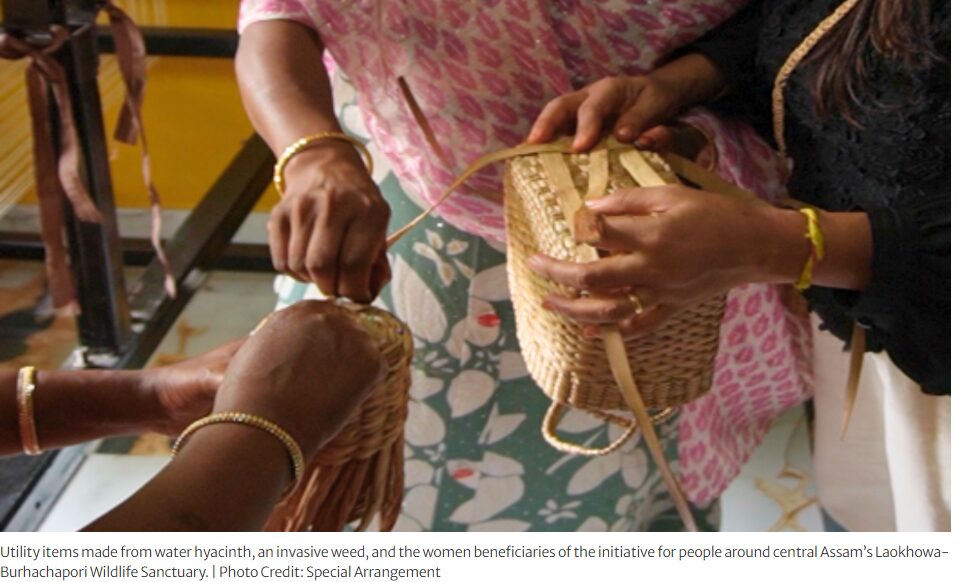
- Value-Added Handloom and Handicraft Production: Following structured technical training, the women harvest, dry, and treat water hyacinth stems to craft market-ready utility products, including dining mats, table runners, storage baskets, purses, biodegradable paper tissue boxes, and flower vases.
- Structured Market Linkages: By partnering with national conservation bodies and regional businesses across major tourism hubs like Nagaon and Kaziranga, the initiative avoids the traditional pitfalls of exploitative middle-men, guaranteeing stable monthly incomes for its members.
Joint Forest Management and Strategic Conservation
Modern wildlife management emphasizes that long-term conservation cannot rely solely on enforcement; it must integrate the socio-economic well-being of local communities. This project serves as an effective practical application of Joint Forest Management (JFM) principles:
- Mitigating Local Resource Conflict: Providing housewives with flexible, home-aligned income opportunities reduces a community’s economic dependence on illegal forest resource collection, livestock grazing, and woodcutting inside protected zones.
- Fostering Local Anti-Poaching Networks: When local communities derive direct financial security from projects tied to wildlife protection, they transition from passive bystanders or accessories into proactive guardians, often providing crucial field intelligence to forest rangers to help prevent poaching.
Multi-Dimensional Dimensions of the Initiative
1. Constitutional & Legal Dimensions
- Article 48A (Directive Principles of State Policy): Directs the State to protect and improve the environment and safeguard the forests and wildlife of the country.
- Article 51A(g) (Fundamental Duties): Mandates every Indian citizen to protect and improve the natural environment, including forests, lakes, rivers, and wildlife.
- The Wild Life (Protection) Act, 1972: Supports severe enforcement actions against illegal encroachments (Sections 29 and 35) while encouraging participatory buffer-zone management.
2. Economic & Social Dimensions
- Rural Women’s Empowerment: The project elevates women into financial stakeholders within their households without disrupting traditional domestic and child-rearing responsibilities.
- Circular Bio-Economy: Adopts a circular economic model that converts bio-waste and ecological hazards into value-added consumer commodities, stimulating sustainable micro-entrepreneurship in remote rural pockets.
3. Environmental & Geopolitical Dimensions
- Convention on Biological Diversity (CBD): Directly aligns with Aichi Biodiversity Target 9 and the Kunming-Montreal Global Biodiversity Framework (Target 6), which call for the identification, control, and eradication of invasive alien species.
- Eco-Corridor Connectivity: Secures the trans-boundary Brahmaputra riverine floodplains, maintaining an open genetic corridor for megafauna moving between Bhutan, Assam, and Bangladesh.
Key Frameworks, Schemes, and Institutional Linkages
- Indian Rhino Vision 2.0 (IRV2.0): Formulated by the Assam Forest Department alongside the IRF, this strategy aims to safely manage meta-populations of greater one-horned rhinos across secure habitats, with a target of reaching 4,500–5,000 rhinos in Assam by 2030. Restoring the LBWLS corridor is a core objective of this vision.
- National Rural Livelihoods Mission (NRLM) / Deendayal Antyodaya Yojana (DAY-NRLM): Provides a state-supported financial framework that strengthens village-level SHGs and boosts micro-enterprise development.
- Supreme Court Judgments: In T.N. Godavarman Thirumulpad v. Union of India, the Supreme Court emphasized the Public Trust Doctrine and the Polluter Pays Principle, noting that natural resources must be preserved for public and ecological welfare, which validates state anti-encroachment operations.
- Science-Based Validation: The project addresses global targets managed by the IUCN Invasive Species Specialist Group (ISSG), which advocates for community-backed mechanical harvesting as an optimal method for controlling water hyacinth over chemical or biological treatments.
Challenges, Concerns, and Criticisms
- Product Durability and Hydrophilic Vulnerability: As highlighted by local wildlife officials, water hyacinth fibers are naturally hydrophilic (moisture-absorbing). In the high-humidity, flood-prone climate of Assam, these products face significant risks of fungal infestation, mold development, and rapid structural decay, which can hurt consumer trust and lower long-term market demand.
- Unresolved Resettlement Issues: While anti-encroachment evictions successfully reclaim critical ecological space, they often cause immediate socio-economic displacement. If comprehensive resettlement and alternative livelihood options do not match the scale of the evictions, it can create lingering local resentment against forest authorities.
- Scaling and Market Constraints: Craft-based micro-enterprises often struggle to scale up production. Limited access to modern preservation technology, lack of diverse e-commerce platforms, and competition from cheap, synthetic plastic alternatives can restrict these groups to small tourist markets.
- Incomplete Ecological Eradication: Mechanical harvesting by community groups targets the fringes of water bodies but cannot keep pace with the hyper-exponential reproductive rate of water hyacinth across massive, deep-water floodplains, making it an incomplete solution for total weed eradication.
Way Forward
1. Technological Innovation and Material Preservation
To build long-term commercial viability, research institutions like the CSIR-North East Institute of Science and Technology (NEIST) should collaborate with local artisans. Introducing eco-friendly, non-toxic water-resistant coatings, anti-fungal treatments, and solar-powered dehydration kilns will reduce moisture absorption and significantly extend the shelf-life of water hyacinth products.
2. Comprehensive Rehabilitation Policy
Forest enforcement actions must operate alongside institutionalized rehabilitation strategies. Future eviction drives should integrate a mandatory “Eco-Restoration and Alternative Livelihoods Plan,” ensuring displaced populations receive priority access to state-sponsored skill development, micro-credit loans, and organized SHG employment.
3. Strategic Brand Positioning and Digital Access
The state should help move water hyacinth products beyond local tourist stalls by listing them on national e-commerce channels like Tribes India (TRIFED) and the Government e-Marketplace (GeM). Marketing these items under a specialized green brand—such as “Kaziranga Eco-Crafts”—can attract eco-conscious global consumers and command premium pricing.
4. Convergence of Centrally Sponsored Schemes
Combining resources from the Mahatma Gandhi National Rural Employment Guarantee Scheme (MGNREGS) for the physical removal of water hyacinth with financial backing from the PM Mudra Yojana or SFURTI (Scheme of Fund for Regeneration of Traditional Industries) can help build modern common facility centers and advanced tool rooms for rural artisans.
Conclusion
The transformation of water hyacinth from an ecological hazard into a sustainable economic asset along the fringes of the Laokhowa-Burhachapori Wildlife Sanctuary demonstrates how environmental preservation can coexist with human development. By linking the economic security of rural women directly to the health of nearby ecosystems, this model provides an effective blueprint for resolving conservation conflicts.
As India works to balance strict environmental laws with social welfare goals, scaling up community-inclusive initiatives like this will be essential to protecting threatened ecosystems, ensuring the safety of endangered wildlife, and empowering vulnerable rural populations.
Practice Questions
Prelims Question 1
With reference to water hyacinth, consider the following statements:
- It is an invasive aquatic plant species.
- It improves dissolved oxygen levels in freshwater ecosystems.
- Dense growth of water hyacinth can obstruct water flow.
Which of the statements given above is/are correct?
A) 1 only
B) 1 and 3 only
C) 2 and 3 only
D) 1, 2 and 3
Correct Answer: B
Explanation: Water hyacinth is an invasive species that obstructs water movement and reduces oxygen levels in aquatic systems. Statement 2 is incorrect.
Prelims Question 2
With reference to community participation in conservation, consider the following:
- Joint Forest Management
- Eco-Development Committees
- Biodiversity Management Committees
Which of the above involve local communities in environmental management?
A) 1 and 2 only
B) 2 and 3 only
C) 1 and 3 only
D) 1, 2 and 3
Correct Answer: D
Explanation: All three mechanisms involve local communities in environmental protection and sustainable resource management.
Mains Question 1
- “Conservation efforts become sustainable when local communities derive economic benefits from environmental protection.” Examine with suitable examples.
- Discuss the role of community participation in biodiversity conservation in India. How can livelihood-based approaches strengthen environmental governance?