FSSAI’s Red Front-of-Pack Warning Proposal
Why in News?
On August 28, 2026, FSSAI submitted an affidavit in the Supreme Court proposing red pictorial front-of-pack warnings for foods high in specified nutrients of concern.
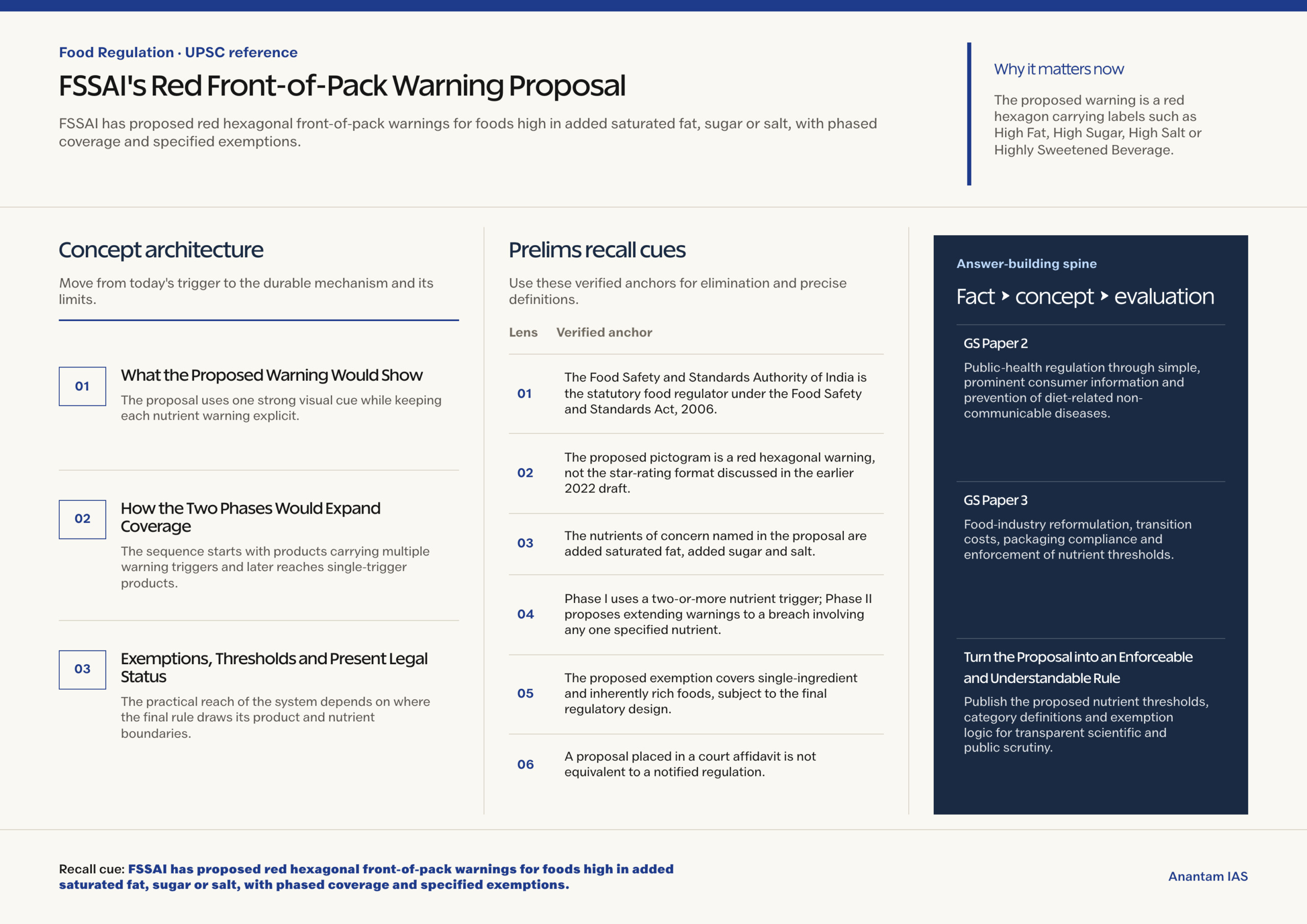
- The proposed warning is a red hexagon carrying labels such as High Fat, High Sugar, High Salt or Highly Sweetened Beverage.
- Phase I would cover foods high in two or more specified nutrients and specified sweetened beverages; Phase II would extend coverage to one-nutrient breaches.
- The proposal links classification to thresholds derived from the Dietary Guidelines for Indians 2024, covering added saturated fat, added sugar and salt.
- Single-ingredient foods and inherently nutrient-rich products such as ghee, edible oil, jaggery and honey are proposed for exemption.
- The affidavit is before the Court; the design has not yet become a notified binding regulation.
- The proposal converts a technical nutrient table into a quick risk signal visible at the point of purchase.
- Phasing seeks to balance consumer comprehension with time for manufacturers to reformulate products and adjust packaging.
- Threshold design and exemptions will determine whether the label captures comparable risks without treating inherently nutrient-rich single foods as formulated products.
UPSC Relevance
Prelims Relevance
- The Food Safety and Standards Authority of India is the statutory food regulator under the Food Safety and Standards Act, 2006.
- The proposed pictogram is a red hexagonal warning, not the star-rating format discussed in the earlier 2022 draft.
- The nutrients of concern named in the proposal are added saturated fat, added sugar and salt.
- Phase I uses a two-or-more nutrient trigger; Phase II proposes extending warnings to a breach involving any one specified nutrient.
- The proposed exemption covers single-ingredient and inherently rich foods, subject to the final regulatory design.
- A proposal placed in a court affidavit is not equivalent to a notified regulation.
Mains Relevance
GS Paper 2
- Public-health regulation through simple, prominent consumer information and prevention of diet-related non-communicable diseases.
- Judicial oversight, regulatory accountability and the difference between a policy proposal and an enforceable rule.
GS Paper 3
- Food-industry reformulation, transition costs, packaging compliance and enforcement of nutrient thresholds.
- Designing exemptions that distinguish single-ingredient foods from formulated packaged products without creating loopholes.
Essay
- Consumer choice becomes meaningful only when technical information is converted into a visible and understandable signal.
Background and Context
What the Proposed Warning Would Show
The proposal uses one strong visual cue while keeping each nutrient warning explicit.
- A red hexagonal pictogram would appear on the principal display panel, making the warning visible at the point of purchase before a buyer turns the package over.
- The words would identify the breached concern directly: High Fat, High Sugar, High Salt or Highly Sweetened Beverage, rather than providing one overall health score.
- FSSAI proposes the warning text at one font point larger than the nutrition-information table printed on the back, making the front signal more prominent.
- The threshold test concerns added saturated fat, added sugar and salt; the proposal anchors those limits in the ICMR-NIN Dietary Guidelines for Indians 2024.
- The design links a nutrient threshold to a named consequence on the pack, reducing the mental calculation required from shoppers reading quantities and serving information.
How the Two Phases Would Expand Coverage
The sequence starts with products carrying multiple warning triggers and later reaches single-trigger products.
- Under Phase I, the warning would apply when a product is high in two or more specified nutrients of concern under the proposed thresholds.
- The first phase would also cover specified sweetened beverages, allowing the Highly Sweetened Beverage warning to identify that product class directly.
- Under Phase II, coverage would extend to products high in any one specified nutrient, widening coverage without requiring a multiple-nutrient breach.
- FSSAI says phased implementation would support consumer acceptability and give manufacturers time to change formulations, labels and compliance systems.
- A phased rule needs declared transition dates and stable testing methods; without them, similar products could face inconsistent classification during the changeover.
Exemptions, Thresholds and Present Legal Status
The practical reach of the system depends on where the final rule draws its product and nutrient boundaries.
- FSSAI proposes exempting single-ingredient foods and items inherently rich in fat, sugar or salt, including ghee, edible oil, jaggery and honey.
- The rationale is categorical: an ingredient’s inherent composition differs from a formulated product to which specified nutrients have been added or combined into a recipe.
- Exempt does not mean risk-free or unregulated; these foods remain subject to other food-safety, composition, nutrition-declaration and labelling requirements.
- The threshold basis must be translated into precise regulatory text covering measurement units, product categories, laboratory methods, treatment of serving size and verification by regulators.
- FSSAI has placed a compliance affidavit and proposal before the Supreme Court. Until due rule-making and notification occur, manufacturers do not face this warning as a final binding mandate.
Way Forward
Turn the Proposal into an Enforceable and Understandable Rule
- Publish the proposed nutrient thresholds, category definitions and exemption logic for transparent scientific and public scrutiny.
- Test the red pictograms across languages, package sizes and digital grocery thumbnails for comprehension, not merely visual preference.
- Set a clear notification, transition and enforcement calendar with validated laboratory methods and guidance for food businesses.
- Review exemptions after implementation to detect loopholes, misleading reformulation and substitution between sugar, salt and fat.
Conclusion
- The new proposal’s importance lies in its specific warning architecture: named red pictograms, phased triggers, Dietary Guidelines-based thresholds and defined exemptions.
- An answer should distinguish this design from an enforceable rule and evaluate whether its thresholds, exemptions and implementation sequence deliver a clear, consistent public-health signal.
- The final test is not the colour alone, but whether buyers can identify a nutrient concern quickly and comparable products are treated by the same transparent standard.
UPSC Practice Questions
Prelims MCQ 1
With reference to FSSAI’s 2026 front-of-pack warning proposal, consider the following statements:
- The proposed warning uses a red hexagonal pictogram.
- Phase I would cover products high in two or more specified nutrients and specified sweetened beverages.
- The proposal has already been notified as a binding regulation.
How many of the above statements are correct?
(a) Only one (b) Only two (c) All three (d) None
Answer: (b) Only two
Explanation:
Statements 1 and 2 describe the affidavit proposal. Statement 3 is incorrect because the proposal remains before the Supreme Court and is not yet a notified binding regulation.
Prelims MCQ 2
Which one of the following best describes the proposed second phase of FSSAI’s front-of-pack warning mechanism?
(a) Warnings only for products breaching all three nutrient thresholds (b) A voluntary star rating for single-ingredient foods (c) Warnings for products high in any one specified nutrient (d) Removal of nutrition information from the back of the pack
Answer: (c) Warnings for products high in any one specified nutrient
Explanation:
Phase II would extend the warning mechanism to products high in any one specified nutrient of concern, following the narrower multiple-trigger first phase.
UPSC Mains Questions
- FSSAI’s proposed front-of-pack warning system combines nutrient thresholds, phased coverage and product exemptions. Evaluate how these design choices affect clarity, fairness and enforceability. (250 words)
- A policy proposal filed before a court is not the same as a notified regulation. Discuss this distinction in the context of regulatory accountability and public-health protection. (250 words)
Sources: The Hindu and ICMR-National Institute of Nutrition, Dietary Guidelines for Indians 2024.
Frequently Asked Questions
What has FSSAI proposed for the front of packaged foods?
FSSAI has proposed red hexagonal pictograms naming High Fat, High Sugar, High Salt or Highly Sweetened Beverage when products meet the specified nutrient-warning conditions.
How would the two implementation phases differ?
Phase I would cover products high in two or more specified nutrients and specified sweetened beverages. Phase II would extend warnings to products high in any one nutrient.
Which foods are proposed to be exempt?
The proposed exemption covers single-ingredient foods and products inherently rich in fat, sugar or salt, with ghee, edible oil, jaggery and honey cited as examples.
Are the red warning labels legally mandatory now?
No. FSSAI placed the design in a compliance affidavit before the Supreme Court. It remains a proposal unless completed rule-making produces a notified, enforceable regulation.
What is the proposed basis for nutrient thresholds?
The affidavit links thresholds for added saturated fat, added sugar and salt to the ICMR-NIN Dietary Guidelines for Indians 2024; final regulatory text must specify their application.