Gaganyaan Crew Module: Three Safety Systems Clear Qualification Tests
Why in News?
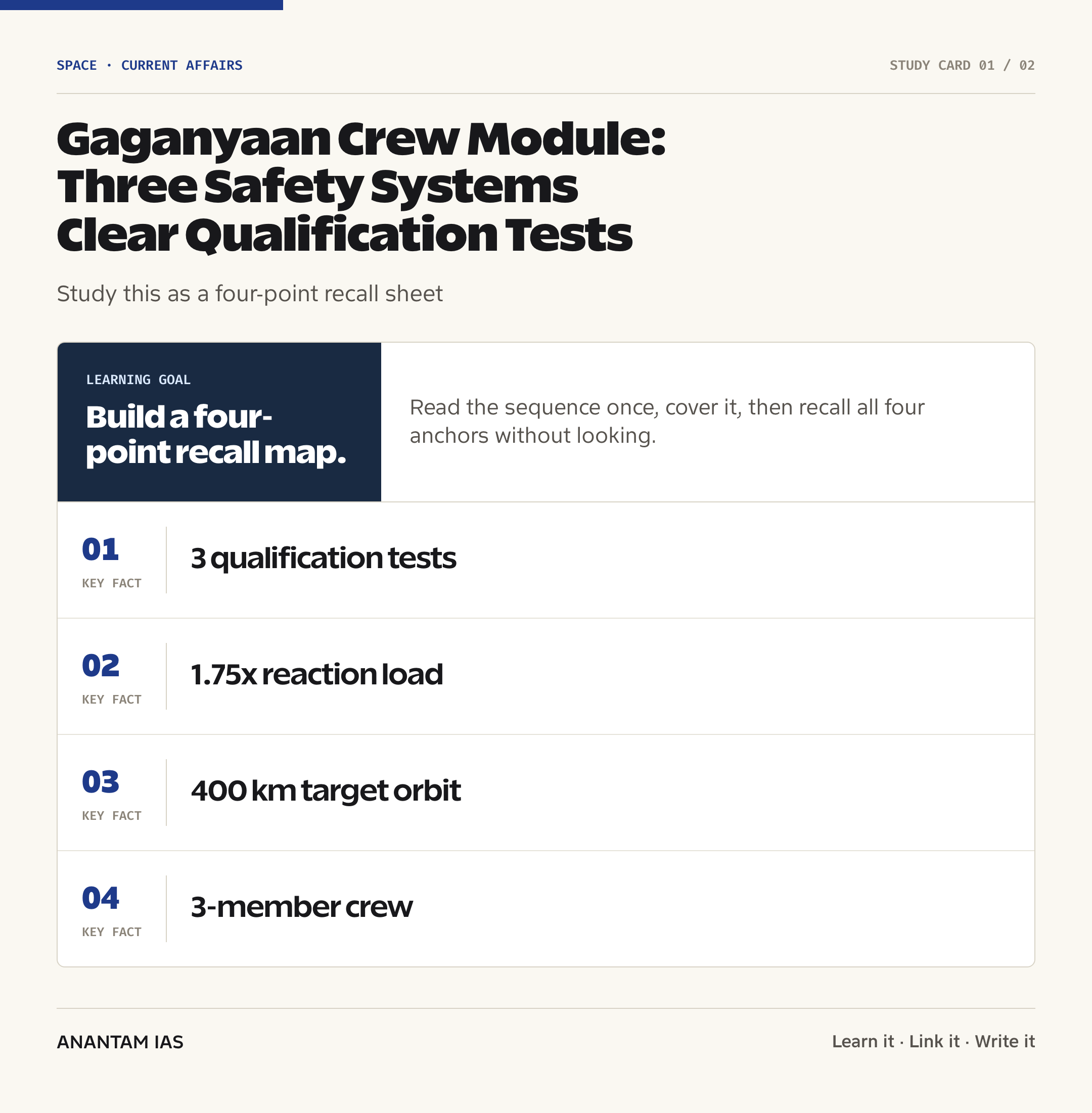
The Indian Space Research Organisation announced on July 12 that it had completed three major qualification tests for systems associated with the Gaganyaan Crew Module. The tests covered post-splashdown uprighting, an umbilical disconnect and the structural load generated when the apex cover separates.
Each trial addressed a different phase or interface in the return-and-recovery chain. The results support the qualification evidence for those specific designs, but they don’t by themselves certify the complete mission, establish crewed-flight readiness or announce a launch date.
- Crew Module Up-righting System: A stored cold-gas system inflated the primary flotation unit across the required gas-bottle pressure range.
- CM-SM Connect Disconnect System: The CSU-2 umbilical separated cleanly from a simulated Crew Module while its panel and interfaces remained structurally stable.
- Apex-cover load test: A test rig applied about 1.75 times the estimated reaction loads at identified points on a simulated Crew Module.
- Qualification scope: ISRO reported compliance with the functional, performance, structural-integrity and design-margin objectives defined for these tests.
The development matters in the context of:
- Human spaceflight demands evidence that safety-critical systems work across expected operating ranges, not only at one nominal condition.
- Return safety depends on a sequence of independent events: module separation, stable re-entry configuration, parachute exposure and deployment, splashdown and post-landing stability.
- Qualification testing verifies a design against specified loads and conditions; later integrated and uncrewed demonstrations are still needed to establish system-level confidence.
UPSC Relevance
Prelims Relevance
- Gaganyaan is India’s programme to demonstrate indigenous human-spaceflight capability.
- The Orbital Module consists of the Crew Module and Service Module.
- The Crew Module provides the habitable volume and is designed to protect the crew through re-entry, descent and splashdown.
- The Service Module is an unpressurised support unit containing propulsion, power, thermal and avionics systems.
- CS-CDS carries electrical communication and hydro-pneumatic connections between the Crew Module and Service Module.
- CSU-1 and CSU-2 are the two umbilical elements on the Service Module and Crew Module sides respectively.
- The apex cover protects parachutes and associated subsystems before it is jettisoned at a predetermined altitude.
- The Crew Module Up-righting System uses stored cold gas to deploy flotation hardware after sea splashdown.
- Qualification tests assess whether a design meets specified performance and structural requirements; they aren’t the same as a complete mission test.
Mains Relevance
GS Paper 3
- Indigenous capability: Explain how crew recovery, separation mechanisms, human-rated structures and life-support interfaces expand India’s high-reliability engineering base.
- Technology validation: Examine why subsystem qualification, integrated testing and uncrewed precursor missions form separate layers of a human-spaceflight safety case.
- Spillovers: Link high-assurance sensors, materials, pyrotechnics, valves and fault-tolerant avionics to wider industrial and disaster-response applications.
GS Paper 2
- Public accountability: Discuss how transparent milestone reporting can distinguish verified subsystem progress from broad mission-readiness claims.
- Institutional coordination: Assess the role of ISRO centres, research institutions, industry and academia in building a nationally distributed human-spaceflight ecosystem.
Essay
- Reliability is accumulated: Complex public technology succeeds through repeated evidence, disciplined interfaces and learning from tests.
- Ambition and restraint: Scientific confidence grows when institutions state both what a result proves and what remains unproven.
Background and Context
Gaganyaan's Mission Architecture
Gaganyaan combines a human-rated launch vehicle, an orbital spacecraft and a layered escape-and-recovery system.
- Declared demonstration: ISRO describes a three-member crew reaching a target orbit of about 400 km, remaining for roughly three days and returning to Indian sea waters.
- Human Rated LVM3: The launch vehicle is a reconfigured LVM3 whose systems must meet higher reliability and safety requirements for carrying people.
- Orbital Module: The spacecraft comprises the pressurised Crew Module and the unpressurised Service Module, linked during orbital operations.
- Crew Module: Its double-wall design combines a pressurised metallic inner structure with an external structure and thermal-protection system for re-entry.
- Service Module: It supplies support functions in orbit through propulsion, power, thermal-control and avionics subsystems.
- Safety layers: A Crew Escape System addresses launch or ascent emergencies, while separation, parachute and flotation systems protect the return phase.
Test 1: Uprighting After Splashdown
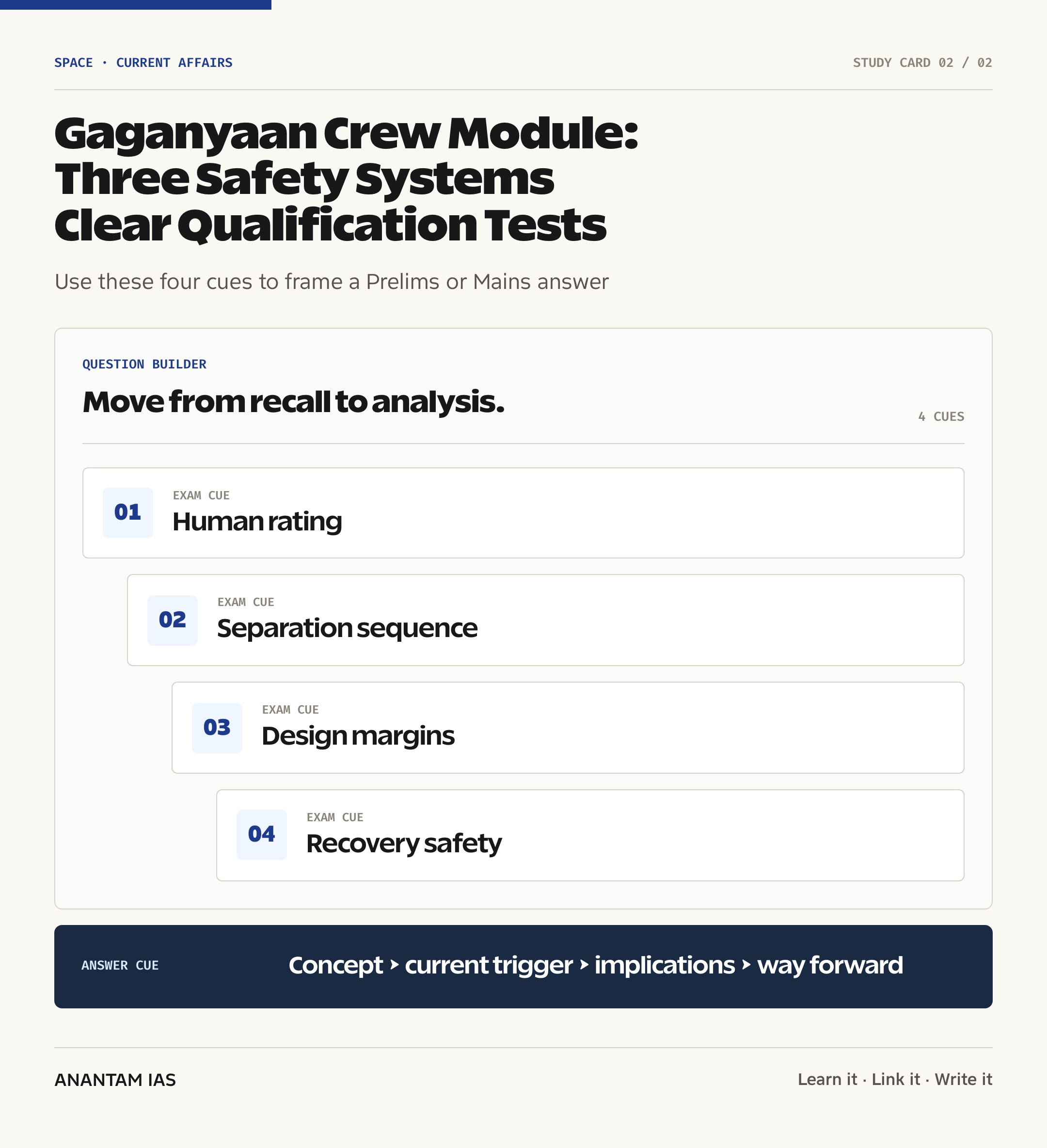
The first qualification test examined whether the recovered capsule can achieve the required upright attitude in the sea.
- Safety need: A stable upright Crew Module supports safe crew conditions, communication and recovery operations after splashdown.
- Operating principle: The Crew Module Up-righting System stores cold gas at high pressure and releases it through control valves to inflate flotation hardware.
- System-level setup: ISRO assembled all elements of the uprighting system needed for the primary inflation-module trial.
- Functional result: The primary flotation deployed as intended when stored gas flowed from the bottle through the commanded valves.
- Range evidence: Inflation-time requirements were demonstrated across the complete operating range of gas-bottle pressures specified for the test.
- Exam distinction: This was a float-inflation qualification test; it wasn’t a full sea-recovery rehearsal involving the entire spacecraft and recovery fleet.
Test 2: Crew-Service Module Umbilical Separation
The second test verified a clean disconnect at a safety-critical electrical and fluid interface between the two modules.
- Umbilical role: The Crew Module-Service Module Connect Disconnect System, or CS-CDS, carries electrical communication and hydro-pneumatic connections.
- Life-support interface: Fluid communication associated with the Environment Control and Life Support System passes through this link while the modules remain connected.
- Two-part design: The system includes CSU-1 and CSU-2, located on the Service Module and Crew Module sides.
- Separation sequence: The Service Module separates from the Crew Module at CSU-1; CSU-2 on the Crew Module side must disconnect before Crew Module re-entry.
- Test article: ISRO separated CSU-2 from a simulated Crew Module rather than conducting an orbital-module flight test.
- Measured outcome: The trial showed clean separation, structural stability of the Crew Module panel and interfaces, integrated functionality and the required design margins.
- Failure significance: An incomplete disconnect or damaging impulse could threaten re-entry configuration, local structure or connected subsystems.
Test 3: Apex-Cover Separation Loads
The third test checked whether the Crew Module structure can withstand the reaction loads created when the parachute cover is jettisoned.
- Apex-cover function: The cover shields parachutes and associated subsystems during earlier mission phases.
- Timed event: At a predetermined altitude, pyrotechnically actuated thrusters separate the cover before sequential parachute deployment.
- Qualification rig: An instrumented setup combined a simulated Crew Module with the associated systems needed to reproduce separation loads.
- Load margin: The rig applied about 1.75 times the estimated reaction loads at identified structural locations.
- Evidence collected: Measured strains and deformations remained within the criteria used to confirm design margin and structural integrity.
- Scope boundary: The result qualifies the structure for the specified apex-cover load case; it doesn’t replace parachute deployment, aerodynamic or end-to-end descent tests.
How Qualification Fits the Safety Case
Human-rating is built from component, subsystem, integrated and mission-level evidence rather than a single pass-fail event.
- Verification: Engineers check that a design conforms to stated specifications through analysis, inspection, demonstration and test.
- Qualification: Representative hardware is exposed to defined environmental or load conditions to show that the design has adequate performance and margin.
- Acceptance: Flight hardware is checked against workmanship and performance criteria before use; acceptance isn’t a substitute for design qualification.
- Integration risk: A subsystem that passes alone may still interact unexpectedly with power, avionics, structures, software or the mission timeline.
- Redundancy and tolerance: Human-rated systems combine conservative margins, fault detection, backups and safe-state behaviour to reduce single-point vulnerability.
- Precursor logic: ISRO’s programme includes air-drop, abort and test-vehicle demonstrations plus uncrewed missions before a crewed flight.
- Related learning: The second integrated air-drop test examined the parachute-led descent and recovery chain at a broader integrated level.
Strategic and Institutional Significance
The tests matter beyond one mission because they deepen India’s capacity for high-reliability systems engineering.
- Human Space Flight Centre: HSFC leads programme coordination across ISRO centres, laboratories, academia and industry.
- Critical technologies: The programme brings together human factors, life support, thermal protection, precision separation, recovery, crew training and certification.
- Interface discipline: The umbilical test shows why seemingly small connectors can become mission-critical when electrical, fluid and structural requirements converge.
- Domestic ecosystem: Qualification campaigns create demanding standards for materials, valves, sensors, test rigs, pyrotechnics and quality assurance.
- Launch-vehicle linkage: The CE20 flight-acceptance process offers a related example of evidence needed before a critical propulsion system enters a mission stack.
- Life-support linkage: The Gaganyaan life-support system explains the environmental-control functions whose interfaces must remain dependable while the modules are connected.
- Communication standard: Public updates should identify the hardware tested, boundary conditions, measured result and remaining integration steps.
Way Forward
Complete the Evidence Chain
- Repeat qualification where configuration changes affect loads, interfaces or operating ranges, and close every test anomaly through documented root-cause review.
- Correlate physical results with structural, fluid and dynamics models so later simulations reflect measured behaviour.
Test Interfaces in Sequence
- Exercise the separation, parachute and flotation events in increasingly integrated conditions, including credible off-nominal cases.
- Verify that pyrotechnic shocks, disconnected lines and residual hardware don’t create new risks for re-entry or parachute deployment.
Protect Crew and Recovery Operations
- Demonstrate reliable post-splashdown attitude, communication, environmental control and crew egress across representative sea states.
- Coordinate spacecraft trials with naval recovery teams, medical support and mission-control procedures.
Report Milestones Precisely
- Publish test objectives, configuration and verified outcomes without converting a subsystem success into a whole-mission claim.
- Keep schedules subordinate to safety evidence and announce crewed-flight readiness only after integrated and uncrewed milestones support it.
Conclusion
The three tests strengthen three distinct links in Gaganyaan’s return-safety chain: upright flotation after splashdown, a clean Crew Module-side umbilical disconnect and structural survival of apex-cover separation loads.
Their real value lies in disciplined qualification evidence. India’s human-spaceflight capability will rest on how these verified subsystems perform together through integrated demonstrations, uncrewed missions and operational recovery rehearsals.
UPSC Practice Questions
Prelims MCQ 1
With reference to the Gaganyaan Crew Module systems, consider the following statements:
- The Crew Module Up-righting System uses stored cold gas to inflate flotation hardware.
- CSU-2 is the Crew Module-side umbilical that must separate before re-entry.
- The apex cover remains attached during parachute deployment to protect the parachutes.
How many of the above statements are correct?
(a) Only one (b) Only two (c) All three (d) None
Answer: (b) Only two
Explanation:
Statements 1 and 2 are correct. The apex cover protects the parachute package earlier, but it must separate at a predetermined altitude before the parachutes deploy in sequence.
Prelims MCQ 2
What was the purpose of the recent apex-cover separation-load qualification test?
(a) To certify the crew’s ability to leave the capsule at sea (b) To measure the Service Module’s orbital propulsion performance (c) To verify Crew Module structural integrity under cover-separation reaction loads (d) To demonstrate an end-to-end uncrewed orbital mission
Answer: (c) To verify Crew Module structural integrity under cover-separation reaction loads
Explanation:
An instrumented rig applied about 1.75 times the estimated reaction loads to a simulated Crew Module. Measured strains and deformations supported the specified structural margin.
UPSC Mains Questions
- Human-spaceflight safety is an evidence chain rather than the outcome of one successful test. Explain this statement using Gaganyaan’s module separation, parachute protection and post-splashdown uprighting systems. What further integrated evidence is needed?
- Gaganyaan is as much a systems-engineering and institutional-coordination programme as a space mission. Discuss its technological spillovers, interface risks and the importance of precise public communication about qualification milestones.
Sources: Indian Space Research Organisation and The Hindu.
Frequently Asked Questions
What did ISRO test?
ISRO reported three qualification tests: primary-float inflation for the Crew Module Up-righting System, CSU-2 umbilical separation from a simulated Crew Module, and Crew Module structural response to apex-cover separation loads. Each trial examined a specific safety-critical function or load case.
Why must the module upright?
The capsule can adopt an unfavourable attitude after sea splashdown. Stored cold gas inflates flotation hardware to help place it in the required upright position, supporting crew safety, communication, environmental conditions and access for recovery teams.
What does the CS-CDS do?
The Crew Module-Service Module Connect Disconnect System provides electrical communication and hydro-pneumatic connections between the two modules. Its Crew Module-side element, CSU-2, must disconnect cleanly before re-entry without damaging the panel, interfaces or nearby systems.
Why is the apex cover separated?
The apex cover shields the parachutes and related subsystems during earlier flight phases. It is jettisoned at a predetermined altitude by pyrotechnically actuated thrusters so the parachutes can deploy in sequence and slow the Crew Module for splashdown.
What does 1.75 times mean?
ISRO applied about 1.75 times the estimated reaction loads from apex-cover separation at identified points on a simulated Crew Module. The measured strain and deformation were used to check structural integrity and design margin for that specified event.
Is Gaganyaan now mission-ready?
No such conclusion follows from these tests alone. They add qualification evidence for three specific systems or load cases. Integrated trials, precursor demonstrations, uncrewed missions, flight-hardware acceptance and operational recovery preparation remain separate parts of the human-spaceflight safety case.