Gang of seven: On the AAP defections

Why in News?
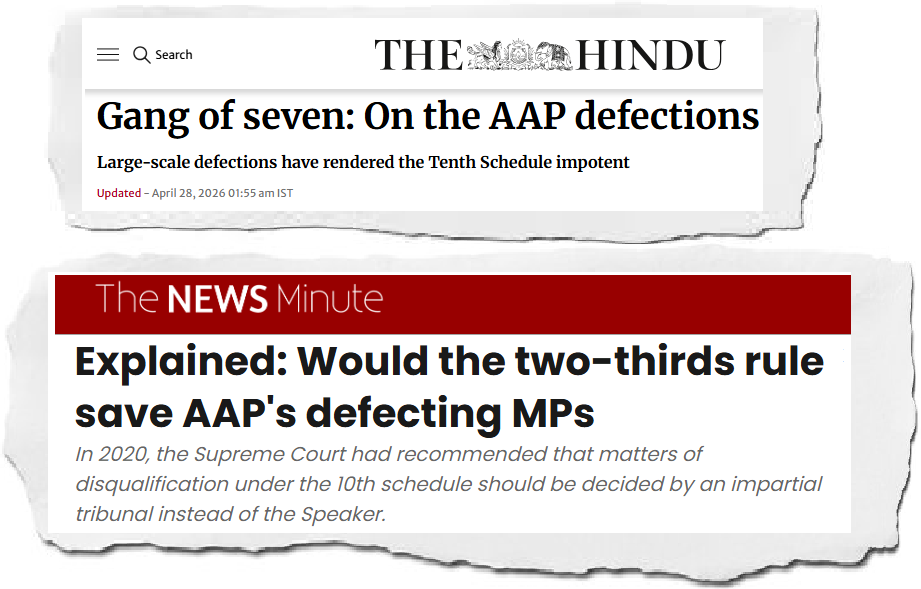
Seven Rajya Sabha members of the Aam Aadmi Party (AAP) announced their merger with the Bharatiya Janata Party (BJP) in April 2026. The Rajya Sabha Chairman accepted their claim of merger under the Tenth Schedule of the Constitution, triggering intense constitutional and political debate regarding the interpretation of anti-defection provisions.
UPSC Relevance
GS-II: Parliament, Constitutional Provisions, Anti-Defection Law, Role of Presiding Officers, Electoral Reforms, Accountability in Democracy
GS-IV: Ethics in Public Life, Political Morality
Background of the Anti-Defection Law
The anti-defection law was introduced through the 52nd Constitutional Amendment Act, 1985, which added the Tenth Schedule to the Constitution.
The law aimed to:
- Prevent political defections motivated by office or power
- Ensure stability of elected governments
- Protect the mandate given by voters
- Reduce “Aaya Ram, Gaya Ram” politics
Key Provisions of the Tenth Schedule
Grounds for Disqualification
A legislator can be disqualified if:
- They voluntarily give up membership of their political party
- They vote or abstain contrary to the party whip without permission
Merger Exception under Paragraph 4
The Tenth Schedule provides protection from disqualification in case of a merger.
For a valid merger:
- The original political party must merge with another party
- At least two-thirds of the legislature party must agree to such merger
This exception was intended to accommodate genuine political realignments rather than opportunistic defections.
Constitutional Controversy in the Present Case
The seven Rajya Sabha MPs argue that since they constitute more than two-thirds of AAP’s Rajya Sabha strength, they are protected under the merger provision.
However, critics argue that:
- The AAP as an organisation has not merged with BJP
- Only a section of legislators has switched allegiance
- Therefore, this amounts to defection rather than merger
The central constitutional question is whether:
A merger of legislators alone is sufficient, or whether the political party itself must first merge at the organisational level.
Supreme Court’s Earlier Interpretation
In the 2022 Shiv Sena split case judgment relating to the Eknath Shinde rebellion, the Supreme Court clarified that:
- A legislature party cannot be treated as independent from the political party
- Legislators alone cannot determine the identity or existence of the original political party
This interpretation weakens the legal basis of the merger claim made by the AAP MPs.
Role of the Presiding Officer
Under the Tenth Schedule:
- The Speaker or Chairman of the House decides questions relating to disqualification
This has repeatedly raised concerns regarding neutrality because:
- Presiding officers often belong to ruling parties
- Decisions are frequently delayed
- Political considerations may influence adjudication
In several cases, courts have criticised prolonged delays in deciding disqualification petitions.
Judicial Concerns Regarding the Present System
The Supreme Court has repeatedly expressed concern about the effectiveness of the anti-defection framework.
In 2020, the Court recommended:
- Establishing an independent tribunal to decide disqualification matters instead of Speakers or Chairpersons
The recommendation emerged because:
- Speakers are often perceived as partisan
- Delay in decisions can alter governments and legislative majorities irreversibly
Earlier Examples of Controversial Defections
Telangana Cases
Several controversies emerged in Telangana involving defections from Congress and TDP to TRS/BRS:
- Legislators claimed protection under the merger clause
- Opposition parties challenged these mergers as unconstitutional
- Questions arose regarding misuse of the two-thirds provision
Maharashtra Political Crisis
The Shiv Sena split demonstrated how:
- Large-scale defections can destabilise governments
- Constitutional ambiguities can be politically exploited
- Delays in judicial and Speaker decisions can produce irreversible political outcomes
Criticism of the Anti-Defection Law
(1) Failure to Prevent Opportunistic Politics
Despite the law, defections continue through:
- Mass resignations
- Strategic mergers
- Delayed disqualification proceedings
(2) Weakening of Representative Democracy
Frequent defections undermine:
- Voter mandate
- Party ideology
- Public trust in democratic institutions
Legislators elected on one party’s platform often switch allegiance without returning to the electorate.
(3) Excessive Party Control
The anti-defection law has also been criticised for:
- Reducing legislators’ independence
- Encouraging excessive party high-command culture
- Weakening deliberative democracy within legislatures
Need for Reforms
(1) Independent Adjudicatory Mechanism
An impartial tribunal or constitutional authority could:
- Reduce political bias
- Ensure timely decisions
- Strengthen public confidence
(2) Time-bound Disposal
Strict timelines for deciding disqualification petitions can prevent:
- Manipulation through delays
- Artificial alteration of legislative majorities
(3) Clearer Definition of “Merger”
The law requires greater clarity regarding:
- Difference between party merger and legislative split
- Organisational consent requirements
- Documentary proof standards
(4) Strengthening Internal Party Democracy
Many defections reflect weak ideological commitment and centralised party structures. Internal democratic functioning within political parties can reduce factionalism and opportunistic alignments.
Constitutional Significance
The present controversy goes beyond a dispute involving a few MPs. It raises broader questions about:
- Integrity of representative democracy
- Limits of political opportunism
- Constitutional morality
- Balance between party discipline and democratic freedom
The effectiveness of the Tenth Schedule ultimately depends not only on legal provisions but also on the willingness of institutions to uphold the spirit of democratic accountability.
Practice Questions
Prelims
Q1. With reference to the Tenth Schedule of the Constitution, consider the following statements:
- The anti-defection law was added through the 52nd Constitutional Amendment Act.
- A legislator can be disqualified for voluntarily giving up party membership.
- The merger exception applies even if only legislators merge without the original political party merging.
Which of the statements given above is/are correct?
(a) 1 and 2 only
(b) 2 and 3 only
(c) 1 and 3 only
(d) 1, 2 and 3
Answer: (a)
Mains
Q. The anti-defection law was enacted to ensure political stability, yet defections continue to reshape Indian politics. Critically examine the limitations of the Tenth Schedule and suggest reforms.