Gaps in the Implementation of the RTI Act
Why in News?
The Right to Information (RTI) Act, 2005, completed 21 years of operation in October 2026.
Recent Central Information Commission (CIC) data reveals significant bottlenecks in Section 4 implementation (Proactive Disclosure). This deficit forces citizens to file formal applications for information that public authorities are legally mandated to publish voluntarily, leading to an increased burden of pendency across Information Commissions.
| UPSC Relevance: GS-2: Polity and Governance: Fundamental Rights, Right to Information, Governance Prelims & Mains: Right to Information: Provisions and Concerns |
What is the RTI Act, 2005?
The Right to Information (RTI) Act, 2005 is India’s landmark transparency law that codifies the citizen’s fundamental right to know.
- It empowers Indian citizens to secure time-bound access to data held by public authorities, subject only to strict, narrow exemptions under Section 8.
- Its ambit covers all branches of government, constitutional bodies, and entities owned, controlled, or substantially financed by the state- including substantially funded non-governmental organizations (NGOs). Access includes inspection of records, certified copies and information in electronic form.
Key institutional pillars:
- Public Information Officers (PIOs): Process applications and ordinarily respond within 30 days, or 48 hours where information concerns a person’s life or liberty.
- First Appellate Authority: An officer senior to the PIO hears appeals against rejection, inadequate responses or failure to respond.
- Central and State Information Commissions: Hear second appeals and specified complaints, and monitor implementation. Ordinary RTI applications are submitted to public authorities; the Commissions primarily handle appellate and complaint functions.
Constitutional & Judicial Foundations:
The right to know is not explicitly mentioned in the Constitution but has been recognized as an intrinsic part of fundamental rights by the judiciary:
- Article 19(1)(a): Implied under the Freedom of Speech and Expression, as a citizen cannot form an informed opinion without accurate facts.
- Article 21: Directly linked to the Right to Life and Liberty, as informational access is vital for ensuring dignity, tracking entitlements, and enforcing accountability.
- State of UP v. Raj Narain (1975): The Supreme Court recognised the “Right to Know” as an intrinsic part of Article 19(1)(a). Citizens have a right to know every public act done by their public functionaries.
- PUCL v. Union of India (2003): Affirmed voters’ right to information about electoral candidates as a facet of Article 19(1)(a). The Court reinforced that a baseline level of informational transparency is a prerequisite for a functional democracy.
Section 4: The Underused Foundation of Transparency
Section 4 of the Right to Information (RTI) Act, 2005 legally binds every public authority in India to proactively publish 17 specific categories of information (suo motu). Suo motu disclosure means disclosure without waiting for an RTI application. It is a statutory obligation.
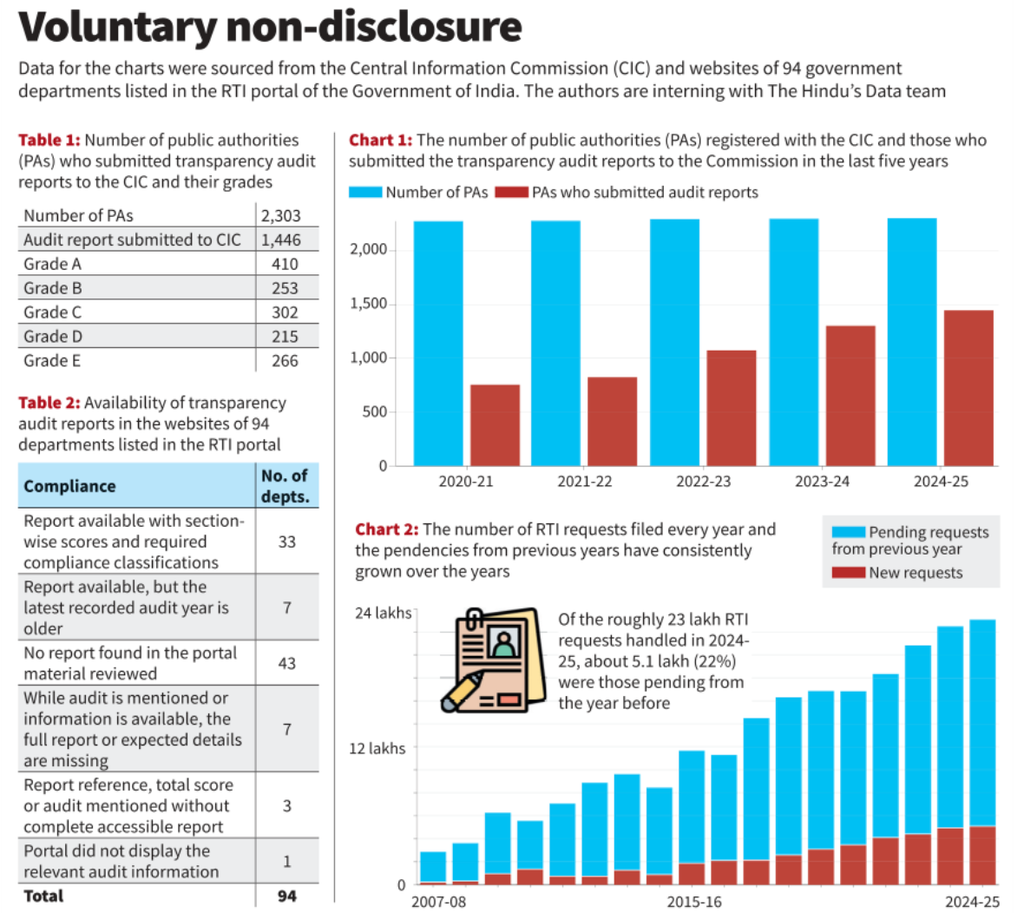
Recent Audit Trends (2024-25):
- Incomplete Audit Registration: Out of 2303 public authorities registered with the CIC, only 62.7% (1,446) submitted third-party audit reports.
- Subpar Compliance Quality: Out of the submitted audits, 783 authorities scored in Grades C, D, or E (signifying performance scores at or below 80%).
- Poor Digital Availability: Out of 94 key government department portals evaluated, only 33 hosted updated transparency audits, while 43 portals had no accessible audit materials whatsoever.
- Systemic Spillover: Deficient proactive disclosures forced an avoidable volume of 23 lakh applications, resulting in a 22% (5.1 lakh) legacy backlog.
Comprehensive Institutional and Legal Challenges:
1. Institutional Weaknesses (Information Commissions):
- Vacancy Crisis: Chronic delays in appointing Information Commissioners lead to functional paralysis.
- High Pendency Trait: Of the 23 lakh requests handled in the 2024-25 cycle, 22% (5.1 lakh) were carried over as backlog, compromising the value of time-sensitive queries.
2. Legal Amendments and Dilutions:
- RTI (Amendment) Act, 2019: Transferred the authority to set tenures, salaries, and service conditions of Central and State Information Commissioners directly to the Executive. Critics argue this undermines the institutional parity they shared with statutory constitutional authorities, weakening autonomy.
- Digital Personal Data Protection (DPDP) Act, 2023: Completely replaced the balanced public-interest exemption clause under Section 8(1)(j) with a rigid blanket exemption on personal data. This creates a firewall protecting public officials’ track records, asset disclosures, and discretionary spending profiles.
3. Behavioural and Infrastructure Barriers:
- Culture of Secrecy: Public Information Officers (PIOs) frequently treat disclosure as an adversarial vulnerability rather than a baseline democratic responsibility. This institutional resistance often manifests as arbitrary demands for an applicant’s motives – a direct violation of Section 6(2) of the RTI Act, which explicitly states that applicants need not give reasons for requesting information.
- Deficient Digital Management: Digital portals remain structurally weak, suffering from dead hyperlinks, unsearchable non-machine-readable PDFs, and unarchived, obsolete datasets.
Ethical Dimensions:
- Breach of the Democratic Social Contract: Transparency is the foundational bedrock of a social contract. When a government insulates its law and order machinery from public accountability, it fosters systemic public distrust.
- Information Asymmetry as Disempowerment: True citizen empowerment relies on symmetric access to data. Curtailing this limits public participation, grassroots social audits, and locks citizens out of governance.
Way Forward:
- Proactive Disclosure (Section 4): Governments must aggressively pursue Section 4(2) of the RTI Act to publicise maximum data automatically via online channels, minimizing the need for citizens to file formal requests.
- Standardised Digital Registries: Deploy machine-readable, indexable, and searchable templates for Section 4 compliance across all departments.
- Performance Auditing Linked to Appraisals: Tie departmental Section 4 audit marks directly to annual civil service evaluation rankings.
- Strengthening Infrastructure: Urgent, time-bound filling of vacancies in both State and Central Information Commissions (CIC/SICs) as regularly emphasised by the Supreme Court.
- Harmonisation of Laws: An institutional balance must be struck between personal privacy under the DPDP Act and public accountability under the RTI Act, ensuring privacy is not weaponised to shield institutional corruption.
- Modernising Records Access: Replace archaic sorting with automated document management systems and provide regular proactive transparency training to PIOs.
Regular proactive disclosure, independent oversight and a responsive administrative culture are essential to make transparency the norm rather than an exception.
Mains Practice Question:
Q. The Right to Information (RTI) Act, 2005 was envisioned to transition Indian governance from official secrecy to structural transparency. However, institutional bottlenecks, legal friction, and bureaucratic resistance continue to dilute its efficacy. Evaluate.
Prelims Practice MCQ:
Q. Consider the following statements regarding the Right to Information (RTI) Act, 2005:
- Under Section 6(2) of the Act, an applicant seeking information from a public authority is legally bound to provide brief reasons or motives for making the request if demanded by the Public Information Officer (PIO).
- The Digital Personal Data Protection (DPDP) Act, 2023 amended Section 8(1)(j) of the RTI Act to remove the provision that allowed personal information to be disclosed if it served a larger public interest.
Which of the statements given above is/are correct?
(a) 1 only
(b) 2 only
(c) Both 1 and 2
(d) Neither 1 nor 2
Answer: (b)
Explanation:
- Statement 1 is incorrect: Section 6(2) of the RTI Act explicitly states that “An applicant making a request for information shall not be required to give any reason for requesting the information or any other personal details except those that may be necessary for contacting him.” A PIO cannot legally demand the motive behind a request.
- Statement 2 is correct: The DPDP Act, 2023 amended Section 8(1)(j) of the RTI Act by substituting the earlier provision with a strict blanket exemption for personal information. Previously, Section 8(1)(j) allowed the disclosure of personal data if the PIO was satisfied that a larger public interest justified it. The new amendment removed this public interest exception, making personal data strictly exempt from disclosure.