First Advance Estimates of GDP 2024-25 released
Why in News?
MoSPI released the First Advance Estimates of GDP and GVA for 2024-25, giving the first official macro growth pointers for the financial year and informing fiscal, monetary and policy calibration.
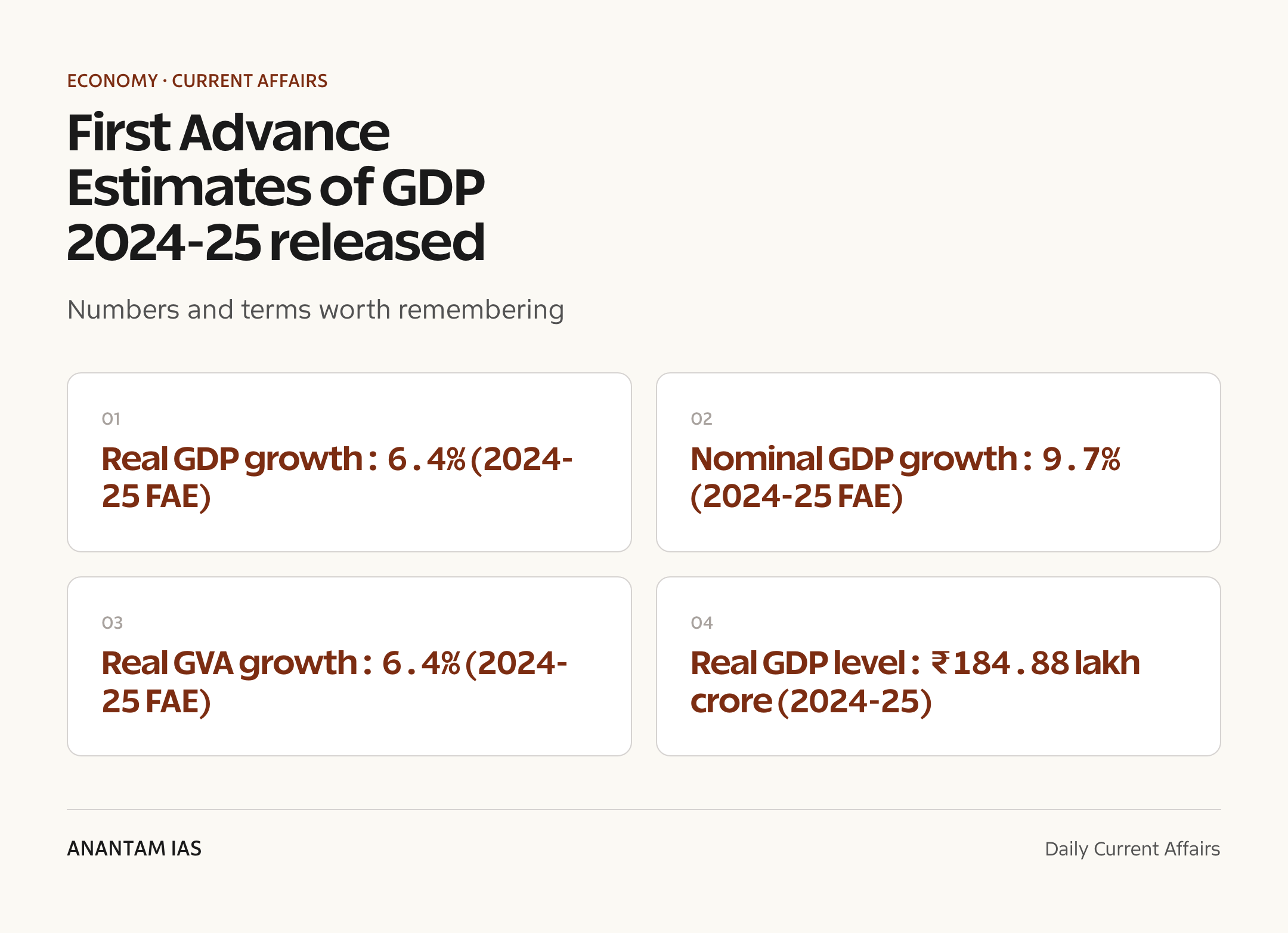
- FAE reports Real GDP for 2024-25 at ₹184.88 lakh crore with growth of 6.4% over 2023-24.
- FAE reports Nominal GDP for 2024-25 at ₹324.11 lakh crore with growth of 9.7% over 2023-24.
- Real GVA growth is estimated at 6.4%, signalling sectoral momentum weaker than 2023-24.
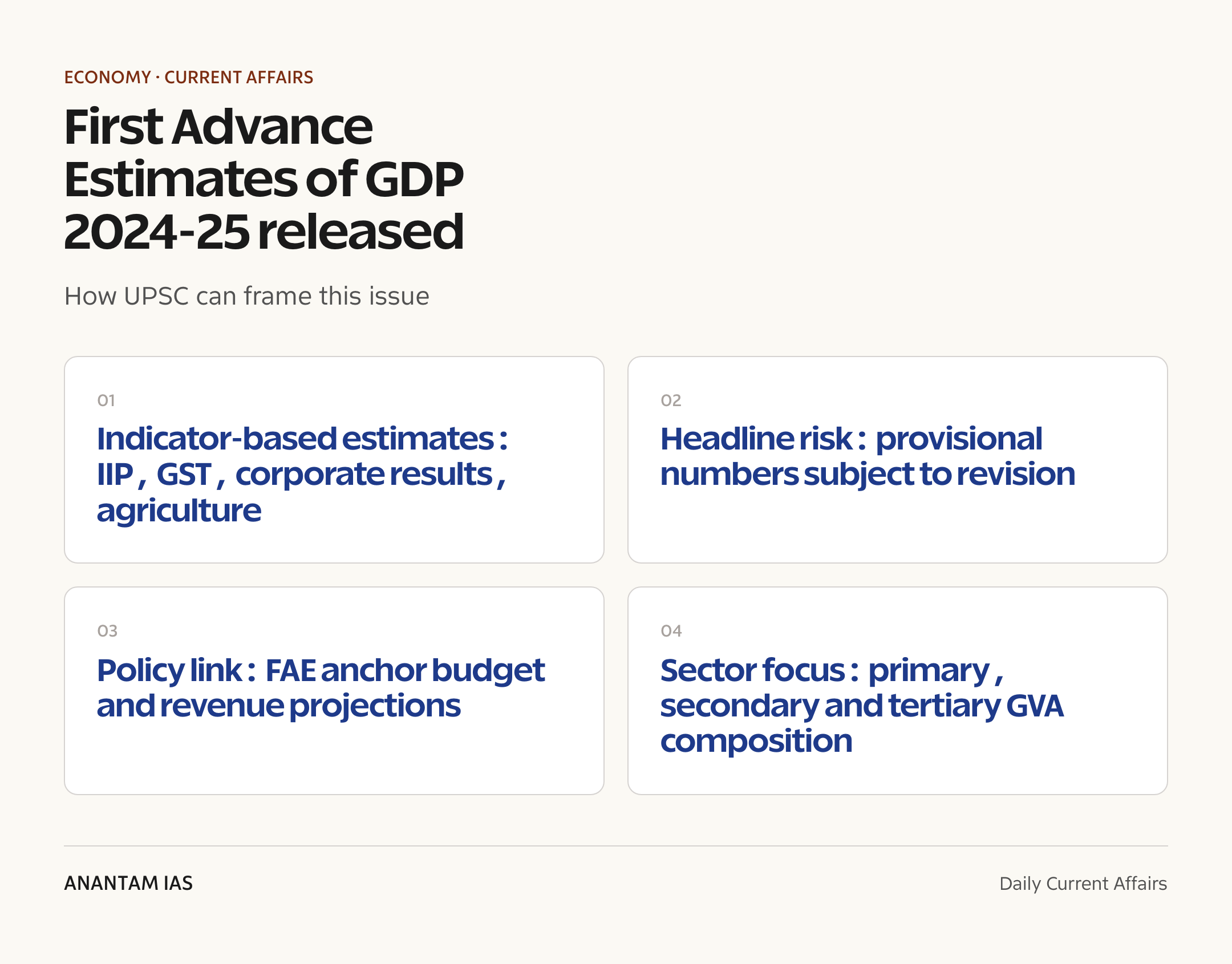
- Estimates are indicator based, using IIP, corporate results, agricultural production, GST data and other administrative sources.
- FAE sets the baseline for budget assumptions, fiscal projections and macroeconomic debates ahead of Second Advance Estimates and Q3 GDP release.
The development matters in the context of:
- FAE are produced by the National Statistics Office under MoSPI using the benchmark-indicator method; they are provisional and subject to revision in subsequent releases.
- The 6.4% real growth estimate contrasts with the 8.2% growth recorded in 2023-24, signalling a moderation that will affect fiscal arithmetic and market expectations.
- Nominal growth at 9.7% implies an inflation-adjusted gap between nominal and real GDP growth, influencing the nominal GDP base used in fiscal deficit calculations.
- Sectoral GVA composition and growth rates are provided for primary, secondary and tertiary sectors; these drive employment, tax buoyancy and policy focus.
- Data inputs include high-frequency indicators: IIP, corporate Q1/Q2 results, GST outward supplies, agricultural production estimates, rail and aviation traffic, coal and petroleum output.
- MoSPI highlights that improved data coverage and later revisions by source agencies can change these estimates; users should treat FAE as a working indicator.

UPSC Relevance
Prelims Relevance
- FAE figures are used in exam questions on national income concepts, difference between nominal and real GDP, GVA composition and the methodology of official estimates. Remember the headline numbers: 6.4% real growth and 9.7% nominal growth for 2024-25.
Mains Relevance
GS3 Economy
- FAE informs answers on macroeconomic performance, fiscal policy design, limitations of indicator-based estimates, and sectoral policy prescriptions. Use FAE to critique data sources, discuss implications for employment and inflation, and link to government revenue projections.
Essay
- Use the FAE to build arguments on economic growth trajectory, sustainability of recovery, structural reform needs and the trade-off between growth and inflation. The nominal-real gap offers a datapoint for essays on fiscal consolidation and public investment.
Background and Context
What are Advance Estimates
Definition and purpose of advance GDP estimates published by MoSPI.
- Advance Estimates provide an early numerical picture of annual GDP and GVA before final data are available.
- These are produced using the benchmark-indicator method: last year’s detailed base is extrapolated using current indicators.
- MoSPI issues First Advance, Second Advance and Final Estimates as data coverage improves along the release calendar.
- The estimates support policy planning, budget assumptions and market signalling while remaining provisional.
Headline numbers in FAE 2024-25
Quick recall of the main figures candidates must remember.
- Real GDP at Constant (2011-12) prices: ₹184.88 lakh crore in 2024-25.
- Real GDP growth: 6.4% in 2024-25 versus 8.2% in 2023-24.
- Nominal GDP at Current prices: ₹324.11 lakh crore, growth 9.7%.
- Real GVA estimated at ₹168.91 lakh crore with growth of 6.4%.
Methodology: benchmark-indicator approach
How the FAE numbers are constructed and what indicators are used.
- Base detailed estimates (previous PE) are extended using current-year indicators for each sector.
- Key indicators include IIP, corporate financials for Q1 and Q2, and administrative datasets from ministries.
- Agricultural estimates are taken from Ministry of Agriculture and Farmers Welfare production projections for crops and horticulture.
- Transport indicators include passenger and freight metrics for rail, air and ports; mining and manufacturing use production and consumption series.
Data sources and coverage issues
List of primary data inputs and caveats about coverage.
- GST outward supplies up to November 2024 used to estimate services and goods activity, but GSTN data remain evolving.
- Corporate results for Q1 and Q2 offer early signals but exclude unlisted firms and lag some sectors.
- State and central accounts up to November 2024 inform government consumption and subsidy estimates; later revisions can alter totals.
- Some indicators have limited frequency or late reporting, creating reliance on proxy series subject to revision.
Interpretation: real vs nominal dynamics
What the gap between real and nominal growth indicates for policy.
- Real growth of 6.4% captures volume expansion after adjusting for price changes.
- Nominal growth at 9.7% reflects both volume and price increases; the difference approximates aggregate price movement.
- A rising nominal base affects tax buoyancy and the denominator in fiscal deficit ratios expressed as a percentage of GDP.
- Policymakers watch nominal GDP closely for revenue projections and for setting fiscal targets in successive budgets.
Limitations and revision risks
Why FAE can change and the consequences for use in policy and exams.
- FAE rely on partial-year indicators; improved coverage or methodological updates lead to Second Advance and Final revisions.
- Non-synchronous reporting across states and agencies can introduce bias into early estimates.
- Sectoral mismeasurement (for example in services) is a recurring challenge for timely GDP estimation.
- Exam answers should note that FAE are provisional and comment on likely directions of revision when relevant.
Way Forward
For policymakers
- Treat FAE as a working baseline when calibrating fiscal targets and avoid over-optimistic revenue pegging.
- Use sectoral GVA signals to prioritise support where growth is lagging, especially for construction and manufacturing if underperforming.
- Monitor inflation indicators alongside nominal growth to decide on the pace of fiscal expansion and public investment.
- Plan contingency buffers in budget estimates recognising potential downward revisions in second and final estimates.
For analysts and students
- Cross-check FAE indicators like IIP, GST, and corporate results to understand sector drivers behind headline growth.
- Track the Second Advance Estimates and Q3 quarterly GDP release for trend confirmation or reversal.
- Use FAE numbers to practice writing balanced Mains answers: state the figure, explain methodology, and discuss implications.
- Learn to quantify the nominal-real gap and explain its relevance for fiscal ratios and price trends.
For state governments
- Align state fiscal plans with the national nominal GDP trajectory to avoid overstating revenue expectations.
- Leverage sectoral insights from GVA to design targeted interventions for agriculture, MSMEs and transport.
- Improve timeliness and transparency of state-level accounts so national aggregates are less subject to late revision.
- Coordinate with central agencies to share administrative data that enhance the accuracy of future estimates.
For exam preparation
- Memorise the headline numbers and the distinction between real and nominal GDP for prelims recall.
- Practice mains answers that critique indicator-based estimates and propose institutional improvements to data systems.
- Use the FAE release as a prompt for essays on growth vs equity, fiscal consolidation and public investment choices.
- Prepare diagrams or short tables contrasting 2023-24 and 2024-25 numbers to present crisp answers under time pressure.
Conclusion
The First Advance Estimates for 2024-25 give the first official view of the year’s macro trajectory: a moderate 6.4% real growth and 9.7% nominal expansion. These figures are provisional and shaped by indicator coverage; they will guide fiscal assumptions and policy debate until revised by the Second Advance and Final Estimates.
UPSC Practice Questions
Prelims MCQ 1
Which of the following is true about the First Advance Estimates (FAE) of GDP published by MoSPI for a financial year?
(a) FAE are final and cannot be revised in subsequent releases. (b) FAE use the benchmark-indicator method to extrapolate from previous year estimates. (c) FAE rely solely on annual surveys completed after the financial year end. (d) FAE provide only nominal GDP and not real GDP estimates.
Answer: (b) FAE use the benchmark-indicator method to extrapolate from previous year estimates.
Explanation:
FAE are provisional and produced using the benchmark-indicator method that extrapolates previous detailed estimates with current indicators. They include both real and nominal GDP estimates and are subject to revision.
Prelims MCQ 2
According to the First Advance Estimates for FY 2024-25, the estimated real GDP growth and nominal GDP growth were:
(a) 8.2% real and 12.0% nominal (b) 6.4% real and 9.7% nominal (c) 5.0% real and 7.5% nominal (d) 7.5% real and 10.2% nominal
Answer: (b) 6.4% real and 9.7% nominal
Explanation:
The FAE for 2024-25 reported real GDP growth of 6.4% and nominal GDP growth of 9.7% compared with 2023-24.
UPSC Mains Questions
- {‘question’: “Critically examine the strengths and weaknesses of the benchmark-indicator method used in India’ s Advance Estimates of GDP. How does reliance on high-frequency indicators affect the reliability of early GDP estimates?”, ‘model_answer’: “Begin by defining the benchmark-indicator method: it extrapolates last year’ s detailed estimates using current-year indicators for each sector. Strengths: provides timely macro signals; uses diverse high-frequency indicators such as IIP, GST data, corporate results and agricultural estimates; helps policymakers and markets form expectations. Weaknesses: partial coverage bias as many indicators exclude informal and unlisted activity; administrative data have reporting lags and revision risk; services sector measurement remains weak with proxy indicators that may misstate growth. Reliance on high-frequency indicators improves timeliness but can reduce reliability if series are noisy or unrepresentative. Conclude by suggesting ways to improve reliability: expand administrative data sharing, strengthen sample surveys, integrate real-time digital footprints cautiously, and communicate uncertainty through confidence ranges or scenario estimates.”}
- {‘question’: ‘What are the implications of a widening gap between nominal and real GDP growth for fiscal policy? Illustrate your answer with reference to the FAE 2024-25 numbers.’, ‘model_answer’: ‘Start by explaining nominal vs real GDP: nominal includes price changes while real adjusts for inflation. A widening gap means higher nominal growth relative to real growth, signalling price effects or inflation. Fiscal implications: higher nominal GDP raises the denominator for fiscal ratios, easing headline fiscal deficit targets if revenues grow correspondingly; it can improve tax buoyancy and debt-to-GDP metrics. Risks include over-reliance on price-driven nominal growth when real activity is weaker, leading to unsustainable expenditure commitments. Using FAE 2024-25: nominal growth 9.7% against real 6.4% suggests an aggregate price component near 3.3 percentage points. Policymakers should treat nominal buoyancy cautiously, avoid permanently raising recurring expenditure based on price-driven gains, and prioritise growth-enhancing capital spending while monitoring inflation.’}
Source: PIB, Ministry of Statistics & Programme Implementation.
Frequently Asked Questions
q
a
q
a
q
a
q
a
q
a
q
a