Glaw Lake Becomes India’s 101st Ramsar Site
Why in News?
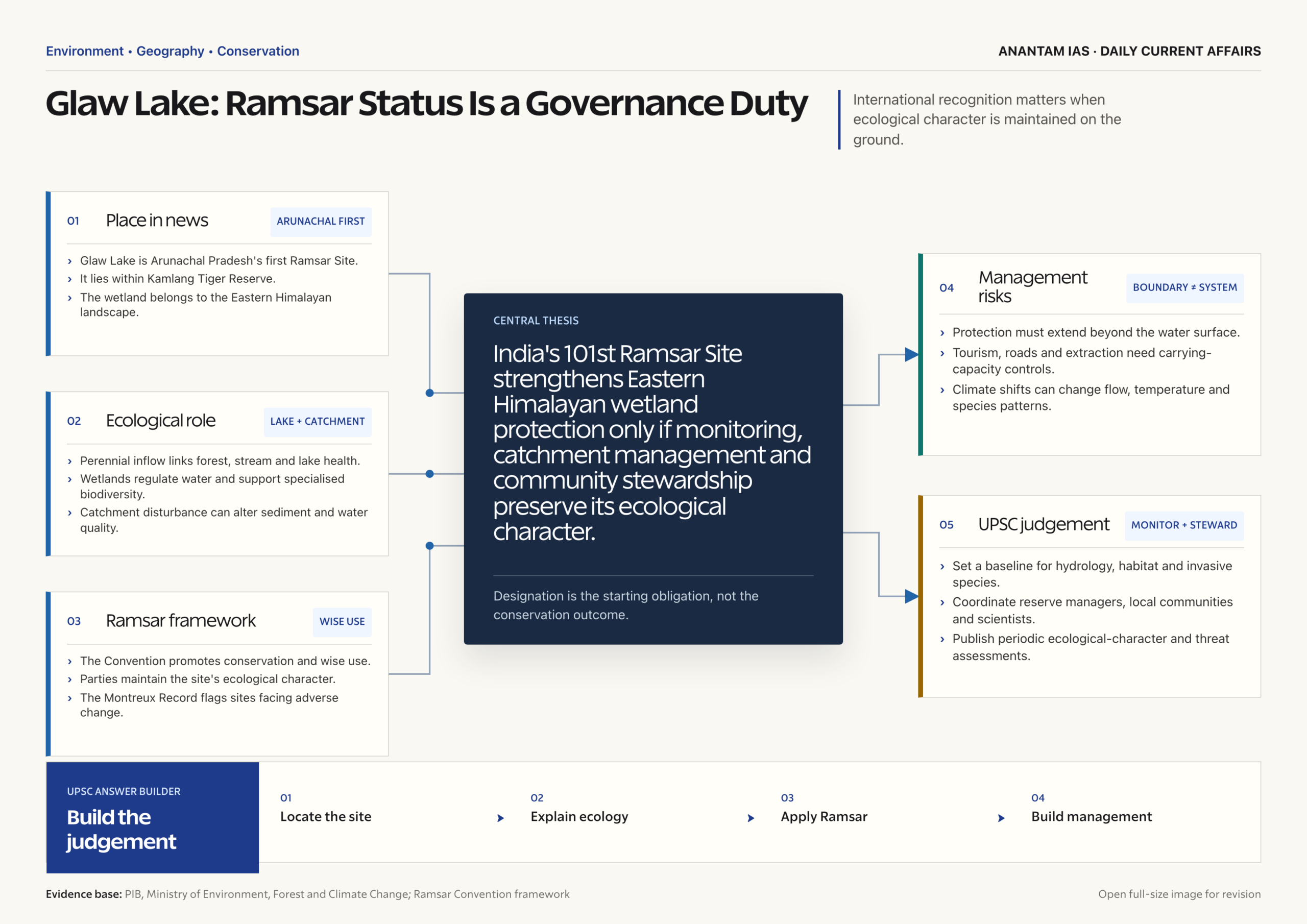
On August 3, 2026, the Union Environment Minister announced the designation of Glaw Lake in Arunachal Pradesh as India’s 101st Ramsar Site .
- The Press Information Bureau identified Glaw Lake as a freshwater lake in the Eastern Himalayas, fed by perennial mountain streams and surrounded by dense vegetation.
- The lake lies within Kamlang Tiger Reserve and Kamlang Wildlife Sanctuary in Lohit district, so its management sits within an already protected forest and wildlife landscape.
- The Government of Arunachal Pradesh describes the lake as spread over about 82 hectares and situated at an elevation of about 1,168 metres near Wakro. These are descriptions of the lake; the PIB announcement did not.
- PIB reported more than 150 tree species and 49 orchid species within the site and its catchment, showing that the wetland’s value extends beyond open water to the surrounding forested catchment.
- India’s official tally rose from 26 Ramsar Sites in 2014 to 101 after this addition, according to the Union Environment Ministry’s announcement.
- For Prelims, connect Glaw Lake, Arunachal Pradesh, Lohit district, Kamlang Tiger Reserve and the Eastern Himalayas rather than memorising the national tally alone.
- For Mains, the case shows why a wetland must be managed as a lake-catchment-landscape system: changes in streams, slopes, vegetation or visitor pressure can alter water quality and ecological character even when the waterbody itself.
- The analytical test is implementation. Ramsar recognition can improve attention and coordination, but conservation outcomes still depend on a credible baseline, hydrological monitoring, protected-area management and local stewardship.
UPSC Relevance
Prelims Relevance
- Glaw Lake is in Arunachal Pradesh’s Lohit district, within Kamlang Wildlife Sanctuary and Tiger Reserve.
- It is a freshwater lake in the Eastern Himalayas, fed by perennial mountain streams.
- It became India’s 101st Ramsar Site and Arunachal Pradesh’s first Ramsar Site in August 2026.
- The state forest department records the lake at about 82 hectares and roughly 1,168 metres above sea level; this should not be confused with the formally delimited Ramsar-site area unless the Ramsar Information Sheet confirms the.
- Kamlang was notified as a tiger reserve in 2017. The National Tiger Conservation Authority lists its total area as 783 square kilometres.
- The Convention on Wetlands, commonly called the Ramsar Convention, was adopted at Ramsar in Iran in 1971 and entered into force in 1975.
Mains Relevance
GS Paper 3
- Explain wetland conservation through ecological character, catchment integrity, biodiversity and climate resilience.
- Assess how Ramsar recognition can strengthen inventories, monitoring, management plans and public accountability without treating designation as the final conservation outcome.
GS Paper 2
- Examine institutional coordination among the Union Environment Ministry, State Wetland Authority, protected-area administration, scientific bodies and local communities.
- Discuss how international environmental commitments are implemented through domestic laws, site plans, funding, monitoring and transparent reporting.
Essay
- A conservation label matters only when institutions protect the ecological processes that made the place valuable.
Background and Context
Glaw Lake and Its Eastern Himalayan Setting
Glaw Lake is best understood as a freshwater wetland embedded in a forested mountain catchment, not as an isolated patch of water.
- The lake lies in the south-eastern part of Lohit district in Arunachal Pradesh, within the Kamlang protected landscape near Wakro.
- The state forest department places it about 18 to 20 kilometres south-east of Wakro and at an elevation of approximately 1,168 metres.
- Perennial mountain streams feed the lake. This hydrological connection makes stream flow, slope stability, vegetation cover and sediment movement central to its ecological health.
- Kamlang Tiger Reserve forms part of a larger forested landscape adjoining Namdapha Tiger Reserve and other forests. The lake adds an aquatic habitat dimension to a landscape usually discussed through large mammals and forest cover.
- The reserve is also a catchment for the Kamlang, Lang and Lati rivers, which are tributaries of the Lohit. The setting links local wetland conservation to the wider Brahmaputra river system.
Ecological Importance of the Lake and Catchment
The designation draws attention to the combined value of open water, perennial inflows and the surrounding Eastern Himalayan vegetation.
- PIB reported more than 150 tree species and 49 orchid species within the wetland site and its catchment. The wording is important because much of the biodiversity value belongs to the lake-catchment complex.
- A perennial freshwater body can provide habitat, refuge, feeding space and breeding conditions for aquatic organisms, wetland-dependent birds and other fauna; site-specific population claims should come from the official Ramsar Information Sheet or field surveys.
- Forested slopes regulate runoff, trap sediment and help moderate the movement of nutrients into the lake. Loss of vegetation can change water clarity, depth and seasonal flow even without direct construction along the shoreline.
- Wetlands also store water, support nutrient cycling and create microhabitats. These services depend on maintaining the site’s ecological character, meaning its ecosystem components, processes and services at a given point in time.
- The PIB release did not publish the Ramsar Criteria under which Glaw Lake qualified. Candidates should avoid assigning a criterion from general biodiversity descriptions until the official Ramsar Information Sheet provides that evidence.
How a Wetland Becomes a Ramsar Site
Ramsar status follows a national nomination and an evidence-based assessment against internationally agreed criteria.
- The national Administrative Authority prepares a Ramsar Information Sheet describing the wetland’s ecological character, boundaries, values, threats and the criteria it meets.
- A site may enter the List of Wetlands of International Importance if it meets at least one of nine criteria. These cover representative wetland types and the support of threatened species, biological diversity, critical life stages.
- The site boundary must be precisely described and delimited. That is why a general estimate for the lake’s surface should not automatically be treated as the Ramsar boundary area.
- The Convention Secretariat checks whether the information and map meet adopted standards before the information is published through the Ramsar Sites Information Service.
- Designation creates an international conservation commitment, but the site remains under national sovereignty and is managed through the country’s legal and administrative system.
Wise Use and Ecological Character
The core Ramsar idea is wise use, not an assumption that every listed wetland must be closed to all human activity.
- The Convention defines wise use as maintaining ecological character through ecosystem approaches within the context of sustainable development.
- Contracting Parties commit to wise use across all wetlands in their territory, not only the sites placed on the Ramsar List.
- For a listed site, management should identify the ecological features to be maintained, establish a baseline, monitor change and respond before degradation becomes difficult to reverse.
- Article 3.1 asks Parties to plan for the conservation of listed wetlands while promoting wise use of wetlands generally. Site management plans and indicators translate that broad duty into local action.
- If a listed site’s ecological character has changed, is changing or is likely to change because of human interference, the Convention provides reporting and advisory mechanisms. The first defence remains reliable domestic monitoring and early corrective.
Way Forward
Publish the Complete Evidence Baseline
- Publish the Ramsar Information Sheet, precise site boundary, qualifying criteria, ecological-character description and source methods in an accessible format.
- Separate verified field records from broad landscape descriptions so that tree, orchid, bird, fish and other species claims remain traceable.
- Create a seasonal baseline for lake level, inflows, water quality, sediment and key biological indicators, with thresholds that trigger management action.
Conclusion
- Glaw Lake’s designation is important because it brings Arunachal Pradesh into India’s Ramsar network and recognises a freshwater ecosystem within the Eastern Himalayan Kamlang landscape.
- The next test is practical: establish the site’s ecological baseline, protect its catchment, coordinate overlapping institutions and monitor change .
UPSC Practice Questions
Prelims MCQ 1
With reference to Glaw Lake, consider the following statements:
- It is a freshwater lake located within Kamlang Tiger Reserve in Arunachal Pradesh.
- It became Arunachal Pradesh’s first Ramsar Site in 2026.
- It is situated in the Western Ghats and drains into the Godavari basin.
How many of the above statements are correct?
(a) Only one (b) Only two (c) All three (d) None
Answer: (b) Only two
Explanation:
Statements 1 and 2 are correct. Glaw Lake is an Eastern Himalayan freshwater lake in Kamlang Tiger Reserve, Lohit district, and became Arunachal Pradesh’s first Ramsar Site. It is not in the Western Ghats or the Godavari basin; the Kamlang landscape is connected to tributaries of the Lohit and the Brahmaputra system.
Prelims MCQ 2
Which one of the following best describes the Ramsar Convention’s principle of wise use?
(a) Complete exclusion of all human activity from every listed wetland (b) Maintenance of wetland ecological character through ecosystem approaches within sustainable development (c) Automatic conversion of every Ramsar Site into a national park (d) Management of listed wetlands exclusively by the Convention Secretariat
Answer: (b) Maintenance of wetland ecological character through ecosystem approaches within sustainable development
Explanation:
Wise use means maintaining ecological character through ecosystem approaches in the context of sustainable development. Ramsar listing does not automatically create a national park, transfer sovereignty or require a universal ban on human activity. National authorities remain responsible for effective site management.
UPSC Mains Questions
- Ramsar designation should be treated as the beginning of accountable wetland management, not the end of conservation action. Discuss with reference to Glaw Lake. (250 words)
- Mountain wetlands must be governed as lake-catchment-landscape systems. Explain the ecological and institutional implications of this approach for Glaw Lake in Kamlang Tiger Reserve. (250 words)
Sources: PIB, Ministry of Environment, Forest and Climate Change and Department of Environment, Forest and Climate Change, Government of Arunachal Pradesh.
Frequently Asked Questions
Where is Glaw Lake located?
Glaw Lake is a freshwater mountain lake in Lohit district of Arunachal Pradesh. It lies within Kamlang Wildlife Sanctuary and Kamlang Tiger Reserve near Wakro in the Eastern Himalayas. The state forest department places it at about 1,168 metres elevation.
Why was Glaw Lake in the news?
On August 3, 2026, the Union Environment Minister announced Glaw Lake’s designation as India’s 101st Ramsar Site. It is Arunachal Pradesh’s first site on the Ramsar List. The announcement highlighted its freshwater ecology, perennial mountain-stream inflows and rich plant diversity.
How large is Glaw Lake?
The Arunachal Pradesh forest department describes Glaw Lake as spread over about 82 hectares. This figure describes the lake and should not automatically be treated as the formally delimited Ramsar-site area. The precise international-site boundary and area should be taken.
What is the ecological importance of Glaw Lake?
Glaw Lake adds a perennial freshwater habitat to the forested Kamlang protected landscape. PIB reported more than 150 tree species and 49 orchid species within the site and its catchment. Its streams, waterbody and vegetation work together, so catchment stability.
Does Ramsar status automatically ban all human activity?
No. The Convention’s organising idea is wise use, which means maintaining ecological character through ecosystem approaches within sustainable development. Site-specific domestic protections and management rules still apply. Because Glaw Lake lies inside a wildlife sanctuary and tiger reserve, its use.